More Than One Person Has Wasted Three Years on Base

比推Publicado a 2026-01-14Actualizado a 2026-01-14

Resumen

A developer known as tuna, co-founder of Pandemic Labs, publicly criticized Base, the Ethereum L2 network backed by Coinbase, for failing to support builders despite initial promises. After nearly three years of developing 10 different products—including games, AI agents, and prediction markets—on Base, tuna received no meaningful support, even after creating the hit game *Infected*, which gained 50,000 users. In contrast, within 48 hours of launching a game on Solana, *Addicted*, it generated $4 million in revenue. Tuna expressed frustration that Base appears to prioritize certain projects like Farcaster and Zora while ignoring independent developers. Other builders, such as Shivam Tandon of zkCross Network and Jacek from the DEGEN project, shared similar experiences, citing ignored outreach and a lack of engagement from Base and its lead, Jesse. Despite bringing significant traffic and value, these teams felt overlooked, with DEGEN even choosing to expand to Solana, where they received immediate support and recognition. Critics argue that Base operates with a top-down, “narrative-driven” approach aligned with Coinbase’s interests, rather than fostering an open, community-oriented ecosystem like Solana. While Base’s 2026 roadmap focuses on asset tokenization and the Base App, many developers question whether it truly intends to serve the broader community or mainly functions as an extension of Coinbase.

Author: Eric, Foresight News

Original Title: More Than One Person Has Wasted Three Years on Base


At 1:13 AM Beijing time on January 13, the co-founder of game studio Pandemic Labs, a user with the X handle "tuna," published an article criticizing Base for its inaction.
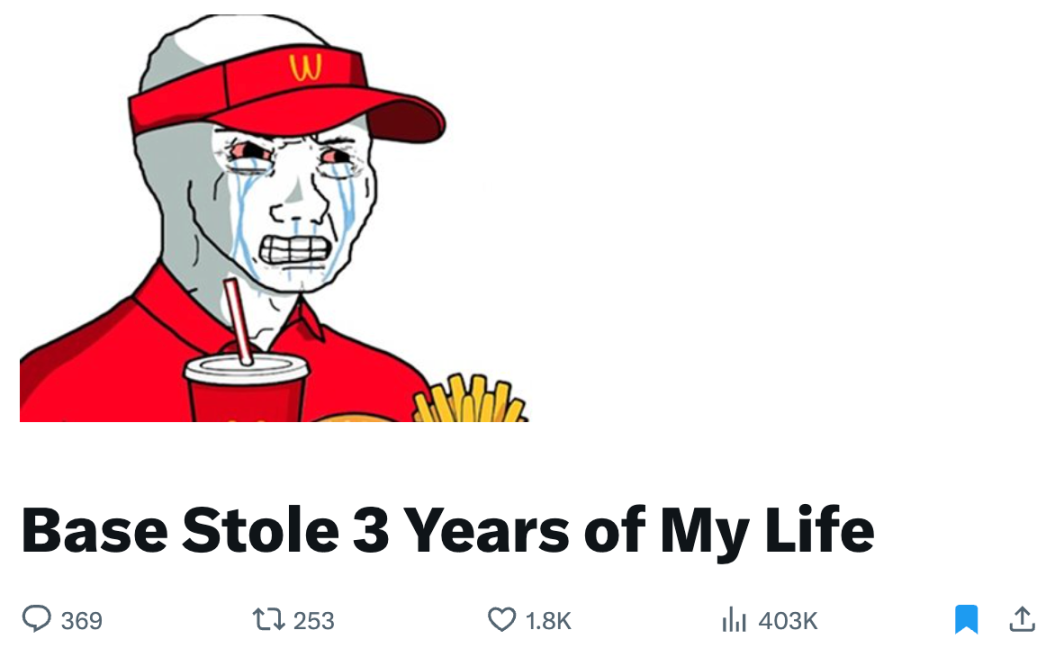
In the article, Tuna stated that Jesse's philosophy of Base being "application-first" rather than focusing on infrastructure attracted him to develop products on Base. However, after "three years" (Base's mainnet has only been live for about two and a half years) of developing 10 products including games, AI Agents, prediction markets, and zkTLS, the promised support from Base never materialized.

After launching the hit game Infected and gaining 50,000 followers in a month, Base proactively contacted tuna and promised support, but ultimately nothing came of it. Tuna mentioned that before Infected, they tried to reach Base officials through X, Discord, and Telegram but received no response.

Disheartened, tuna switched to Solana and developed the game Addicted, which generated $4 million in revenue within 48 hours of its launch on Solana. The stark contrast of earning $4 million in 2 days versus achieving nothing in nearly 3 years led tuna to lament that, compared to Base, which constantly promotes Farcaster and Zora, he had finally found an "organization" that treats developers like human beings.

Shivam Tandon, founder of zkCross Network, had a similar experience. He also initially believed in Jesse's story of prioritizing products and builders. However, after developing Surf on Base, their efforts to contact Base via email and private messages similarly went unanswered. Shivam Tandon stated that he doesn't mind if Base wants to support projects invested in by Coinbase, but he wishes they would be upfront about it and not waste developers' time.

Although some pragmatic users believe Base has its own preferences and that project failures shouldn't be blamed on this, most people expressed support for tuna.

Developer criticism of Base didn't start this year. In February 2025, a user with the X handle Lamboland felt that Base's approach seemed insufficiently "degen." Coinbase offered no support for a high-traffic project like Virtuals but listed the VVV token on its launch day. Lamboland mentioned that many projects were considering migrating to Solana, primarily because Base's marketing was out of touch, lacking "seasoned veterans" who understand CT culture to build a good community environment.

Similarly, just two weeks ago, Jacek, a member of DEGEN—which airdropped $50 million in tokens to Farcaster users and once had a market cap exceeding $1 billion—also posted a long thread expressing disappointment with Base.

Jacek stated that developers choose Base largely because of its connection to Coinbase, hoping to gain support or brand endorsement. However, as the previous two mentioned, Base devoted significant effort to projects like Zora, while even the official Base Twitter account didn't follow or retweet projects like DEGEN that brought massive traffic to Base. In Jacek's view, to Base, anything outside the mainstream narrative simply doesn't exist.

Furthermore, DEGEN's proposal for a $1 million airdrop on Base and the Base App was ignored. Jacek noted that when DEGEN announced plans to cross-chain to Solana, they immediately received attention and support from Solana. At offline events, Solana officials were eager to interact with ecosystem projects, even giving out Bonk keychains. It's these small, seemingly insignificant details that demonstrate official respect for developers and participants. In contrast, Jacek expressed that he doesn't mind Base promoting Zora, but the attitude of completely ignoring other projects is disappointing.

Interestingly, despite such severe public criticism, neither Base nor Jesse offered any explanation or proposed solutions in the replies to these tweets. On the 9th of this month, Jesse retweeted a post from Base product manager Nick, expressing Base's willingness to assist developers, but the comments were filled with skepticism, with the most common question being: How exactly do you plan to help?

Over the past year, Base has indeed been a gold rush destination, but it almost experienced "sudden death" after its flagship projects fizzled out. Unlike Solana, Base is part of the Coinbase ecosystem, an extension of the exchange, born with the attribute of serving stakeholders. Clearly, the unhealthy tendencies existing within the already large Coinbase have also affected Base's operations. Perhaps Base's sudden popularity was indeed supported by Coinbase's strong resources, but the core contributors to its brief success were still the talented developers in the community.

Coinbase's plans for Base in 2026 primarily revolve around on-chain assets and the Base App. Coinbase plans to gradually evolve into a comprehensive exchange in the future, with aspects like stock tokenization and commodity tokenization mainly being handled by Base. Additionally, the Base App is planned to be developed into a Web3 traffic入口 (entry point) integrating trading, social features, and a wallet. This indicates that Base will likely continue to adhere to its recognized "mainstream narrative," and its functional role in assisting Coinbase will remain stronger than being an open community itself.

Over the past year, Base wanted to use its influence to strongly promote projects like Farcaster and Zora, which have capital backing and "orthodox" narratives, but misjudged the "crazy" mainstream style of this market cycle. For Coinbase, it needs to clarify whether Base is merely a tool to serve the exchange and Coinbase Ventures, or a truly open network for the entire world. If it's the latter, it must adopt an operational philosophy like Solana's—"from the masses, to the masses."


Twitter:https://twitter.com/BitpushNewsCN

BitPush TG Discussion Group:https://t.me/BitPushCommunity

BitPush TG Subscription: https://t.me/bitpush

Original article link:https://www.bitpush.news/articles/7602760

Criptos en tendencia

Preguntas relacionadas

QWhat was the main complaint of the game studio Pandemic Labs' co-founder (tuna) against Base?

ATuna complained that despite Base's initial promise of an 'application-first' approach and support for developers, after nearly three years of developing 10 different products (including games, AI Agent, prediction markets, zkTLS) on Base, the promised support never materialized. Even after creating a hit game 'Infected' that gained 50,000 followers, Base's offer of support ultimately came to nothing.

QWhat contrasting result did tuna experience after switching from Base to Solana?

AAfter switching to Solana and developing the game 'Addicted', tuna generated $4 million in revenue within just 48 hours of its launch. This starkly contrasted with nearly three years of achieving nothing on Base, leading him to feel that Solana was an organization that treated developers with respect.

QAccording to the article, what is a common criticism from developers like Shivam Tandon (zkCross Network) and Jacek (DEGEN) regarding Base's support?

ADevelopers like Shivam Tandon and Jacek criticized Base for ignoring their attempts to make contact via emails and private messages, and for showing preferential support to projects like Zora and those backed by Coinbase Ventures, while neglecting other developers who brought significant traffic and value to the ecosystem, such as DEGEN which airdropped $50 million to users.

QHow did the article characterize Base's relationship with Coinbase and its potential future focus?

AThe article characterized Base as an extension of the Coinbase exchange, born with the attribute of serving its stakeholders. Its future planning for 2026 is focused primarily on on-chain assets and the Base App, aiming to develop into a comprehensive exchange handling stock tokenization, commodity tokenization, and acting as a Web3 traffic entry point. Its functional role in assisting Coinbase is seen as stronger than being a truly open community.

QWhat key difference in community engagement did Jacek highlight between Solana and Base?

AJacek highlighted that when DEGEN announced plans to bridge to Solana, they immediately received attention and support from Solana. At offline events, Solana's official staff were eager to interact with ecosystem projects, even giving out small gifts like Bonk keychains. This demonstrated a respect for developers and participants that was lacking in Base's approach, which largely ignored projects outside its 'mainstream narrative'.

Lecturas Relacionadas

GPT-5.6 Countdown: Abandon the Illusion of a Single API, Computational Iteration Can't Outpace a Single Page of Compliance

In mid-June, three seemingly independent industry events—the compliance-driven throttling of Fable 5, the open-sourcing of GLM-5.2, and the leaked release timeline for GPT-5.6—are pushing the global AI industry toward a watershed moment. These shifts signal a fundamental restructuring of the industry's underlying logic. First, **"usability" has substantially overtaken "advanced capabilities"** as the primary weight, pushing the global large language model (LLM) supply chain into a "dual-track" phase of controlled closed-source and local open-source coexistence. Second, **the competitive moats of closed-source giants are shifting**. Their technical focus is moving from "language intelligence" toward "spatial intelligence (world models)"—a domain heavily reliant on computing power. Third, faced with常态化 transnational compliance risks, **a "model-agnostic" decoupled design has become a survival necessity for application-layer developers to maintain business continuity.** The article details how Anthropic's Fable 5, despite its advanced engineering feats, was restricted for non-U.S. citizens within 72 hours of launch, highlighting how geopolitical compliance can instantly limit even the most advanced models. In response, the open-source camp, exemplified by Zhipu AI's MIT-licensed GLM-5.2, is gaining market share by offering stable performance improvements and significant cost advantages (up to 70% savings for enterprises), while achieving full adaptation with domestic semiconductor platforms. Meanwhile, closed-source leaders like OpenAI are pivoting. The anticipated GPT-5.6 reportedly shifts focus from language to spatial intelligence and world models, aiming to rebuild a generational gap in areas like 3D understanding, simulation, and industrial design that demand immense compute. The core conclusion is that the LLM supply chain's logic has changed. Enterprises must now evaluate infrastructure based on a composite of technical performance and policy compliance. For developers, complete reliance on a single closed-source API poses unacceptable risk. Implementing a truly model-agnostic architecture—enabling swift switches to compliant, locally deployable open-source alternatives—is no longer just good practice but a fundamental baseline for business continuity.

marsbitHace 49 min(s)

GPT-5.6 Countdown: Abandon the Illusion of a Single API, Computational Iteration Can't Outpace a Single Page of Compliance

marsbitHace 49 min(s)

Is the 'Token Subsidy War' Among AI Giants Almost Over?

The article discusses the ongoing "token subsidy war" among AI giants like OpenAI and Anthropic, questioning whether it's nearing its end. It reveals that current AI subscription prices are heavily subsidized, with some plans offering tokens at up to 70 times the actual cost to attract and retain heavy users, especially developers and enterprises. This strategy mirrors past internet-era subsidy battles, but with a key difference: AI tokens lack "lock-in" effects. Unlike ride-hailing or food delivery apps, users can easily switch between AI providers as APIs become standardized, making it difficult for companies to raise prices post-subsidy. The piece highlights a structural asymmetry in the competition. Giants like Google, with massive advertising revenue, can afford to subsidize tokens indefinitely, akin to using "tokens as a weapon." In contrast, venture-backed companies like OpenAI and Anthropic face pressure to become profitable, especially as they approach IPO. The article cites Google Ventures founder Bill Maris, who suggests Google could slash token prices by 80%, putting immense pressure on competitors. Two potential endgames are presented: the "internet service" model (subsidize, monopolize, then raise prices) and the "utility" model (tokens become a standardized, low-margin commodity like electricity). Given the low switching costs, the latter seems more likely. The competition may not have a single winner but could instead accelerate AI's evolution into a foundational, infrastructure-level technology, akin to a public utility. For now, users continue to benefit from heavily subsidized token costs.

marsbitHace 1 hora(s)

Is the 'Token Subsidy War' Among AI Giants Almost Over?

marsbitHace 1 hora(s)

Beyond the Stadium: The Profitable Games Surrounding the World Cup

"Beyond the Pitch: The Profit Game Around the World Cup" The FIFA World Cup transcends being a sporting spectacle, evolving into a massive global arena for speculation and profit-seeking. The 2026 tournament has amplified this dynamic, creating a multi-layered ecosystem of financial opportunism alongside the football. **Prediction markets** have surged into the mainstream. Platforms like Polymarket and Kalshi saw trading volumes for World Cup contracts soar, attracting new users with their financial trading model and high-profile, chain-based wealth stories that overshadow traditional sports betting in terms of growth and narrative. However, **traditional sportsbooks** remain the dominant force, leveraging established user habits, legal markets, and comprehensive product offerings to handle the vast majority of speculative wagers, with projections suggesting record-breaking betting volumes. Capital markets also react. **"Concept stocks"** in countries like South Korea and Japan experience volatile price swings based on team performance and anticipated fan spending on items like chicken, beer, and viewing parties, effectively becoming a stock market reflecting fan sentiment. The **ticket resale market** has become a sophisticated arena for arbitrage. Prices fluctuate wildly based on team draws and star power, with sellers sometimes listing tickets they don't yet own in a practice akin to short-selling, while FIFA's own "Right to Buy" tokens add another layer of speculative trading. **Collectibles and merchandise** offer another avenue. Panini sticker albums, with their inherent scarcity and nostalgic value, can become high-value collectibles. Limited-edition or locally themed jerseys command significant premiums on secondary markets, and even counterfeit vendors profit from fans' desire for affordable match-day identity. The **cryptocurrency** space has seen a frenzy of speculative, unauthorized World Cup-themed meme coins on chains like Solana. These tokens, often exploiting team names and player imagery, experience extreme pump-and-dump cycles, creating stories of massive gains for a few early entrants and steep losses for many others. Finally, an entire industry thrives on **providing information and tools** to other speculators. Developers create platforms like SeatSidekick to track ticket inventory and prices, while paid Telegram groups and subscriptions sell betting tips and predictions, monetizing the widespread desire for an informational edge. In essence, the World Cup has become a compressed, global laboratory for speculation. While the games determine champions on the field, a parallel, complex network of financial transactions—spanning prediction contracts, bets, stocks, tickets, collectibles, crypto, and information services—settles its own scores in the global market.

marsbitHace 1 hora(s)

Beyond the Stadium: The Profitable Games Surrounding the World Cup

marsbitHace 1 hora(s)

How Does Codex Use a Computer? Three Entry Points and Permission Boundaries

This article explains the three primary methods for Codex to interact with a computer, each with distinct use cases, permission boundaries, and trust levels. **1. Computer Use:** This offers the broadest access, allowing Codex to visually control and interact with the graphical user interface of authorized macOS/Windows apps, system settings, and even iOS simulators. It's ideal for tasks lacking APIs or structured tools, such as operating legacy software or multi-app workflows. However, it's the slowest method and has the widest permission scope, requiring careful supervision for sensitive actions. **2. Chrome Extension:** This grants Codex access to the user's logged-in Chrome browser state, including cookies, profiles, and open tabs. It's best for tasks requiring user identity across websites like Gmail, LinkedIn, Salesforce, or internal dashboards. Its key advantage is multi-tab control for complex workflows. While more powerful for browser-based tasks than Computer Use, it carries higher sensitivity as actions are performed under the user's identity. **3. In-App Browser:** This is a browser isolated within the Codex thread, separate from the user's personal browsing data. It excels in web development and debugging scenarios—previewing local servers, testing responsive layouts, or annotating designs directly on the page. Its isolation is a strength for development but a limitation for tasks requiring login sessions. The core principle is to choose the narrowest, safest, and most structured interface for the task. Use plugins or MCPs first, resort to visual control (Computer Use) only for GUI-dependent tasks, employ the Chrome extension for identity-reliant browser work, and prefer the In-App Browser for isolated development. **Appshots** are clarified as a fourth, complementary tool for *inputting* context—capturing a screenshot of a window to point Codex to something—rather than a method for Codex to *act*. Together, this layered approach highlights a key to AI agent productization: not granting unlimited permissions, but constraining them within clear boundaries for specific tasks while preserving user oversight.

marsbitHace 3 hora(s)

How Does Codex Use a Computer? Three Entry Points and Permission Boundaries

marsbitHace 3 hora(s)

Trading

Spot
Futuros

Artículos destacados

Cómo comprar ONE

¡Bienvenido a HTX.com! Hemos hecho que comprar Harmony (ONE) sea simple y conveniente. Sigue nuestra guía paso a paso para iniciar tu viaje de criptos.Paso 1: crea tu cuenta HTXUtiliza tu correo electrónico o número de teléfono para registrarte y obtener una cuenta gratuita en HTX. Experimenta un proceso de registro sin complicaciones y desbloquea todas las funciones.Obtener mi cuentaPaso 2: ve a Comprar cripto y elige tu método de pagoTarjeta de crédito/débito: usa tu Visa o Mastercard para comprar Harmony (ONE) al instante.Saldo: utiliza fondos del saldo de tu cuenta HTX para tradear sin problemas.Terceros: hemos agregado métodos de pago populares como Google Pay y Apple Pay para mejorar la comodidad.P2P: tradear directamente con otros usuarios en HTX.Over-the-Counter (OTC): ofrecemos servicios personalizados y tipos de cambio competitivos para los traders.Paso 3: guarda tu Harmony (ONE)Después de comprar tu Harmony (ONE), guárdalo en tu cuenta HTX. Alternativamente, puedes enviarlo a otro lugar mediante transferencia blockchain o utilizarlo para tradear otras criptomonedas.Paso 4: tradear Harmony (ONE)Tradear fácilmente con Harmony (ONE) en HTX's mercado spot. Simplemente accede a tu cuenta, selecciona tu par de trading, ejecuta tus trades y monitorea en tiempo real. Ofrecemos una experiencia fácil de usar tanto para principiantes como para traders experimentados.

301 Vistas totalesPublicado en 2024.12.12Actualizado en 2026.06.02

Cómo comprar ONE

Discusiones

Bienvenido a la comunidad de HTX. Aquí puedes mantenerte informado sobre los últimos desarrollos de la plataforma y acceder a análisis profesionales del mercado. A continuación se presentan las opiniones de los usuarios sobre el precio de ONE (ONE).

活动图片