More Than One Person Has Wasted Three Years on Base

比推Publicado a 2026-01-14Actualizado a 2026-01-14

Resumen

A developer known as tuna, co-founder of Pandemic Labs, publicly criticized Base, the Ethereum L2 network backed by Coinbase, for failing to support builders despite initial promises. After nearly three years of developing 10 different products—including games, AI agents, and prediction markets—on Base, tuna received no meaningful support, even after creating the hit game *Infected*, which gained 50,000 users. In contrast, within 48 hours of launching a game on Solana, *Addicted*, it generated $4 million in revenue. Tuna expressed frustration that Base appears to prioritize certain projects like Farcaster and Zora while ignoring independent developers. Other builders, such as Shivam Tandon of zkCross Network and Jacek from the DEGEN project, shared similar experiences, citing ignored outreach and a lack of engagement from Base and its lead, Jesse. Despite bringing significant traffic and value, these teams felt overlooked, with DEGEN even choosing to expand to Solana, where they received immediate support and recognition. Critics argue that Base operates with a top-down, “narrative-driven” approach aligned with Coinbase’s interests, rather than fostering an open, community-oriented ecosystem like Solana. While Base’s 2026 roadmap focuses on asset tokenization and the Base App, many developers question whether it truly intends to serve the broader community or mainly functions as an extension of Coinbase.

Author: Eric, Foresight News

Original Title: More Than One Person Has Wasted Three Years on Base


At 1:13 AM Beijing time on January 13, the co-founder of game studio Pandemic Labs, a user with the X handle "tuna," published an article criticizing Base for its inaction.
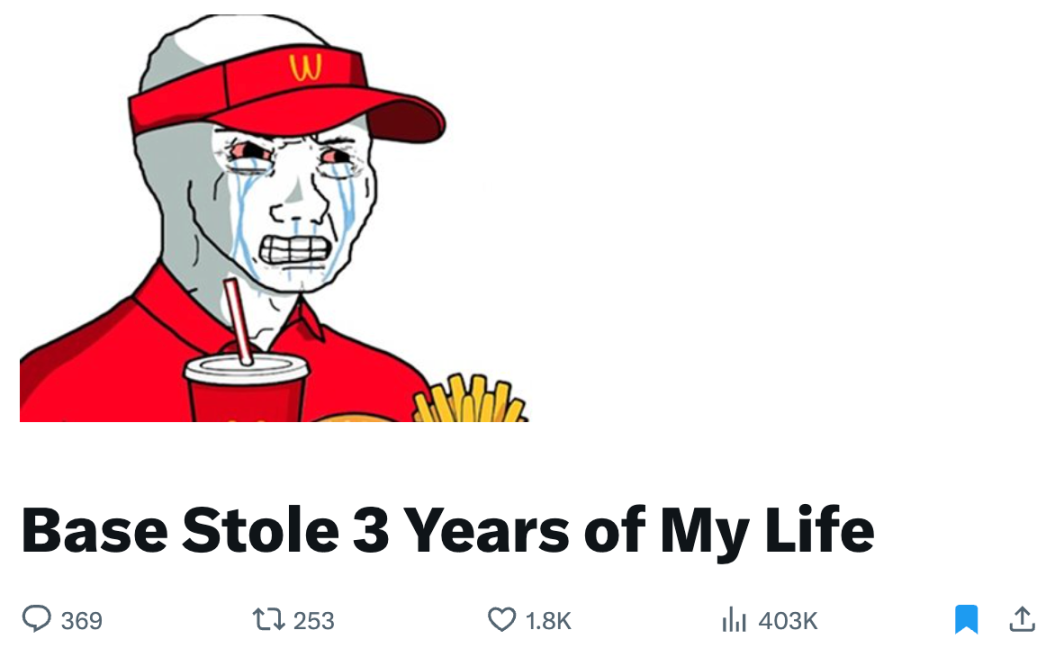
In the article, Tuna stated that Jesse's philosophy of Base being "application-first" rather than focusing on infrastructure attracted him to develop products on Base. However, after "three years" (Base's mainnet has only been live for about two and a half years) of developing 10 products including games, AI Agents, prediction markets, and zkTLS, the promised support from Base never materialized.

After launching the hit game Infected and gaining 50,000 followers in a month, Base proactively contacted tuna and promised support, but ultimately nothing came of it. Tuna mentioned that before Infected, they tried to reach Base officials through X, Discord, and Telegram but received no response.

Disheartened, tuna switched to Solana and developed the game Addicted, which generated $4 million in revenue within 48 hours of its launch on Solana. The stark contrast of earning $4 million in 2 days versus achieving nothing in nearly 3 years led tuna to lament that, compared to Base, which constantly promotes Farcaster and Zora, he had finally found an "organization" that treats developers like human beings.

Shivam Tandon, founder of zkCross Network, had a similar experience. He also initially believed in Jesse's story of prioritizing products and builders. However, after developing Surf on Base, their efforts to contact Base via email and private messages similarly went unanswered. Shivam Tandon stated that he doesn't mind if Base wants to support projects invested in by Coinbase, but he wishes they would be upfront about it and not waste developers' time.

Although some pragmatic users believe Base has its own preferences and that project failures shouldn't be blamed on this, most people expressed support for tuna.

Developer criticism of Base didn't start this year. In February 2025, a user with the X handle Lamboland felt that Base's approach seemed insufficiently "degen." Coinbase offered no support for a high-traffic project like Virtuals but listed the VVV token on its launch day. Lamboland mentioned that many projects were considering migrating to Solana, primarily because Base's marketing was out of touch, lacking "seasoned veterans" who understand CT culture to build a good community environment.

Similarly, just two weeks ago, Jacek, a member of DEGEN—which airdropped $50 million in tokens to Farcaster users and once had a market cap exceeding $1 billion—also posted a long thread expressing disappointment with Base.

Jacek stated that developers choose Base largely because of its connection to Coinbase, hoping to gain support or brand endorsement. However, as the previous two mentioned, Base devoted significant effort to projects like Zora, while even the official Base Twitter account didn't follow or retweet projects like DEGEN that brought massive traffic to Base. In Jacek's view, to Base, anything outside the mainstream narrative simply doesn't exist.

Furthermore, DEGEN's proposal for a $1 million airdrop on Base and the Base App was ignored. Jacek noted that when DEGEN announced plans to cross-chain to Solana, they immediately received attention and support from Solana. At offline events, Solana officials were eager to interact with ecosystem projects, even giving out Bonk keychains. It's these small, seemingly insignificant details that demonstrate official respect for developers and participants. In contrast, Jacek expressed that he doesn't mind Base promoting Zora, but the attitude of completely ignoring other projects is disappointing.

Interestingly, despite such severe public criticism, neither Base nor Jesse offered any explanation or proposed solutions in the replies to these tweets. On the 9th of this month, Jesse retweeted a post from Base product manager Nick, expressing Base's willingness to assist developers, but the comments were filled with skepticism, with the most common question being: How exactly do you plan to help?

Over the past year, Base has indeed been a gold rush destination, but it almost experienced "sudden death" after its flagship projects fizzled out. Unlike Solana, Base is part of the Coinbase ecosystem, an extension of the exchange, born with the attribute of serving stakeholders. Clearly, the unhealthy tendencies existing within the already large Coinbase have also affected Base's operations. Perhaps Base's sudden popularity was indeed supported by Coinbase's strong resources, but the core contributors to its brief success were still the talented developers in the community.

Coinbase's plans for Base in 2026 primarily revolve around on-chain assets and the Base App. Coinbase plans to gradually evolve into a comprehensive exchange in the future, with aspects like stock tokenization and commodity tokenization mainly being handled by Base. Additionally, the Base App is planned to be developed into a Web3 traffic入口 (entry point) integrating trading, social features, and a wallet. This indicates that Base will likely continue to adhere to its recognized "mainstream narrative," and its functional role in assisting Coinbase will remain stronger than being an open community itself.

Over the past year, Base wanted to use its influence to strongly promote projects like Farcaster and Zora, which have capital backing and "orthodox" narratives, but misjudged the "crazy" mainstream style of this market cycle. For Coinbase, it needs to clarify whether Base is merely a tool to serve the exchange and Coinbase Ventures, or a truly open network for the entire world. If it's the latter, it must adopt an operational philosophy like Solana's—"from the masses, to the masses."


Twitter:https://twitter.com/BitpushNewsCN

BitPush TG Discussion Group:https://t.me/BitPushCommunity

BitPush TG Subscription: https://t.me/bitpush

Original article link:https://www.bitpush.news/articles/7602760

Preguntas relacionadas

QWhat was the main complaint of the game studio Pandemic Labs' co-founder (tuna) against Base?

ATuna complained that despite Base's initial promise of an 'application-first' approach and support for developers, after nearly three years of developing 10 different products (including games, AI Agent, prediction markets, zkTLS) on Base, the promised support never materialized. Even after creating a hit game 'Infected' that gained 50,000 followers, Base's offer of support ultimately came to nothing.

QWhat contrasting result did tuna experience after switching from Base to Solana?

AAfter switching to Solana and developing the game 'Addicted', tuna generated $4 million in revenue within just 48 hours of its launch. This starkly contrasted with nearly three years of achieving nothing on Base, leading him to feel that Solana was an organization that treated developers with respect.

QAccording to the article, what is a common criticism from developers like Shivam Tandon (zkCross Network) and Jacek (DEGEN) regarding Base's support?

ADevelopers like Shivam Tandon and Jacek criticized Base for ignoring their attempts to make contact via emails and private messages, and for showing preferential support to projects like Zora and those backed by Coinbase Ventures, while neglecting other developers who brought significant traffic and value to the ecosystem, such as DEGEN which airdropped $50 million to users.

QHow did the article characterize Base's relationship with Coinbase and its potential future focus?

AThe article characterized Base as an extension of the Coinbase exchange, born with the attribute of serving its stakeholders. Its future planning for 2026 is focused primarily on on-chain assets and the Base App, aiming to develop into a comprehensive exchange handling stock tokenization, commodity tokenization, and acting as a Web3 traffic entry point. Its functional role in assisting Coinbase is seen as stronger than being a truly open community.

QWhat key difference in community engagement did Jacek highlight between Solana and Base?

AJacek highlighted that when DEGEN announced plans to bridge to Solana, they immediately received attention and support from Solana. At offline events, Solana's official staff were eager to interact with ecosystem projects, even giving out small gifts like Bonk keychains. This demonstrated a respect for developers and participants that was lacking in Base's approach, which largely ignored projects outside its 'mainstream narrative'.

Lecturas Relacionadas

Why Do You Always Lose Money on Polymarket? Because You're Betting on News, While the Pros Read the Rules

Why do you always lose money on Polymarket? Because you bet on news, while the pros study the rules. This article explains how top traders ("che tou") profit by meticulously analyzing market rules, not just predicting events. Polymarket, a prediction market platform, often sees disputes over event outcomes due to ambiguous rule wording. For instance, a market asking "Who will be the leader of Venezuela by the end of 2026?" was misinterpreted by many who bet on Delcy Rodríguez, assuming she held power. However, the rules specified "officially holds" as the formally appointed, sworn-in individual. Since Nicolás Maduro was still recognized as president officially, he won the market—even being in prison. To resolve such disputes, Polymarket uses a decentralized arbitration system via UMA protocol. The process involves: 1. Proposal: Anyone can propose a market outcome by staking 750 USDC, earning 5 USDC if unchallenged. 2. Dispute: A 2-hour window allows challenges with a 750 USDC stake; successful challengers earn 250 USDC. 3. Discussion: A 48-hour period on UMA Discord for evidence and debate. 4. Voting: UMA token holders vote in two 24-hour phases (blind then public). Outcomes require >65% consensus and 5M tokens voted; otherwise, four re-votes occur before Polymarket intervention. 5. Settlement: Results are final and automatic. Unlike traditional courts, Polymarket’s system lacks separation between arbitrators and stakeholders—voters often hold market positions, creating conflicts of interest. This leads to herd mentality in discussions and non-transparent outcomes without explanatory rulings, preventing precedent formation. Thus, success on Polymarket hinges on deep rule interpretation, not just event prediction, exploiting gaps between reality and contractual wording.

marsbitHace 20 min(s)

Why Do You Always Lose Money on Polymarket? Because You're Betting on News, While the Pros Read the Rules

marsbitHace 20 min(s)

DeepSeek Funding: Liang Wenfeng's 'Realist' Pivot

DeepSeek, a leading Chinese AI company, has initiated its first external funding round, aiming to raise at least $300 million at a valuation of no less than $10 billion. This move marks a significant shift from its founder Liang Wenfeng’s previous idealistic stance of rejecting external capital to maintain independence. Despite strong financial backing from its parent company, quantitative trading firm幻方量化 (Huanfang Quant), which provided an estimated $700 million in revenue in 2025 alone, DeepSeek faces mounting challenges. Key issues include a 15-month gap in major model updates, delays in its flagship V4 release, and the loss of several core researchers to competitors offering significantly higher compensation. The company is also undergoing a strategic pivot by migrating its infrastructure from NVIDIA’s CUDA to Huawei’s Ascend platform, a move aligned with China’s push for technological self-reliance amid U.S. export controls. However, DeepSeek lags behind rivals like智谱AI and MiniMax—both now publicly listed—in areas such as product ecosystem, multimodal capabilities, and commercialization. The funding round, though relatively small in scale, is seen as a way to establish a market-validated valuation anchor, making employee stock options more competitive and facilitating talent retention. It also signals DeepSeek’s transition from a pure research-oriented organization to a commercially-driven player in the global AI ecosystem.

marsbitHace 59 min(s)

DeepSeek Funding: Liang Wenfeng's 'Realist' Pivot

marsbitHace 59 min(s)

Trading

Spot
Futuros

Artículos destacados

Cómo comprar ONE

¡Bienvenido a HTX.com! Hemos hecho que comprar Harmony (ONE) sea simple y conveniente. Sigue nuestra guía paso a paso para iniciar tu viaje de criptos.Paso 1: crea tu cuenta HTXUtiliza tu correo electrónico o número de teléfono para registrarte y obtener una cuenta gratuita en HTX. Experimenta un proceso de registro sin complicaciones y desbloquea todas las funciones.Obtener mi cuentaPaso 2: ve a Comprar cripto y elige tu método de pagoTarjeta de crédito/débito: usa tu Visa o Mastercard para comprar Harmony (ONE) al instante.Saldo: utiliza fondos del saldo de tu cuenta HTX para tradear sin problemas.Terceros: hemos agregado métodos de pago populares como Google Pay y Apple Pay para mejorar la comodidad.P2P: tradear directamente con otros usuarios en HTX.Over-the-Counter (OTC): ofrecemos servicios personalizados y tipos de cambio competitivos para los traders.Paso 3: guarda tu Harmony (ONE)Después de comprar tu Harmony (ONE), guárdalo en tu cuenta HTX. Alternativamente, puedes enviarlo a otro lugar mediante transferencia blockchain o utilizarlo para tradear otras criptomonedas.Paso 4: tradear Harmony (ONE)Tradear fácilmente con Harmony (ONE) en HTX's mercado spot. Simplemente accede a tu cuenta, selecciona tu par de trading, ejecuta tus trades y monitorea en tiempo real. Ofrecemos una experiencia fácil de usar tanto para principiantes como para traders experimentados.

186 Vistas totalesPublicado en 2024.12.12Actualizado en 2025.03.21

Cómo comprar ONE

Discusiones

Bienvenido a la comunidad de HTX. Aquí puedes mantenerte informado sobre los últimos desarrollos de la plataforma y acceder a análisis profesionales del mercado. A continuación se presentan las opiniones de los usuarios sobre el precio de ONE (ONE).

活动图片