Metaplanet Strengthens Bitcoin Treasury Position Amid Yen Weakness

TheNewsCryptoPublicado a 2026-01-05Actualizado a 2026-01-05

Resumen

Metaplanet, a Japanese firm, is strategically leveraging significant Bitcoin holdings to counter the weakening yen and national debt pressures. With 35,102 BTC on its balance sheet, the company benefits as Bitcoin's value appreciates strongly against the depreciating yen, effectively reducing the real cost of its yen-denominated debt. This unique financial position is further supported by recent capital restructuring efforts, including issuing preferred shares, to attract institutional investment and enhance long-term stability.

Metaplanet has been identified to greatly benefit from the depreciated value of the Japanese currency, given that a change in the value of the Bitcoin-focused balance sheet is dependent on the value of the currency that the company uses to repay its debts. Analysts indicate that companies that possess Bitcoin and repay debts in the form of the Japanese Yen may notice a drop in the costs of their debts due to the devaluation of the local currency.

Bitcoin analyst Adam Livingston highlighted the case of Japan, which has a government debt of around 250% of its GDP, as one of the factors that has been pressuring the Japanese yen. These kinds of factors help create a situation where companies involved in hard assets like Bitcoin may have different financial dynamics compared to those involved in strong fiat currencies.
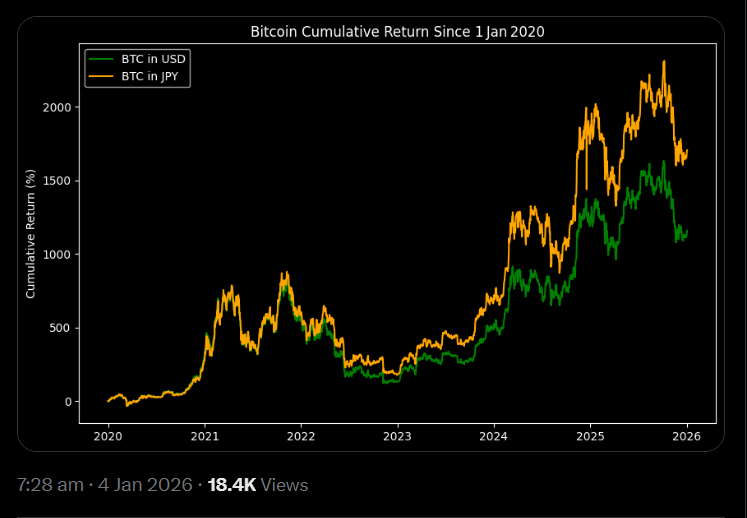
Data indicates that the appreciation of Bitcoin against the U.S. dollar is approximately 1,159% since 2020. Compared to the Japanese yen, the appreciation is higher, standing at 1,704% appreciation, thus indicating the rising discrepancy concerning the appreciation of value in the Japanese currency compared to Bitcoin.

Debt Costs and Treasury Position

As observed by analysts, Metaplanet is servicing a reported coupon of 4.9% with a currency that is constantly depreciating against Bitcoin. This means that the actual costs associated with such payments keep on lowering. This is opposed to the liabilities associated with the cryptocurrency treasuries that service a higher coupon with a stronger currency.

As of data from Bitcoin Treasuries, Metaplanet currently has a total of approximately 35,102 BTC, which makes it one of the top companies that have Bitcoin as a corporate asset. In fact, it recently expanded its holdings by approximately 4,279 BTC through a purchase worth $451 million.

Capital Restructuring to Attract Institutions

In December 2025, Metaplanet affirmed the modification of its capital structure to enhance access to long-term capital. The firm authorized the issuance of dividend-bearing preference stocks. This is in a bid to attract institutional investors.

The director of Bitcoin strategy at the company, Dylan LeClair, has confirmed that investors have approved proposals regarding preferred share issuance and alternative dividend arrangements, as well as possible share repurchase actions by reclassification of capital reserves.

The relevance of Metaplanet’s strategy is because the firm is affected by macroeconomic variables such as the value of Yen against the US dollar. For MetaPlanet, the presence of Yen–dominated liabilities in addition to the growth in the value of Bitcoin presents a paradigm with a unique balance sheet that is quite different from the rest globally.

In this respect, however, the increased Bitcoin reserves and capital structure of Metaplanet also imply a strategic, institutional, and flexible focus. As the cryptocurrency treasury market also grapples with market volatility and valuation challenges, the corporate structure of Metaplanet also signifies the increasing relevance of currency exposure, debt, and capital strategy in cryptocurrency adoption.

Highlighted Crypto News:

‌BTC and ETH Note Upswings as Respective ETFs See Inflows; Tides Turning?

TagsBitcoinbitcoin treasuryBTCmetaplanet

Preguntas relacionadas

QWhy does Metaplanet benefit from the depreciated Japanese Yen according to the article?

AMetaplanet benefits because it holds Bitcoin as a corporate asset and repays its debts in Japanese Yen. As the Yen depreciates, the real cost of servicing its debt decreases, making it cheaper for the company to pay back its loans.

QWhat is the appreciation of Bitcoin against the Japanese Yen since 2020, as stated in the article?

AThe appreciation of Bitcoin against the Japanese Yen since 2020 is 1,704%.

QHow much Bitcoin does Metaplanet currently hold in its treasury?

AMetaplanet currently holds a total of approximately 35,102 BTC in its treasury.

QWhat recent capital restructuring move did Metaplanet make to attract institutional investors?

AIn December 2025, Metaplanet authorized the issuance of dividend-bearing preference stocks as part of a modification to its capital structure to attract institutional investors.

QAccording to the article, what is one of the major factors pressuring the Japanese Yen?

AOne of the major factors pressuring the Japanese Yen is Japan's high government debt, which is around 250% of its GDP.

Lecturas Relacionadas

a16z: From Companies to DAOs, DUNA May Become the Next Generation Organizational Form

This article, "From Companies to DAOs: How DUNA Could Become the Next Organizational Form," traces the 500-year evolution of business collaboration. It begins with medieval structures like the *commenda* and Florentine *compagnia*, which exposed partners to personal risk. The modern corporation, exemplified by the Dutch East India Company (VOC), was a revolutionary leap, enabling large-scale, capital-intensive ventures by offering limited liability and reducing coordination costs. However, corporations introduced new challenges like principal-agent problems and bureaucratic overhead. The piece argues that software and internet-native protocols are now reducing these traditional overheads. Decentralized Autonomous Organizations (DAOs) emerged as a new model for coordination without centralized management. Yet, DAOs face a significant legal vacuum: they lack legal recognition, leaving members exposed to unlimited personal liability, and their tokens are vulnerable to being classified as securities under unclear regulations (e.g., the Howey Test). This has forced projects into suboptimal workarounds like offshore foundations. The article identifies the Decentralized Unincorporated Nonprofit Association (DUNA) as a potential solution. Recently legalized in states like Wyoming, the DUNA provides a legal wrapper for decentralized networks. It grants key protections—legal personality, limited liability, and perpetual existence—to a group without imposing a traditional hierarchical management structure. This allows token-holder communities to govern, hold assets, and contract as a single legal entity, aligning with their decentralized nature. While DUNA doesn't solve all governance challenges or magically resolve securities law questions, it represents a crucial step. It fills the legal recognition gap, offering a native legal form for internet-scale, decentralized collaboration and extending the separation of personal risk from organizational venture into a new domain.

marsbitHace 5 min(s)

a16z: From Companies to DAOs, DUNA May Become the Next Generation Organizational Form

marsbitHace 5 min(s)

2026 Mid-Year Report On-Chain RWA: Tokenized Stock Market Cap Doubles in a Year, But 90% of Rights Are Hollow Shells

The 2026 Mid-Year Report on On-Chain RWA highlights a significant growth in tokenized stock market capitalization, which nearly doubled from $951 million in March to $1.89 billion by July. However, the report reveals a fundamental contradiction in this "layer 2.5" ecosystem: products with the strongest legal foundation (like regulated U.S. infrastructure) lack liquidity and distribution, while freely tradable offshored wrapper products often lack substantive ownership rights. The increase is driven largely by a few products (SECZ, FGRS, STRCx) and platforms (Ondo, xStocks, Securitize collectively hold over 85% share). While distributed value across networks like Ethereum, Solana, and BNB Chain has grown, the market remains fragmented. Products referencing the same underlying asset (e.g., Apple stock) are distinct legal liabilities with different intermediaries and jurisdictional rules, offering varying degrees of legal claim. The report cautions that headline numbers are misleading, as they reflect changes in distributed token value—driven by issuance, conversions, and price movements—not pure investor inflows. True "canonical shares" with legal ownership, wide wallet distribution, institutional liquidity, and independent on-chain price discovery do not yet exist at scale. Tokenized treasuries show stronger product-market fit, and ETFs may be easier to scale than single stocks. The core takeaway is a trade-off: legal certainty versus liquidity and composability.

marsbitHace 55 min(s)

2026 Mid-Year Report On-Chain RWA: Tokenized Stock Market Cap Doubles in a Year, But 90% of Rights Are Hollow Shells

marsbitHace 55 min(s)

Coldcard Hardware Wallet Hacked: 594 Bitcoin Withdrawn in 25 Minutes

The Coldcard hardware wallet has been compromised, with hackers stealing approximately 594.5 Bitcoin (~$40 million) from 500 addresses in just 25 minutes. The root cause was a critical software bug, undetected for five years, which disabled the device's secure chip for generating true random numbers. This led to the creation of private keys based on predictable data like the processor's serial number, drastically reducing cryptographic security. The attackers exploited this offline by brute-forcing possible seed phrases, finding active addresses on the public ledger, and signing transactions. Initially, Coinkite (Coldcard's maker) claimed only older models were at risk but later admitted all devices running the compromised firmware were vulnerable. CEO Rodolphe Novak (NVK) apologized but ruled out financial compensation for affected users. To secure funds, owners must urgently update their firmware to specific safe versions, generate a completely new seed phrase on the updated device, and transfer all assets to new addresses created with that new seed. While a BIP-39 passphrase can help, it does not replace this migration process. Other Coinkite products like TAPSIGNER were not affected. This incident underscores that even specialized hardware requires rigorous, independent code audits, especially for cryptographic functions. It parallels past failures, like a 2006 OpenSSL bug in Debian, and raises questions about whether automated code analysis can ever fully replace human scrutiny in critical security areas.

cryptonews.ruHace 3 hora(s)

Coldcard Hardware Wallet Hacked: 594 Bitcoin Withdrawn in 25 Minutes

cryptonews.ruHace 3 hora(s)

Trading

Spot
活动图片