Meta Follows the Trend into Prediction Markets: Can It Avoid Repeating the Failure of the Metaverse?

Foresight NewsPublicado a 2026-06-25Actualizado a 2026-06-25

Resumen

Meta, the tech giant behind Facebook, has reportedly formed a team to develop "Arena," a new application focused on prediction markets. Users would use platform points to place bets on outcomes in politics, sports, and global events. This move follows Meta's massive, nearly $900 billion, losses from its heavily-invested metaverse division, Reality Labs. The prediction market industry is already showing strong demand, with leading platforms like Kalshi and Polymarket facilitating hundreds of billions in annual volume. Meta, with its 3.56 billion daily active users across its apps, possesses the unprecedented scale to bring this niche activity to a mainstream audience, similar to its past success in cloning features like Stories and Reels. However, Arena faces significant hurdles. Meta plans to start with a points-based system to avoid strict financial regulations, but this may dilute the core incentive of accurate prediction that real-money markets provide. More critically, Meta enters the space with a major trust deficit stemming from its past regulatory battles, notably the failed Libra/Diem stablecoin project, and its controversial history with political content and misinformation. The prediction market sector itself is under increasing regulatory scrutiny, with recent CFTC actions including fines and the first-ever insider trading case. While Meta's vast user base offers a unique opportunity to expand the market, its success hinges on navigating complex regulations and ...


Author: Gino Matos

Compilation: Luffy, Foresight News


TL;DR:


  • The New York Times reports that Meta has formed a small team to develop an internal project codenamed Arena, a point-based prediction app allowing users to wager on outcomes of politics, sports, and global events.
  • Prediction markets have demonstrated genuine demand. With 3.56 billion daily active users, Meta has the potential to bring this niche sector to the mass market.
  • However, Meta's trust crisis, combined with election and misinformation scrutiny, could make Arena a regulatory target even before it scales.


On June 23, The New York Times reported that Mark Zuckerberg is leading a dedicated team to develop a prediction market application called Arena. Users will use platform points to place bets on outcomes like political elections, sporting events, and international affairs.


This is the same company that rebranded for the metaverse and whose Reality Labs division has accumulated nearly $90 billion in losses. Now turning to prediction markets, a sector with strong real demand and an established user base but fraught with complex regulatory rules, this pivot could be Meta's smartest strategic adjustment or a repeat of its past costly failures.


The Metaverse's Staggering Bill


In October 2021, Facebook officially changed its name to Meta. Zuckerberg stated the company's core goal was "to bring the metaverse to life" and predicted the metaverse would reach one billion users within a decade.


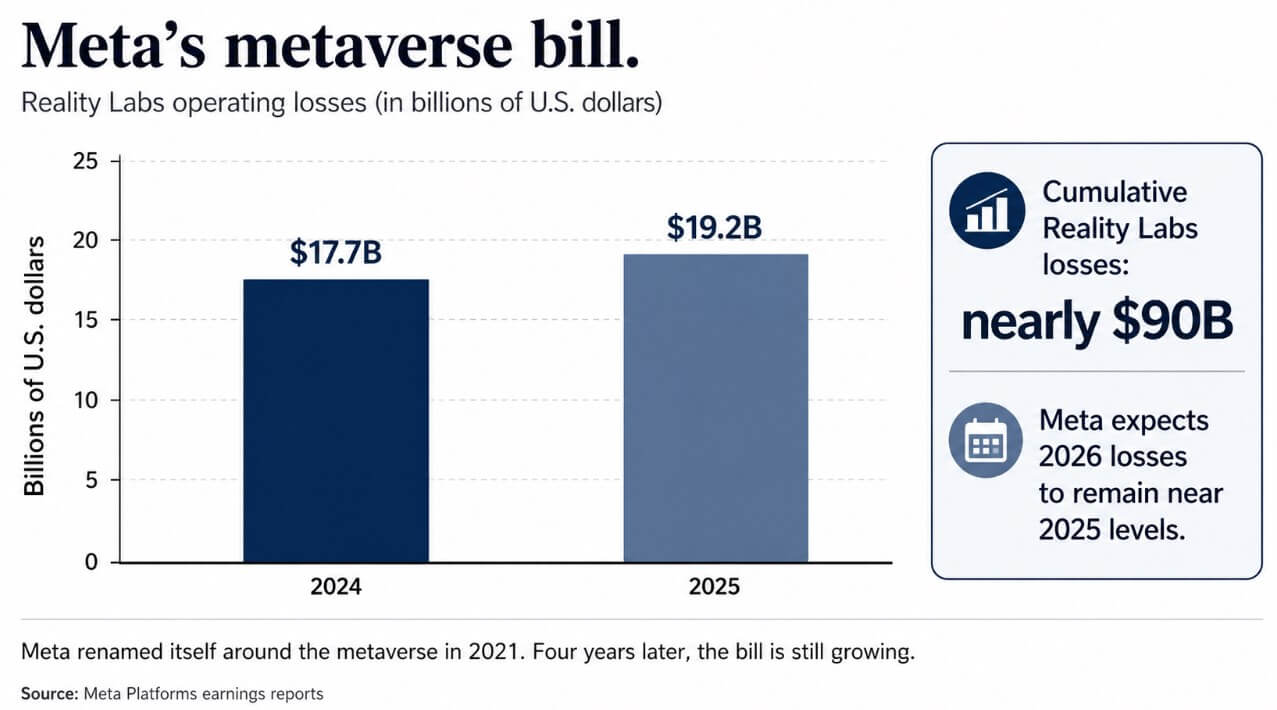
Losses for the Reality Labs division, which carries this vision, have continued to swell: $17.7 billion in operating losses in 2024, $19.2 billion in 2025, with cumulative losses nearing $90 billion. Meta has indicated to investors that losses for this segment in 2026 could be on par with 2025.


Its flagship social VR platform, Horizon Worlds, saw monthly active users drop below 200,000 in 2022, far short of the initial 500,000 target. Meta subsequently revised expectations downward again and plans to wind down the VR version by 2026.


Why Prediction Markets Are a Completely Different Game


In 2026, the combined monthly trading volume of the two leading platforms, Kalshi and Polymarket, was approximately $24 billion, with industry projections for full-year prediction market trading volume exceeding $130 billion.


Robinhood launched a prediction markets section in 2025, Interactive Brokers integrated event contracts into its trading platform, and the Golden Globe Awards even incorporated prediction market interaction segments. A Bernstein research report in April estimated the sector's annual trading volume could reach $1 trillion by 2030.


Meta has always been adept at replicating popular products and leveraging its massive traffic to overtake: Instagram launched Stories after Snapchat's ephemeral posts; Meta launched Threads after Twitter dominated social text for a decade; Reels followed TikTok's short-video craze. As of April, Meta's family of apps boasts 3.56 billion daily active users, a traffic volume that dwarfs all existing prediction market platforms.


Arena's points-based design continues Meta's consistent strategy: capturing existing user behaviors and demand, embedding them within its own traffic ecosystem, and relying on massive distribution to compensate for a lack of product originality.


Building a prediction market primarily requires software, an information feed, an account system, content moderation, and compliance, with some scenarios possibly involving licensed partners. In contrast, the metaverse requires custom hardware, immersive content, avatars, dedicated runtime environments, and years spent cultivating user habits. The massive losses at Reality Labs prove the extreme cost of creating a completely new paradigm from scratch.
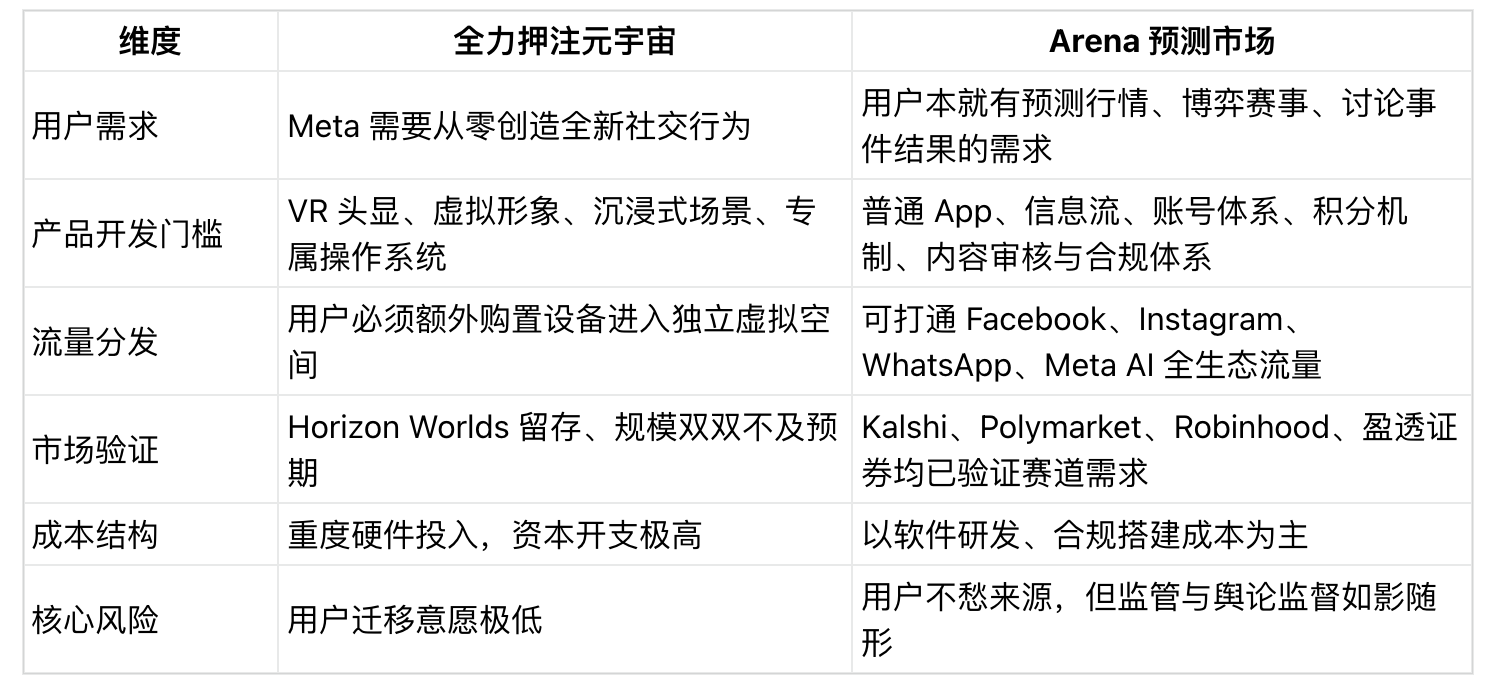

Comparison of Core Dimensions: Metaverse vs. Prediction Market Arena


Arena Is Not Meta's First Foray into Prediction Markets; Its Previous Product Was Shut Down Long Ago


As early as 2020, during the initial pandemic, Meta launched Forecast, a points-based public prediction app focused on current events, which was shut down in 2022. At that time, Polymarket had not yet exploded with the 2024 U.S. presidential election, Kalshi had not won its lawsuit with the Commodity Futures Trading Commission (CFTC) over election contracts, and annual industry trading volume had not yet surpassed $50 billion.


The sector Meta is about to enter is rife with regulatory penalty cases:


  • In 2022, the CFTC determined Polymarket was offering off-exchange event derivative contracts without registration and fined it $1.4 million.
  • Kalshi spent years in federal litigation fighting for the right to offer election contracts. A district court issued a favorable ruling in September 2024, and the CFTC dropped its appeal in May 2025, opening a compliance space for election event contracts, but debates over political trading and market integrity persist.
  • In April 2026, the CFTC brought the first-ever insider trading lawsuit in prediction markets, accusing an active-duty U.S. military officer of profiting from trades on Polymarket using confidential information about Venezuelan operations.


Meta's past forays into financial products have long made regulators highly wary of its financial ambitions. The digital stablecoin project Diem (originally Libra), spearheaded by Facebook, was ultimately sold at a low price to Silvergate Bank in 2022 after regulators concluded that Meta controlling a payment network for billions of users would concentrate excessive financial and social power. During the Libra hearings, Meta's model combining social identity, political content, financial incentives, and market data faced fierce opposition from regulators.


It's precisely because points-based prediction gaming can avoid stringent financial regulations in the early stages that Meta has chosen it as Arena's starting point.


What Advantages Does Massive Traffic Bring?


The most viable form for Arena's initial product is building mass prediction features leveraging social scale: Instagram creators launching prediction markets for award shows, Facebook groups discussing sports odds, WhatsApp communities sharing collective prediction views, and Meta AI aggregating mainstream expectations across the network.


This version would temporarily avoid the cash-settled event contracts that have previously drawn regulatory penalties, operating solely within Meta's social graph of 3.56 billion daily active users.


However, the core logic of prediction markets relies on real monetary stakes to discipline prediction behavior and form fair prices. Once replaced with points-based interaction incentives, the product will prioritize reach and user engagement time over the accuracy of prediction outcomes.


Meta's poor track record of handling political content and combating misinformation means regulators and media will naturally scrutinize every controversy Arena triggers.


Meta's traffic advantage is sufficient to support the sector's scale. The success logic of Stories and Reels is identical: capture existing user preferences and amplify their spread through a billion-user platform. If Arena builds lightweight social prediction features, controls financial barriers to entry, and makes prediction markets easily accessible to the average Facebook user while platforms like Kalshi maintain their professional trading positioning, Meta could grow the overall industry pie, benefiting existing leading platforms.


Crypto-native users with financial awareness have built the trillion-dollar prediction market sector. Meta's 3.56 billion daily active users represent a massive, previously untapped mainstream user base, which is also the greatest opportunity in this move.


But just two months before news of Meta's entry broke, the CFTC brought the first-ever insider trading lawsuit in prediction markets, indicating ongoing tightening of regulatory scrutiny. Meta's platforms covering prediction markets related to elections, sports events, and public figures are highly susceptible to regulatory intervention. Coupled with the company's negative history of handling sensitive political content, Meta enters the arena with an inherent credibility deficit, where its massive traffic could amplify all kinds of negative controversies.
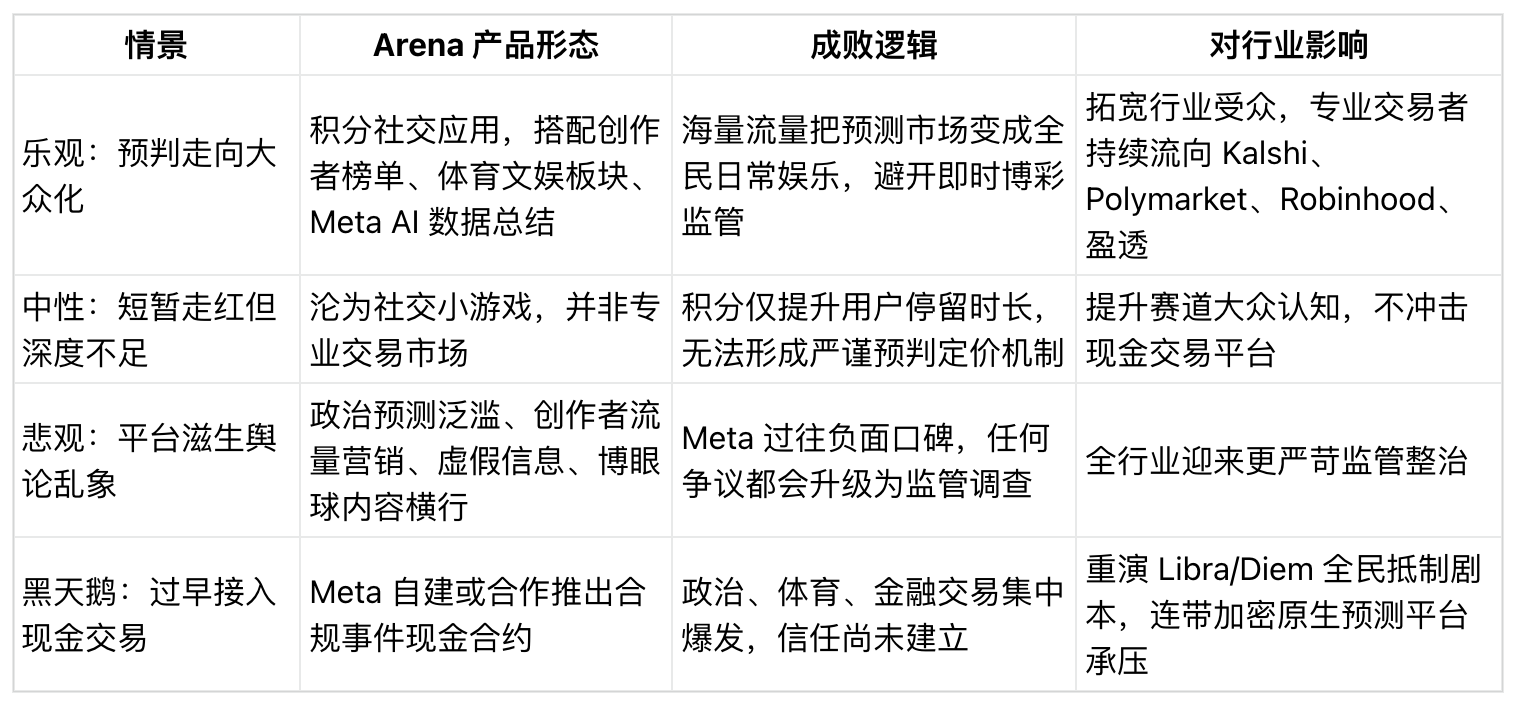

Four Potential Development Scenarios for Arena


Several of Meta's previous financial products have failed outright because regulators deemed trust issues unsolvable.


Arena has inherent advantages: the prediction market sector is established, and a real user base exists. But the operator, Meta, carries the same negative reputation that doomed Libra. Once elections and monetary transactions are involved, trust becomes a core asset Meta must earn through long-term stewardship; traffic scale alone cannot compensate for a lack of credibility.


Preguntas relacionadas

QAccording to the article, what is the name of Meta's new prediction market application project and what is its key feature?

AAccording to the article, Meta's new prediction market application project has the internal codename 'Arena'. Its key feature is that users can use platform points (a non-cash, points-based system) to place bets on the outcomes of political elections, sports events, and international affairs.

QWhat significant financial loss did Meta's Reality Labs division incur as part of its metaverse strategy, and what happened to its Horizon Worlds platform?

AMeta's Reality Labs division, which spearheaded the metaverse strategy, has accumulated losses nearing $90 billion. Its flagship social VR platform, Horizon Worlds, saw its monthly active users drop below 200,000 in 2022, failing to meet its initial 500,000 target. Meta subsequently lowered expectations further and plans to gradually shut down the VR version by 2026.

QHow does the article contrast the business model and challenges of building a metaverse versus building a prediction market like Arena?

AThe article contrasts the two by stating that building a prediction market primarily requires software, information flow, account systems, content moderation, and compliance systems, which can sometimes rely on licensed partners. In contrast, building a metaverse requires custom hardware, immersive content, virtual avatars, specialized operating environments, and takes years to cultivate user habits. Reality Labs' massive losses demonstrate the extremely high cost of creating a completely new market category from scratch.

QWhat are the main regulatory challenges and historical baggage that Meta faces in launching Arena, according to the article?

AThe main regulatory challenges and historical baggage include: 1) Meta's previous failed digital currency project, Diem (formerly Libra), was blocked due to regulators' concerns about Meta's control over a potential payment network for billions of users. 2) There is ongoing industry scrutiny, including the first-ever insider trading lawsuit in the prediction market sector by the CFTC just two months before Meta's announcement. 3) Meta's past poor record in handling political content and combating misinformation means regulators and the media will scrutinize any Arena-related controversy, especially around elections and financial incentives. This trust deficit is identified as a core weakness.

QWhat is the article's view on the potential impact of Meta's massive user base on the prediction market industry?

AThe article sees Meta's massive daily active user base of 3.56 billion as both its biggest opportunity and a potential risk. The opportunity lies in introducing the concept of prediction markets to a vast audience of mainstream users that existing niche, crypto-native platforms have never reached, potentially growing the overall industry 'pie' to the benefit of all players. However, the risk is that Meta's inherent 'trust crisis' and negative reputation, combined with its enormous scale, could amplify any controversies or regulatory issues Arena faces, potentially drawing intense scrutiny before the product can even scale.

Lecturas Relacionadas

Comprehensive Analysis of the AI Inference Market: How Can Crypto Projects Break Through?

"AI Inference Market: A Strategic Overview and Crypto's Path to Disruption" The AI inference market, where trained models generate responses to user prompts, is now the primary economic driver, surpassing model training in value. This market is fragmented: hyperscalers (AWS, Google, Microsoft) dominate enterprise reliability; specialized providers (Together, Fireworks) optimize performance; and routing platforms like OpenRouter act as critical bottlenecks, dynamically allocating requests based on cost, latency, and privacy. Crypto AI networks are not competing directly on reliability but are carving out distinct niches: permissionless access, lower-cost supply, privacy, verifiable computation, and agent-native payments. Key projects include Chutes (decentralized inference platform), Akash & io.net (GPU marketplaces), Targon (confidential computing), Darkbloom & Venice (private, consumer-focused inference), and NuNet (orchestration for distributed workloads). The core differentiator is that traditional providers sell trust and enterprise workflows, while crypto networks offer new incentive loops, censorship resistance, and programmable access to resources like compute. For crypto projects to succeed, key metrics are paid token volume (not just usage), sustainable GPU provider revenue, integration into routers like OpenRouter, robust verification against fraud, and genuine privacy guarantees. Ultimately, market control will belong to entities that route, verify, and settle demand—not just those supplying raw compute. The inference market is evolving to resemble a financial system, with tokens as units of account, and crypto's unique value propositions position it to capture emerging segments in this expanding landscape.

Foresight NewsHace 11 min(s)

Comprehensive Analysis of the AI Inference Market: How Can Crypto Projects Break Through?

Foresight NewsHace 11 min(s)

The War Without a Unified Name: The Domestic Tech Giants' World Model Landscape

The article outlines the diverse and fragmented landscape of "World Models" in China's tech industry, where major players are pursuing similar goals under different names like world foundational models, physical AI, or integrated within autonomous driving and embodied intelligence systems. The core aim is to enable AI to create an internal, dynamic environment for simulation, reasoning, and learning, reducing reliance on infinite real-world data. This "data engine" allows for unlimited generation, experimentation, and iteration. The report categorizes the approaches of different companies: * **Internet Giants:** Alibaba is developing models for linguistic, virtual, and physical worlds (Qwen-AgentWorld, HappyOyster, Qwen-RobotWorld). Tencent's HY-World focuses on 3D, game, and social scenarios. ByteDance leverages its vast video data for a potential "digital twin" model. Huawei integrates its model into industrial applications like smart cars and robotics without separately branding it. Baidu embeds world model capabilities within its Apollo autonomous driving and Ernie systems. * **Automakers:** Companies like NIO, Li Auto, XPeng, and Geely are using world models as virtual "driving schools" and "testing grounds." They generate complex scenarios (e.g., rain, snow) to train and validate autonomous driving systems in simulation, aiming for more capable and safer AI drivers. * **Autonomous Driving Suppliers:** Firms such as Momenta, Horizon Robotics, Haomo.ai, and DeepRoute.ai are building the underlying "world engines." They focus on large-scale video generation for simulation, reinforcement learning, and enhancing end-to-end autonomous driving models, often integrating these capabilities into commercial products. While startups bring focus and innovation, they face challenges like limited data, compute resources, and deployment channels. Large companies possess these advantages and are rapidly transitioning world models from research projects into core business infrastructure powering products in vehicles, games, and industry. The conclusion is that world models represent an evolution and convergence of existing AI fields into crucial industrial infrastructure, moving the competition from simply building a model to effectively deploying it to understand and interact with the physical world.

marsbitHace 27 min(s)

The War Without a Unified Name: The Domestic Tech Giants' World Model Landscape

marsbitHace 27 min(s)

The Crypto Industry Enters the 'Show Me' Era: Vision Alone Is No Longer Enough

The crypto industry has entered a "Show Me" era, where grand visions and white papers are no longer sufficient to gain traction. This shift is driven by increased skepticism, high-profile bad actors, and notably, the serious entry of traditional finance (TradFi) institutions like BlackRock, Fidelity, and JPMorgan Chase, which are launching real, scaled products such as tokenized funds and blockchain-based settlement. This raises the bar for what constitutes a credible project. The communication dynamic has fundamentally changed. The focus is no longer on "what you are building" but on "what you have built and who is using it." Startups must now provide a "proof stack": verifiable data like mainnet transaction volume and active wallets, genuine partnerships with signed contracts, and evidence of organic product-market fit from real users, not just investors. Announcements must be backed by concrete, chain-verifiable evidence. For communication strategies, this means leading with proven facts and hard data—even if modest—rather than speculative narratives. A compelling story must be grounded in demonstrated results. While vision remains important, the balance has inverted from 80% vision/20% substance to the opposite. This higher threshold ultimately benefits builders with genuine traction, filtering out noise and allowing their real signals to stand out clearly. The "Show Me" era is a permanent maturation, demanding that communication strategies prove value, not just promise it.

链捕手Hace 59 min(s)

The Crypto Industry Enters the 'Show Me' Era: Vision Alone Is No Longer Enough

链捕手Hace 59 min(s)

Trading

Spot
Futuros
活动图片