Meme Takes Off First, Will This Time Be Different?

比推Publicado a 2026-01-03Actualizado a 2026-01-03

Resumen

Following a period of stagnant holiday trading, the crypto market showed signs of recovery on the second trading day of 2026. Bitcoin rose to over $90,700, while Ethereum climbed above $3,100. Meme coins led the rally, with PEPE surging over 30%, and other established meme tokens like DOGE and FLOKI also gaining. This meme-driven uptick is seen as a risk sentiment test rather than a confirmed bullish trend. Analysts note that meme coins often act as high-volatility proxies, sensitive to shifts in market mood due to their low fundamental dependency and high emotional and social media-driven demand. Factors such as tax-loss harvesting at the end of 2025 and subsequent buybacks at the start of the new tax year in the U.S. contributed to the short-term momentum. Influencer predictions, like one projecting PEPE’s market cap to reach $69 billion, further fueled retail interest. However, broader market indicators remain cautious. Bitcoin and Ethereum have yet to break key resistance levels, and meme coin dominance within the altcoin market is still near multi-year lows, indicating that speculative activity has not fully returned. Analysts emphasize that sustained growth depends on Bitcoin’s performance, improved liquidity, and broader sector rotation—not meme coins alone. For now, the meme rally signals a potential shift away from extreme pessimism, but it is not yet a definitive indicator of a new bull market.

After nearly two weeks of stagnant holiday trading, the cryptocurrency market saw a noticeable rebound on the second trading day of 2026.

On January 2nd, Bitcoin briefly rose above $90,700, with an intraday increase of about 2%; Ethereum surged over 4%, breaking through the $3,100 mark.

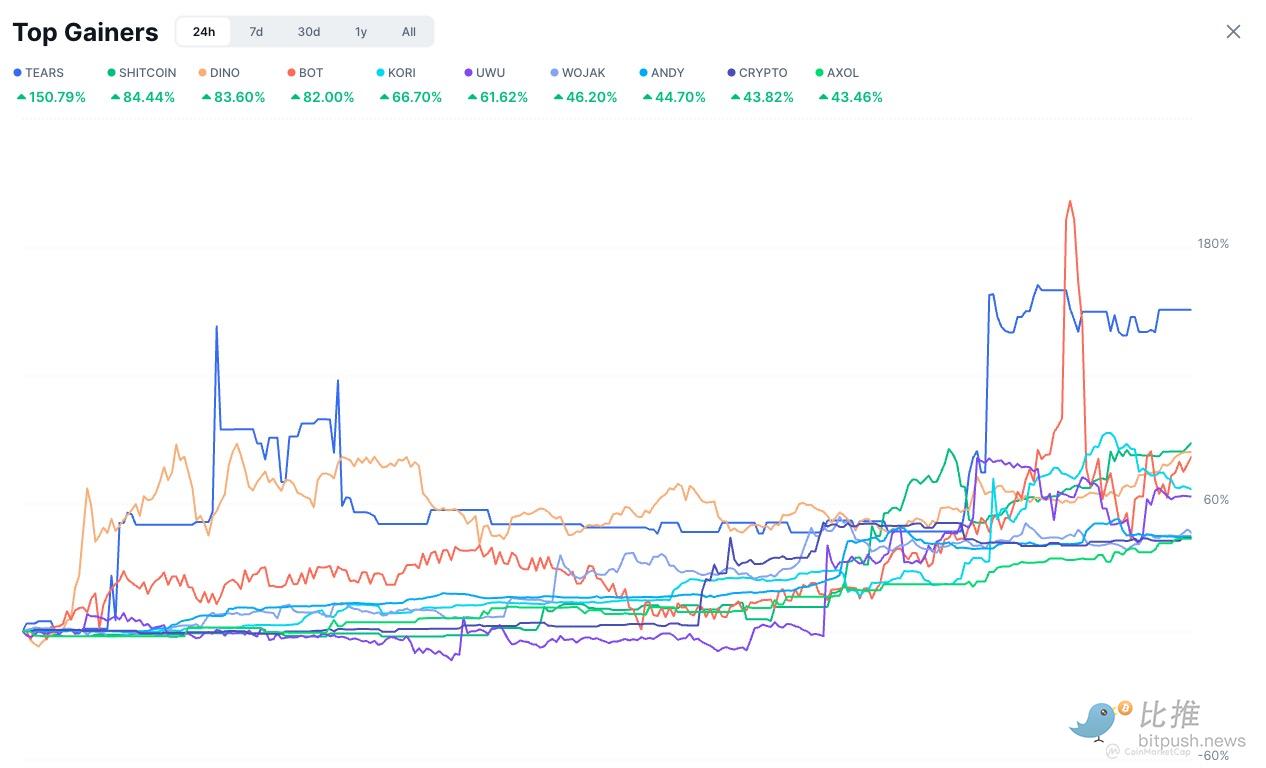
At the same time, the meme coin sector collectively strengthened: PEPE surged over 30% intraday, while established meme coins like DOGE and FLOKI also rebounded, significantly boosting market risk appetite.
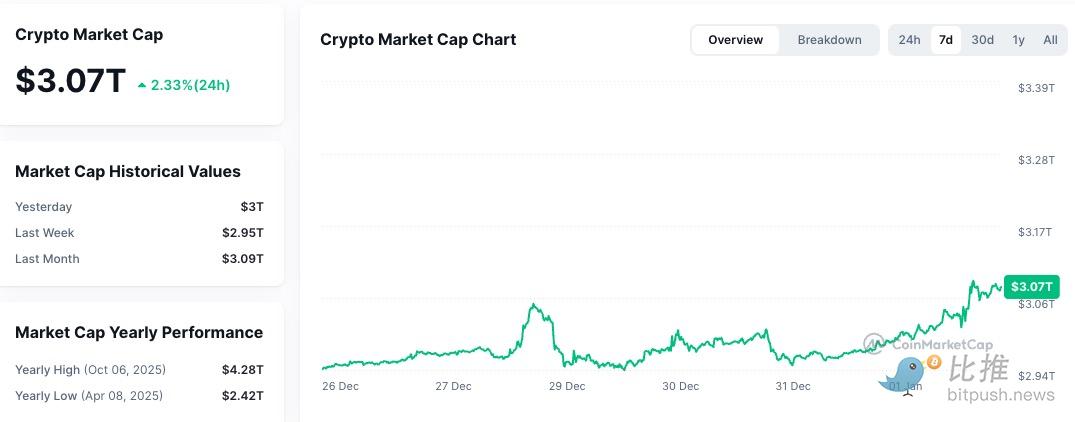
According to CoinMarketCap data, as of that day, the total market capitalization of all crypto assets was approximately $3.07 trillion, with a 24-hour growth of about 2.33%; overall market trading volume rebounded to over $120 billion. In terms of structure, Bitcoin's market share is about 57%, and Ethereum's is about 11.9%. Mainstream assets still dominate, but high-volatility sectors have already started to move first.
A Classic "Risk Appetite Test"

The meme coins leading this round of market movement is not an isolated event but the result of the combined effects of market phase, capital behavior, and narrative mechanisms. From a higher perspective, the current crypto market is still in a transitional phase before trend confirmation:

  • Bitcoin and Ethereum are rebounding moderately but have not yet broken through key structural levels;

  • Altcoins are generally in a repair phase, with no systematic rotation seen yet;

  • Trading volume has rebounded but remains below the levels seen during the initial stages of previous bull markets.

At this stage, capital is more inclined to test risk appetite with smaller costs rather than making long-term bets on "slow variable" assets.

Meme coins恰恰具备这种结构性优势:弹性大、反馈快、对基本面要求低,是风险情绪变化中最敏感的价格载体。

Meme's Role: The Risk "Thermometer"

In the cryptocurrency market, meme coins have long played a role similar to "high-volatility options":

  • Strong price leverage per unit of capital

  • Price increases are more driven by sentiment and traffic

  • Can form trends without improvements in fundamentals

Therefore, when the market shifts from "extreme defense" to "cautious offense," memes often become the first assets to be bought.

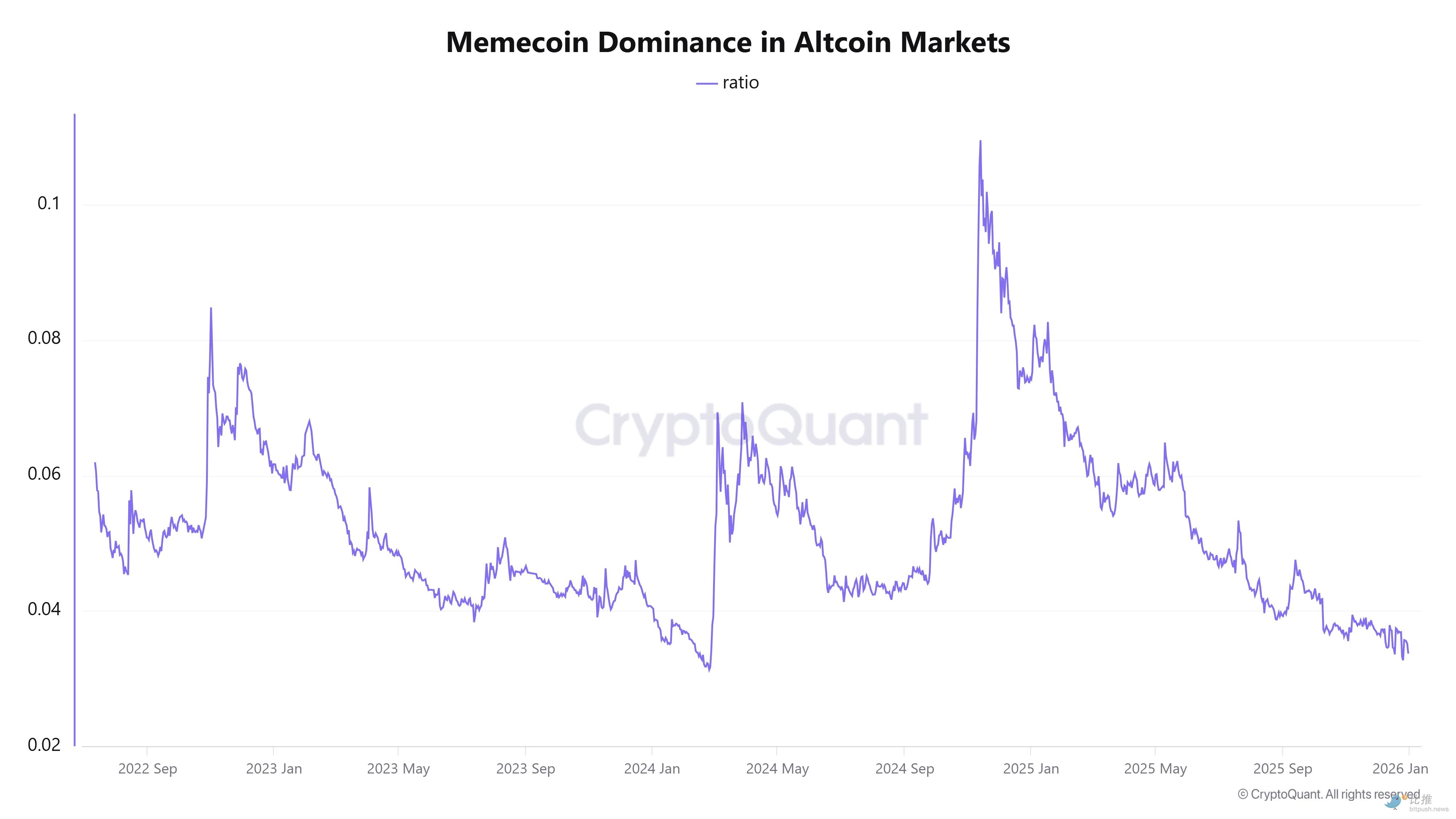
On-chain data also confirms this. According to CryptoQuant statistics, although meme coins have seen significant recent gains, their share of the total altcoin market capitalization remains at historically low levels and has not yet shown the structural expansion seen in previous meme seasons.

Year-Beginning Effect and Tax Factors Amplify Short-Term Buying

From a timing perspective, this rally occurred on the second trading day of the new tax year in North America, showing clear seasonal characteristics.

Several market participants pointed out that at the end of 2025, many U.S. investors sold losing assets through tax-loss harvesting to offset tax liabilities. After entering 2026, capital that remains bullish quickly re-entered positions, and meme coins, due to their deep declines, decent liquidity, and high volatility, became the preferred choice.
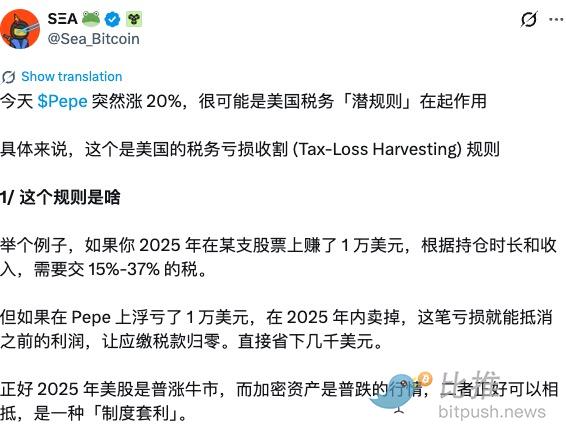
CoinGecko data shows that PEPE's 24-hour trading volume exceeded $1 billion that day, indicating clear concentrated buying back.

KOL Statements Accelerate the Rise

Unlike other sectors, the pricing mechanism of meme coins highly depends on KOL sentiment.

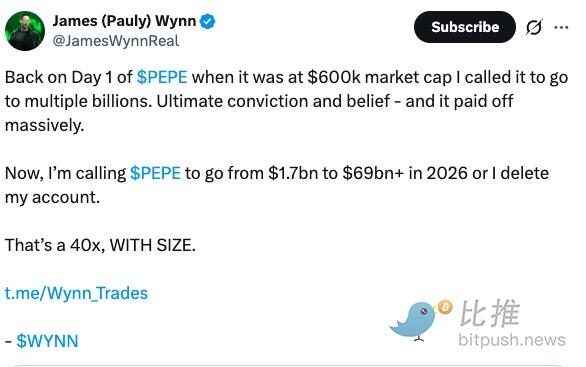
Famous Hyperliquid trader James Wynn released a 2026 prediction, stating that PEPE's market capitalization could surge from the current $2 billion to $69 billion, comparing it to SHIB from the last cycle (which surged from $3.5 billion to $41 billion). Wynn's "delete my account if it fails" vow greatly stirred community sentiment.
Can It Last? Analysts: It's a Signal, But Not the Answer Yet

Although meme coins performed well, the market remains restrained from a higher time dimension.

CryptoQuant charts show that the "dominance" of meme coins in the altcoin market is still near the low levels seen since 2022, with no trend of increase. This means retail speculation heat has not yet systematically returned.
Jake Kennis (Senior Research Analyst at Nansen) pointed out:

"This rotation of年初资金 into large meme coins is more like a position adjustment after a long period of consolidation. To confirm a trend性上涨, structural confirmation is needed on higher time frames."

Kennis also emphasized that PEPE and DOGE are still down about 80% from their all-time highs, and the current rebound is more of a technical repair.

Institutional views are generally cautiously optimistic.

Neil Staunton (CEO of Superset) believes there is speculative anticipation in the market for a potential memecoin ETF in 2026:

"Even just the discussion of an ETF itself is enough to create a narrative at the psychological level: 'If it might be packaged by institutions, does that mean it's an investable asset?'"

However, he also noted that such expectations affect sentiment and valuation anchors more than they determine long-term trends.

Some analysts also warn that historically, memes have often been the fastest-rising but also the earliest-falling sector. If Bitcoin cannot maintain its structural strength, the rally in risk assets could quickly cool down.

综合盘面表现、链上数据与分析师观点来看,本轮 meme 币领涨释放的核心信号并非“牛市已来”,而是:

The market may be moving out of the extremely pessimistic phase and starting to take on risk again.

The rebound in meme coins is more like an early test of returning risk appetite. What ultimately determines how far the行情 can go is still Bitcoin's trend performance, sustained improvement in liquidity, and broader sector rotation. Until these conditions are clear, memes remain just a signal, not the answer.

Author: Seed.eth


Twitter:https://twitter.com/BitpushNewsCN

Bitpush TG Discussion Group:https://t.me/BitPushCommunity

Bitpush TG Subscription: https://t.me/bitpush

Original link:https://www.bitpush.news/articles/7599770

Preguntas relacionadas

QWhat was the performance of meme coins like PEPE and DOGE on January 2, 2026, according to the article?

AOn January 2, 2026, PEPE surged by more than 30% at one point during the trading session, while DOGE and other established meme coins also rebounded, driving a noticeable improvement in market risk appetite.

QAccording to the article, what role do meme coins typically play in the cryptocurrency market?

AMeme coins typically act as a 'high-volatility option' or a risk 'thermometer' in the cryptocurrency market. They have strong price leverage per unit of capital, are driven more by sentiment and traffic, and can form trends without requiring fundamental improvements.

QWhat seasonal factor is mentioned as amplifying short-term buying pressure for meme coins at the start of 2026?

AThe article mentions the 'year-start effect' and tax factors as amplifying short-term buying pressure. At the beginning of the new tax year in North America, investors who remained bullish quickly replenished their positions. Meme coins, due to their deep declines, decent liquidity, and high volatility, became a priority choice.

QWhat did analyst Jake Kennis from Nansen suggest about the meme coin rally?

AJake Kennis, a senior research analyst at Nansen, suggested that the rotation of funds into large meme coins at the start of the year was more like a position adjustment after a long period of consolidation. To confirm a trend-based rise, structural confirmation is needed on higher time frames. He also noted that PEPE and DOGE were still down about 80% from their all-time highs, indicating the current rebound is more of a technical repair.

QWhat is the core signal that the meme coin surge releases, according to the article's conclusion?

AThe core signal released by the meme coin surge is not that 'the bull market has arrived,' but that the market may be moving out of an extremely pessimistic phase and beginning to take on risk again. It is an early test of returning risk appetite. The ultimate factors determining how far the行情 can go are still Bitcoin's trend performance, sustained improvement in liquidity, and broader sector rotation.

Lecturas Relacionadas

In-Depth Report on the On-Chain Lending Market: When Off-Chain Credit Meets On-Chain Liquidation

The on-chain lending market has evolved from a peripheral DeFi niche into core financial infrastructure. As of early 2026, total value locked (TVL) in on-chain lending protocols has reached $64.3 billion, accounting for 53.54% of total DeFi TVL, making it the largest and most mature vertical within decentralized finance. Aave dominates the sector with approximately $32.9 billion in TVL, commanding nearly half of the market—a leadership position that is unlikely to be challenged in the foreseeable future. However, the path of on-chain lending forward is not without risk. Liquidation cascades, credit defaults, and cross-chain vulnerabilities remain systemic threats hanging over the industry. At the same time, a deeper structural transformation is underway: on-chain lending is shifting from a “leverage tool for crypto-native users” to a “compliant gateway for institutional capital”. The scale of RWA (Real World Asset) lending has surpassed $18.5 billion, with U.S. Treasuries and government securities increasingly serving as core collateral. Institutional capital inflows are reshaping both the user base and risk appetite of the sector. This report systematically analyzes the evolution of on-chain lending definitions, competitive dynamics, core risks, and future trends, providing a comprehensive industry outlook for investors and trade practitioners. Key findings suggest that the “one dominant player with several strong challengers” structure will persist in the short term, while fixed-rate lending, compliant collateral, and institutional credit underwriting will define the next phase of competition. For investors focused on DeFi infrastructure, three key opportunity tracks stand out, namely, the Aave ecosystem (Morpho, Spark), RWA lending protocols (Ondo, Maple) and fixed-rate innovation (Notional, Pendle).

HTX LearnHace 33 min(s)

In-Depth Report on the On-Chain Lending Market: When Off-Chain Credit Meets On-Chain Liquidation

HTX LearnHace 33 min(s)

Fu Peng's First Public Speech in 2026: What Exactly Are Crypto Assets? Why Did I Join the Crypto Asset Industry?

Fu Peng, a renowned macroeconomist and now Chief Economist at New火 Group, delivered his first public speech of 2026 at the Hong Kong Web3 Festival. He explained his perspective on crypto assets and why he joined the industry, framing it within the context of macroeconomic trends and financial evolution. Fu emphasized that crypto assets are transitioning from an early, belief-driven phase to a mature, institutionally integrated asset class. He drew parallels to the 1970s-80s, when technological advances (like computing) revolutionized traditional finance, leading to the rise of FICC (Fixed Income, Currencies, and Commodities). Similarly, current advancements in AI, data, and blockchain are reshaping finance, with crypto assets becoming part of a new "FICC + C" (C for Crypto) framework. He noted that institutional capital, including traditional hedge funds, avoided early crypto due to its speculative nature but are now engaging as regulatory clarity emerges (e.g., stablecoin laws, CFTC classifying crypto as a commodity). Fu predicted that 2025-2026 marks a turning point where crypto becomes a standardized, financially viable asset for diversified portfolios, akin to commodities or derivatives in traditional finance. Fu defined Bitcoin not as "digital gold" in a simplistic sense but as a value-preserving, financially tradable asset. He highlighted that crypto's future lies in regulated, institutional adoption, moving away from retail-dominated trading. His entry into crypto signals this maturation, where traditional finance integrates crypto into mainstream asset management.

marsbitHace 1 hora(s)

Fu Peng's First Public Speech in 2026: What Exactly Are Crypto Assets? Why Did I Join the Crypto Asset Industry?

marsbitHace 1 hora(s)

Justin Sun Sues Trump Family: What $75 Million Bought Was Only a Blacklist

Justin Sun, founder of Tron, has filed a lawsuit in federal court against World Liberty Financial (WLF), alleging he was made the "primary target of a fraudulent scheme" after investing $75 million. Sun claims the investment secured him an advisor title and WLFI tokens, which were later frozen by WLF, causing "hundreds of millions in losses." The dispute began in late 2024 when Sun's investment helped revive WLF's struggling token sale, which ultimately raised $550 million. Shortly after, the SEC dropped its lawsuit against Sun following Donald Trump's inauguration. However, relations soured when Sun refused WLF's demands for additional funding. In August 2025, WLF added a "blacklist" function to its smart contract, allowing it to unilaterally freeze tokens. Sun's holdings, worth approximately $107 million, were frozen, and he was threatened with token destruction. The lawsuit highlights WLF's structure, which directs 75% of token sale profits to the Trump family, who had earned $1 billion by December 2025. WLF's CEO is Zach Witkoff, son of U.S. Middle East envoy Steve Witkoff. The project faces scrutiny for opaque operations, including a controversial loan arrangement on the Dolomite platform, co-founded by a WLF advisor. Despite Sun's history with the SEC, the case underscores centralization risks within DeFi, as WLF controls governance and holds powers to freeze assets arbitrarily. Sun's tokens remain frozen as legal proceedings begin.

marsbitHace 1 hora(s)

Justin Sun Sues Trump Family: What $75 Million Bought Was Only a Blacklist

marsbitHace 1 hora(s)

Trading

Spot
Futuros

Artículos destacados

Qué es MEME 2.0

Memecoin 2.0: El Ascenso de $MEME 2.0 en el Mundo de las Criptomonedas Introducción En el panorama siempre cambiante de las criptomonedas, ha surgido un nuevo contendiente. Memecoin 2.0, simbolizada como $MEME 2.0, lleva el concepto de las monedas meme a un emocionante nuevo nivel. Como un subproducto del Memecoin original, este proyecto ha capturado la atención de la comunidad cripto al cambiar el enfoque de los incentivos financieros típicos a una experiencia comprometida y entretenida. Operando en la blockchain de Ethereum, Memecoin 2.0 redefine audazmente la participación de la comunidad en la esfera cripto. ¿Qué es Memecoin 2.0, $MEME 2.0? En su núcleo, Memecoin 2.0 es un proyecto de criptomoneda que prioriza el espíritu comunitario y la diversión asociada con la cultura meme. A diferencia de las criptomonedas convencionales, que se concentran en casos de uso prácticos y beneficios tangibles, Memecoin 2.0 se distingue al abrazar el lado más liviano de la moneda digital. El proyecto existe sin promesas de utilidad, un mapa estructurado o retornos financieros, enfocándose en cambio en fomentar una comunidad vibrante centrada en memes y en el disfrute compartido. Al hacerlo, aprovecha la creciente tendencia de la cultura meme en el espacio en línea, convirtiéndose en un jugador único en el mundo de los activos digitales. Creador de Memecoin 2.0, $MEME 2.0 A pesar de la extensa investigación sobre los orígenes de Memecoin 2.0, la identidad explícita de su creador sigue siendo desconocida. Esta anonimidad no es inusual en la comunidad cripto, donde muchos proyectos son liderados por individuos o grupos que prefieren permanecer en las sombras. La falta de información disponible públicamente sobre el creador podría verse como un movimiento estratégico, poniendo el foco en la participación comunitaria en lugar de la notoriedad individual dentro del espacio. Inversores de Memecoin 2.0, $MEME 2.0 La información sobre los inversores o el respaldo financiero de Memecoin 2.0 es escasa. Esta ausencia de detalles puede sugerir que el proyecto es autofinanciado o que su enfoque en la comunidad en lugar de las estructuras de inversión tradicionales ha atraído a un tipo diferente de apoyo. Dado que el mundo de las monedas meme generalmente involucra una participación más de base en lugar de inversión institucional, este enfoque está alineado con la ética de los proyectos impulsados por la comunidad. ¿Cómo Funciona Memecoin 2.0, $MEME 2.0? Memecoin 2.0 opera completamente en la blockchain de Ethereum, capitalizando sus robustas características de seguridad y escalabilidad. Al aprovechar las fortalezas de Ethereum, Memecoin 2.0 puede ofrecer un entorno seguro para las interacciones de los usuarios, asegurando que las transacciones sean tanto eficientes como rentables. Uno de los atributos únicos de Memecoin 2.0 radica en su estructura impulsada por la comunidad. El valor y la popularidad del token $MEME 2.0 derivan de la participación activa de sus usuarios, en vez de de una utilidad inherente. Este diseño refuerza el enfoque del proyecto en el aspecto de entretenimiento de las criptomonedas, lo que implica que la risa y la participación comunitaria son las verdaderas monedas que impulsan su éxito. Además, el proyecto encaja dentro del ecosistema más amplio de las monedas meme, donde el valor de cada moneda meme oscila basado en la cultura, tendencias y la participación de la comunidad, en lugar de principios económicos tradicionales. Cronología de Memecoin 2.0, $MEME 2.0 Para entender mejor la evolución y los hitos de Memecoin 2.0, aquí hay una cronología que destaca eventos significativos en su historia: 2024: Se reconoce la creación de Memecoin 2.0 como una ramificación del Memecoin original, estableciéndose dentro del contexto próspero de las monedas meme mientras opera en la blockchain de Ethereum. 13 de julio de 2024: Memecoin 2.0 se posiciona oficialmente como una moneda meme centrada en la comunidad en la red de Ethereum, enfatizando su enfoque centrado en el entretenimiento que invita a los usuarios a participar y crecer. Puntos Clave Sobre Memecoin 2.0, $MEME 2.0 Varios rasgos críticos definen a Memecoin 2.0: Enfoque Centrado en la Comunidad: La misión principal de Memecoin 2.0 es crear una experiencia comunitaria divertida y atractiva, capitalizando en el disfrute colectivo derivado de la cultura memética. Construido sobre Ethereum: Operar en la blockchain de Ethereum proporciona al proyecto una infraestructura esencial que garantiza seguridad y escalabilidad. Falta de Utilidad o Hoja de Ruta: En un notable desvío de las criptomonedas tradicionales, Memecoin 2.0 no promete características utilitarias ni retornos financieros, reafirmando su compromiso con la participación comunitaria y el compromiso social. Enfoque en la Cultura Memética: Al abrazar los aspectos humorísticos y culturales del fenómeno meme, Memecoin 2.0 proporciona una plataforma para que los usuarios interactúen con cripto tanto fuera de línea como en línea. Contexto Adicional: La Importancia de las Monedas Meme Las monedas meme han surgido como una clase distinta de criptomonedas, a menudo impulsadas por el humor y un enfoque desenfadado para el comercio. Estas monedas generalmente carecen de una utilidad significativa o hojas de ruta de desarrollo, atrayendo a los usuarios con la promesa de diversión, interacción comunitaria y relevancia cultural. En el panorama del ecosistema cripto más amplio, las monedas meme reviven la importancia de la participación comunitaria, revirtiendo enfoques únicamente motivados por el lucro. Proyectos como Memecoin 2.0 inauguran una era donde el entretenimiento puede armonizar con las aspiraciones financieras, convirtiendo la blockchain en un parque de diversiones para la creatividad y la interacción social. Conclusión Memecoin 2.0, o $MEME 2.0, encarna una nueva ola de criptomonedas que prioriza la participación comunitaria sobre estructuras financieras rígidas. Con un enfoque en el humor y la interacción social, capitaliza sobre la fascinación que rodea la cultura meme. Al operar en la blockchain de Ethereum, Memecoin 2.0 aprovecha las capacidades de la tecnología mientras se mantiene firme en su compromiso con el valor de entretenimiento de la moneda digital. A medida que el espacio alrededor de las criptomonedas continúa evolucionando, Memecoin 2.0 sirve como un testimonio de la noción de que el futuro de los activos digitales podría depender, en gran medida, de experiencias compartidas, risas y sólidas conexiones comunitarias. En el mundo impredecible de las criptomonedas, quizás la alegría pueda ser tan valiosa como la ganancia financiera tradicional.

95 Vistas totalesPublicado en 2024.04.04Actualizado en 2024.12.03

Qué es MEME 2.0

Cómo comprar MEME

¡Bienvenido a HTX.com! Hemos hecho que comprar Memeland (MEME) sea simple y conveniente. Sigue nuestra guía paso a paso para iniciar tu viaje de criptos.Paso 1: crea tu cuenta HTXUtiliza tu correo electrónico o número de teléfono para registrarte y obtener una cuenta gratuita en HTX. Experimenta un proceso de registro sin complicaciones y desbloquea todas las funciones.Obtener mi cuentaPaso 2: ve a Comprar cripto y elige tu método de pagoTarjeta de crédito/débito: usa tu Visa o Mastercard para comprar Memeland (MEME) al instante.Saldo: utiliza fondos del saldo de tu cuenta HTX para tradear sin problemas.Terceros: hemos agregado métodos de pago populares como Google Pay y Apple Pay para mejorar la comodidad.P2P: tradear directamente con otros usuarios en HTX.Over-the-Counter (OTC): ofrecemos servicios personalizados y tipos de cambio competitivos para los traders.Paso 3: guarda tu Memeland (MEME)Después de comprar tu Memeland (MEME), guárdalo en tu cuenta HTX. Alternativamente, puedes enviarlo a otro lugar mediante transferencia blockchain o utilizarlo para tradear otras criptomonedas.Paso 4: tradear Memeland (MEME)Tradear fácilmente con Memeland (MEME) en HTX's mercado spot. Simplemente accede a tu cuenta, selecciona tu par de trading, ejecuta tus trades y monitorea en tiempo real. Ofrecemos una experiencia fácil de usar tanto para principiantes como para traders experimentados.

178 Vistas totalesPublicado en 2024.12.12Actualizado en 2025.03.21

Cómo comprar MEME

Discusiones

Bienvenido a la comunidad de HTX. Aquí puedes mantenerte informado sobre los últimos desarrollos de la plataforma y acceder a análisis profesionales del mercado. A continuación se presentan las opiniones de los usuarios sobre el precio de MEME (MEME).

活动图片