Meme Cultivation Manual: Reborn as a Diamond Hand (Part 4) | Produced by Nan Zhi

marsbitPublicado a 2026-01-04Actualizado a 2026-01-04

Resumen

"Meme Cultivation Guide: Reborn as a Diamond Hand (Part 4)" by Nan Zhi updates the progress of a meme coin copy-trading experiment on Solana. After implementing a depth evaluation system, Copy 1 and 2 accounts showed improved stability, providing steady returns, while Copy 6 saw a nearly 5x gain in a week (though this was partly due to an unexpected profit event from a split account strategy). As of November 4, the author details various copy-trading strategies: Accounts 1 and 2 follow low-frequency, high-profit-ratio "diamond hand" addresses; Account 5 follows an extremely low-frequency, high-risk address; and test accounts 1-6 track promising but unstable addresses with very small amounts to avoid significant losses. The depth evaluation system was upgraded with two new modules: a "copy-trading effect test" (calculating profit per initial trade round) and an "internal market performance evaluation" (assessing performance on Pump.fun to identify potential scam risks or poor internal trading skill). The author cautions that the system is still in early stages (28 days of operation) and lacks sufficient data for rigorous conclusions. Future plans include further system refinements to improve the copy-trading strategy.

Original | Odaily Planet Daily (@OdailyChina)

Author | Nan Zhi (@Assassin_Malvo)

Last week, after introducing the in-depth evaluation system, the stability of Copy Trading Accounts 1 and 2 significantly improved, beginning to provide sustained funding support for other test accounts. Furthermore, Copy Trading Account 6 achieved a nearly 5x increase in one week.

In this installment, the author will update the progress of each wallet, display the copy trading address tracking charts, and detail the upgrades to the in-depth evaluation system along with future plans.

Risk Warning: This system was launched on October 8th and has only been running for 28 days. While it has achieved certain results, objectively speaking, the data volume and controlled experiments are insufficient, and the rigor is limited. This is for readers' information only.

Funding Progress and Strategy Showcase

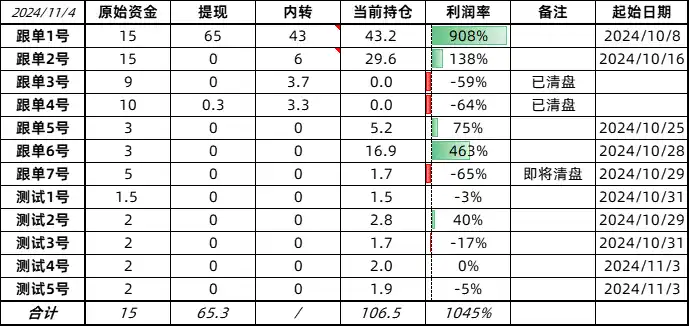
The funding status of each address as of November 4th, 17:30 (UTC+8) is shown below. The profit potential and growth curve vary significantly across accounts based on the style and strategy of the copied target. Notably, Copy Trading Account 6 achieved a nearly fivefold gain in one week under specific circumstances. For details, please refer to the next subsection.

This section will further elaborate on the specific copy trading strategies, showcasing the author's thought process.
The details of the tracked copy trading targets are shown in the figure below:

  • The left column is the strategy column, with different settings based on the wallet's profitability, purchase frequency, and on-premises market (Pump.fun) profitability.
  • The middle section shows the practical results and preliminary evaluation system labels.
  • The right column shows labels based on the In-depth Evaluation System I, with the label categories as shown in the legend in the top right corner.

(Note: The rationale for the left column settings is detailed in "Diamond Hands, High Profit Ratio? What are the Winning Factors in Solana Meme Trading?" and "Meme Cultivation Manual: Reborn as a Diamond Hand (Part 2)". The right column is detailed in "Meme Cultivation Manual: Reborn as a Diamond Hand (Part 3)".)
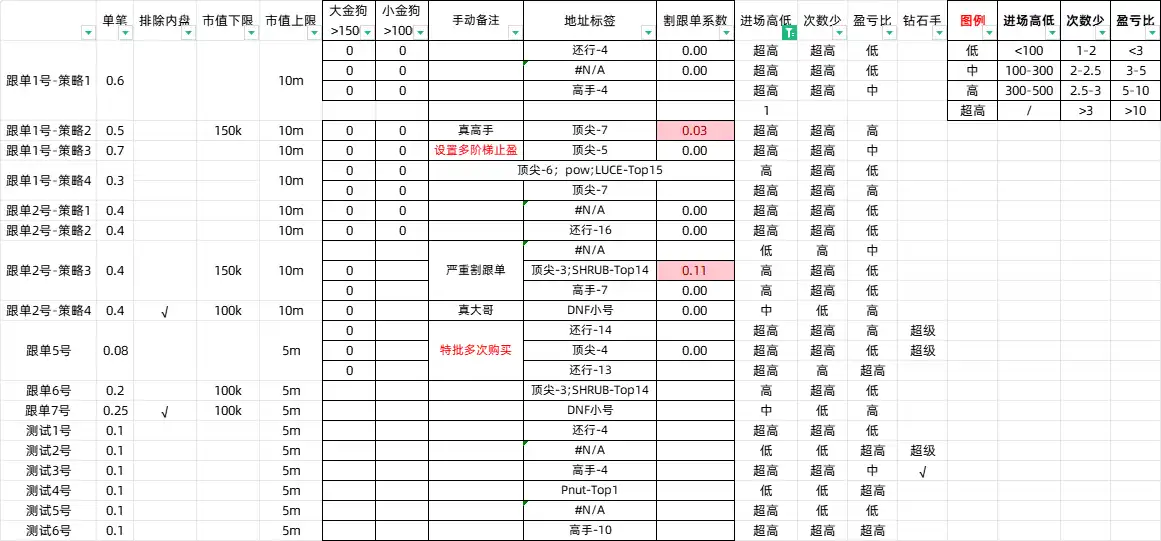
Copy Trading Strategy Overview

  • Copy Trading Accounts 1 and 2 are addresses selected early on for their low frequency, high profit ratio, and diamond hand behavior. Furthermore, addresses with high drawdowns were removed based on the guiding principles from Part 3. The results so far are acceptable: Account 1's profit rate increased from 725% to 908% in 6 days, and Account 2's increased from 84% to 138%.
  • Copy Trading Account 5 is an extremely low-frequency (only 11 buy operations to date), high profit ratio, extreme diamond hand address. Because these addresses have historically successfully added positions at highs multiple times, they are the only addresses for which multiple purchases are enabled, and the single purchase amount has been reduced. However, due to the limited total number of transactions, no conclusions can yet be drawn regarding their impact on the system's profitability.
  • Before the split, Wallet B (i.e., Account 7) purchased a certain token. Wallet B performed numerous profit-taking operations on this token, but after the split, Wallet B's operations were no longer copied. This resulted in unexpected gains and profits (accounting for about 50% of Account 6's total profit). Therefore, although Account 6 achieved a fivefold gain in a week, Accounts 6 and 7 should actually be combined with Account 2 for comparison. The combined weekly growth was 10.6 SOL (a 132.5% increase), still showing a certain advantage compared to Account 2's growth of 8.1 SOL.
  • Test Accounts 1-6 are used to test addresses that have outstanding strengths but lack stability. They use ultra-small amounts to test their long-term purchasing ability. If an account gets liquidated (goes to zero), it is cleared and marked as unsuitable for copy trading.

Version Iteration

In-depth Evaluation System (I)

In Part 3, the author introduced the In-depth Evaluation System (I) to further analyze an address's ability to "buy at the bottom," the risk of losing money by "FOMOing at highs," the ability to achieve high returns with small capital, stop-loss style, and the degree of "diamond hands."

Last week, the system was further enhanced with two new sub-modules: "Copy Trading Effect Test" and "On-Premises (Pump.fun) Performance Evaluation." The complete evaluation results of the system are shown in the figure below.

The "Copy Trading Effect Test" is currently still relatively rudimentary. Its calculation method is: Total profit provided by GMGN ÷ Number of first-round transactions. The converted profit for each token is then summed to obtain the "Converted Profit" for each address.

(Number of first-round transactions = the number of transactions from the first buy to the first sell, sourced from GMGN - Address Data - Token Transaction Details. Transferring tokens is also considered a sell.)

The reason for adopting this calculation method is that the copy trading system mostly only copies the buy action once, so it's necessary to evaluate the profit change under this style. A small decrease or even an increase in the converted profit is the ideal scenario. This ideal scenario occurs because the high-profit tokens of the copied target are a result of "buying once after identifying an opportunity," while the high-loss tokens are caused by "multiple additions to the position."

The calculation method for the "On-Premises Performance Evaluation" is also currently quite straightforward. First, it statistics whether the token was purchased on the Pump.fun on-premises market. Then, the win rate and multiple are calculated based on the token's total profit and total cost. The purpose of this data is to evaluate whether to copy on-premises trades. If a situation arises where "on-premises participation rate" is too high + "on-premises win rate" is high + "on-premises multiple" is too low, then this address carries the risk of cutting (scamming) copy traders. In cases where the win rate is low and the profit ratio is not high, it indicates poor on-premises trading skills, and their on-premises trades should not be copied.

Future Outlook

The copy trading system still has many areas that need improvement. Those currently planned include:


Criptos en tendencia

Preguntas relacionadas

QWhat is the main topic of the article 'Meme修炼手册:重生之我要做钻石手(四)'?

AThe article provides an update on the progress of a copy-trading system for Solana Meme coins, detailing the performance of various copy-trading wallets, the upgrades to a deep evaluation system, and future plans.

QWhich copy-trading wallet achieved a nearly 5x increase in one week according to the article?

ACopy-trading Wallet No. 6 achieved a nearly 5x increase in one week.

QWhat new sub-modules were added to the Deep Evaluation System (一) in the past week?

ATwo new sub-modules were added: 'Copy-trading Effect Test' and 'Internal Market Performance Evaluation'.

QWhat is the purpose of the 'Internal Market Performance Evaluation' sub-module?

AIts purpose is to assess whether to follow an address's trades on internal markets (Pump fun) by evaluating their win rate and profit multiple there, helping to identify addresses that might be 'cutting off' copy-traders or have poor trading skills in that specific environment.

QWhat is the calculated metric for the 'Copy-trading Effect Test' sub-module?

AThe metric is 'Converted Profit', calculated as the total profit provided by GMGN divided by the number of first-round transactions (from first buy to first sell, where transferring tokens also counts as a sale), with the converted profit for each token then summed up.

Lecturas Relacionadas

In Conversation with Ray Dalio: We Are Currently in an AI Bubble, with 1% of My Portfolio in Bitcoin

Ray Dalio, founder of Bridgewater Associates, warns in an interview that the current AI boom shows classic bubble characteristics, which could lead to significant economic downturns as seen in past cycles like 1929 or 2000. He explains that speculative enthusiasm, fueled by debt and overvaluation, often precedes a crash when rising rates or taxation force asset sales, causing widespread losses and recession. Dalio also outlines his "Big Cycle" theory, describing an approximate 80-year pattern where widening wealth gaps, massive government deficits, and shifting geopolitical power (like China's rise) create internal conflict and global instability. He emphasizes that we are in a late-cycle, transitional phase where traditional powers like the US and UK face decline. For personal wealth protection, Dalio advises diversification beyond cash into assets like stocks, bonds, real estate, and particularly gold, which he prefers over Bitcoin. While he holds about 1% of his portfolio in Bitcoin as a non-printable hard asset, he views gold as more secure from technological or governmental threats. Regarding AI's impact, Dalio believes it will disproportionately benefit capital owners, worsening inequality by replacing both physical and cognitive labor. He suggests that human intuition and emotional intelligence, combined with AI, will be key for future workers. On taxation, Dalio argues that wealth taxes are impractical and risk triggering asset sell-offs, reducing productive investment. He points to the UK as a cautionary example of debt, low productivity, and political strife. Geopolitically, Dalio foresees a more regionalized world, with the US showing weakness in prolonged conflicts like with Iran, akin to past imperial declines. The ideal outcome, he suggests, is coexisting powerful blocs (e.g., Americas, China-Asia Pacific) without major war.

marsbitHace 3 hora(s)

In Conversation with Ray Dalio: We Are Currently in an AI Bubble, with 1% of My Portfolio in Bitcoin

marsbitHace 3 hora(s)

Daily 7.2 Trillion KRW: Foreign Capital's Record Net Buying on Friday! Wall Street Says Headwinds for Korean Stock Fund Flows Have Subsided

South Korean stock market sees a dramatic shift in fund flows. On July 31, foreign investors made a record net purchase of approximately KRW 7.2 trillion in KOSPI stocks, marking a fundamental reversal from the persistent large-scale net outflows seen in previous months. This contributed to a significant narrowing of foreign net selling in July to KRW 9.8 trillion, down sharply from KRW 48.4 trillion in June and KRW 44.5 trillion in May. Simultaneously, domestic institutional pressure eased. South Korean pension funds and asset managers turned to a net buying position in July, purchasing KRW 1.0 trillion worth of KOSPI shares, contrasting with net sales in May and June. Market volatility is expected to be dampened by new financial regulations. Effective July 31, the Financial Services Commission tightened access for retail investors to single-stock leveraged ETFs by raising the minimum cash deposit requirement. Trading volumes for these products subsequently dropped to about 50% of their monthly average. Citigroup Research maintains its year-end KOSPI target of 10,000 points. The firm cites several supportive factors: the substantial easing of headwinds from capital outflows, a robust fundamental outlook for the semiconductor sector, historically low market valuations, strong economic fundamentals, and the potential for policy support from financial authorities if needed.

marsbitHace 3 hora(s)

Daily 7.2 Trillion KRW: Foreign Capital's Record Net Buying on Friday! Wall Street Says Headwinds for Korean Stock Fund Flows Have Subsided

marsbitHace 3 hora(s)

Thanks to Dice Rolls, Bitcoin Keys Are Stored Offline, But Not Everyone Will Do It

The article discusses using dice rolls to generate secure Bitcoin wallet seeds, providing entropy independent of potentially flawed hardware random number generators. It explains that each fair dice roll offers about 2.585 bits of entropy, with around 50 rolls needed for a standard 12-word seed phrase and 99+ recommended for higher security. This method gained attention after a vulnerability was revealed in some Coldcard hardware wallets, where a faulty firmware RNG (dating back to 2021) compromised generated keys. The analysis notes that while a dice-generated main seed was safe from this specific flaw, other Coldcard functions (like creating paper wallets, backup keys, or passwords) could still be vulnerable if they used the defective RNG. The piece argues that while dice-based entropy is technically robust, the manual process is error-prone, tedious, and unrealistic for most new users, who might make mistakes in recording or inputting rolls. It concludes that while manual entropy generation should remain an option for advanced users, the long-term goal is to develop reliable, user-friendly hardware and software that securely generates randomness without requiring specialized knowledge. Coldcard users are advised to check their firmware version and replace any secondary secrets (like paper wallet keys) created with vulnerable devices, while also considering multi-signature setups with devices from different manufacturers for added security.

cryptonews.ruHace 9 hora(s)

Thanks to Dice Rolls, Bitcoin Keys Are Stored Offline, But Not Everyone Will Do It

cryptonews.ruHace 9 hora(s)

Trading

Spot

Artículos destacados

Qué es MEME 2.0

Memecoin 2.0: El Ascenso de $MEME 2.0 en el Mundo de las Criptomonedas Introducción En el panorama siempre cambiante de las criptomonedas, ha surgido un nuevo contendiente. Memecoin 2.0, simbolizada como $MEME 2.0, lleva el concepto de las monedas meme a un emocionante nuevo nivel. Como un subproducto del Memecoin original, este proyecto ha capturado la atención de la comunidad cripto al cambiar el enfoque de los incentivos financieros típicos a una experiencia comprometida y entretenida. Operando en la blockchain de Ethereum, Memecoin 2.0 redefine audazmente la participación de la comunidad en la esfera cripto. ¿Qué es Memecoin 2.0, $MEME 2.0? En su núcleo, Memecoin 2.0 es un proyecto de criptomoneda que prioriza el espíritu comunitario y la diversión asociada con la cultura meme. A diferencia de las criptomonedas convencionales, que se concentran en casos de uso prácticos y beneficios tangibles, Memecoin 2.0 se distingue al abrazar el lado más liviano de la moneda digital. El proyecto existe sin promesas de utilidad, un mapa estructurado o retornos financieros, enfocándose en cambio en fomentar una comunidad vibrante centrada en memes y en el disfrute compartido. Al hacerlo, aprovecha la creciente tendencia de la cultura meme en el espacio en línea, convirtiéndose en un jugador único en el mundo de los activos digitales. Creador de Memecoin 2.0, $MEME 2.0 A pesar de la extensa investigación sobre los orígenes de Memecoin 2.0, la identidad explícita de su creador sigue siendo desconocida. Esta anonimidad no es inusual en la comunidad cripto, donde muchos proyectos son liderados por individuos o grupos que prefieren permanecer en las sombras. La falta de información disponible públicamente sobre el creador podría verse como un movimiento estratégico, poniendo el foco en la participación comunitaria en lugar de la notoriedad individual dentro del espacio. Inversores de Memecoin 2.0, $MEME 2.0 La información sobre los inversores o el respaldo financiero de Memecoin 2.0 es escasa. Esta ausencia de detalles puede sugerir que el proyecto es autofinanciado o que su enfoque en la comunidad en lugar de las estructuras de inversión tradicionales ha atraído a un tipo diferente de apoyo. Dado que el mundo de las monedas meme generalmente involucra una participación más de base en lugar de inversión institucional, este enfoque está alineado con la ética de los proyectos impulsados por la comunidad. ¿Cómo Funciona Memecoin 2.0, $MEME 2.0? Memecoin 2.0 opera completamente en la blockchain de Ethereum, capitalizando sus robustas características de seguridad y escalabilidad. Al aprovechar las fortalezas de Ethereum, Memecoin 2.0 puede ofrecer un entorno seguro para las interacciones de los usuarios, asegurando que las transacciones sean tanto eficientes como rentables. Uno de los atributos únicos de Memecoin 2.0 radica en su estructura impulsada por la comunidad. El valor y la popularidad del token $MEME 2.0 derivan de la participación activa de sus usuarios, en vez de de una utilidad inherente. Este diseño refuerza el enfoque del proyecto en el aspecto de entretenimiento de las criptomonedas, lo que implica que la risa y la participación comunitaria son las verdaderas monedas que impulsan su éxito. Además, el proyecto encaja dentro del ecosistema más amplio de las monedas meme, donde el valor de cada moneda meme oscila basado en la cultura, tendencias y la participación de la comunidad, en lugar de principios económicos tradicionales. Cronología de Memecoin 2.0, $MEME 2.0 Para entender mejor la evolución y los hitos de Memecoin 2.0, aquí hay una cronología que destaca eventos significativos en su historia: 2024: Se reconoce la creación de Memecoin 2.0 como una ramificación del Memecoin original, estableciéndose dentro del contexto próspero de las monedas meme mientras opera en la blockchain de Ethereum. 13 de julio de 2024: Memecoin 2.0 se posiciona oficialmente como una moneda meme centrada en la comunidad en la red de Ethereum, enfatizando su enfoque centrado en el entretenimiento que invita a los usuarios a participar y crecer. Puntos Clave Sobre Memecoin 2.0, $MEME 2.0 Varios rasgos críticos definen a Memecoin 2.0: Enfoque Centrado en la Comunidad: La misión principal de Memecoin 2.0 es crear una experiencia comunitaria divertida y atractiva, capitalizando en el disfrute colectivo derivado de la cultura memética. Construido sobre Ethereum: Operar en la blockchain de Ethereum proporciona al proyecto una infraestructura esencial que garantiza seguridad y escalabilidad. Falta de Utilidad o Hoja de Ruta: En un notable desvío de las criptomonedas tradicionales, Memecoin 2.0 no promete características utilitarias ni retornos financieros, reafirmando su compromiso con la participación comunitaria y el compromiso social. Enfoque en la Cultura Memética: Al abrazar los aspectos humorísticos y culturales del fenómeno meme, Memecoin 2.0 proporciona una plataforma para que los usuarios interactúen con cripto tanto fuera de línea como en línea. Contexto Adicional: La Importancia de las Monedas Meme Las monedas meme han surgido como una clase distinta de criptomonedas, a menudo impulsadas por el humor y un enfoque desenfadado para el comercio. Estas monedas generalmente carecen de una utilidad significativa o hojas de ruta de desarrollo, atrayendo a los usuarios con la promesa de diversión, interacción comunitaria y relevancia cultural. En el panorama del ecosistema cripto más amplio, las monedas meme reviven la importancia de la participación comunitaria, revirtiendo enfoques únicamente motivados por el lucro. Proyectos como Memecoin 2.0 inauguran una era donde el entretenimiento puede armonizar con las aspiraciones financieras, convirtiendo la blockchain en un parque de diversiones para la creatividad y la interacción social. Conclusión Memecoin 2.0, o $MEME 2.0, encarna una nueva ola de criptomonedas que prioriza la participación comunitaria sobre estructuras financieras rígidas. Con un enfoque en el humor y la interacción social, capitaliza sobre la fascinación que rodea la cultura meme. Al operar en la blockchain de Ethereum, Memecoin 2.0 aprovecha las capacidades de la tecnología mientras se mantiene firme en su compromiso con el valor de entretenimiento de la moneda digital. A medida que el espacio alrededor de las criptomonedas continúa evolucionando, Memecoin 2.0 sirve como un testimonio de la noción de que el futuro de los activos digitales podría depender, en gran medida, de experiencias compartidas, risas y sólidas conexiones comunitarias. En el mundo impredecible de las criptomonedas, quizás la alegría pueda ser tan valiosa como la ganancia financiera tradicional.

153 Vistas totalesPublicado en 2024.04.04Actualizado en 2024.12.03

Qué es MEME 2.0

Cómo comprar MEME

¡Bienvenido a HTX.com! Hemos hecho que comprar Memeland (MEME) sea simple y conveniente. Sigue nuestra guía paso a paso para iniciar tu viaje de criptos.Paso 1: crea tu cuenta HTXUtiliza tu correo electrónico o número de teléfono para registrarte y obtener una cuenta gratuita en HTX. Experimenta un proceso de registro sin complicaciones y desbloquea todas las funciones.Obtener mi cuentaPaso 2: ve a Comprar cripto y elige tu método de pagoTarjeta de crédito/débito: usa tu Visa o Mastercard para comprar Memeland (MEME) al instante.Saldo: utiliza fondos del saldo de tu cuenta HTX para tradear sin problemas.Terceros: hemos agregado métodos de pago populares como Google Pay y Apple Pay para mejorar la comodidad.P2P: tradear directamente con otros usuarios en HTX.Over-the-Counter (OTC): ofrecemos servicios personalizados y tipos de cambio competitivos para los traders.Paso 3: guarda tu Memeland (MEME)Después de comprar tu Memeland (MEME), guárdalo en tu cuenta HTX. Alternativamente, puedes enviarlo a otro lugar mediante transferencia blockchain o utilizarlo para tradear otras criptomonedas.Paso 4: tradear Memeland (MEME)Tradear fácilmente con Memeland (MEME) en HTX's mercado spot. Simplemente accede a tu cuenta, selecciona tu par de trading, ejecuta tus trades y monitorea en tiempo real. Ofrecemos una experiencia fácil de usar tanto para principiantes como para traders experimentados.

268 Vistas totalesPublicado en 2024.12.12Actualizado en 2026.06.02

Cómo comprar MEME

Discusiones

Bienvenido a la comunidad de HTX. Aquí puedes mantenerte informado sobre los últimos desarrollos de la plataforma y acceder a análisis profesionales del mercado. A continuación se presentan las opiniones de los usuarios sobre el precio de MEME (MEME).

活动图片













