Mastercard and Ripple Complete Historic Transaction, New Use Case for XRP?

bitcoinistPublicado a 2026-05-08Actualizado a 2026-05-08

Resumen

Mastercard, Ripple, Ondo Finance, and J.P. Morgan's Kinexys have successfully completed the first near real-time, cross-border, cross-bank redemption of tokenized US Treasuries. The pilot transaction, executed in under five seconds, used the XRP Ledger as the settlement blockchain to connect public blockchain infrastructure directly to traditional global banking rails for the first time. Ripple redeemed a tokenized treasury fund (OUSG) on the XRPL, triggering a fiat payout via Mastercard's Multi-Token Network. J.P. Morgan's Kinexys then processed the payment to Ripple's bank account in Singapore. This integration demonstrates a single, uninterrupted flow between on-chain and off-chain systems, addressing a key gap in the rapidly growing tokenized real-world assets (RWA) market. The development highlights a significant step towards a 24/7 financial system and positions the XRP Ledger as a potential settlement infrastructure for institutional cross-border transactions.

Ondo Finance, Kinexys by J.P. Morgan, Mastercard, and Ripple have jointly completed the first near real-time cross-border, cross-bank redemption of tokenized US Treasuries — with the XRP Ledger serving as the settlement blockchain at the center of a transaction that connected public blockchain infrastructure directly to global banking rails for the first time.

The pilot, announced on May 6, executed in under five seconds — a stark contrast to the one-to-three business day timeframe that cross-border correspondent banking typically requires. It also occurred outside traditional banking hours, underscoring what the participating firms described as a step toward a financial system capable of operating 24 hours a day, seven days a week.
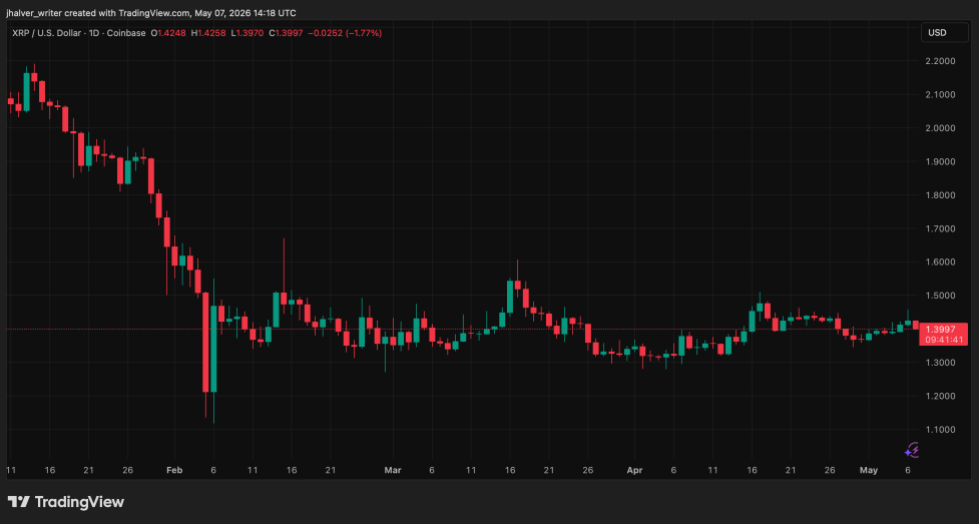
XRP's price trends sideways on the daily chart. Source: XRPUSD on Tradingview

Ripple Gains Relevance with Mastercard Partnership

The mechanics of the pilot reveal how each institution contributed a distinct piece of the settlement architecture. Ripple redeemed a portion of its holdings in OUSG — Ondo Finance’s Short-Term US Government Treasuries fund, a tokenized product available to accredited investors and qualified purchasers — directly on the XRP Ledger. Ondo processed the redemption and triggered a fiat payout instruction through Mastercard’s Multi-Token Network (MTN), a platform designed to enable interoperability between on-chain assets and traditional money movement systems.

From there, Mastercard’s MTN routed the instruction to Kinexys by J.P. Morgan — JPMorgan’s blockchain infrastructure platform, which has now processed more than $3 trillion in cumulative transactions, per figures cited in the announcement.

Kinexys debited Ondo’s Blockchain Deposit Account and delivered US dollar proceeds to Ripple’s bank account in Singapore through its correspondent banking network. One leg of the transaction settled on a public blockchain. The other settled on institutional banking rails. Both happened within the same uninterrupted flow.

What It Signals For The Broader Market

The transaction arrives against a backdrop of rapid growth in tokenized real-world assets. Tokenized US Treasuries crossed the $10 billion mark for the first time on February 11, 2026, according to TheStreet Crypto, and stood at approximately $12.88 billion by early April — a 225% increase over 15 months. The broader tokenized RWA market surged 256.7% from $5.42 billion at the start of 2025 to $19.3 billion by the end of Q1 2026. Despite that growth, redemption infrastructure has lagged, still dependent on wire transfers, manual processes, and fixed banking windows. This pilot addresses that gap directly.

Markus Infanger, SVP of RippleX, noted in the official release that the XRP Ledger enables real-time asset movement and that, when paired with global banking infrastructure, the pilot demonstrates how institutions can execute cross-border transactions as a single integrated flow — rather than a sequence of siloed instructions across separate systems.

The DTCC separately announced earlier this week that it plans to launch its own tokenization service later in 2026 — a signal that the institutional race to build out this infrastructure is accelerating across the industry simultaneously.

This development marks a pivotal moment for the nascent sector and, specifically, for the XRP Ledger’s positioning within institutional finance. Whether the XRPL’s role as settlement infrastructure in this pilot translates into a sustained and expanded use case will depend on how many further cross-border tokenized asset transactions adopt the same architecture — and how quickly the broader regulatory and banking framework catches up to what the technology can already do.

Cover image from Grok, XRPUSD chart on Tradingview

Criptos en tendencia

Preguntas relacionadas

QWhat was the significance of the pilot transaction involving Mastercard and Ripple announced on May 6?

AIt was the first near real-time cross-border, cross-bank redemption of tokenized US Treasuries. The transaction connected public blockchain infrastructure (the XRP Ledger) directly to global banking rails for the first time, settling in under five seconds and outside traditional banking hours.

QWhich institutions were involved in the pilot, and what was the specific role of the XRP Ledger?

AOndo Finance, Kinexys by J.P. Morgan, Mastercard, and Ripple were involved. The XRP Ledger served as the settlement blockchain where Ripple redeemed its tokenized US Treasury holdings (OUSG), enabling the on-chain leg of the integrated transaction.

QWhat problem does this pilot transaction aim to address in the tokenized real-world asset (RWA) market?

AIt addresses the gap in redemption infrastructure, which has lagged behind market growth. Traditional redemptions rely on slow wire transfers, manual processes, and fixed banking windows. This pilot demonstrates a near-instant, 24/7 integrated flow for cross-border redemptions.

QAccording to the article, what key statistic highlights the growth of the tokenized RWA market?

AThe broader tokenized RWA market surged 256.7% from $5.42 billion at the start of 2025 to $19.3 billion by the end of Q1 2026. Specifically, tokenized US Treasuries grew to approximately $12.88 billion by early April 2026, a 225% increase over 15 months.

QWhat broader industry trend does the DTCC's separate announcement about launching a tokenization service signal?

AIt signals that the institutional race to build out tokenization and related settlement infrastructure is accelerating across the financial industry simultaneously, highlighting the growing importance and adoption of this technology.

Lecturas Relacionadas

The Verdict in Choi Tae-won's Divorce Case: Revealing the Inheritance Undercurrent Behind SK Hynix's Trillion-Won Empire

SK Group Chairman Chey Tae-won's high-profile divorce case, involving a record 1.38 trillion won settlement, has drawn attention to the succession plans for Korea's second-largest conglomerate, especially its crown jewel, SK hynix. Unlike traditional chaebol scripts centered on the eldest son, Chey's three children from his marriage to former President Roh Tae-woo's daughter, Roh Soh-yeong, are carving distinct, non-traditional paths. Eldest daughter Chey Yun-jung (b. 1989) is seen as the most evident successor. With a scientific and consulting background, she holds executive roles at SK bioscience and SK Inc.'s growth support department, focusing on future strategy and biopharma. Her marriage is to an AI infrastructure entrepreneur, not a traditional business alliance. Second daughter Chey Min-jung (b. 1991) took a unique route, voluntarily serving as a South Korean naval officer, including an anti-piracy deployment. She later worked on policy and strategy for SK hynix in Washington D.C. before co-founding an AI-driven healthcare startup. She married a former U.S. Marine Corps officer, connecting her to U.S. defense and policy circles—networks crucial for a global semiconductor giant. The only son, Chey In-geun (b. 1995), who studied physics like his father, worked briefly at SK E&S before joining McKinsey. Despite fitting the traditional "heir" profile as the eldest son, he remains silent and holds no public position or shares in SK, suggesting the old succession playbook is obsolete. As SK hynix's valuation soars, becoming a geopolitical asset in the AI era, the heirs' legitimacy is no longer automatic. They must prove themselves in fields like AI biotech, global policy, and strategic consulting. Their marriages also reflect new elite networks in tech and defense, not old political alliances. Their inheritance is the complex challenge of navigating a globalized, tech-driven world, not just a corporate throne.

marsbitHace 6 hora(s)

The Verdict in Choi Tae-won's Divorce Case: Revealing the Inheritance Undercurrent Behind SK Hynix's Trillion-Won Empire

marsbitHace 6 hora(s)

From OpenSea to OpenRouter: Is Alex Atallah Repeating His 'Exit at the Peak' Playbook?

From OpenSea to OpenRouter: Is Alex Atallah Repeating His "Exit at the Peak" Playbook? According to the Wall Street Journal, payments giant Stripe is in talks to acquire the AI model aggregation platform OpenRouter in a potential deal valuing the company near $100 billion. This would mark founder Alex Atallah's second creation of a company reaching a $100 billion valuation, following his co-founding of NFT marketplace OpenSea. OpenRouter, founded just over three years ago, has grown rapidly by acting as a unified gateway for developers to access over 400 AI models. It currently has about 10 million users and processes over 200 trillion tokens monthly. While the platform's annualized revenue is around $50 million, its valuation has skyrocketed from $1.3 billion in March 2026. The potential acquisition by Stripe, a company OpenRouter's founder once likened it to, represents a major expansion into AI infrastructure for the payments leader. This move echoes Atallah's previous timing with OpenSea, where he departed before the NFT market's significant downturn. For OpenRouter, selling now may be strategic. Despite its scale, its business model—charging a 5-5.5% fee on AI inference calls—faces pressure from competition, open-source models, and potential price wars among model providers, limiting its profitability narrative for an IPO. A key asset for potential acquirers like Stripe is OpenRouter's vast repository of real-world AI usage data, which offers unique insights into model performance and developer preferences that are difficult to replicate. Whether this potential deal signifies a new valuation benchmark for AI infrastructure or another market peak signal remains to be seen.

链捕手Hace 7 hora(s)

From OpenSea to OpenRouter: Is Alex Atallah Repeating His 'Exit at the Peak' Playbook?

链捕手Hace 7 hora(s)

Trading

Spot

Artículos destacados

Qué es XRP 2.0

XRP 2.0: Una Nueva Frontera en el Panorama de las Criptomonedas Introducción a XRP 2.0 En el siempre cambiante ámbito de las criptomonedas, nuevos proyectos surgen continuamente, compitiendo por atención y adopción. Una de estas iniciativas prometedoras es XRP 2.0, un nuevo proyecto de criptomoneda diseñado para aprovechar la tecnología blockchain avanzada y metodologías de encriptación robustas. Aunque el nombre establece paralelismos con el XRP de Ripple, es crucial señalar que XRP 2.0 opera de manera independiente, enfocándose en mejorar la seguridad de las transacciones, la privacidad y la escalabilidad. A medida que el panorama financiero digital abraza cada vez más soluciones descentralizadas, XRP 2.0 busca contribuir de manera significativa a web3 y a la expansión general de los proyectos de criptomonedas. ¿Qué es XRP 2.0? En esencia, XRP 2.0 es un proyecto de criptomoneda que busca crear un ecosistema de moneda digital seguro y descentralizado. Su tecnología fundamental integra principios avanzados de blockchain con técnicas de encriptación de vanguardia. El objetivo principal de XRP 2.0 es establecerse como una plataforma confiable y eficiente que permita la ejecución rápida de transacciones mientras prioriza la protección de la privacidad de sus usuarios. El proyecto se promociona como una solución a muchas limitaciones enfrentadas por las criptomonedas existentes, proponiendo un sistema que puede manejar un mayor volumen de transacciones con mejor velocidad y privacidad. Esta versatilidad posiciona a XRP 2.0 como un competidor significativo en un mercado plagado de diversas monedas digitales. ¿Quién es el Creador de XRP 2.0? La identidad del creador detrás de XRP 2.0 ha sido señalada como 'Wilbur.' Sin embargo, los detalles completos sobre Wilbur o su entidad asociada siguen siendo elusivos. La anonimidad de muchos creadores de criptomonedas no es un fenómeno poco común en la industria, a menudo diseñado para mantener un grado de privacidad y seguridad. ¿Quiénes son los Inversores de XRP 2.0? Hasta ahora, la información específica relacionada con las fundaciones o organizaciones de inversión que apoyan a XRP 2.0 no está disponible públicamente. En el sector de las criptomonedas, el respaldo de inversores respetables puede influir significativamente en la credibilidad y el éxito de un proyecto, sin embargo, la transparencia sobre los patrocinadores financieros de XRP 2.0 no se ha establecido. ¿Cómo Funciona XRP 2.0? XRP 2.0 se destaca al emplear una combinación de tecnología blockchain y algoritmos de encriptación avanzados que aseguran transacciones seguras y descentralizadas. Su estructura innovadora incluye características únicas diseñadas para fomentar el compromiso del usuario y ampliar las funcionalidades más allá de las transacciones convencionales de criptomonedas. Entre estas características, XRP 2.0 incorpora capacidades impulsadas por IA, como funcionalidades de texto a imagen y de texto a voz. Estas adiciones están diseñadas para mejorar la experiencia interactiva de los usuarios, promoviendo una mayor aplicabilidad en diversos sectores. Al unir avances tecnológicos con un diseño centrado en el usuario, XRP 2.0 busca captar la atención de una amplia gama de individuos y empresas que buscan integrar soluciones de criptomonedas en sus marcos operativos. Cronología de XRP 2.0 Entender XRP 2.0 requiere examinar los hitos que han definido su viaje hasta ahora: 23 de julio de 2023: Se presenta XRP 2.0 como un nuevo proyecto de criptomonedas, con el objetivo de revolucionar las capacidades de transacciones seguras y descentralizadas en el ámbito de blockchain. 8 de septiembre de 2023: Se lanza otro proyecto, XRP20, marcando la aparición de un token ERC-20 en la blockchain de Ethereum que no guarda relación con XRP 2.0. 13 de noviembre de 2023: El Libro Mayor de XRP experimenta una actualización significativa con el lanzamiento de la versión 2.0.0 del software del servidor rippled. Es esencial señalar que este desarrollo está desconectado del proyecto de criptomonedas XRP 2.0. Puntos Clave sobre XRP 2.0 Para destilar la esencia de XRP 2.0, surgen varios factores críticos: Características Únicas: La inclusión de características como texto a imagen y texto a voz impulsadas por IA diversifica aún más las aplicaciones potenciales de XRP 2.0. Tecnología Blockchain: El marco utiliza mecanismos avanzados de blockchain y protocolos de encriptación, asegurando un entorno seguro y descentralizado para las transacciones. Escalabilidad y Privacidad: XRP 2.0 prioriza la protección mejorada de la privacidad en los procesos de transacción y la escalabilidad necesaria para acomodar una base de usuarios creciente. No Afiliación con Ripple: Es importante destacar que, a pesar de su nombre, XRP 2.0 no tiene ninguna lealtad ni colaboración con el XRP de Ripple, diferenciando su marco operativo y objetivos dentro del ecosistema de criptomonedas. Conclusión XRP 2.0 representa una ambiciosa aventura en la esfera de las criptomonedas, buscando ofrecer una combinación de seguridad, privacidad y eficiencia en las transacciones digitales. Al integrar tecnologías sofisticadas y características amigables para el usuario, el proyecto se propone ampliar los horizontes de lo que la criptomoneda puede lograr en la economía digital de hoy. Si bien la anonimidad de su creador y la falta de inversores revelados pueden generar cuestionamientos para algunos, el enfoque de XRP 2.0 en funcionalidades avanzadas y descentralización realza su atractivo en un mercado de criptomonedas cada vez más abarrotado. A medida que el paisaje de las criptomonedas sigue evolucionando, XRP 2.0 podría emerger como un jugador crucial en la expansión de soluciones blockchain seguras y escalables.

226 Vistas totalesPublicado en 2024.04.05Actualizado en 2024.12.03

Qué es XRP 2.0

Cómo comprar XRP

¡Bienvenido a HTX.com! Hemos hecho que comprar XRP (XRP) sea simple y conveniente. Sigue nuestra guía paso a paso para iniciar tu viaje de criptos.Paso 1: crea tu cuenta HTXUtiliza tu correo electrónico o número de teléfono para registrarte y obtener una cuenta gratuita en HTX. Experimenta un proceso de registro sin complicaciones y desbloquea todas las funciones.Obtener mi cuentaPaso 2: ve a Comprar cripto y elige tu método de pagoTarjeta de crédito/débito: usa tu Visa o Mastercard para comprar XRP (XRP) al instante.Saldo: utiliza fondos del saldo de tu cuenta HTX para tradear sin problemas.Terceros: hemos agregado métodos de pago populares como Google Pay y Apple Pay para mejorar la comodidad.P2P: tradear directamente con otros usuarios en HTX.Over-the-Counter (OTC): ofrecemos servicios personalizados y tipos de cambio competitivos para los traders.Paso 3: guarda tu XRP (XRP)Después de comprar tu XRP (XRP), guárdalo en tu cuenta HTX. Alternativamente, puedes enviarlo a otro lugar mediante transferencia blockchain o utilizarlo para tradear otras criptomonedas.Paso 4: tradear XRP (XRP)Tradear fácilmente con XRP (XRP) en HTX's mercado spot. Simplemente accede a tu cuenta, selecciona tu par de trading, ejecuta tus trades y monitorea en tiempo real. Ofrecemos una experiencia fácil de usar tanto para principiantes como para traders experimentados.

1.5k Vistas totalesPublicado en 2024.12.10Actualizado en 2026.06.02

Cómo comprar XRP

Discusiones

Bienvenido a la comunidad de HTX. Aquí puedes mantenerte informado sobre los últimos desarrollos de la plataforma y acceder a análisis profesionales del mercado. A continuación se presentan las opiniones de los usuarios sobre el precio de XRP (XRP).

活动图片