Market Plunge, But These Crypto OGs Are Still 'Topping Up Their Faith'

marsbitPublicado a 2026-02-06Actualizado a 2026-02-06

Resumen

Summary: On February 6, Bitcoin plunged 15.48% to $60,000, marking its largest single-day drop since the FTX collapse. The Crypto Fear & Greed Index hit 9, indicating "extreme fear" and a new low since the 2022 bear market. Despite widespread panic, several crypto veterans reaffirmed their conviction. Michael Saylor encouraged buying Bitcoin as a form of support. The founder of Base emphasized long-term commitment to building. Lily Liu, President of the Solana Foundation, argued that blockchain's core purpose is financialization, stressing the importance of protecting liquidity unity. She criticized the "Web3 narrative" as overly simplistic and called for creating new markets rather than relying on speculative narratives. Balaji expressed strong bullishness, stating that "code-based order" is rising as "rules-based order" collapses, making short-term prices irrelevant. He emphasized the need for on-chain companies and internet-native systems. The founder of Helius shared similar optimism, advocating for filtering out "tourists" to improve signal-to-noise ratio in the space. Linda Xie shared her experience of a 75% drawdown in 2018, advising against emotionally-driven decisions and emphasizing holding assets with strong fundamental belief. Crypto influencer神鱼 (Shenyu) succinctly stated: "1 BTC = 1 BTC." Overall, these leaders urge perseverance, focus on fundamentals, and long-term belief in crypto's transformative potential despite market volatility.

Editor's Note: On February 6th, Bitcoin fell to a low of $60,000, plummeting 15.48% in a single day, marking its largest single-day drop since the FTX collapse. At the same time, the Crypto Fear & Greed Index dropped to 9, indicating a state of 'Extreme Fear' in the market, hitting a new low since the 2022 bear market.

However, as pessimism spreads, many veteran Builders and thought leaders in the crypto world are voicing a different perspective. This 'Crypto Faith Topping-Up List' compiles their thoughts and perseverance amidst the storm. Perhaps it can offer you a sliver of solace and direction to move forward during this market winter.

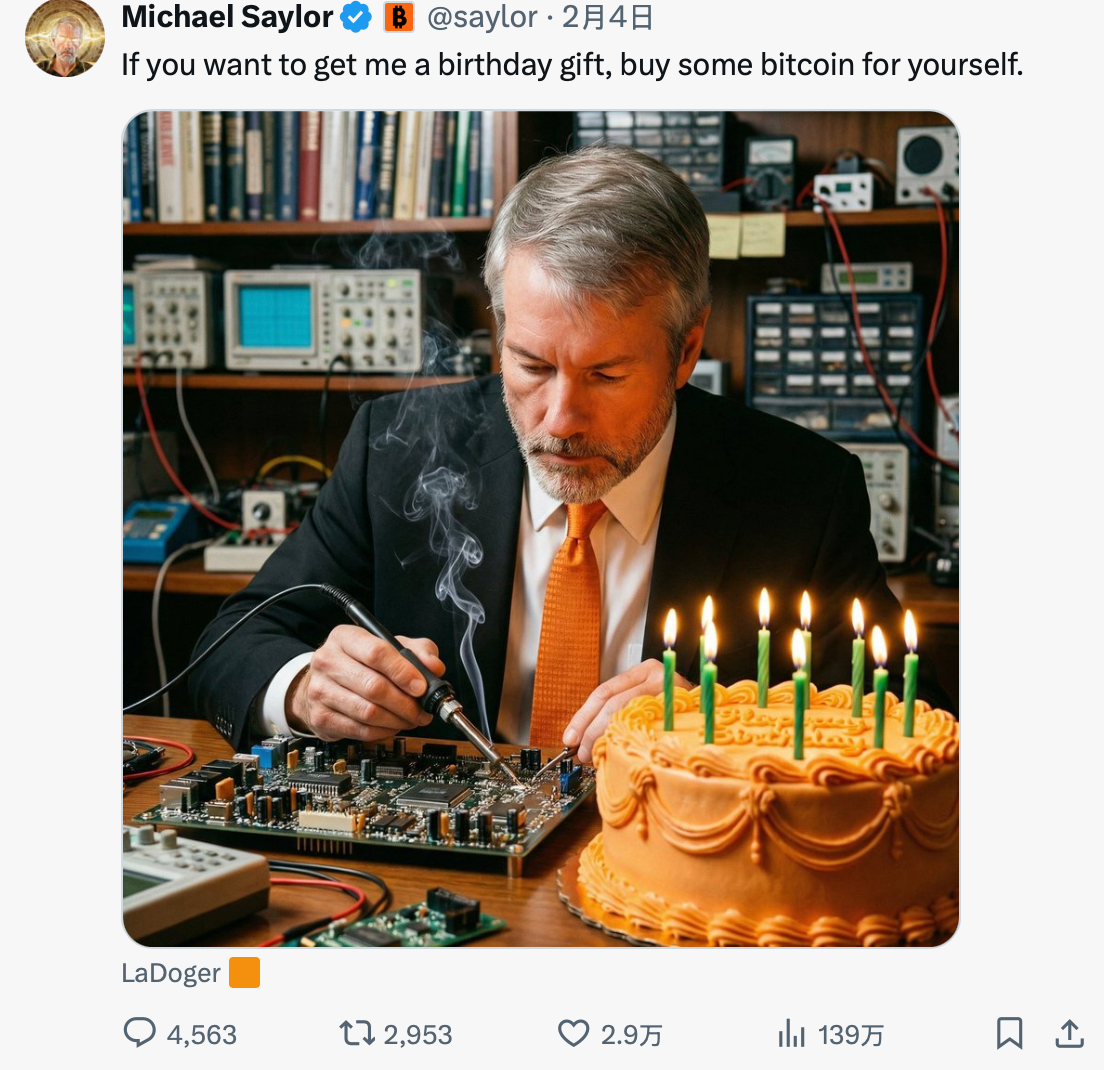
Michael Saylor:

If you want to give me a birthday present, buy yourself some Bitcoin!
Base Founder:

13 years have passed, and I'm not going anywhere.

There's still so much to build.

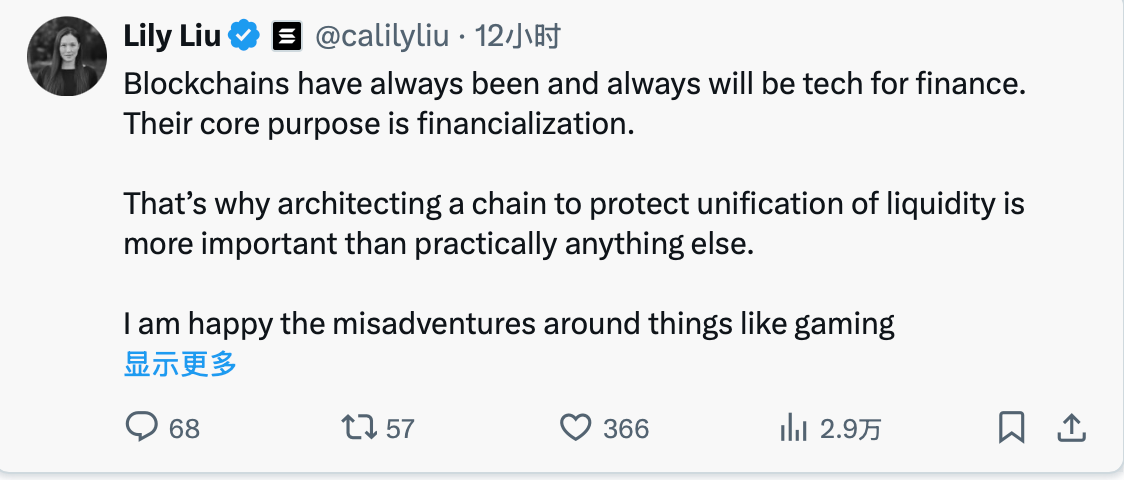
Solana Foundation President LilyLiu:

Blockchain was, is, and always will be financial technology. Their core purpose is financialization.

This is also why, when designing a chain, protecting the unity of liquidity is more important than almost anything else.

I'm glad the misguided focus on things like 'chain games' is finally over.

More broadly, the 'read write own' / 'Web3 narrative' is essentially too skeuomorphic and, to be honest, a bit intellectually lazy. New technology is never as simple as 'put something on-chain, and voilà—everything changes'; you must truly create new markets.

The old narrative was more of a fig leaf, used to justify VCs pouring money into various unnecessary infrastructures, hoping to create a private asset that could become 'magic internet money.'

The more projects try to attract prices through narrative packaging and take a share of the liquidity from the 'wild west' of the internet, the harder the 'narrative justification machine' has to work, shaping everything into the 'great third wave of applications'—'everything you do today can now earn you money.'

The reality is, the opportunities are indeed huge, far beyond what even our most creative minds can imagine, but not in the way they've been described over the past few years.

The blockchain journey has always been about finance: providing open financial infrastructure for anyone and everyone on the internet.

This enables capital formation and internet innovation to happen anywhere in the world, allowing the resulting innovation and progress to truly take root. Open finance brings greater economic freedom, and economic freedom brings individual sovereignty and autonomy.
Balaji:

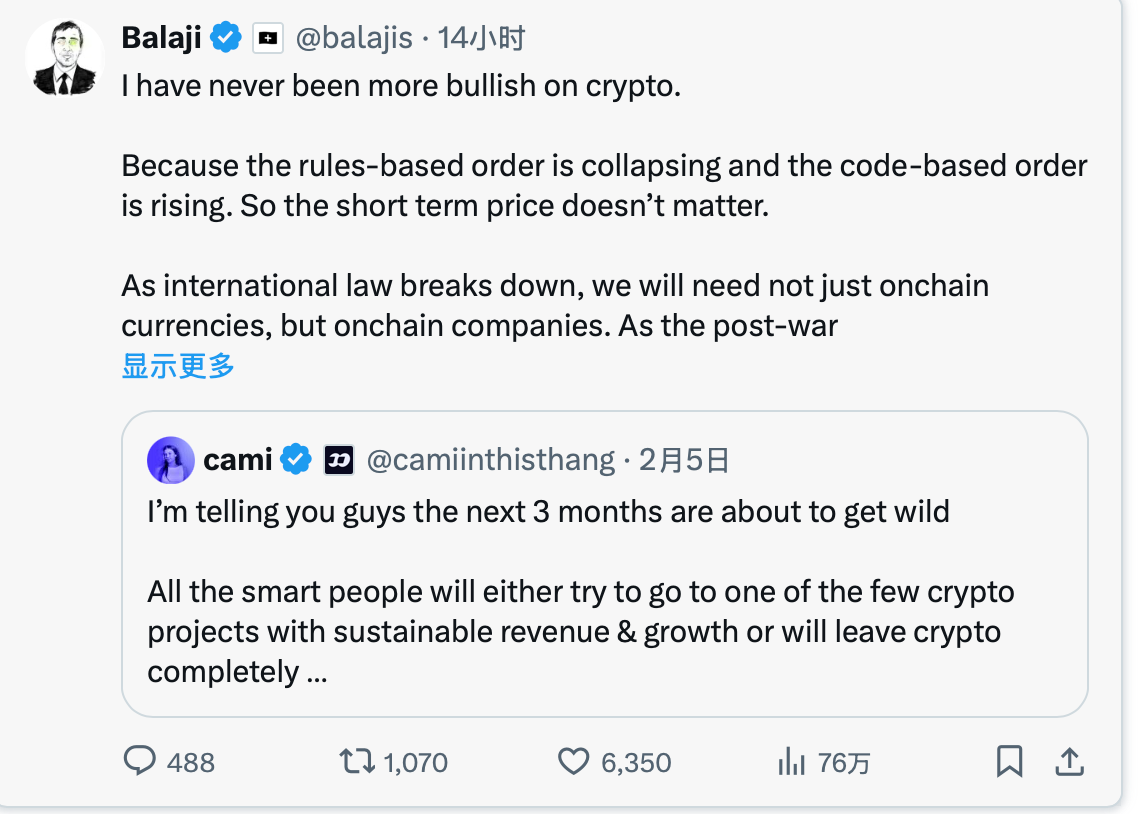
I have never been more bullish on cryptocurrency than I am now.

Because the 'rules-based order' is collapsing, and the 'code-based order' is rising. So short-term prices simply don't matter.

As the international legal system disintegrates, we need not only on-chain money but also on-chain companies. As the post-war order unravels, we similarly need a 'post-internet order.' Nations will fail, and networks will replace them.

We need internet capitalism, we need internet democracy, we need internet privacy.

So we need cryptocurrency.
Helius Founder:

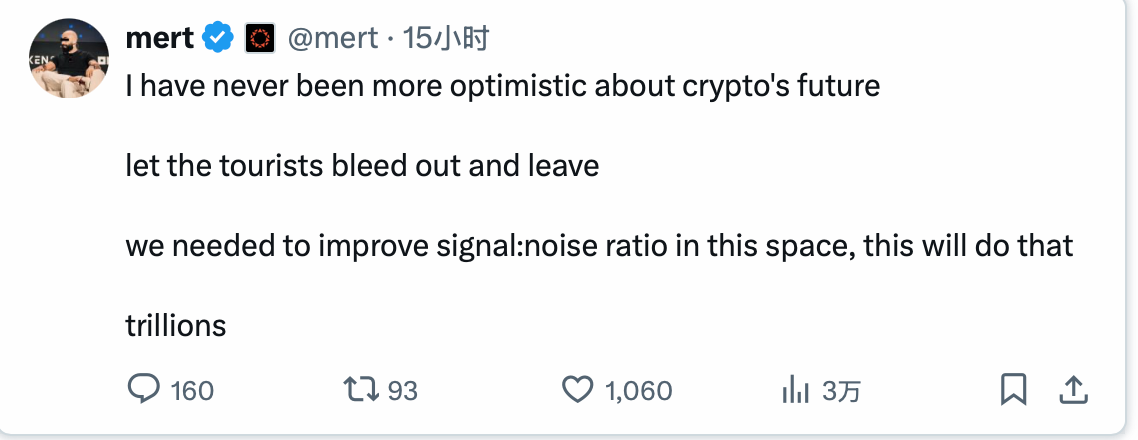
I have never been more confident about the future of cryptocurrency than I am now.

Let the tourists bleed out and leave.

We need to increase the signal-to-noise ratio in this space, and this will achieve that goal.

Trillion
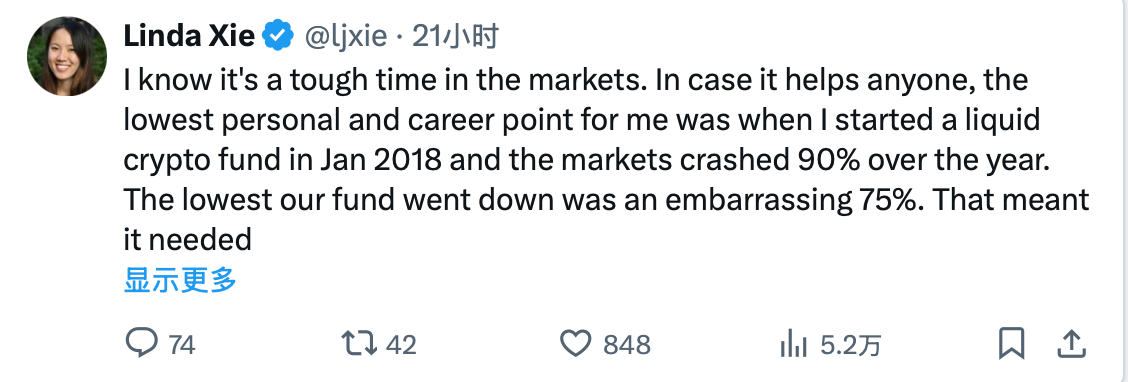
Linda Xie:

I know the current market environment is tough. I hope these experiences can be helpful to some. For me, the personal and professional low point was in January 2018, after launching a crypto liquidity fund, when the market fell 90% that year. Our fund experienced a maximum drawdown of a humiliating 75%, meaning the fund needed to quadruple just to break even.

At the time, many investors chose to trust us (this was after about 1,000 fundraising meetings), some of whom I deeply respected, and I felt I had let them down; some investors even yelled at me over the phone. I was extremely worried about what I had gotten everyone into, including employees. I had also invested almost all of my personal savings.

But we stuck to the direction we truly believed in, and it eventually paid off years later (currently delivering about 4x DPI for investors). Hold onto assets you genuinely believe in fundamentally, and don't make any extreme decisions driven by emotion.
Shenyu:

1btc = 1btc

Preguntas relacionadas

QWhat was the significance of Bitcoin's price drop to $60,000 on February 6th?

AIt marked a 15.48% single-day drop, the largest since the FTX crash, and pushed the Crypto Fear & Greed Index to 9, indicating 'extreme fear' and a new low since the 2022 bear market.

QAccording to Solana Foundation's Lily Liu, what is the core purpose of blockchains?

ABlockchains are, and always will be, financial technology. Their core purpose is financialization, providing open financial infrastructure to anyone on the internet to enable capital formation and innovation globally.

QWhat is Balaji's main argument for being extremely bullish on cryptocurrency despite short-term price movements?

AHe believes the 'rules-based order' is collapsing and a 'code-based order' is rising. As international law and the post-war order disintegrate, there is a need for on-chain money, companies, and new systems like internet capitalism and democracy, which cryptocurrency enables.

QWhat personal experience did Linda Xie share to help others during the difficult market?

AShe shared that her crypto liquidity fund launched in Jan 2018 experienced a 90% market drop and a 75% drawdown, requiring a 4x return just to break even. By sticking to their convictions and not making emotional decisions, they eventually delivered about 4x DPI (Distributed to Paid-In Capital) to investors.

QWhat common sentiment is expressed by multiple figures like Michael Saylor, the Base founder, and the Helius founder?

AThey express unwavering confidence and a long-term commitment to cryptocurrency. Saylor encourages buying Bitcoin, the Base founder states he's 'not going anywhere,' and the Helius founder says he's 'never been more confident,' suggesting that weak hands (tourists) leaving will improve the space.

Lecturas Relacionadas

Dialogue with Morgan Stanley Executive: Wall Street Isn't Rejecting Bitcoin, It's Just Waiting for the Right Time

In a podcast interview, Amy Oldenburg, Head of Digital Asset Strategy at Morgan Stanley, discusses Wall Street's evolving stance on Bitcoin, explaining the bank's measured approach and the road ahead. Oldenburg, with 26 years at Morgan Stanley, traces her perspective to witnessing transformative tech cycles and her experience in emerging markets, where she observed the need for alternative financial systems like mobile money (e.g., M-Pesa). This background informs her view of Bitcoin's value proposition. She clarifies that Morgan Stanley is "client-driven." Regulatory hurdles, particularly as a bank holding company under Federal Reserve oversight, initially slowed their entry. While the firm couldn't act as quickly as independent asset managers, persistent client demand and a changing regulatory environment led to offerings like their low-fee Bitcoin ETP (MSBT). They are now gradually rolling out spot Bitcoin trading on their E*Trade platform. Regarding advisor adoption, Oldenburg cites a "lack of education" as the primary barrier. Morgan Stanley recommends a 0-2% allocation for more conservative portfolios and 2-4% for aggressive ones, but price volatility and confusion about its place in asset allocation persist. She notes competition for investor attention from AI and commodities. Addressing Bitcoin's price stagnation despite institutional buying, Oldenburg points to a confluence of factors: competing investment narratives (AI, quantum computing) and the complex financial landscape. She suggests a catalyst for Bitcoin as a neutral reserve asset might require a "slow-burn crisis" that exposes fragility in traditional systems. For wider bank adoption, including holding Bitcoin on balance sheets, she identifies the need for regulatory clarity to reduce punitive capital treatment and for the asset to be usable as collateral within financial ecosystems. Looking ahead, Oldenburg predicts steady, moderate adoption growth through 2030 rather than an explosive "J-curve." She emphasizes the importance of differentiating Bitcoin from other crypto assets and expresses concern that the core cypherpunk ethos of self-custody is being diluted as traditional finance enters the space. She concludes that the digital asset field remains in its early stages with significant innovation, like AI agents and micropayments, still to come.

marsbitHace 6 min(s)

Dialogue with Morgan Stanley Executive: Wall Street Isn't Rejecting Bitcoin, It's Just Waiting for the Right Time

marsbitHace 6 min(s)

10% Position Limit Proposed: UK Retail Authorized Funds to Gain Indirect Exposure to Crypto Assets

The UK Financial Conduct Authority (FCA) is consulting on a proposal (CP26/17) that would allow retail funds, including UCITS and most Non-UCITS Retail Schemes (NURS), to invest up to 10% of their total assets in cryptoasset exchange-traded notes (crypto ETNs). This would enable indirect exposure to cryptoassets for mainstream investors through regulated funds. The rule maintains the existing prohibition on funds holding underlying cryptocurrencies like Bitcoin or Ethereum directly. The proposal introduces a strict 10% cap, positioning crypto ETNs as a potential satellite holding within diversified portfolios. Funds must ensure these investments align with their stated objectives and risk profiles. Notably, the cap does not apply to Qualified Investor Schemes (QIS) for professional clients, while Long-Term Asset Funds (LTAFs) would be prohibited from holding crypto ETNs. This move builds on the FCA's 2025 decision to permit retail trading of crypto ETNs on UK regulated exchanges. However, significant compliance burdens fall on fund managers, who must conduct thorough due diligence, assess liquidity, and provide clear risk disclosures to investors. The FCA emphasizes that even a small allocation can significantly impact a fund's risk profile. The policy's practical impact remains uncertain. Widespread adoption depends on whether asset managers deem the potential benefits worth the operational costs, disclosure requirements, and reputational risks. The consultation is open for feedback until July 13, 2026. Ultimately, the proposal represents a cautious, incremental step toward integrating cryptoassets into the regulated fund landscape, rather than a broad opening.

Foresight NewsHace 35 min(s)

10% Position Limit Proposed: UK Retail Authorized Funds to Gain Indirect Exposure to Crypto Assets

Foresight NewsHace 35 min(s)

Public Version of Mythos Officially Launched: Analyzing the Advantages and Limitations of AI Smart Contract Auditing

Publicly available Mythos, Anthropic's AI model, has officially launched, demonstrating both significant potential and limitations in smart contract security auditing. The article analyzes its capabilities through real-world cases. AI excels in identifying subtle, low-level vulnerabilities through pattern recognition and large-scale code screening. A key example is detecting a storage slot collision between a custom rewards mapping and a third-party library's ReentrancyGuard, a vulnerability easily missed in manual audits. In the recent Zcash incident, AI also rapidly discovered a critical soundness bug that had remained hidden for years. However, AI currently struggles with complex, interconnected scenarios. When tested on the Curve LlamaLend sDOLA exploit, which involved manipulating prices across multiple protocols (Curve pools, lending markets) to trigger liquidations, Fable 5 failed to identify the core cross-protocol attack vector. These scenarios require a deep understanding of DeFi economic models and multi-contract interactions. In conclusion, while AI tools like Mythos significantly boost efficiency in finding standardized, syntactic vulnerabilities, they cannot yet replace expert analysis for complex, business-logic, and cross-protocol attacks. An effective audit workflow combines AI's speed for initial screening with human expertise for in-depth, holistic analysis.

marsbitHace 40 min(s)

Public Version of Mythos Officially Launched: Analyzing the Advantages and Limitations of AI Smart Contract Auditing

marsbitHace 40 min(s)

Trade.xyz's Rebase Refusal Sparks Controversy, On-Chain Pre-IPO Market Faces Major Pricing Test

The debate surrounding Trade.xyz's refusal to adjust its SPCX (SpaceX pre-IPO) perpetual contract pricing amid updated share count revelations highlights a key challenge for on-chain pre-IPO markets. While several centralized exchanges (CEXs) paused and repriced their contracts after SpaceX's filing showed a ~10% increase in total shares, Trade.xyz maintained its market-driven pricing logic, which tracks expected per-share price sentiment rather than fundamental valuation metrics like market cap. This discrepancy triggered cross-platform arbitrage and caused leveraged long positions on Trade.xyz to suffer significant losses, as the platform's HIP-3 architecture lacks a native "Rebase" mechanism to neutrally adjust all user positions following such corporate actions. The incident underscores the difficulty for decentralized perpetual exchanges (Perp DEXs) to implement Rebase—a process CEXs handle by centrally pausing markets and adjusting ledger data. On-chain, this requires complex smart contract modifications, increasing gas costs, complexity, and potential attack surfaces. While some DEXs have managed similar adjustments, Trade.xyz's current design does not natively support it, though the team is reportedly exploring solutions for future events like stock splits. Ultimately, the controversy serves as a critical case study for the nascent on-chain pre-IPO sector, raising questions about price discovery reliability, transparent rule disclosure, and the readiness of DeFi infrastructures to handle traditional corporate actions as real-world assets (RWAs) gain traction.

marsbitHace 48 min(s)

Trade.xyz's Rebase Refusal Sparks Controversy, On-Chain Pre-IPO Market Faces Major Pricing Test

marsbitHace 48 min(s)

Trading

Spot
Futuros
活动图片





