Make crypto games great again? ‘Trump Billionaires Club’ launches this month

cointelegraphPublicado a 2025-12-10Actualizado a 2025-12-10

Resumen

A Trump-themed crypto mobile game, "Trump Billionaires Club," is set to launch on the Apple App Store by December 30. Created by Freedom 45 Games and linked to the TRUMP Coin, the game operates under a licensing agreement to use Trump’s name. It features a Monopoly-style board where players use dice rolls to earn funds for construction and other activities. The game integrates cryptocurrency and NFTs, allowing players to fund accounts with cash, crypto, or TRUMP Coin, and trade in-game items. A pre-launch airdrop of Trump tokens is offered to top performers. However, a disclaimer states the game is not affiliated with Donald Trump, his businesses, or any campaign, and collectibles are for enjoyment, not investment. This launch occurs as the Trump memecoin has dropped 92% from its all-time high, though it saw a slight uptick following the game's announcement.

A Trump-themed crypto mobile game, created by Bill Zanker, a member of the team that helped launch the official Trump memecoin and various NFT collections, is reportedly set to be released on the Apple App Store before the end of the year.

The game uses Trump’s name under a licensing agreement and is being created by Freedom 45 Games, according to the game’s website. It is also tied in with the Trump Coin.

The Apple App Store has an expected release date of Dec. 30, and the app is currently in pre-registration.

Zanker was already linked to a project blending gaming and cryptocurrency elements in April, with the project reportedly bearing some similar aspects to MONOPOLY GO; however, at the time, a spokesperson denied any similarity to Monopoly.

On the game’s website, it lists cash, cryptocurrency, or TRUMP Coin as ways to fund a game account and mentions trading non-fungible token statues and pins that can be used in the game.
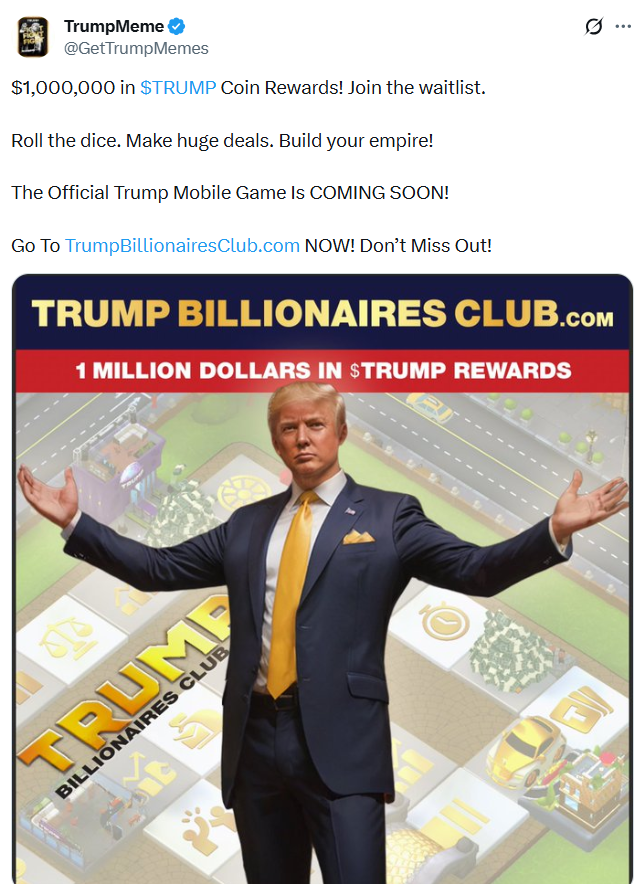
Source: TrumpMeme

However, a disclaimer outlines that it’s not designed, manufactured, or distributed by US President Donald Trump or any of his businesses or affiliates.

The Trump Billionaires Club didn’t immediately respond to a request for comment.

Trump game features crypto elements

A demo of Trump Billionaires Club on its website appear to feature a digital version of New York and show a player using dice rolls to move around a Monopoly-style gameboard, earning funds for constructions and other activities.

The game also offers an air drop of Trump tokens to whoever earns the most points pre-launch, which can be gained by opening an account, holding the TRUMP coin, and referring new users to the project.

Related: Trump’s national security strategy is silent on crypto, blockchain

Trump memecoin is down 92% from ATH

The new Trump-themed crypto game comes at a challenging time for Trump’s memecoin holders.

The Official Trump memecoin launched days before Donald Trump took office on Jan. 20. It surged to an all-time high of over $73 a day after launch — with its value reaching over $14.5 billion — but has since dropped over 92% to trade at $5.89 as of Wednesday, according to CoinGecko. Over the last 24 hours, since the game announcement, the token has seen a 3.4% increase.

Under the disclaimer, the game collectibles are said to be for “enjoyment only,” not for “investment purposes,” and are not connected to “any political campaign.”

Trump’s crypto ventures, and those bearing his name, have come under scrutiny from Democrat lawmakers in the US who have previously demanded an investigation from the financial regulators and the government ethics office.

Magazine: When privacy and AML laws conflict: Crypto projects’ impossible choice

Lecturas Relacionadas

The Niche Consensus Among Elites: Has College Become an Expensive Waste?

**Summary:** A growing "anti-college" movement is gaining traction among elite circles in Silicon Valley, challenging the traditional value of a four-year university degree. Proponents argue that college has become an expensive, slow, and increasingly irrelevant waste of time, especially in the fast-paced tech world where opportunities pass by quickly. The movement is led by figures like billionaire Peter Thiel, who criticizes universities for high costs, ideological indoctrination, and stifling true innovation. His "Thiel Fellowship" pays young people to drop out and pursue ventures. Companies like Palantir Technologies (co-founded by Thiel) fuel this trend with programs like the "Meritocracy Fellowship," which offers high school graduates paid internships as an alternative to immediate college enrollment, promising a practical "Palantir Degree." Key drivers include: 1. **Economics:** Skyrocketing student debt versus the allure of immediate, high-paying tech jobs or startup funding. 2. **Technology:** AI and online tools lowering barriers to self-education and product development, making formal instruction seem inefficient. 3. **Culture:** A backlash against perceived "woke" ideology and DEI policies in universities, coupled with a belief that these institutions suppress meritocracy and masculine drive. The movement is notably male-dominated. Critics, like economist David Deming, warn against overgeneralizing from dropout success stories (survivorship bias). He emphasizes that genuine autodidacts are rare, corporate training is narrowly focused, and the "college wage premium" remains high for most people. University liberal arts education, he argues, builds adaptable problem-solving skills and broad perspectives. The debate highlights a deeper crisis in education. The core model of the modern university appears increasingly mismatched with the speed of the information age. The movement signals a shift in the locus of learning from institutional "education" to personal, active "learning" powered by the internet and AI. Ultimately, this may not mean the end of university, but rather a painful evolution. The future likely holds more hybrid, personalized, and lifelong learning pathways. The central question becomes: in a world changing faster than any curriculum, how do we best learn?

marsbitHace 9 min(s)

The Niche Consensus Among Elites: Has College Become an Expensive Waste?

marsbitHace 9 min(s)

From Subsidies to Token-Based Pricing to Price Cuts: Is OpenAI Sparking a Price War? Is the Inflection Point for Token Economics Nearing?

The commercialization of generative AI is facing a critical inflection point as a potential price war looms. According to The Wall Street Journal, OpenAI is considering a significant cut to its token fees to compete with rival Anthropic, signaling a shift from a growth-at-all-costs model focused on token consumption. This move comes as both companies, reportedly losing billions on compute, prepare for IPOs, and as enterprise customers face "bill shock" from switching to usage-based token billing. Reports indicate poor ROI, with one analysis finding only 18 cents of every dollar spent on AI tokens generates user-facing value. The industry's initial phases—from flat-rate subscriptions to aggressive subsidies—have given way to a reckoning with real costs. Analysts debate the future: some predict a bifurcation between premium, high-cost models for complex tasks and cheaper alternatives for routine work, while others believe overall spending will still rise as agentic AI increases tokens per task. Notably, Chinese model DeepSeek's low-cost API is gaining traction with U.S. enterprises, adding competitive pressure. The core challenge is redefining value beyond token volume ("tokenmaxxing") toward measurable productivity ("valuemaxxing"), as the entire AI value chain, from cloud providers to chipmakers, feels the ripple effects of unsustainable pricing.

marsbitHace 13 min(s)

From Subsidies to Token-Based Pricing to Price Cuts: Is OpenAI Sparking a Price War? Is the Inflection Point for Token Economics Nearing?

marsbitHace 13 min(s)

Trading

Spot
Futuros
活动图片




