Luxury Cars Become Targets, Families Used as Pawns: Crypto 'Wrench Attacks' Sweep Across Europe and America

marsbitPublicado a 2026-06-10Actualizado a 2026-06-10

Resumen

In a significant U.S. federal case, 22-year-old Saif Faiq of Missouri pleaded guilty to conspiracy to commit Hobbs Act robbery, related to an attempted Bitcoin theft and the kidnapping of two individuals in Danbury, Connecticut. Prosecutors state the 2024 plot targeted the parents of a person involved in a separate large-scale Bitcoin theft, intending to use them as hostages to coerce the transfer of crypto assets. Faiq's role involved recruiting accomplices and surveillance. This case, involving a Lamborghini Urus carjacking, exemplifies the growing threat of "wrench attacks"—physical violence and coercion to steal cryptocurrency—where a holder's family, vehicles, and visible wealth become targets. The guilty plea, alongside that of co-conspirator Adam Iza, marks the formal entry of such crypto-related violent crimes into the U.S. federal judiciary. It highlights that while blockchain technology itself is secure, the human endpoint is vulnerable. Attackers leverage personal connections and luxury items as indicators of crypto wealth to plan kidnappings and extortion. Though this case occurred in the U.S., Europe remains the epicenter for such attacks. CertiK's 2026 report notes 34 confirmed wrench attacks in the first four months of 2026, with 82% occurring in Europe, primarily France, causing an estimated $101 million in losses. The Danbury case serves as a stark warning for crypto holders globally: operational security must now extend beyond digital threats to include ph...

Author: Liam 'Akiba' Wright

Compiled by: Saoirse, Foresight News

Quick Summary Key Points

  • A Missouri man pleaded guilty in Hartford federal court to participating in a robbery conspiracy involving an attempted Bitcoin theft and a double kidnapping in Danbury, Connecticut.
  • Prosecutors state this case highlights that holding crypto assets can make an individual's family and vehicles potential targets for physical coercion.
  • Saif Faiq is scheduled for sentencing on August 28; this 'wrench attack' crime pattern is spreading from Europe and now appearing in US court cases.

Saif Faiq, a 22-year-old man from St. Louis, Missouri, pleaded guilty on June 8th in Hartford federal court to conspiracy to commit robbery affecting interstate commerce. Prosecutors allege the case originated from a plot in August 2024 to steal Bitcoin from a family connected to another Bitcoin theft case involving hundreds of millions of dollars.

The charge carries a statutory maximum penalty of 20 years in prison. Saif Faiq's sentencing hearing is set for August 28.

According to prosecutors, the two kidnapped victims were the parents of a person involved in the Bitcoin case. Saif Faiq's role involved recruiting accomplices, coordinating with Adam Iza, and conducting surveillance on the victims' home.

The Danbury case is further evidence of the escalating threat of physical violence linked to crypto wealth. Prosecutors connected key elements: targeting relatives, prolonged surveillance, luxury vehicles, and the criminals' logic of taking hostages to coerce the transfer of Bitcoin.

Previous CryptoSlate reports indicated a surge in cases in France where crypto holders' identities were leaked, leading to violence against their families. The court documents from this Danbury case demonstrate that this same security threat has now emerged within the US federal justice system.

US Court Documents: Real Physical Violence Cases Triggered by Crypto Assets

In September 2024, Danbury police responded to a reported Lamborghini Urus carjacking and kidnapping, leading to charges against six Florida residents. Authorities stated two victims were forced from their vehicle, bound, and placed in a van before police intervened and arrested the suspects.

A June 2026 US Department of Justice announcement stated that six other individuals involved in the carjacking and kidnapping had pleaded guilty.

Saif Faiq is not the only one to plead guilty. The DOJ identified his brother, Adam Iza, as a key organizer. Adam Iza pleaded guilty on June 1st to the same Hobbs Act robbery conspiracy charge related to the attempted Bitcoin robbery and Danbury kidnapping.

Prosecutors said Adam Iza used phones and encrypted messaging apps to communicate with multiple kidnappers, coordinated logistics, and funded the criminal operation.

This federal criminal case includes several classic violent crime charges: recruitment, funding, surveillance, carjacking, kidnapping, and robbery conspiracy. The crypto connection lies in the plan to hold family members hostage to physically coerce a Bitcoin holder into surrendering assets.

This guilty plea formally categorizes crimes involving physical coercion against crypto asset holders as part of US federal violent crime prosecutions.

For cryptocurrency holders, this case delivers a stark security warning: if criminals believe someone holds Bitcoin, their family, vehicles, residence, or any public signs of wealth can become targets.

All 'wrench attack' cases operate on this logic of coercion.

The presence of a Lamborghini in the case is not incidental—prosecutors' narrative shows the luxury car served as a visual wealth indicator, signaling to criminals that the target held significant Bitcoin worth robbing.

Thus, flashy luxury vehicles can serve as a security alarm, reminding holders to be vigilant about their exposed wealth, loved ones, and access to digital assets.
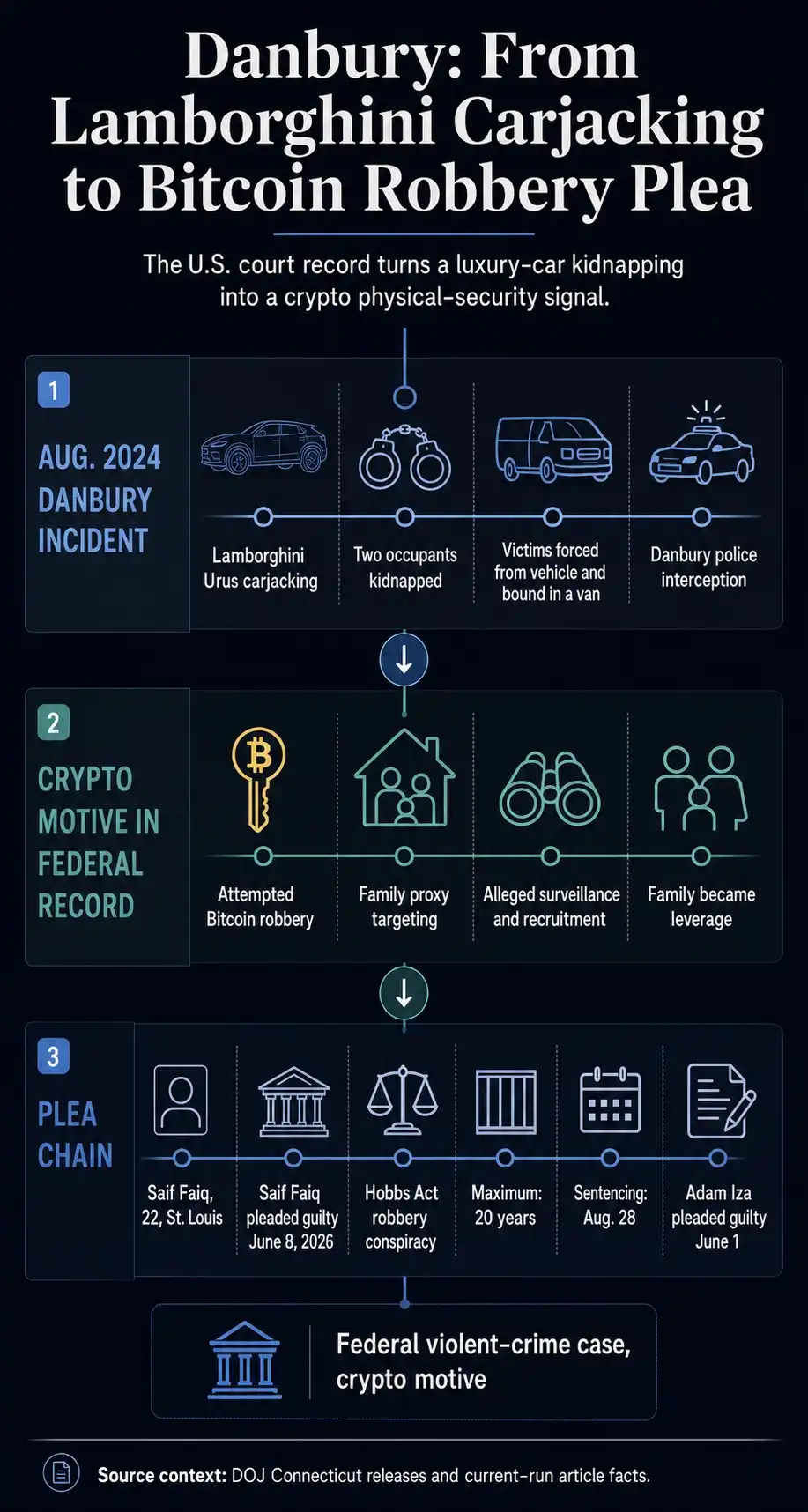
This infographic details a 2024 violent incident in Danbury, USA, involving a Lamborghini carjacking and kidnapping aimed at seizing Bitcoin, disclosing plot details and the 2026 guilty pleas and pending sentencing of two suspects.

The Attack Vector is Always the Human Element

In security research, a 'wrench attack' is defined as a crime involving physical violence or coercion to force a victim to reveal passwords, private keys, or access to digital assets.

CertiK's "2025 SkyNet Wrench Attack Report" categorizes such crimes as attacks on the 'human endpoint,' reporting 72 verified cases in 2025, a 75% year-on-year increase.

This is crucial for Bitcoin holders: the security of the blockchain protocol and the holder's personal safety are two separate systems. Even if the blockchain code is virtually unbreakable and Bitcoin cannot be stolen remotely, the individual controlling the assets is highly vulnerable to physical coercion.

Once criminals believe hardware wallets, seed phrases, exchange accounts, mobile devices, or a target's relatives can lead to transferable crypto assets, all become potential pressure points.

In the Danbury case, the pressure point was the victims' relatives. The US DOJ explicitly stated the two kidnapped parents were not involved in the Bitcoin theft.

They were targeted because their child was involved in the multi-hundred-million-dollar Bitcoin theft case. This also makes it a case of 'indirect target' hostage-taking for robbery.

Similar cases in France prove this is now a widespread personal safety hazard. A March report by this publication noted that victims of violent attacks in France are no longer limited to industry insiders or corporate executives; criminals are increasingly targeting ordinary individuals and private residences.

The Danbury case brings this established modus operandi into US court records. Conspicuous luxury cars are wealth markers, family is leverage, and the ultimate target asset is Bitcoin.

The criminals' core logic: find a person to physically coerce in order to access crypto assets.

The Danbury case clearly demonstrates that relatives can become indirect hostages in crypto-related crimes. The series of cases in France shows that as such attacks become recurrent, local public safety guidelines, travel and protection habits of industry executives, and self-protection methods for ordinary holders are all forced to adapt.

Europe Remains the Core Hotspot for Wrench Attack Cases

Apart from the Danbury guilty plea, overall case data shows Europe remains the concentrated epicenter for 'wrench attack' crimes.

CertiK's "2026 Wrench Attack Overview Report" states that 34 attack cases were verified from January to April 2026, with estimated total losses of approximately $101 million.

Of these 34 cases, 28 occurred in Europe, accounting for 82% of all recorded cases, with France having the highest number of incidents.

A May CryptoSlate special analysis on wrench attacks reached the same conclusion: the wave of offline violent extortion targeting crypto holders continues to accelerate, with the core region still being Europe, particularly France.
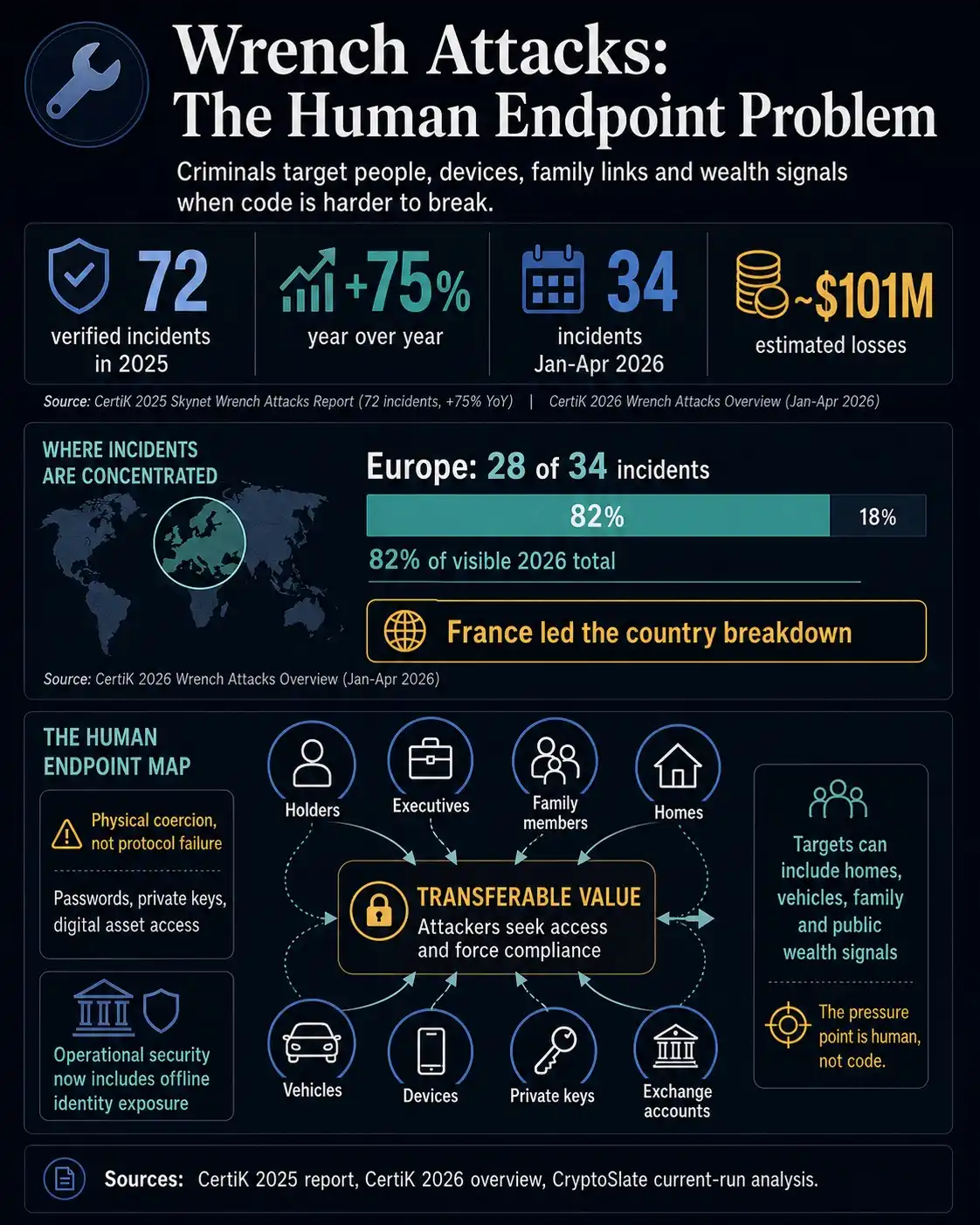
CertiK data shows that crypto 'wrench attacks' targeting holders, family, devices, and other physical endpoints confirmed 72 incidents in 2025, a 75% year-on-year increase. Of 34 cases in the first 4 months of 2026, 82% occurred in Europe, with estimated total losses of ~$101M. The core risk lies in the human/physical endpoint, not code vulnerabilities.

The Danbury case confirms that this attack model against crypto holders is now a judicial challenge for US prosecutors and federal courts.

Court records fully illustrate how the offline safety crisis sparked by crypto assets integrates into standard violent crime enforcement: gang recruitment, cross-regional operations, surveillance, hostage-taking of family, luxury car target identification, and hostage coercion for Bitcoin—the entire criminal chain is clearly documented.

For crypto asset holders and industry businesses, the scope of operational security has broadened significantly. Beyond online risks like phishing, wallet theft, exchange account breaches, and smart contract vulnerabilities, offline exposure risks related to identity, home addresses, electronic devices, and family must be seriously addressed.

The next key judicial signal will be the sentencing outcome. Saif Faiq's August 28th hearing will demonstrate how federal courts define and punish his culpability in this robbery conspiracy.

Long-term, all cases warranting close attention share a commonality: criminals identify crypto holders through offline clues like family, residences, vehicles, and public social profiles. It is precisely these cases that are transforming a safety crisis once concentrated in France into a societal issue that law enforcement across the US must confront—each court filing serves as a risk warning.


Preguntas relacionadas

QWhat is a 'wrench attack' in the context of cryptocurrency, as described in the article?

AA 'wrench attack' is a type of crime where physical violence or coercion is used to force a victim into surrendering passwords, private keys, or access to their digital assets.

QAccording to the article, what was the primary target of the assailants in the Danbury, Connecticut case?

AThe primary target was Bitcoin. The assailants planned to kidnap the parents of an individual involved in a separate Bitcoin theft case to coerce that individual into handing over the cryptocurrency.

QBased on the data from CertiK's reports cited in the article, which region is identified as the core hotspot for 'wrench attacks'?

AEurope, specifically France, is identified as the core hotspot for 'wrench attacks'. Data shows 82% of recorded attacks in early 2026 occurred in Europe.

QWhat role did the Lamborghini Urus play in the Danbury kidnapping case, according to the prosecutors?

AThe Lamborghini Urus served as a visible marker of wealth, signaling to the criminals that the target likely held significant Bitcoin and was worth targeting for robbery.

QWhat broader security lesson does the Danbury case highlight for cryptocurrency holders?

AIt highlights that while blockchain protocols themselves may be secure, the human holders are vulnerable. Physical security is crucial, as family members, luxury possessions, and public displays of wealth can make holders and their loved ones targets for violent coercion aimed at seizing crypto assets.

Lecturas Relacionadas

Partner at Pantera Capital: How Tokenization Can Restructure the Private Equity and Early-Stage Investment Ecosystem?

"Tokenized Startups: Rebalancing Access to High-Growth Companies" by Jay Yu, compiled by Jiahuan, ChainCatcher The article explores how tokenization could democratize access to high-growth private companies, addressing a market gap created as firms like Stripe and SpaceX stay private for over a decade, depriving public investors of early growth returns. It identifies three converging trends enabling this shift: the explosive growth of Special Purpose Vehicles (SPVs) as makeshift liquidity tools, the rise of tokenized real-world assets (RWA), and the breakdown of the "token vs. equity" consensus where project tokens often fail to capture value. The landscape of tokenized startup platforms is analyzed across two dimensions: investment mechanisms (from equity-holding SPVs like PreStocks to perpetual futures like TradeXYZ) and company stage (early-stage to pre-IPO giants). A key finding is a strong power-law concentration, with most platform volume driven by a few high-profile pre-IPO names like SpaceX and Anthropic. Platforms providing direct equity exposure (e.g., Robinhood Ventures) currently see higher volumes than pure synthetic/perpetual platforms. The discussion highlights major challenges and opportunities: 1. **Founder/Team Alignment:** Gaining company consent for tokenization is critical, as seen when Anthropic and OpenAI objected. Proposed solutions include tokenized startup baskets, accelerator models (e.g., Street, MetaDAO helping startups grow), and community token distributions to align incentives. 2. **Non-U.S. Jurisdictions:** Tokenization offers significant potential in regions with less efficient capital markets (e.g., South Korea), providing global liquidity and better valuations for local champions. 3. **Price Discovery for Perpetuals:** Synthetic/perpetual platforms avoid consent issues but face price discovery challenges for illiquid private assets. TradeXYZ's success with Cerebras Systems' pre-IPO perpetual, which accurately predicted the IPO price, showcases potential but scalability remains unproven. 4. **Legal & Regulatory Structure:** Regulatory treatment varies. Issuer-sponsored tokens are treated as traditional securities. Third-party tokens face complex classifications—custodial tokens represent claims on held shares, while synthetic tokens (perpetuals, linked notes) are separate securities subject to strict rules, often restricting U.S. retail access. In conclusion, tokenized startup mechanisms represent an attempt to restore the public market's historical function of providing early, liquid exposure to high-growth companies. For crypto tokens, successfully capturing real economic upside in startups could resolve their current identity crisis and fulfill their original promise.

marsbitHace 30 min(s)

Partner at Pantera Capital: How Tokenization Can Restructure the Private Equity and Early-Stage Investment Ecosystem?

marsbitHace 30 min(s)

Partner at Pantera Capital: How Tokenization Could Reshape the Private Equity and Early-Stage Investment Ecosystem?

The article discusses how tokenization could reshape private equity and early-stage investment. Historically, public markets allowed early access to high-growth companies, but today's leading tech firms (e.g., Stripe, SpaceX) remain private for over a decade, with private capital capturing their growth phase. Temporary fixes like SPVs and secondary markets have emerged but are not fundamental solutions. Tokenized venture assets present a potential solution, converging three trends: the explosive growth of SPVs, the rapid expansion of tokenized real-world assets (RWA), and the breakdown of the "token vs. equity" consensus, where project tokens have become subordinate to equity in value capture. This creates an opportunity for tokenized startups to offer public, liquid exposure to venture-scale returns. The landscape includes various models: equity-backed tokens via SPVs or funds (e.g., PreStocks, Robinhood Ventures) and synthetic perpetual futures offering only price exposure (e.g., TradeXYZ, Ventuals). Trading volume is heavily concentrated in late-stage, pre-IPO companies like SpaceX and Anthropic and shows a power-law distribution across platforms. Key challenges and opportunities include aligning with founder/team interests, which can be addressed through models like tokenized startup baskets, accelerator models, or community token distributions. Expanding into non-U.S. jurisdictions with less efficient capital markets offers another path. For perpetual futures models, the central challenge is accurate price discovery for private assets without reliable oracles; TradeXYZ's success with Cerebras Systems pre-IPO pricing demonstrates potential. Regulatory and legal structures for these tokenized instruments remain nascent and untested. In conclusion, tokenization represents an effort to restore the early, liquid access to high-growth companies that public markets once provided. It could also resolve the identity crisis of project tokens by granting them genuine claims on venture-scale upside, potentially fulfilling crypto's original promise with more mature infrastructure.

链捕手Hace 49 min(s)

Partner at Pantera Capital: How Tokenization Could Reshape the Private Equity and Early-Stage Investment Ecosystem?

链捕手Hace 49 min(s)

SpaceX's Core Window for Listed Trading: July 7th Nasdaq Inclusion Date and Post-Q2 Earnings Lockup Expiration

SpaceX is set for its historic IPO on June 12 at $135 per share, with a paper valuation of $1.75 trillion. A key insight from analyst Alexandra Mertz highlights the IPO's unique structure, where an extremely low initial public float of only 4.3% is expected to create a significant supply vacuum. This scarcity is set to collide with massive forced buying from index funds like Vanguard, CRSP, and FTSE Russell, which are scheduled to start adding SpaceX to their indices as early as June 18/22 and July 7 (NASDAQ 100 inclusion). This could propel the stock price sharply higher, with AI models like Grok predicting a potential doubling from the IPO price around July 7. Another critical date is the post-Q2 earnings call (estimated late July), when early insider shareholders (excluding Elon Musk, who has a 366-day lock-up) become eligible to sell. However, actual selling pressure may be only 10-15% of shares, as major holders like Ron Baron and BlackRock have expressed intentions to hold or buy more. The discussion introduces a compelling "Goldilocks scenario": a potential stock-for-stock merger announcement between SpaceX and Tesla in the window between the July 7 price peak and the late-July unlock period. This timing could help Elon Musk manage a personal $7 billion tax liability related to exercising Tesla stock options by August 15, while leveraging high valuations for both companies. Furthermore, the inclusion of former Tesla adversaries like Charles Schwab, Morgan Stanley, and J.P. Morgan as SpaceX IPO underwriters is seen as a strategic move to secure their "yes" votes for a potential Tesla merger approval in a November shareholder vote. The rationale for SpaceX acquiring Tesla, rather than the reverse, centers on SpaceX's superior governance structure, which offers Musk stronger control through super-voting shares and mandatory arbitration clauses, protecting the combined entity from activist investors and legal challenges.

marsbitHace 1 hora(s)

SpaceX's Core Window for Listed Trading: July 7th Nasdaq Inclusion Date and Post-Q2 Earnings Lockup Expiration

marsbitHace 1 hora(s)

Trading

Spot
Futuros

Artículos destacados

Cómo comprar QUICK

¡Bienvenido a HTX.com! Hemos hecho que comprar Quickswap (QUICK) sea simple y conveniente. Sigue nuestra guía paso a paso para iniciar tu viaje de criptos.Paso 1: crea tu cuenta HTXUtiliza tu correo electrónico o número de teléfono para registrarte y obtener una cuenta gratuita en HTX. Experimenta un proceso de registro sin complicaciones y desbloquea todas las funciones.Obtener mi cuentaPaso 2: ve a Comprar cripto y elige tu método de pagoTarjeta de crédito/débito: usa tu Visa o Mastercard para comprar Quickswap (QUICK) al instante.Saldo: utiliza fondos del saldo de tu cuenta HTX para tradear sin problemas.Terceros: hemos agregado métodos de pago populares como Google Pay y Apple Pay para mejorar la comodidad.P2P: tradear directamente con otros usuarios en HTX.Over-the-Counter (OTC): ofrecemos servicios personalizados y tipos de cambio competitivos para los traders.Paso 3: guarda tu Quickswap (QUICK)Después de comprar tu Quickswap (QUICK), guárdalo en tu cuenta HTX. Alternativamente, puedes enviarlo a otro lugar mediante transferencia blockchain o utilizarlo para tradear otras criptomonedas.Paso 4: tradear Quickswap (QUICK)Tradear fácilmente con Quickswap (QUICK) en HTX's mercado spot. Simplemente accede a tu cuenta, selecciona tu par de trading, ejecuta tus trades y monitorea en tiempo real. Ofrecemos una experiencia fácil de usar tanto para principiantes como para traders experimentados.

95 Vistas totalesPublicado en 2024.12.11Actualizado en 2026.06.02

Cómo comprar QUICK

Discusiones

Bienvenido a la comunidad de HTX. Aquí puedes mantenerte informado sobre los últimos desarrollos de la plataforma y acceder a análisis profesionales del mercado. A continuación se presentan las opiniones de los usuarios sobre el precio de QUICK (QUICK).

活动图片












