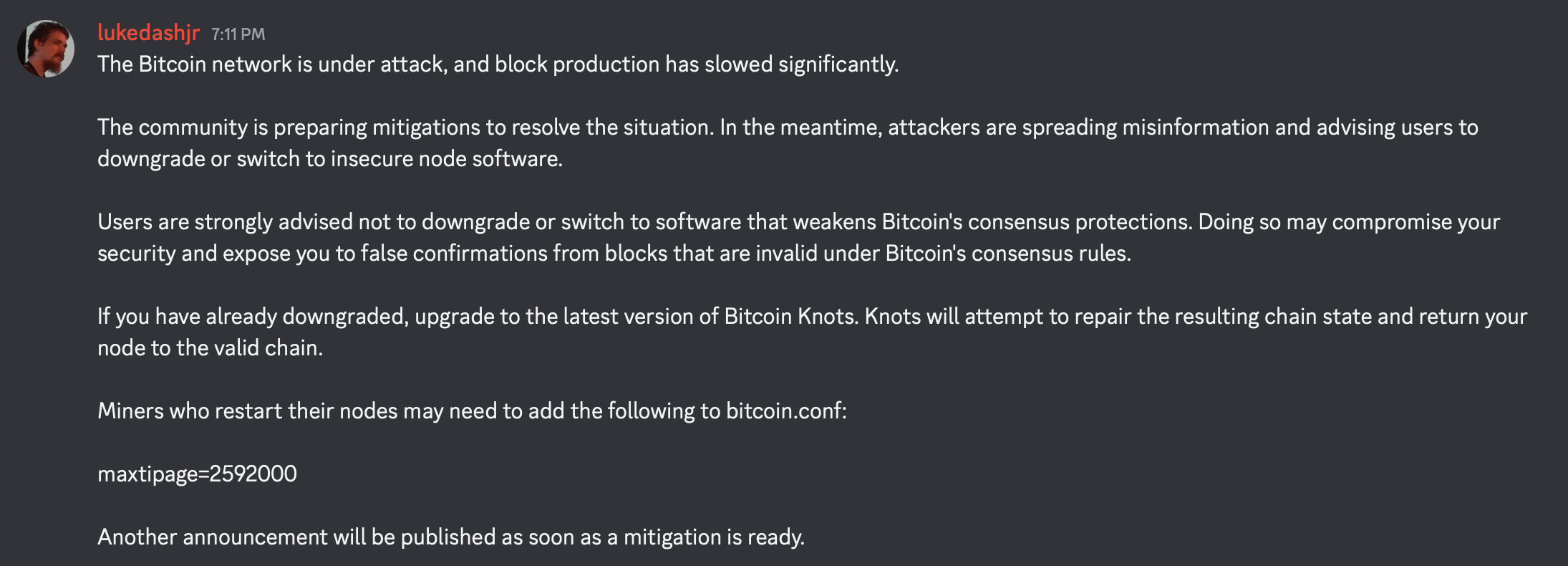
"I am taking a leave of absence from OCEAN as Chairman and CTO and will focus in the near term on work on Bitcoin and open source projects that support Bitcoin. I believe this is the best use of my time and is in the interest of Bitcoin and its long-term well-being," Dashjr wrote on X on Monday evening.
Bitcoin Mechanic, OCEAN's Head of Communications, replied, "Same!" indicating that he is also taking a leave. Both characterized their moves as a temporary leave, not a permanent resignation.
Dashjr Steps Back from Mining Pool He Helped Found
With this, Dashjr is temporarily stepping back from the day-to-day leadership of Ocean, just as the technical battle he advocated for enters a much more substantial phase. The Ocean project launched in November 2023 by Mummolin Inc., co-founded by Dashjr, Mark Artymko, and Ian Norton. A $6.2 million seed funding round led by Twitter founder and Block CEO Jack Dorsey helped finance the mining pool, built on principles of noncustodial payouts and giving individual miners more control over block construction.
Ocean remains small compared to dominant Bitcoin pools like Foundry USA and Antpool, but its DATUM system became a key part of the BIP-110 saga. DATUM allows participating miners to build their own block templates, rather than simply accepting templates prepared by a centralized pool operator. The Roughnecks used Ocean's DATUM system to mine the first two blocks of the BIP-110 minority chain after the fork at block 961632. The fork then effectively stalled due to Bitcoin's inherited mining difficulty of 127.48 trillion and its tiny share of SHA-256d hashpower.
BIP-110 Developers Shift from Debate to Hard Fork Roadmap
The discussion has now moved beyond whether the minority chain should abandon the SHA-256d Proof-of-Work algorithm inherited from Bitcoin. During an August 10 Bitcoin Knots developers meeting, participants began assigning specific tasks for the proposed hard fork. According to the work plan, Dashjr will handle block header and PoW algorithm changes, a person named Kyle will handle replay protection, and software developer Chris Guida will handle the adaptation of the "Reduced Data Temporary Softfork" (RDTS). A new DATUM gateway and server will also be needed.
The scale of reviving the minority chain is significant. Developers counted a revamped block header, a deliberately high difficulty reset, and replay protection among the highest-priority tasks. Among other ideas discussed on Discord were increasing nonce space for miners, a 64-bit block timestamp, a possible fix for block withholding issues, and temporarily reducing the block size to 600 weight units during the RDTS. Fixes for "timewarp" and "timejacking" attacks were also discussed, though some changes remain optional and may be excluded.
Replay protection is important because the BIP-110 network shares the transaction history of Bitcoin. Without sufficient protection, BTC transactions intended for the Bitcoin blockchain could, under certain circumstances, be valid on the BIP-110 minority chain. Developers discussed transaction signature changes in detail, while the broader header revamp adapts the block header for whichever new mining algorithm is ultimately chosen.
Developers Plan Surprise PoW Algorithm Selection
The most notable part of the plan is how the developers intend to choose the new Proof-of-Work (PoW) algorithm. Instead of publicly selecting one in advance, Dashjr described a "commit-reveal" process designed to prevent miners and hardware manufacturers from preparing for the winning algorithm before anyone else.
A preliminary list of candidates discussed during the meeting included BLAKE2b-256, SHA3x, BLAKE2s, Scrypt, BLAKE3x2, and Eaglesong. Dashjr explained that the group plans to first publish a cryptographic hash of a secret mapping, then use a Bitcoin block generated after 14:00 UTC the following day to determine the selection. Publishing the hash in advance would allow observers to later verify that developers did not change the mapping after seeing the block.
"The current plan is: later today we will announce the hash (HASH) of a 'blockhash-to-algorithm' mapping, and tomorrow at 14:00 UTC we will publish the mapping as soon as a Corecoin block is available to compare it with," Dashjr reported in the developers' Discord channel. When Guida asked if the algorithm would be determined by the last block before 14:00 UTC, Dashjr clarified it would be the next block after that.
Stalled Chain Drives Urgency
Difficulty is another priority, as developers have already seen what happens when a minority fork inherits mining conditions calibrated for Bitcoin's massive industrial hashpower.
Kyle told Discord participants that preventing another stuck chain is likely the "top priority," while another participant suggested speeding up difficulty adjustments so a bad initial estimate or rapidly changing hashpower could be corrected within hours, not over Bitcoin's typical 2,016-block adjustment period.
The Fork Fighting Over Which Chain Is Bitcoin
Dashjr continues to reject the suggestion that his side is abandoning Bitcoin. In his own framing, the dominant chain is a contested fork. "Is it actually a contested hard fork attempt. Do you just give up? Or stay in Bitcoin and fight?" Dashjr wrote on X, comparing the dispute to prior conflicts around Segwit2X and Bitcoin Cash.
This conviction now clashes with the on-chain realities. The overwhelmingly dominant Bitcoin chain continues to produce blocks with the SHA-256d algorithm, while the BIP-110 branch has struggled to produce a third block. During the Knots development discussion, even participants sympathetic to the project acknowledged that both optics and technicals are at stake. One warned that overhauling the design too much could turn the situation from choosing a new algorithm into the following:
"They made a bunch of changes and think it's Bitcoin."
What comes next could determine whether BIP-110 remains a two-block-stalled minority fork or transforms into a substantially different network. Developers are no longer merely discussing a hypothetical departure from Bitcoin miners. They are assigning consensus work, drafting replay protection, preparing a difficulty reset, and working on a method to select a new PoW algorithm.
Bitcoiners Reject Dashjr's Claims
The broader Bitcoin community has largely rejected the stance of Dashjr and the BIP-110 community. On X and other public forums, critics mocked and ridiculed the stalled branch, dubbing it "Lukecoin" and "Knotcoin," arguing that declaring a minority chain "Bitcoin" does not overcome economic reality and PoW reality. The dominant chain continued to generate blocks, commanding the overwhelming majority of SHA-256d hashpower, while the BIP-110 branch managed only two blocks before its progress virtually halted.
To BIP-110 critics, this episode demonstrated that nodes can enforce whatever rules their operators choose, but this does not compel users, miners, exchanges, companies, or the market at large to follow them.
end-content