Looking Back at Prediction Markets by the End of 2025: Scale, Players, and the Watershed Moment

比推Publicado a 2025-12-29Actualizado a 2025-12-29

Resumen

By the end of 2025, prediction markets have fundamentally shifted from being event-driven tools reliant on black swan events to platforms sustained by structural trading demand. The total monthly trading volume has grown from under $100 million in early 2024 to over $1 billion by late 2025, indicating a phase of explosive growth and consistent liquidity. The industry has evolved into five distinct segments: 1. **Compliant Markets**: Kalshi (CFTC-regulated, exchange-like) and Polymarket (globally liquid, later US-compliant) lead with institutional and high-frequency trading, especially in sports contracts. 2. **Crypto-Native Experiments**: Platforms like Opinion explore high-risk, crypto-policy, and speculative events, driving innovation but facing regulatory uncertainty. 3. **High-Frequency Trading Platforms**: Limitless shortens contract cycles, blurring lines between prediction markets and derivatives trading. 4. **Embedded Markets**: Myriad Markets integrates prediction features into wallets and super-apps, reducing user acquisition costs and making participation more casual. 5. **Native Information Markets**: Platforms like predict.fun and media integrations use incentives and community mechanisms to blend prediction with content and social interaction. Regulation in 2025 has not meant full liberalization but rather the establishment of boundaries—predictive contracts are recognized as financial instruments, yet state-level gambling laws remain a friction point. Th...

If we were to summarize prediction markets in 2025 in one sentence, it might be:

This is the first year prediction markets no longer rely on black swan events but instead begin to rely on structural trading demand.
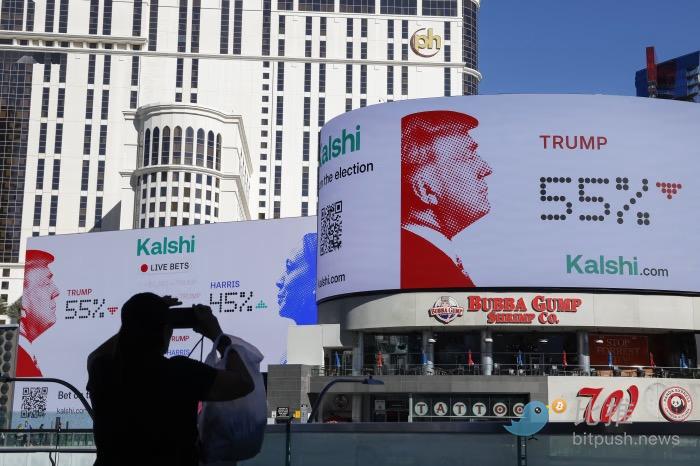
This was almost unimaginable in the past. For a long time, prediction markets were more like "event tools": they only became briefly active during major uncertainties like elections, pandemics, or wars, then quickly cooled down. But this year, high-frequency events such as sports matches, macroeconomic data, and policy changes provided prediction markets with a stable trading rhythm, making them exhibit, for the first time, operational characteristics close to those of financial exchanges—sustained liquidity, frequent trading, and clear settlements.

On the surface, this is a change in scale; but more importantly, it is a change in role.
Prediction markets are shifting from "betting on whether something will happen" to "how the market prices uncertainty." In other words, probabilities are no longer just personal opinions but are beginning to be treated as price signals that can be repeatedly referenced, much like interest rates, exchange rates, or stock prices.

The True Scale of Prediction Markets in 2025

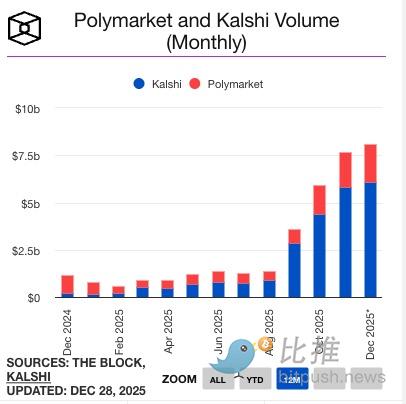
The overall trading volume of prediction markets has grown by an order of magnitude over the past two years. According to industry data from Dune & Keyrock, the monthly trading volume of prediction markets has increased from less than $100 million in early 2024 to stabilize in the range of over $1 billion by the end of 2025, showing explosive growth.

Taking leading platforms as an example, data from The Block shows that Kalshi approached a trading volume of nearly $6 billion in November 2025, with sports contracts contributing the vast majority of the transactions;

Meanwhile, on-chain data and platform disclosures from Polymarket indicate that it also maintained monthly trading volumes in the tens of billions of dollars during several peak months in 2025.

The message behind these numbers is clear: prediction markets no longer rely on "occasional major events" but have entered a stage where they can operate sustainably in everyday environments.

The Industry Gradually Forms "Five Major Camps"

If we only look at trading volume, it is easy to overlook the most critical change in 2025—platforms have embarked on completely different development paths.

For the average reader, it can be simply understood as: some platforms are striving to "become like exchanges," some are trying to "make predictions lighter and more frequent," and others are exploring "whether predictions can be embedded into everyday products."

These differences determine the form prediction markets will take in the future.

First Camp: The Mainstream of Compliant Prediction Markets—Parallel Competition of Two Paths

In 2025, the true marker of prediction markets entering mainstream finance was not the growth in trading volume but the clear differentiation of compliance paths.

One path is the "local compliance, exchange-oriented route" represented by Kalshi. Kalshi chose from the outset to operate entirely within the regulatory framework of the U.S. Commodity Futures Trading Commission (CFTC), defining prediction contracts as standardized event derivatives. In 2025, with the large-scale launch of sports contracts, its trading structure evolved significantly toward high frequency and short cycles, and its product form increasingly resembled that of traditional financial exchanges.

The other path is represented by Polymarket. This is a more challenging route: after initially building scale by leveraging global liquidity, Polymarket completed a compliance restructuring in 2025, acquiring a licensed entity and gaining regulatory approval to officially return to the U.S. market. This made it one of the few platforms in the industry with both a global user base and U.S. compliance status.

The difference between the two lies not in "whether they are compliant" but in the accumulation before compliance. Kalshi's advantage lies in institutional certainty and local distribution capabilities; Polymarket's advantage lies in the global liquidity it has already formed and broader event coverage. They represent two different evolutionary directions for prediction markets within the regulatory framework.

Second Camp: Crypto-Native Experimental Platforms

Outside the mainstream compliance path, there remains a category of platforms that serve the function of trial and error and innovation.
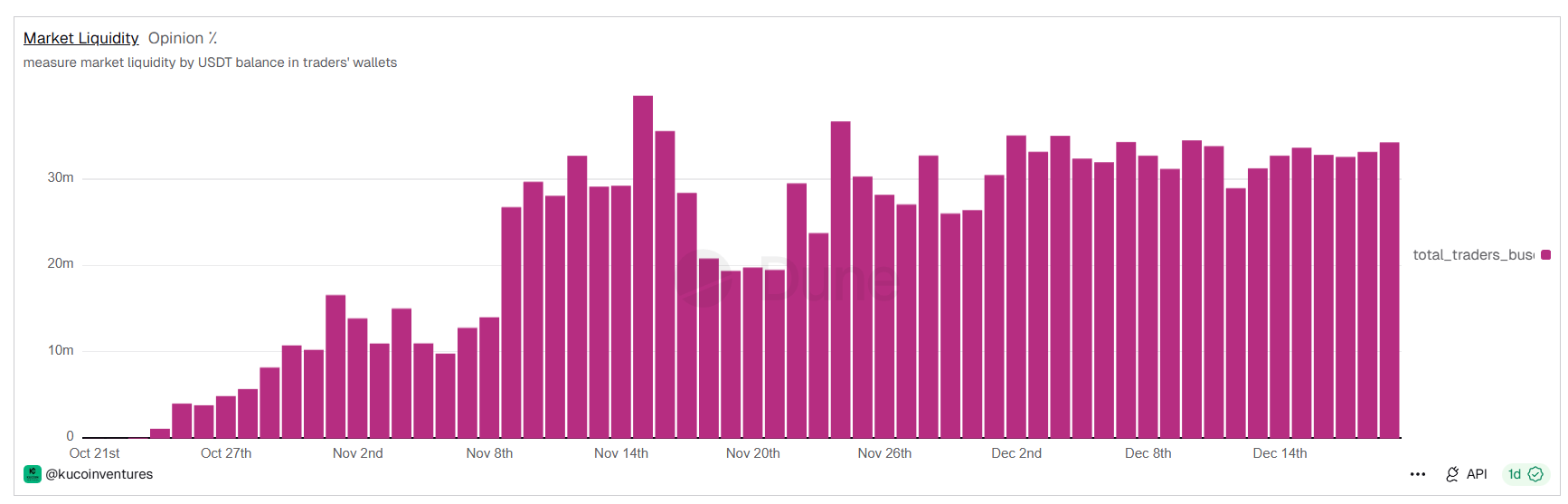
Represented by platforms like Opinion, this camp leverages the native liquidity and community diffusion capabilities of the crypto ecosystem to achieve rapid growth. They are more aggressive in event selection, often covering crypto policies, extreme hypotheses, or highly controversial issues that mainstream platforms have not yet addressed.

The significance of these platforms lies not in short-term scale but in being the first to price highly uncertain questions. However, their trading data often comes from platform displays or third-party statistics and has not yet entered a clear compliance framework, so long-term sustainability remains to be verified.

Third Camp: High-Frequency, Exchange-Thinking Prediction Markets

Platforms represented by Limitless are pushing prediction markets in a new direction.

Here, prediction is no longer an act of "waiting for results" but a trading behavior of high-frequency entry and exit of positions. Contract cycles are deliberately shortened, settlement frequencies are continuously increased, and user behavior resembles that of short-term traders rather than event analysts.

This model blurs the line between prediction markets and derivative trading, also hinting that regulators may need to address new product definitions in the future.

Fourth Camp: The Wallet and Super-Entry Embedded Route

The value of Myriad Markets lies not in trading volume but in its path choice.

Through integration with mainstream wallets, prediction markets are embedded into users' daily asset management processes. Users do not "enter a prediction market" but participate casually while viewing assets or completing interactions.

The long-term significance of this model is its extremely low customer acquisition cost and highly natural user conversion, indicating that prediction markets are shifting from "high-participation-cost behavior" to "everyday light decision-making behavior."

Fifth Camp: Information Markets Native to Public Chains and Content Ecosystems

Platforms represented by predict.fun attempt to treat prediction markets as a native information application.

They rely on public chain ecosystems for diffusion, use incentive mechanisms to drive participation, and deeply integrate prediction behavior with content and communities. At the same time, traditional media are exploring similar directions, using prediction markets as interactive supplements to news content rather than mere trading tools.

Although this camp may struggle to compete with compliant platforms in terms of trading scale in the short term, the product forms and participation mechanisms they explore could influence the usage methods and content organization structures of prediction markets in the medium to long term.

Compliance Is Not Deregulation but Setting Boundaries

In 2025, prediction markets were not "fully liberalized."

A more accurate description is: regulators explicitly acknowledged for the first time that prediction contracts can exist as financial instruments but did not relinquish control over their boundaries. Federal-level attitudes gradually clarified, while state-level gambling regulations became new sources of friction. This inconsistency means prediction markets will remain in a state of "expandable but not uncontrollable."

For the average user, the most important cognitive shift in 2025 is: prediction markets are no longer just about "betting on right or wrong" but about "trading the market's pricing of uncertainty."

Price reflects consensus rather than fact; liquidity is often more important than opinion; profit comes from judgment differences, not the final result itself; and the biggest risk often comes from rule changes, not misjudgment.

Conclusion

Looking back at 2025, the real change in prediction markets is not which platform is more lively, but that a more fundamental question began to be taken seriously:

Who has the right to price uncertainty?
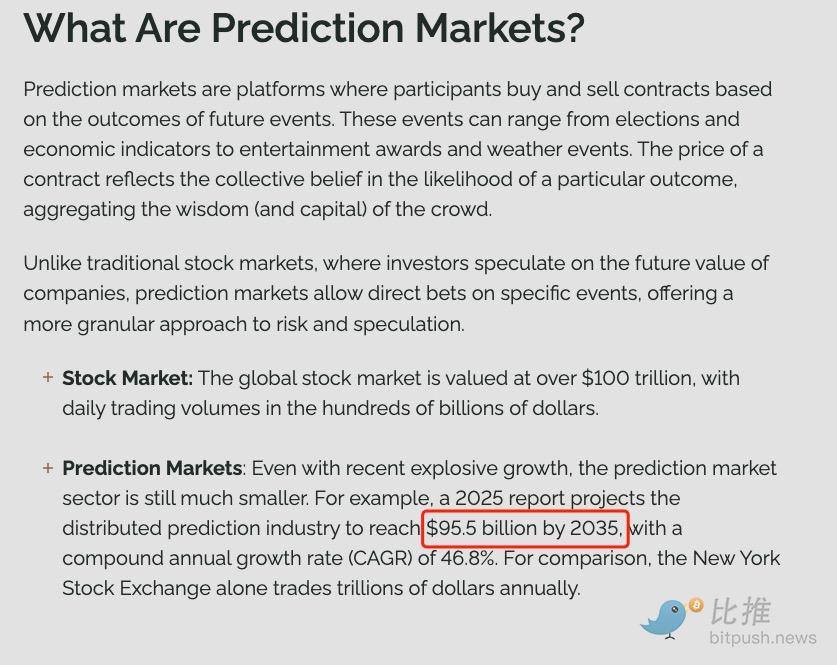
Compliant platforms are setting boundaries, experimental platforms are exploring possibilities, and the true winners may not emerge until after 2026. What is certain is that prediction markets are no longer just gambling but are becoming a tool to help people understand uncertainty. A report released by Certuity predicts that by 2035, the prediction market size could reach $95.5 billion, with a compound annual growth rate of 46.8%.

2025 is just the beginning.

Author: Bootly


Twitter:https://twitter.com/BitpushNewsCN

Bitpush TG Discussion Group:https://t.me/BitPushCommunity

Bitpush TG Subscription: https://t.me/bitpush

Original link:https://www.bitpush.news/articles/7599007

Criptos en tendencia

Preguntas relacionadas

QWhat is the key shift in prediction markets highlighted for 2025?

APrediction markets shifted from relying on black swan events to depending on structural trading demand, moving towards pricing uncertainty like traditional financial instruments.

QWhat was the approximate monthly trading volume of prediction markets by the end of 2025?

AThe monthly trading volume stabilized above $1 billion by the end of 2025, up from less than $100 million in early 2024.

QName the two main compliance paths for prediction markets as described in the article.

AThe two main compliance paths are represented by Kalshi (domestic compliance and exchange-like structure under CFTC regulation) and Polymarket (global liquidity with later U.S. compliance through regulatory approval).

QWhat is the significance of the 'wallet and super entry embedded route' exemplified by Myriad Markets?

AIt embeds prediction markets into daily asset management workflows, reducing user acquisition costs and transforming prediction participation into a light, everyday decision rather than a high-cost activity.

QWhat is the article's conclusion about the fundamental question prediction markets began to address in 2025?

AThe fundamental question is 'Who has the right to price uncertainty?', with prediction markets evolving from mere betting tools into instruments for understanding and pricing uncertainty.

Lecturas Relacionadas

In Conversation with Ray Dalio: We Are Currently in an AI Bubble, with 1% of My Portfolio in Bitcoin

Ray Dalio, founder of Bridgewater Associates, warns in an interview that the current AI boom shows classic bubble characteristics, which could lead to significant economic downturns as seen in past cycles like 1929 or 2000. He explains that speculative enthusiasm, fueled by debt and overvaluation, often precedes a crash when rising rates or taxation force asset sales, causing widespread losses and recession. Dalio also outlines his "Big Cycle" theory, describing an approximate 80-year pattern where widening wealth gaps, massive government deficits, and shifting geopolitical power (like China's rise) create internal conflict and global instability. He emphasizes that we are in a late-cycle, transitional phase where traditional powers like the US and UK face decline. For personal wealth protection, Dalio advises diversification beyond cash into assets like stocks, bonds, real estate, and particularly gold, which he prefers over Bitcoin. While he holds about 1% of his portfolio in Bitcoin as a non-printable hard asset, he views gold as more secure from technological or governmental threats. Regarding AI's impact, Dalio believes it will disproportionately benefit capital owners, worsening inequality by replacing both physical and cognitive labor. He suggests that human intuition and emotional intelligence, combined with AI, will be key for future workers. On taxation, Dalio argues that wealth taxes are impractical and risk triggering asset sell-offs, reducing productive investment. He points to the UK as a cautionary example of debt, low productivity, and political strife. Geopolitically, Dalio foresees a more regionalized world, with the US showing weakness in prolonged conflicts like with Iran, akin to past imperial declines. The ideal outcome, he suggests, is coexisting powerful blocs (e.g., Americas, China-Asia Pacific) without major war.

marsbitHace 56 min(s)

In Conversation with Ray Dalio: We Are Currently in an AI Bubble, with 1% of My Portfolio in Bitcoin

marsbitHace 56 min(s)

Daily 7.2 Trillion KRW: Foreign Capital's Record Net Buying on Friday! Wall Street Says Headwinds for Korean Stock Fund Flows Have Subsided

South Korean stock market sees a dramatic shift in fund flows. On July 31, foreign investors made a record net purchase of approximately KRW 7.2 trillion in KOSPI stocks, marking a fundamental reversal from the persistent large-scale net outflows seen in previous months. This contributed to a significant narrowing of foreign net selling in July to KRW 9.8 trillion, down sharply from KRW 48.4 trillion in June and KRW 44.5 trillion in May. Simultaneously, domestic institutional pressure eased. South Korean pension funds and asset managers turned to a net buying position in July, purchasing KRW 1.0 trillion worth of KOSPI shares, contrasting with net sales in May and June. Market volatility is expected to be dampened by new financial regulations. Effective July 31, the Financial Services Commission tightened access for retail investors to single-stock leveraged ETFs by raising the minimum cash deposit requirement. Trading volumes for these products subsequently dropped to about 50% of their monthly average. Citigroup Research maintains its year-end KOSPI target of 10,000 points. The firm cites several supportive factors: the substantial easing of headwinds from capital outflows, a robust fundamental outlook for the semiconductor sector, historically low market valuations, strong economic fundamentals, and the potential for policy support from financial authorities if needed.

marsbitHace 56 min(s)

Daily 7.2 Trillion KRW: Foreign Capital's Record Net Buying on Friday! Wall Street Says Headwinds for Korean Stock Fund Flows Have Subsided

marsbitHace 56 min(s)

Thanks to Dice Rolls, Bitcoin Keys Are Stored Offline, But Not Everyone Will Do It

The article discusses using dice rolls to generate secure Bitcoin wallet seeds, providing entropy independent of potentially flawed hardware random number generators. It explains that each fair dice roll offers about 2.585 bits of entropy, with around 50 rolls needed for a standard 12-word seed phrase and 99+ recommended for higher security. This method gained attention after a vulnerability was revealed in some Coldcard hardware wallets, where a faulty firmware RNG (dating back to 2021) compromised generated keys. The analysis notes that while a dice-generated main seed was safe from this specific flaw, other Coldcard functions (like creating paper wallets, backup keys, or passwords) could still be vulnerable if they used the defective RNG. The piece argues that while dice-based entropy is technically robust, the manual process is error-prone, tedious, and unrealistic for most new users, who might make mistakes in recording or inputting rolls. It concludes that while manual entropy generation should remain an option for advanced users, the long-term goal is to develop reliable, user-friendly hardware and software that securely generates randomness without requiring specialized knowledge. Coldcard users are advised to check their firmware version and replace any secondary secrets (like paper wallet keys) created with vulnerable devices, while also considering multi-signature setups with devices from different manufacturers for added security.

cryptonews.ruHace 6 hora(s)

Thanks to Dice Rolls, Bitcoin Keys Are Stored Offline, But Not Everyone Will Do It

cryptonews.ruHace 6 hora(s)

Trading

Spot

Artículos destacados

Cómo comprar ONE

¡Bienvenido a HTX.com! Hemos hecho que comprar Harmony (ONE) sea simple y conveniente. Sigue nuestra guía paso a paso para iniciar tu viaje de criptos.Paso 1: crea tu cuenta HTXUtiliza tu correo electrónico o número de teléfono para registrarte y obtener una cuenta gratuita en HTX. Experimenta un proceso de registro sin complicaciones y desbloquea todas las funciones.Obtener mi cuentaPaso 2: ve a Comprar cripto y elige tu método de pagoTarjeta de crédito/débito: usa tu Visa o Mastercard para comprar Harmony (ONE) al instante.Saldo: utiliza fondos del saldo de tu cuenta HTX para tradear sin problemas.Terceros: hemos agregado métodos de pago populares como Google Pay y Apple Pay para mejorar la comodidad.P2P: tradear directamente con otros usuarios en HTX.Over-the-Counter (OTC): ofrecemos servicios personalizados y tipos de cambio competitivos para los traders.Paso 3: guarda tu Harmony (ONE)Después de comprar tu Harmony (ONE), guárdalo en tu cuenta HTX. Alternativamente, puedes enviarlo a otro lugar mediante transferencia blockchain o utilizarlo para tradear otras criptomonedas.Paso 4: tradear Harmony (ONE)Tradear fácilmente con Harmony (ONE) en HTX's mercado spot. Simplemente accede a tu cuenta, selecciona tu par de trading, ejecuta tus trades y monitorea en tiempo real. Ofrecemos una experiencia fácil de usar tanto para principiantes como para traders experimentados.

377 Vistas totalesPublicado en 2024.12.12Actualizado en 2026.06.02

Cómo comprar ONE

Discusiones

Bienvenido a la comunidad de HTX. Aquí puedes mantenerte informado sobre los últimos desarrollos de la plataforma y acceder a análisis profesionales del mercado. A continuación se presentan las opiniones de los usuarios sobre el precio de ONE (ONE).

活动图片













