Lazy Man's Financial Management Restart|Ethereal Earns 27% APR While Farming Points; Huma Opens New 28% APY God Pool (January 6th)

Odaily星球日报Publicado a 2026-01-06Actualizado a 2026-01-06

Resumen

Odaily Planet Daily has restarted its "Lazy Man's Cryptocurrency Guide" series, focusing on relatively low-risk stablecoin yield opportunities. The article highlights several current strategies across centralized exchanges (CEXs) and decentralized platforms. On CEXs, Binance offers a 20.06% APR on USD1 deposits (up to $50k) until January 24, while OKX provides up to 10% APR on USDG holdings. For on-chain opportunities, Ethereal allows users to hedge positions from other perpetual DEXs while earning up to 27.2% APR on USDe collateral, plus potential airdrops. Huma Prime offers a fixed-term pool with up to 28% APR for 6-month lockups, though it's currently full. Kamino enables leveraged farming with PRIME/CASH, achieving up to 23.45% APY. Lastly, Pendle's sNUSD LP pool offers up to 18.41% APY with additional积分 multipliers. The author advises prioritizing CEX options for simplicity and lower risk, noting that on-chain strategies involve higher fees and are better suited for larger capital.

Original | Odaily Planet Daily(@OdailyChina)

Author|Azuma(@azuma_eth)

Early last year, considering readers' increasing demand for stablecoin financial management opportunities, Odaily Planet Daily launched the column "A More Suitable Lazy Man's U-based Financial Management Guide," aiming to cover relatively low-risk yield strategies in the market primarily involving stablecoins (and their derivative tokens), helping users who wish to gradually amplify their capital scale through U-based financial management to find relatively ideal interest-earning opportunities.

This series was updated 29 times in total, introducing nearly a hundred yield windows with relatively high returns during different periods. In addition to pure U-based returns, the attached points and additional rewards also captured "big airdrops" such as Plasma, Ethena, Huma, Avantis, Falcon, etc.

However, the sudden black swan event on October 11 led to a sharp contraction of on-field liquidity. Coupled with the occurrence of several security incidents in succession, we judged at that time that the risk transmission of on-chain DeFi had not yet ended, so we suspended the update of this column. Recently, market sentiment and liquidity have shown obvious signs of recovery, so we decided to restart this column.

Simplest Strategy: Deposit Activities on Major CEXs

Currently, the simplest financial management opportunities are obviously the deposit activities launched by major CEXs.

First is the hottest Binance USDⓈ deposit activity, with an APR of 20.06%, a limit of 50,000 USDⓈ. The activity will last until 7:59 on January 24th, leaving about half a month of the yield window. Although USDⓈ currently has a slight premium compared to USDT (and is expected to have a certain discount after the activity ends), the returns are enough to cover the wear and tear.

In addition, the OKX Pay account's USDG holding interest-earning activity also has a maximum annualized yield of 10%, but the quota is relatively small, only 10,000 USDG; the annualized yield for the excess part will drop to 5%.

I recall that other exchanges also have similar deposit activities (such as Huobi's 20% annualized U current earn coin), but I haven't participated personally yet. You can consider them according to your own usage.

On-chain Strategy One: Ethereal Hedging Orders, Maximum APR Up to 27%

When there is still quota space on the CEX side, I personally suggest giving priority to CEX activities. First, because the incentive intensity of current CEX activities is already attractive enough; second, it can also reduce unnecessary protocol risks and path wear and tear.

If you really consider on-chain opportunities, it is recommended to use the strategy of amplifying margin returns through hedging orders on the decentralized contract exchange Ethereal (https://app.ethereal.trade/trade/BTCUSD).

Lighter's TGE reignited the interactive enthusiasm for the Perp DEX track. My current operation method is to open orders on popular Perp DEXs like Variational to earn points, while simultaneously opening reverse orders on Ethereal in a completely mirrored way for hedging. The reason for doing this is that while Ethereal gives the抵押资产 USDe a basic APR of 5.13%, it also amplifies the yield based on the user's order situation (APR can reach up to 27.2%,收益来自交易费分成), and additionally gives points rewards corresponding to future airdrops.
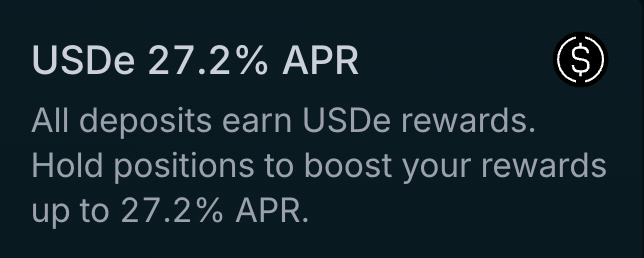
Everyone has different judgments about the future competitive landscape of Perp DEXs, but whether you are mainly farming points on Variational, Backpack, Nado, or StandX, it is currently recommended to use Ethereal as the number one hedging option, using the实实在在的抵押资产收益 to slow down or even cover the wear and tear.

It should be noted that using Ethereal temporarily requires an invitation code to unlock all functions (easy to get in DC), and then you need to bridge USDe from Ethereum to the Ethereal chain (can use StarGate) for deposit and use it as a gas token. There will be certain wear and tear on the path, so it is not recommended to operate with too small an amount.

On-chain Strategy Two: Huma Prime Waiting for Increased Quota, Maximum Annualized 28%

This is a pool that requires setting a small alarm clock.

PayFi leader Huma launched a new pool called Huma Prime yesterday. Actually, to put it bluntly, it is a revolving loan pool for PST. If locked for 6 months, the maximum annualized yield can reach 28% (22.6% without badge加成). The收益 is composed of basic收益, revolving loan收益, plus HUMA incentives.
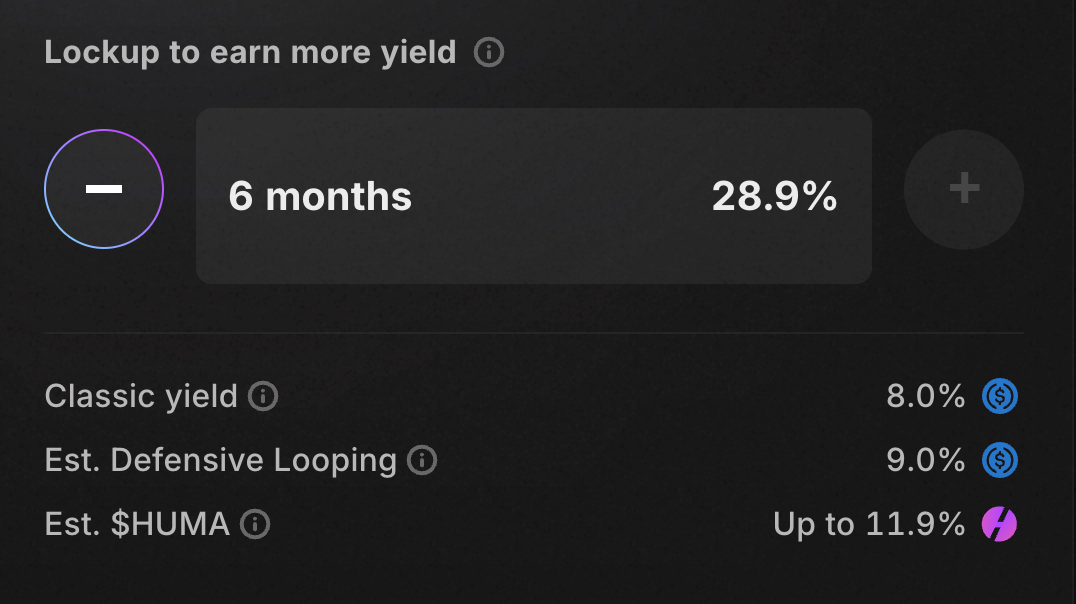
The first 12 hours after the launch of this pool were not open to the public, only supporting OG and Vanguard badge holders to deposit. However, it was filled up only 3 hours after opening, so new users暂时 have no chance to deposit and can only wait for the official quota increase to participate.

It needs to be emphasized first that Huma Prime is different from the previous Classic and Maxi pools. The LP positions have no secondary market, so it is impossible to exit early. Users can only redeem at the Huma official window after the lock-up period ends.

On-chain Strategy Three: Kamino PRIME/CASH Revolving Loan, Maximum Annualized 23.45%

Users who can accept Huma Prime are generally not too resistant to revolving loans. If you don't want to wait for the quota, you can consider the PRIME/CASH revolving loan on Kamino. The Multiply function can build positions with one click by selecting the leverage multiplier, up to 8 times, corresponding to an APY of about 23.45%.

In terms of asset risk, PRIME is a yield stablecoin issued by Hastra, Figure, and Provenance, with抵押资产 being real-world Home Equity Line of Credit (HELOC). CASH is a stablecoin issued by Phantom.

This pool has been open for over a month now, and the historical yield backtest is relatively stable. It is recommended to assess the risk and return situation yourself before participating.

On-chain Strategy Four: Pendle Neutrl(sNUSD) LP, Maximum Annualized 18.41%

Neutrl is a project I personally like very much and have introduced many times before. Simply put, it is a more aggressive version of Ethena, but the hedging asset is changed from mainstream tokens to altcoins acquired at a discount OTC — the main investor is the largest OTC trading platform STIX, giving it a certain uniqueness in model.
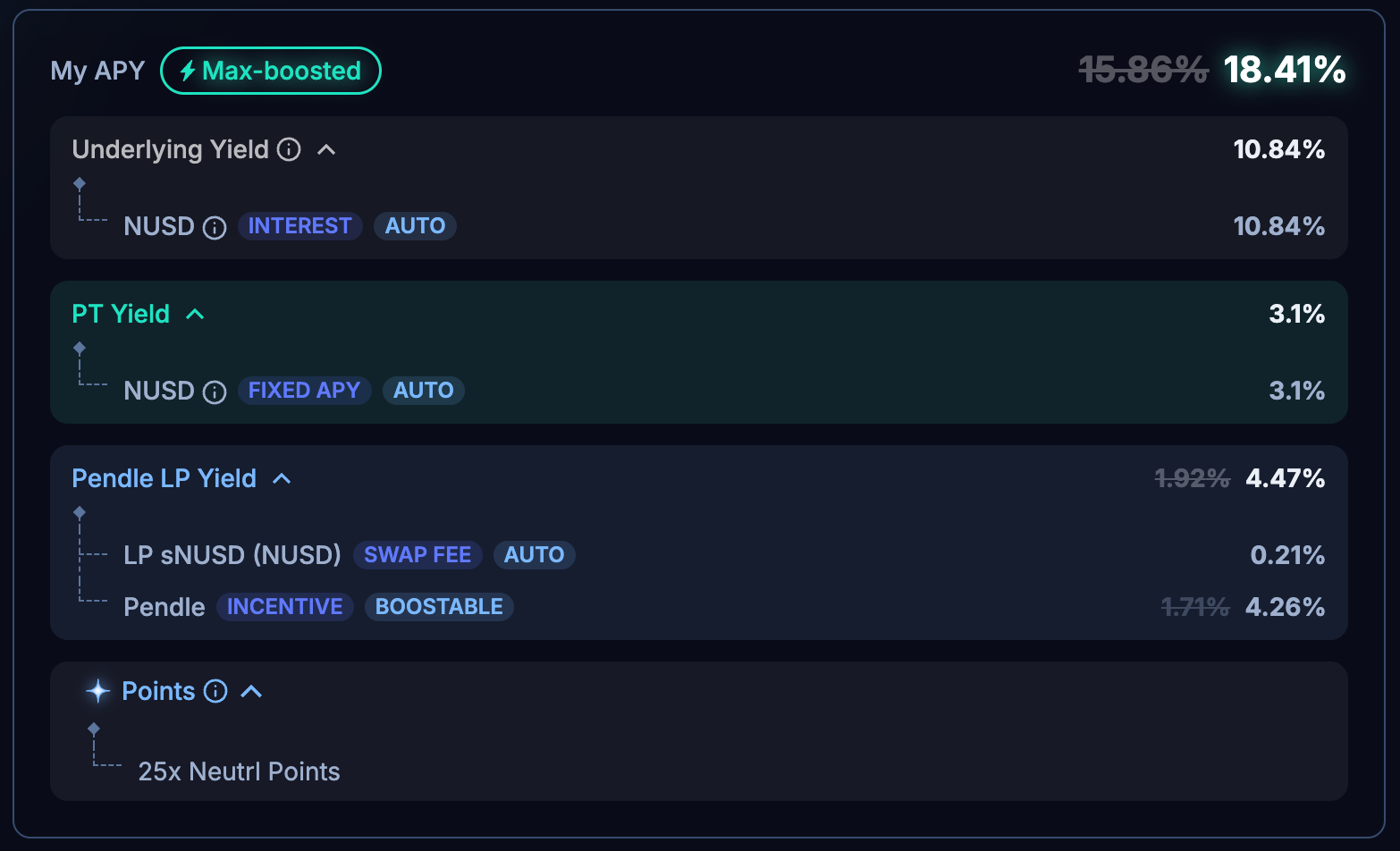
Compared to static deposits (holding NUSD) or staking (holding sNUSD), the most efficient way to participate now is to form an sNUSD LP on Pendle. With sufficient PENDLE staking, the maximum annualized yield can reach 18.41%, the basic annualized yield is 13.97%, plus 25x Neutrl points to capture airdrop opportunities.

Since the pool is on the Ethereum mainnet, there will be certain wear and tear when entering and exiting the path, so it is not recommended to participate with small amounts.


Criptos en tendencia

Preguntas relacionadas

QWhat is the highest APR offered by the Binance USD1 deposit activity mentioned in the article, and what is the deposit limit?

AThe Binance USD1 deposit activity offers an APR of 20.06% with a deposit limit of 50,000 USD1.

QHow can users achieve a maximum APR of 27% on the decentralized exchange Ethereal, and what is required to unlock all its features?

AUsers can achieve a maximum APR of 27% on Ethereal by using a hedging strategy, which involves opening positions to earn trading fee shares. An invitation code is required to unlock all features of the platform.

QWhat is the highest annual yield offered by the new Huma Prime pool, and what is the lock-up period for achieving this yield?

AThe Huma Prime pool offers a maximum annual yield of 28% with a lock-up period of 6 months.

QWhich strategy on Kamino allows users to achieve an APY of up to 23.45% using leverage, and what assets are involved?

AThe Kamino PRIME/CASH loop strategy allows users to achieve an APY of up to 23.45% by using leverage of up to 8x. The assets involved are PRIME, a yield stablecoin backed by real-world home equity lines of credit (HELOC), and CASH, a stablecoin issued by Phantom.

QWhat is the maximum APY achievable by providing liquidity for sNUSD on Pendle, and what additional incentive is offered besides the yield?

AThe maximum APY achievable by providing liquidity for sNUSD on Pendle is 18.41%, and users also earn 25x Neutrl points to capture potential airdrop opportunities.

Lecturas Relacionadas

Agent Race Ends, Super Workbench Takes Over

The era of fragmented AI agents is ending. Over the past month, China's tech giants—Tencent, Alibaba, and ByteDance—have simultaneously shifted strategy: instead of launching new, standalone AI agents, they are consolidating their various agent projects into unified "super workbenches." Tencent integrated its QClaw teams into WorkBuddy, a strategic product hailed as a potential third flagship after QQ and WeChat. Alibaba is merging its QoderWork, Wukong, and MuleRun agents into a new "Qianwen Office" platform under DingTalk's leadership. ByteDance rebranded its TRAE SOLO coding agent to TRAE Work, signaling a broader focus on workflow collaboration. This convergence marks a pivotal industry consensus. The initial exploration phase, where companies rapidly built numerous overlapping agents for different scenarios, proved costly and inefficient. With open-source tools eroding technical barriers, competition has shifted from agent creation to resource consolidation and cost control. Historically, platform wars are won not by creating more products, but by simplifying them—as seen with browsers unifying web access and super-apps consolidating services. Now, the "super workbench" aims to become the unified AI entry point for work. This reflects a deeper market realization: the primary audience for AI is no longer just programmers (a market in the tens of millions) but all knowledge workers (a market of billions). The real opportunity lies in augmenting everyday tasks—managing emails, documents, data, and meetings—across the entire workday. The core battleground is becoming control over the primary AI entry point that employees use daily. Tencent's WorkBuddy leverages WeChat and Tencent Docs; Alibaba's Qianwen Office taps into DingTalk's organizational data; ByteDance's TRAE Work integrates with Feishu's workflows. Whoever owns this "super workbench" gains strategic control over orchestrating enterprise data and APIs. This shift is redefining enterprise software. Traditional SaaS applications, valued for their user interfaces, will recede into the background. Their core functionalities will be exposed as standardized "Skills" or APIs for the super workbench's agents to invoke. Software value will shift from selling user seats to charging based on API calls and outcomes delivered. The evolution of agents is moving through clear stages: first as novel standalone products, then as consolidated primary work entry points, and finally as pervasive, invisible capabilities embedded into the digital fabric. The recent moves by major tech firms signal the transition from the first stage into the second, accelerating toward the third. In the end, the most successful agent technology may become invisible—like electricity or the HTTP protocol—a fundamental, unnamed infrastructure powering work itself.

marsbitHace 19 min(s)

Agent Race Ends, Super Workbench Takes Over

marsbitHace 19 min(s)

Michael Saylor: 110 Reasons to Oppose BIP-110

Michael Saylor presents 110 arguments against Bitcoin Improvement Proposal (BIP) 110, a soft fork aimed at restricting certain non-monetary data storage uses (like inscriptions) on the Bitcoin blockchain. He acknowledges the proponents' valid concerns—such as node costs, fee pressure, and preserving Bitcoin's monetary focus—but fundamentally disagrees with the proposed solution. Saylor argues that BIP 110 represents a dangerous precedent of using consensus rules to enforce value judgments on transaction validity, moving away from Bitcoin's core principles of neutrality and permissionless innovation. His key objections are organized into eleven categories: 1) It violates neutrality and hard consensus by banning currently valid transactions. 2) It fails to meet the high burden of proof required for a consensus change, lacking concrete data on the alleged crisis. 3) Its seven bundled technical restrictions are overly broad, targeting generic script functionalities and blocking future upgrade paths. 4) It sacrifices compatibility and future optionality by closing off designed upgrade hooks. 5) Its temporary rules add significant complexity (grandfathering, expiry states) without sufficient justification. 6) The economic and security impacts, particularly on miner revenue and fee markets, are uncertain and unmodeled. 7) Superior, market-based tools (fee markets, relay/mining policies) already exist to manage blockchain load. 8) It stifles innovation by creating a chilling effect for developers. 9) Its modified activation mechanism (55% threshold, forced signaling) is aggressive and risks network splits. 10) The precedent it sets—using consensus to suppress disliked but legal uses—is more dangerous than the problem it aims to solve. 11) A better path exists: improving measurements, refining resource-based policies, and allowing market forces to work. Saylor concludes that Bitcoin's strength lies in its neutral rules, open markets, and hard consensus. Changing these foundational elements to target specific use cases is an unnecessary and risky "iatrogenic" intervention. He advocates for guarding Bitcoin's neutrality rather than acting as its redeemer.

marsbitHace 34 min(s)

Michael Saylor: 110 Reasons to Oppose BIP-110

marsbitHace 34 min(s)

Trading

Spot

Artículos destacados

Cómo comprar APR

¡Bienvenido a HTX.com! Hemos hecho que comprar aPriori (APR) sea simple y conveniente. Sigue nuestra guía paso a paso para iniciar tu viaje de criptos.Paso 1: crea tu cuenta HTXUtiliza tu correo electrónico o número de teléfono para registrarte y obtener una cuenta gratuita en HTX. Experimenta un proceso de registro sin complicaciones y desbloquea todas las funciones.Obtener mi cuentaPaso 2: ve a Comprar cripto y elige tu método de pagoTarjeta de crédito/débito: usa tu Visa o Mastercard para comprar aPriori (APR) al instante.Saldo: utiliza fondos del saldo de tu cuenta HTX para tradear sin problemas.Terceros: hemos agregado métodos de pago populares como Google Pay y Apple Pay para mejorar la comodidad.P2P: tradear directamente con otros usuarios en HTX.Over-the-Counter (OTC): ofrecemos servicios personalizados y tipos de cambio competitivos para los traders.Paso 3: guarda tu aPriori (APR)Después de comprar tu aPriori (APR), guárdalo en tu cuenta HTX. Alternativamente, puedes enviarlo a otro lugar mediante transferencia blockchain o utilizarlo para tradear otras criptomonedas.Paso 4: tradear aPriori (APR)Tradear fácilmente con aPriori (APR) en HTX's mercado spot. Simplemente accede a tu cuenta, selecciona tu par de trading, ejecuta tus trades y monitorea en tiempo real. Ofrecemos una experiencia fácil de usar tanto para principiantes como para traders experimentados.

952 Vistas totalesPublicado en 2025.10.27Actualizado en 2026.06.02

Cómo comprar APR

Discusiones

Bienvenido a la comunidad de HTX. Aquí puedes mantenerte informado sobre los últimos desarrollos de la plataforma y acceder a análisis profesionales del mercado. A continuación se presentan las opiniones de los usuarios sobre el precio de APR (APR).

活动图片









