KuCoin taps Tomorrowland festivals as MiCA-era on-ramp for European fans

cointelegraphPublicado a 2025-12-17Actualizado a 2025-12-17

Resumen

KuCoin has signed an exclusive multi-year partnership with Tomorrowland music festivals from 2026 to 2028, becoming the event's official crypto and payments partner. This follows KuCoin’s recent acquisition of a MiCA-regulated license in the EU, allowing it to operate as a fully compliant crypto service provider. The collaboration aims to integrate cryptocurrency seamlessly into festival operations—including ticketing, merchandise, and concessions—without disrupting the user experience. Emphasizing security and regulatory compliance, KuCoin seeks to position crypto as a mainstream financial tool, learning from past failed Web3 partnerships like FTX’s with Tomorrowland. The goal is a smooth, invisible integration of digital assets into live events.

KuCoin announced an exclusive multiyear deal with Tomorrowland Winter and Tomorrowland Belgium from 2026 to 2028, making the exchange the music festival’s exclusive crypto and payments partner.

The move comes just weeks after KuCoin secured a Markets in Crypto-Assets Regulation (MiCA) service provider license in the European Union.

KuCoin’s MiCA play goes mass‐market

KuCoin EU Exchange recently obtained a crypto asset service provider license in Austria under the EU’s MiCA regime, giving it a fully regulated foothold in the bloc as Brussels’ new rulebook for exchanges, custody and stablecoins comes into force.

The Tomorrowland deal signals how KuCoin plans to use that status, not just to run a compliant trading venue, but to plug crypto rails directly into mainstream culture.
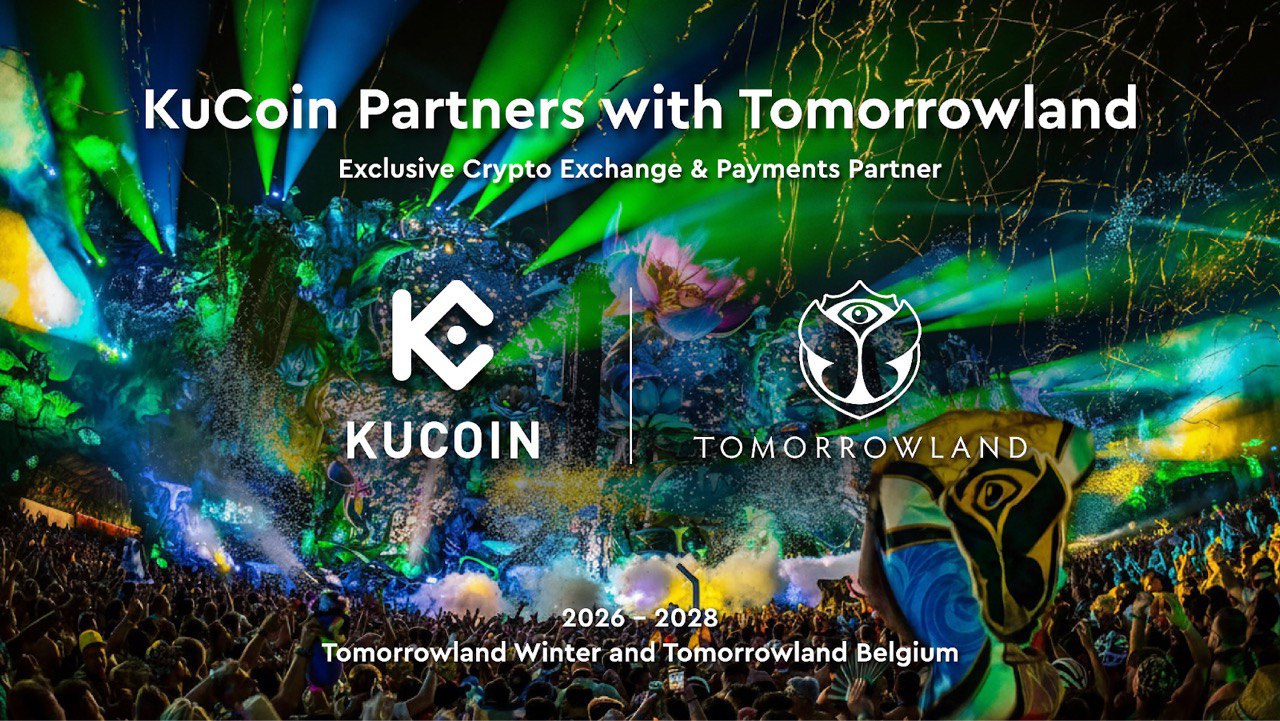
KuCoin joins forces with Tomorrowland. Source: KuCoin

KuCoin said the Tomorrowland deal will cover Tomorrowland Winter 2026 in Alpe d’Huez, France, and Tomorrowland Belgium 2026 in Boom, Belgium, with the same arrangement continuing through 2028.

Related: Burning Man-inspired festival in Bali goes full Web3: Here’s how

From sponsorship to payment rails

KuCoin insists this is not just a logo play. A spokesperson at KuCoin told Cointelegraph that as an exclusive payments partner, the exchange is working with Tomorrowland to weave crypto into the festival’s existing payments stack so that “financial tools” sit behind the scenes of ticketing, merch and food and drink.

The stated goal is to keep the rails “intuitive and invisible,” rather than forcing festivalgoers through clunky wallets or unfamiliar flows, with KuCoin positioning itself as facilitating the secure and efficient movement of value while fans focus on the music.

The company declined to spell out exactly which assets and rails will be supported on‐site, or whether every purchase will run natively onchain, but said that KuCoin’s “Trust First. Trade Next.” mantra runs through its messaging.

The spokesperson stressed advanced security, multi‐layer protection and adherence to EU standards as the foundation for taking crypto beyond the trading screen and into live events.

Related: What is Markets in Crypto-Assets (MiCA)?

Learning from FTX’s Tomorrowland flop

Tomorrowland’s organizers have been here before. In 2022, the festival announced a Web3 partnership with FTX Europe that promised NFTs and “the future of music festivals” before collapsing along with the exchange itself months later.

That experience makes the choice of a MiCA‐licensed partner, and the emphasis on user protection, more than cosmetic; it is a second attempt at bridging culture and crypto (this time with regulatory scaffolding and clearer guardrails).

Rather than setting public hard targets for user numbers or payment volumes by 2028, KuCoin is pitching success as “seamless integration” of crypto into the festival experience:

“We aim to demonstrate that digital assets can be a core component of global digital finance, moving from a niche technology to a mainstream utility. “

Related: Spain’s regulator sets out MiCA transition rules for crypto platforms

Criptos en tendencia

Lecturas Relacionadas

Kraken Changed Its Vote at the Last Minute, Solana's Inflation Policy Narrowsly Passes by 0.33 Percent

Kraken’s last-minute vote reversal secured the passage of SGP-0002, a pivotal Solana governance proposal to accelerate the network’s annual inflation reduction from 15% to 30%. The final vote tally was 67.001%, narrowly exceeding the required 66.667% supermajority by just 0.334 percentage points. This change will bring Solana’s terminal inflation rate of 1.5% forward to around 2029, reducing future SOL issuance over six years by approximately 18.9 million tokens (about 2.6% of current supply). The vote, the first major test of Solana’s new on-chain governance system, saw intense drama. The Kraken 2 validator, controlling about 8.9 million staked SOL, switched from support to opposition hours before the deadline, pushing the "yes" vote below the passing threshold. A flurry of lobbying, including direct outreach by Helius CEO Mert Mumtaz, ensued. Kraken ultimately flipped back to supporting the proposal, and JitoSOL holders used the "staker override" mechanism to bypass opposing validators and vote directly with their stake. While SGP-0002 passed, a companion proposal (SGP-0003) to restructure transaction fees failed, indicating community willingness to adjust token supply but hesitance to change fee economics. The approved proposal now moves to a technical implementation phase, requiring client teams to code and activate the change. The event highlighted both the power of large validators and the resilience of Solana’s governance mechanisms, marking a significant, albeit messy, step in decentralized monetary policy management.

marsbitHace 11 min(s)

Kraken Changed Its Vote at the Last Minute, Solana's Inflation Policy Narrowsly Passes by 0.33 Percent

marsbitHace 11 min(s)

Trading Volume Surges 10 Times in a Month, Who's Driving UNI's Soaring Price?

The article discusses the recent surge in the price of UNI, the governance token of Uniswap, which reached a high above $5.4 on August 31, marking a three-month increase of over 100%. The resurgence is attributed primarily to two key developments. First, Uniswap was designated as the primary Automated Market Maker (AMM) on the newly launched Robinhood Chain. Data shows Uniswap generated $4.29 million in fees in 24 hours on this chain and facilitated a tenfold increase in stock token trading volume over a month, reaching approximately $130 million daily. Second, a fundamental change in UNI's tokenomics, approved in December 2025, activated a "fee switch" mechanism. A portion of protocol fees is now directed to a "TokenJar" contract. Arbitrage bots can destroy an equivalent value of UNI tokens to claim these fees, creating a perpetual buy-and-burn pressure. This mechanism has led to the burning of over 110 million UNI tokens (worth $630 million), with recent daily burns exceeding $400,000 in value, nearly half contributed by activity on Robinhood Chain. The symbiotic relationship is highlighted: Uniswap gains a substantial new source of on-chain revenue to fuel its token deflation, while Robinhood Chain leverages Uniswap's deep liquidity and decentralized infrastructure for its stock token offerings. This integration represents a deeper convergence of traditional and decentralized finance.

marsbitHace 25 min(s)

Trading Volume Surges 10 Times in a Month, Who's Driving UNI's Soaring Price?

marsbitHace 25 min(s)

Major Reshuffle in Foreign Trade Cities! Shenzhen Surpasses Shanghai, Suzhou Surpasses Beijing

A major reshuffle has occurred in China's foreign trade city rankings for the first seven months of 2026. Shenzhen has consolidated its position as the top city, significantly widening its lead over Shanghai. Notably, Shenzhen's import value surpassed Shanghai's for the first time historically. Suzhou overtook Beijing to become the third-ranked city, while Wuxi entered the top ten, replacing Qingdao which dropped out. Xi'an emerged as the biggest dark horse, with its foreign trade soaring by 100.4%. Nationally, import growth (22%) significantly outpaced export growth (14%), becoming the primary driver of overall trade expansion. This surge in imports, particularly of intermediate goods, signals a recovery in domestic demand and strengthens the foundation for future exports. Key cities leading the charge are those with strong foundations in semiconductors and AI hardware. Xi'an's explosive growth is powered by major memory chip manufacturers like Samsung and Micron. Suzhou's rise is driven by electronics and AI computing hardware exports. Shenzhen, Hefei, and Wuxi also benefited from their robust integrated circuit and electronics manufacturing industries. The overall trend shows manufacturing and export-oriented cities advancing rapidly in the rankings. However, 19 of the top 30 cities grew slower than the national average, indicating an uneven recovery.

marsbitHace 40 min(s)

Major Reshuffle in Foreign Trade Cities! Shenzhen Surpasses Shanghai, Suzhou Surpasses Beijing

marsbitHace 40 min(s)

Marvell: Can't Compare to NVIDIA, Can't Meet Expectations, Overvaluation Gets Squeezed First?

Marvell Technology (MRVL.O) reported its Q2 FY2027 earnings (ending July 2026) after market close on August 27. Key points include: The company raised its full-year revenue outlook for FY2027 to $12 billion (from $11.5B) and for FY2028 to $18 billion (from $16.5B). However, these upward revisions were only slightly above market expectations and significantly trailed NVIDIA's recent explosive guidance. The Data Center segment, accounting for 79% of revenue, grew 19% quarter-over-quarter to $2.17 billion, primarily driven by connectivity products. For FY2028, management forecasts over 60% growth for this segment, again below NVIDIA's >70% outlook. A major disappointment for investors was the lack of an upward revision to the Custom ASIC business guidance, despite Marvell's recent partnership agreement with Google. The market had anticipated potential gains from Google's TPU orders, but the maintained guidance for "over 100% growth" in FY2028 (with no specific target for FY2027) led to concerns that the Google deal may be a less favorable "framework agreement" where Marvell holds a weaker negotiating position. Adjusted gross margin was flat at 58.3%. Q3 revenue guidance is $3.15 billion, slightly above consensus. Overall, the report was largely in line with expectations, but the subsequent stock decline is attributed to growth forecasts that failed to meet heightened market expectations (particularly versus NVIDIA) and lingering uncertainty around the tangible benefits of the Google ASIC partnership. High valuation faces near-term pressure, but expectations for >50% growth in the coming years and long-term ASIC opportunity may provide support.

marsbitHace 1 hora(s)

Marvell: Can't Compare to NVIDIA, Can't Meet Expectations, Overvaluation Gets Squeezed First?

marsbitHace 1 hora(s)

US Stock Market Trend (August 31st): Kashkari's Hawkish Remarks Weigh on Chip Stocks, US-Iran Weekend Strikes Boost Oil Prices

U.S. stock markets ended lower on Friday following hawkish remarks from Federal Reserve Chair Wash at the Jackson Hole symposium, which sharply increased the probability of a September rate hike from 35% to nearly 60%. Major indexes fell: the S&P 500 dropped 0.25%, the Nasdaq declined 0.52%, and the Dow was essentially flat. This shift in interest rate expectations pressured rate-sensitive assets, leading to significant declines in chip stocks. The Philadelphia Semiconductor Index fell 3.47%, with Nvidia dropping 4.57%, erasing about half its post-earnings gains. Geopolitical tensions also escalated over the weekend as the U.S. and Iran exchanged military strikes, raising concerns over the security of oil transit through the Strait of Hormuz. This pushed oil prices up over 2% in early Asian trading on Monday, reintroducing a geopolitical risk premium. In other energy news, former President Trump announced a landmark 25-year oil deal with Venezuela, aiming to significantly increase the country's oil production. However, this long-term supply boost was overshadowed in the short term by the Middle East conflict and the dominant market focus on interest rates. The core market narrative for the coming week revolves around the interplay between re-priced hawkish rate expectations and escalating geopolitical risks. Key areas to watch include the trajectory of Treasury yields, the evolution of U.S.-Iran tensions and its impact on oil prices, and whether the sell-off in high-valuation tech and semiconductor stocks stabilizes or continues under the pressure of higher rates.

marsbitHace 1 hora(s)

US Stock Market Trend (August 31st): Kashkari's Hawkish Remarks Weigh on Chip Stocks, US-Iran Weekend Strikes Boost Oil Prices

marsbitHace 1 hora(s)

Trading

Spot

Artículos destacados

Cómo comprar ERA

¡Bienvenido a HTX.com! Hemos hecho que comprar Caldera (ERA) sea simple y conveniente. Sigue nuestra guía paso a paso para iniciar tu viaje de criptos.Paso 1: crea tu cuenta HTXUtiliza tu correo electrónico o número de teléfono para registrarte y obtener una cuenta gratuita en HTX. Experimenta un proceso de registro sin complicaciones y desbloquea todas las funciones.Obtener mi cuentaPaso 2: ve a Comprar cripto y elige tu método de pagoTarjeta de crédito/débito: usa tu Visa o Mastercard para comprar Caldera (ERA) al instante.Saldo: utiliza fondos del saldo de tu cuenta HTX para tradear sin problemas.Terceros: hemos agregado métodos de pago populares como Google Pay y Apple Pay para mejorar la comodidad.P2P: tradear directamente con otros usuarios en HTX.Over-the-Counter (OTC): ofrecemos servicios personalizados y tipos de cambio competitivos para los traders.Paso 3: guarda tu Caldera (ERA)Después de comprar tu Caldera (ERA), guárdalo en tu cuenta HTX. Alternativamente, puedes enviarlo a otro lugar mediante transferencia blockchain o utilizarlo para tradear otras criptomonedas.Paso 4: tradear Caldera (ERA)Tradear fácilmente con Caldera (ERA) en HTX's mercado spot. Simplemente accede a tu cuenta, selecciona tu par de trading, ejecuta tus trades y monitorea en tiempo real. Ofrecemos una experiencia fácil de usar tanto para principiantes como para traders experimentados.

818 Vistas totalesPublicado en 2025.07.17Actualizado en 2026.06.02

Cómo comprar ERA

Discusiones

Bienvenido a la comunidad de HTX. Aquí puedes mantenerte informado sobre los últimos desarrollos de la plataforma y acceder a análisis profesionales del mercado. A continuación se presentan las opiniones de los usuarios sobre el precio de ERA (ERA).

活动图片