Korea Tones Down 20% Crypto Exchange Stake Ban as Regulators Seek Governance ‘Middle Ground’

bitcoinistPublicado a 2026-03-05Actualizado a 2026-03-05

Resumen

South Korean regulators and the ruling party have agreed to impose a 20% ownership cap on major shareholders of cryptocurrency exchanges, following months of debate. The policy includes a three-year grace period for large platforms like Upbit and Bithumb, and up to six years for smaller exchanges. The cap, part of the broader Digital Asset Basic Act, aims to limit founder control while allowing limited exceptions for new businesses. Opposition from industry groups and some lawmakers may still affect the bill's final passage.

South Korean authorities and the ruling party agree on a 20% ownership ceiling for “major shareholders” in crypto and virtual assets exchanges, with a three‐year implementation delay.

From A Strict Proposal To Compromise

After months of friction, the Financial Services Commission (FSC) and the Democratic Party’s digital asset task force have finally converged on a 20% cap for major shareholders, the Korea Herald reports.

South Korea’s 20% cap is the culmination of a long‐running push by FSC, the top financial regulator, to curb founder control at the country’s biggest crypto exchanges. Regulators initially floated a stricter 15–20% range for major shareholders at the leading platforms, a proposal that sparked outrage and fierce opposition from the industry. The backlash was led by the Digital Asset Exchange Alliance (DAXA), a self‐regulatory body representing South Korea’s five major exchanges, including, of course, Upbit and Bithumb.

The Deal Terms

The agreement on a 20% cap and a generous grace period looks like an attempt to find middle ground and defuse tensions. The FSC and the ruling party have endorsed a three‐year grace period to enforce the major shareholder stake restriction, giving Upbit and Bithumb, which together command roughly 90% of the domestic market, some breathing room to start trimming their stakes to meet the new threshold.

Smaller exchanges that do not meet the estimated 20% market‐share bar, such as Coinone, Korbit and GOPAX, will get an even longer runway. South Korean authorities have agreed to grant them an additional three‐year grace period, giving these platforms up to six years in total to prepare for full enforcement of the cap.

Exceptions

The FSC has also carved out narrow exceptions via enforcement decree, allowing stakes of up to 34% only for new businesses, not for existing exchanges. According to The Korea Herald, this threshold appears to mirror the Commercial Act’s 33.3% veto line for general shareholders’ meetings, effectively giving qualified new investors blocking power without restoring full control

The Final Details On The Digital Asset Basic Act

The ruling party’s policy committee is expected to hammer out the final details after a closed‐door meeting with the Financial Services Commission on the morning of the 5th, according to Hankyung. The ownership cap will be folded into a broader Digital Assets Basic Act, an umbrella bill that packages a wide range of crypto policy measures, from stablecoin rules to crypto exchange‐traded funds.

However, the bill’s passage is far from guaranteed. The Korea Herald notes that not only is the opposition party pushing back, but some lawmakers also object to strict limits on major shareholder stakes, casting doubt over whether the cap will clear the National Assembly in its current form.
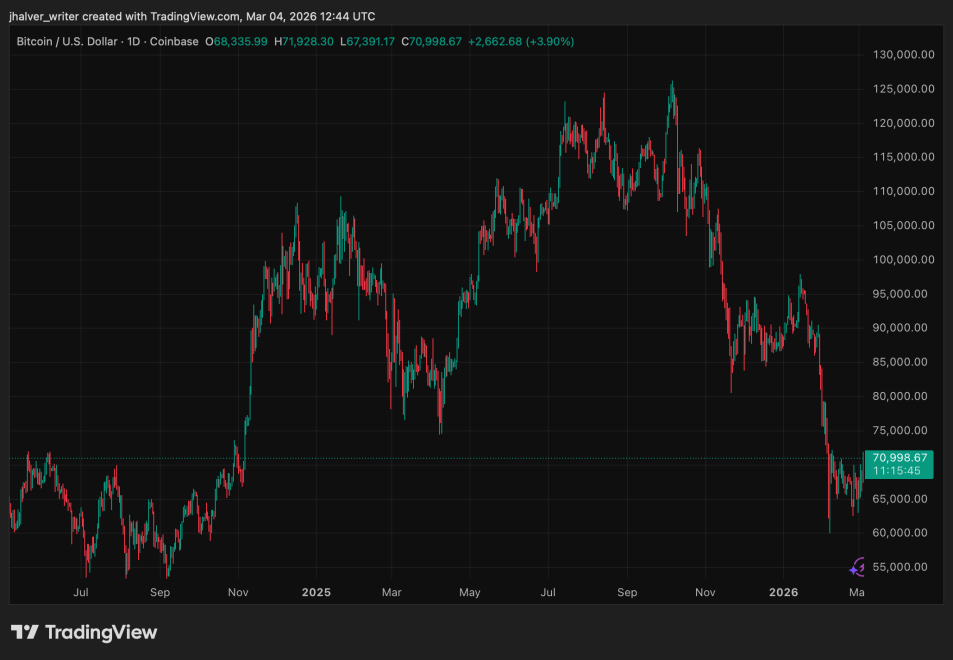
BTC's price trends to the downside on the daily chart. Source: BTCUSD on Tradingview

Cover image from ChatGPT, BTCUSD chart from Tradingview

Preguntas relacionadas

QWhat is the new ownership cap for major shareholders in South Korean crypto exchanges, and what was the implementation delay agreed upon?

AThe new ownership cap for major shareholders in South Korean crypto exchanges is 20%, with a three-year implementation grace period.

QWhich two major South Korean crypto exchanges, which dominate the market, were given a three-year grace period to comply with the new stake limit?

AUpbit and Bithumb, which together command roughly 90% of the domestic market, were given a three-year grace period.

QHow does the grace period for smaller exchanges like Coinone and Korbit differ from that of the major ones?

ASmaller exchanges that do not meet the 20% market-share bar will be granted an additional three-year grace period, giving them up to six years in total to comply.

QWhat is the exception to the ownership cap, and what specific power does it grant to qualified new investors?

AAn exception allows stakes of up to 34% for new businesses (not existing exchanges), which mirrors the Commercial Act's 33.3% veto line, giving qualified new investors blocking power in shareholders' meetings.

QInto what larger legislative package will the ownership cap be incorporated, and what is a major obstacle to its passage?

AThe ownership cap will be folded into the broader Digital Assets Basic Act. A major obstacle to its passage is opposition from some lawmakers and the opposition party who object to the strict limits on major shareholder stakes.

Lecturas Relacionadas

You Bet on the News, the Pros Read the Rules: The True Cognitive Gap in Losing Money on Polymarket

The article explains that the key to profiting on Polymarket, a prediction market platform, lies not just predicting real-world events correctly, but in meticulously understanding the specific rules that govern how each market will be resolved. It illustrates this with examples, such as a market on Venezuela's 2026 leader, where the official rules defining "officially holds" the office overruled the intuitive answer of who was in practical control. Other examples include debates over the definition of a "token" or what constitutes an "agreement." The core argument is that a "reality vs. rules" gap creates pricing discrepancies that savvy traders ("车头" or "whales") exploit. The platform has a formal dispute resolution process managed by UMA token holders to settle ambiguous outcomes. This process involves proposal submission, a challenge window, a discussion period, and a final vote. However, the article highlights a critical flaw in this system compared to a traditional court: the lack of separation between the arbiters (UMA voters) and the interested parties (traders with financial stakes in the outcome). This conflict of interest undermines the discussion phase, leads to herd mentality, and results in opaque final decisions without explanatory rulings. Consequently, the system lacks a body of precedent, making it difficult for users to learn from past disputes. The ultimate takeaway is that success on Polymarket requires a lawyer-like scrutiny of the rules to identify and capitalize on the cognitive gap between how events appear and how they are contractually defined for settlement.

marsbitHace 14 min(s)

You Bet on the News, the Pros Read the Rules: The True Cognitive Gap in Losing Money on Polymarket

marsbitHace 14 min(s)

Will the Fed Still Cut Interest Rates? Tonight's Data Is Crucial

The core debate surrounding the Federal Reserve's potential interest rate cuts is intensifying amid geopolitical conflict and rebounding inflation. The key question is whether high energy prices will cause persistent inflation or weaken consumer demand enough to force the Fed to cut rates. Citigroup presents a bullish case for cuts, arguing that oil supply disruptions from the Strait of Hormuz are temporary and will not lead to lasting inflationary pressure. They point to receding bond yields and oil prices as evidence the market is pricing in a short-lived shock. Citi's data also shows tightening financial conditions, a stabilizing labor market, and healthy tax returns, supporting their view that the path to lower rates remains open. Conversely, Deutsche Bank offers a starkly contrasting, more hawkish outlook. They argue the Fed's current policy is already neutral and expect rates to remain unchanged indefinitely. Their view is based on stalled disinflation progress and a shift toward more hawkish rhetoric from key Fed officials like Waller, who cited risks from prolonged Middle East conflict and tariffs. Other officials, including Williams and Hammack, signaled rates would likely stay on hold for a "considerable time." The market pricing has shifted dramatically, now forecasting zero cuts in 2026. The imminent release of the March retail sales "control group" data is highlighted as a critical test. This metric, which excludes gas station sales, will reveal if high gasoline prices are eroding consumer spending in other areas. A weak reading could support the case for imminent rate cuts, while a strong one would bolster the argument for the Fed to hold steady. This data is pivotal for determining the near-term policy path.

marsbitHace 34 min(s)

Will the Fed Still Cut Interest Rates? Tonight's Data Is Crucial

marsbitHace 34 min(s)

The Second Half of Macro Influencer Fu Peng's Career

Fu Peng, a prominent Chinese macroeconomist and former chief economist of Northeast Securities, has joined Hong Kong-based digital asset management firm Bitfire Group (formerly New Huo Group) as its chief economist. This move, announced in April 2026, triggered an 11% surge in Bitfire's stock price. Fu, known for his accessible macroeconomic commentary and large social media following, will focus on integrating digital assets into global asset allocation frameworks, particularly combining FICC (fixed income, currencies, and commodities) with cryptocurrencies for institutional clients. His career includes roles at Lehman Brothers and Solomon International, with significant influence gained through public communication. However, in late 2024, Fu faced temporary social media bans after a controversial private speech at HSBC on China's economic challenges, though he denied regulatory sanctions. He later left Northeast Securities citing health reasons. Bitfire, a licensed virtual asset manager serving high-net-worth clients, seeks to build trust and attract traditional capital through Fu’s expertise and credibility. The partnership represents a strategic shift for both: Fu enters the crypto sector after a traditional finance peak, while Bitfire aims to leverage his macro framework for institutional adoption. Outcomes remain uncertain regarding capital inflows and compatibility within corporate structure.

marsbitHace 1 hora(s)

The Second Half of Macro Influencer Fu Peng's Career

marsbitHace 1 hora(s)

Trading

Spot
Futuros

Artículos destacados

Cómo comprar BAN

¡Bienvenido a HTX.com! Hemos hecho que comprar Comedian (BAN) sea simple y conveniente. Sigue nuestra guía paso a paso para iniciar tu viaje de criptos.Paso 1: crea tu cuenta HTXUtiliza tu correo electrónico o número de teléfono para registrarte y obtener una cuenta gratuita en HTX. Experimenta un proceso de registro sin complicaciones y desbloquea todas las funciones.Obtener mi cuentaPaso 2: ve a Comprar cripto y elige tu método de pagoTarjeta de crédito/débito: usa tu Visa o Mastercard para comprar Comedian (BAN) al instante.Saldo: utiliza fondos del saldo de tu cuenta HTX para tradear sin problemas.Terceros: hemos agregado métodos de pago populares como Google Pay y Apple Pay para mejorar la comodidad.P2P: tradear directamente con otros usuarios en HTX.Over-the-Counter (OTC): ofrecemos servicios personalizados y tipos de cambio competitivos para los traders.Paso 3: guarda tu Comedian (BAN)Después de comprar tu Comedian (BAN), guárdalo en tu cuenta HTX. Alternativamente, puedes enviarlo a otro lugar mediante transferencia blockchain o utilizarlo para tradear otras criptomonedas.Paso 4: tradear Comedian (BAN)Tradear fácilmente con Comedian (BAN) en HTX's mercado spot. Simplemente accede a tu cuenta, selecciona tu par de trading, ejecuta tus trades y monitorea en tiempo real. Ofrecemos una experiencia fácil de usar tanto para principiantes como para traders experimentados.

536 Vistas totalesPublicado en 2024.12.11Actualizado en 2025.03.21

Cómo comprar BAN

Discusiones

Bienvenido a la comunidad de HTX. Aquí puedes mantenerte informado sobre los últimos desarrollos de la plataforma y acceder a análisis profesionales del mercado. A continuación se presentan las opiniones de los usuarios sobre el precio de BAN (BAN).

活动图片