Kenyan KNEC Places 15 Million Academic Records on Avalanche

cryptonews.ruPublicado a 2026-08-03Actualizado a 2026-08-03

Resumen

The Kenyan National Examinations Council (KNEC) has digitized over 15 million academic records on the Avalanche ($AVAX) C-Chain blockchain. This new system allows for near-instant verification of certificates for job seekers and employers, replacing a paper-based process that previously took up to six months for large-scale checks. The initiative, developed with local tech firm LegitDoc, covers key exam records (KCPE, KCSE), professional diplomas, and teacher certificates. It aims to combat fraud by providing immutable, secure records easily verifiable through an official portal. While the network's ability to handle high volumes at low cost makes it attractive for such large-scale government projects, the price of AVAX has seen a significant decline. This project follows other major government uses of Avalanche, including land record management in India and document handling by California's DMV.

Kenya's National Examinations Council (KNEC) is providing job applicants and employers the ability to verify certificates in seconds by recording the country's academic data on the Avalanche ($AVAX) C-Chain system.

Ava Labs announced the product launch in a blog post on August 3, and Avalanche confirmed it on the same day via platform X.

What is the New Data Recording System in Kenya?

For years, verifying a Kenyan certificate meant submitting a request through official portals or sending physical documents back and forth. A single verification could take up to a month, and bulk verification for large recruitment agencies could take up to six months.

However, the National Examinations Council of Kenya (KNEC) has recently begun migrating the country's academic records to the Avalanche blockchain, enabling verification within seconds.

Reportedly, over 15 million records are now stored on the Avalanche ($AVAX) C-Chain, with the system expected to grow to approximately 35 million records.

KNEC CEO Dr. David Njengere stated that students can now "securely access, download, and verify their KCSE certificates online." Certificates for the 2025 KCSE exams, taken by nearly 1 million students, are now available exclusively through this digital system.

The project encompasses documents for 8th-grade (KCPE), 12th-grade (KCSE), diploma, and teacher certification. The work is being carried out on the LegitDoc platform by a local Kenyan technology company.

In addition to increasing verification speed, the old paper system was also prone to fraud. Counterfeit certificates were a problem, and even QR codes on these diplomas led to regular databases that could be copied using fake websites.

However, each record in the new blockchain system is a secure, immutable entry, and anyone with access to the official portal can quickly verify the true status of a certificate.

Why is Kenya Using Avalanche?

The LegitDoc platform and the Avalanche blockchain were also used in India's Dantewada district to host over 700,000 land records on the blockchain. This project reduced verification time from several weeks to less than a day.

Avalanche has been used for other major projects as well, including the California Department of Motor Vehicles' work with 42 million vehicle documents and the Bergen County, New Jersey, project for processing real estate documents.

Cryptopolitan reported that Japanese company Progmat used the Avalanche Layer 1 for a security tokenization project worth over $3 billion, and the Aave lending protocol deployed its new system on Avalanche.

The network's ability to handle large transaction volumes at low cost makes it attractive for large-scale government projects. Records dating back to 1989 are now included in the new system.

However, even despite these successes, the price of $AVAX has declined. On August 3, 2026, $AVAX was trading at approximately $6.52, down about 70% from a year ago.

end-content

Preguntas relacionadas

QWhat is the main purpose of the new system launched by the Kenya National Examinations Council (KNEC) on the Avalanche blockchain?

AThe main purpose is to allow job seekers and employers to verify academic certificates in seconds, by storing the country's academic records on the Avalanche C-Chain.

QHow many academic records has KNEC reportedly placed on the Avalanche blockchain initially, and what is the expected growth?

AKNEC has reportedly placed over 15 million academic records on the Avalanche C-Chain initially, and the system is expected to grow to approximately 35 million records.

QWhat specific exam certificates for the year 2025 are now exclusively available through the new digital system?

AThe certificates for the 2025 Kenya Certificate of Secondary Education (KCSE) exams, taken by nearly 1 million candidates, are now exclusively available through this digital system.

QWhat are some of the other major government or institutional projects mentioned that have utilized the Avalanche blockchain?

AOther major projects include storing over 700,000 land records for the Dantewada district in India, the California Department of Motor Vehicles' project with 42 million vehicle documents, the Bergen County, New Jersey property deed project, a $3 billion+ securities tokenization project by Japan's Progmat, and the new system rollout for the Aave lending protocol.

QWhat was the reported trading price of AVAX on August 3, 2026, and how does it compare to its price a year prior?

AOn August 3, 2026, AVAX was reportedly trading at approximately $6.52, which is about 70% lower than its price a year ago.

Lecturas Relacionadas

XRP Ledger Active Users Approach 200,000

The number of daily active users on the XRP Ledger is approaching 200,000, one of the highest levels in recent months. Despite XRP continuing to trade below key technical resistance, on-chain data shows accelerated network activity, suggesting growing ecosystem usage even as price momentum remains subdued. The increase to roughly 190,800 daily active users has been sustained through late July, marking a significant recovery from levels around 100,000 during the broader market correction. This rise indicates user return driven by sustained engagement rather than just speculative trading. Higher address activity typically reflects broader blockchain adoption and can boost transaction counts, payment volumes, and dApp liquidity—considered healthier indicators than price fluctuations. However, XRP's price has not mirrored this network improvement, currently trading near $1.07 and struggling to break resistance at $1.10. It remains below its 50-day and 100-day moving averages, with a recent attempt to break out of a symmetrical triangle losing momentum. The technical outlook remains mixed; while blockchain activity shows improving fundamentals, price action lacks confirmation of a broader recovery. A decisive break above the 200-day moving average near $1.21 is needed to strengthen the long-term technical outlook. Momentum indicators like the RSI, around 47, show a balanced forecast with reduced selling pressure. In conclusion, XRP Ledger user activity nears a yearly high despite the asset's price being below major technical barriers. Sustained user growth, coupled with a price recovery above key moving averages, could begin to align the technical structure with the strengthening on-chain fundamentals.

cryptonews.ruHace 1 hora(s)

XRP Ledger Active Users Approach 200,000

cryptonews.ruHace 1 hora(s)

ZEC Price Just Surpassed $490 — Here's What Fueled the Rally

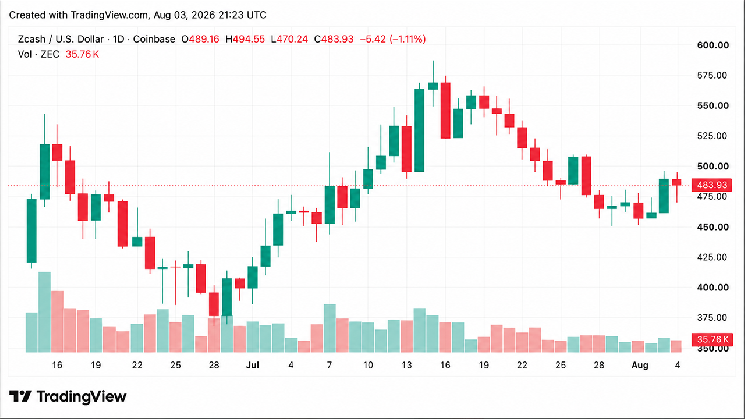
ZEC Surges Past $490, Key Drivers Behind the Rally On August 3, the privacy-focused cryptocurrency Zcash (ZEC) surged nearly 5%, climbing over $20 in a six-hour rally to a session high near $494. This move helped ZEC's market cap reclaim $8 billion, solidifying its position as the most valuable privacy coin and marking an almost 8% gain for the month. While benefiting from a broader market uptrend, ZEC's outperformance was driven by significant fundamental catalysts. The primary driver was the integration by privacy infrastructure project Nym of Zcash's new shielded pool, Ironwood. This enables direct, end-to-end private payments in ZEC for network services, a landmark development for privacy-first decentralized finance. The rally coincides with renewed industry focus on privacy as digital assets mature. Industry observers note privacy is becoming the "next frontier," evolving from Bitcoin's proof-of-concept to Ethereum's programmability and Solana's scalability. Commentary highlighted that true privacy, via zero-knowledge (ZK) technology which is now production-ready, was a foundational goal for early crypto pioneers. Further momentum came from Zcash's progress in decentralized governance, launching a retroactive grant funding (RetroPGF-like) program. This shifts treasury fund distribution from closed committees to direct coin holder voting, pioneering a privacy-native funding mechanism. ZEC's surge helped push the total market capitalization of privacy-focused coins above $30 billion. Other notable gainers included NEAR, ZK, and NOCK. However, losses in coins like ZANO, ZBT, and a significant drop in last week's leader COTI partially offset the sector's overall gains.

cryptonews.ruHace 1 hora(s)

ZEC Price Just Surpassed $490 — Here's What Fueled the Rally

cryptonews.ruHace 1 hora(s)

Jim Cramer Plans to Dump His Bitcoin, Warns Quantum Firm Will Crack Crypto Soon

CNBC's Jim Cramer announced plans to sell his Bitcoin holdings, citing warnings from IBM's CEO Arvind Krishna that commercially viable quantum computers could break Bitcoin's cryptography within three to four years. This statement triggered the popular "Inverse Cramer" reaction in crypto markets, with many traders viewing it as a bullish signal, and Bitcoin's price remained stable around $63,764. The specific quantum threat targets the ECDSA signature scheme, potentially exposing private keys from public ones for Bitcoin addresses that have been reused or are visible during transaction broadcasts. Researchers estimate around 30% of all BTC, or 6-7 million coins held in older "dormant" wallets, could be vulnerable. While a recent Google Quantum AI paper suggested such an attack might require fewer physical qubits than previously thought, current quantum systems are still orders of magnitude away from the reliable logical qubits needed. Expert timelines for a functional cryptographically relevant quantum computer vary widely, from Krishna's 2028-2029 estimate to more conservative predictions in the 2030s or 2040s. Cramer has a history of shifting his Bitcoin stance, and his latest warning was largely interpreted as a market sentiment indicator rather than a technical analysis. The focus now is on whether Bitcoin's development of quantum-resistant upgrades will outpace the advancement of quantum computing hardware.

cryptonews.ruHace 1 hora(s)

Jim Cramer Plans to Dump His Bitcoin, Warns Quantum Firm Will Crack Crypto Soon

cryptonews.ruHace 1 hora(s)

Trading

Spot
活动图片