K2.6 is Yang Zhilin's First Roadshow

marsbitPublicado a 2026-04-22Actualizado a 2026-04-22

Resumen

K2.6 is Yang Zhilin's first roadshow for Moonshot AI's upcoming IPO. The release of K2.6 marks a strategic shift from a developer-focused approach to one aimed at investors and enterprise clients. Key changes include a 58% price increase for API inputs, structured to favor locked-in enterprise users over casual customers. The model is positioned against previous-generation international models like GPT-5.4 rather than the latest competitors, framing it as "first-tier." It also introduces large-scale Agent clusters (300+ agents) and open-source offerings, targeting enterprise automation scenarios. These moves are seen as preparations for K3, a anticipated 3-4 trillion parameter model. With Moonshot's valuation rising to $18 billion, K2.6 is a crucial step to demonstrate commercial viability and market positioning ahead of a potential late-2026 IPO.

By Xiang Xianzhi

The night before last, Moonshot AI released Kimi K2.6 and raised the API input price from $0.60 per million tokens to $0.95 per million tokens.

A 58% increase. The first price hike since the K2 series launched.

But it seems no one is paying attention to this.

Four months ago, in an internal letter on the last day of 2025, Yang Zhilin wrote that Moonshot AI was "not in a hurry for an IPO in the short term." At that time, Zhipu and MiniMax had already submitted their prospectuses to the Hong Kong Stock Exchange. This was clearly a deliberate positioning strategy.

He also wrote in that letter that the company's cash reserves exceeded $1.4 billion, and the Series C round of $500 million was oversubscribed—the subtext being that the potential of the primary market had not been fully utilized, and there was no rush for the secondary market.

Three months later, Bloomberg reported that he had begun talks with CICC and Goldman Sachs. Three weeks after that, K2.6 was launched.

A person who dislikes "rushing" did in four months what he previously said he wouldn't do.

K2.6 is certainly not the last product release before Moonshot AI's IPO. But this version release is Yang Zhilin's first roadshow after Moonshot AI planned to go public.

Kimi Has Never Released a Model Version Like This Before

Kimi had a set routine for releasing models in the past.

Publish a technical report, open-source the weights, top the HuggingFace leaderboard, and then await scrutiny from the tech community. K1.5 countered o1 with a reasoning methodology, with technical details outweighing benchmark numbers; K2 Thinking directly dumped the weights on HuggingFace, letting developers run their own tests. These moves were aimed at developers and researchers.

The rhetoric was also from the tech community: what problem did we solve, why is our method better, welcome to reproduce.

K2.6's moves are somewhat different.

First, the price increase. In RMB terms, the input price for K2.6 is 6.5 yuan per million tokens (cache miss), compared to 4 yuan for K2.5. The output price increased from 21 yuan to 27 yuan. The cache hit price is 1.1 yuan.

This is a structured price increase. Superficially, all tiers are increasing, but the cache hit tier has the smallest increase—from 0.7 yuan to 1.1 yuan, which is $0.16 per million tokens in USD.

This $0.16 is the key to understanding this price hike.

For enterprise users who repeatedly call the same system prompt: code assistants, Agent orchestration frameworks, smart customer service—their prefix is highly reusable, and cache hit rates can reach 75% to 83%. Moonshot AI left a nearly flat price for these customers.

For scattered customers who use it occasionally with different prompts each time, this price increase falls squarely on them.

This is a friendly price adjustment for "enterprises already tied to Kimi" and an unfriendly one for "scattered customers still comparing prices". The former are the "enterprise locked-in clients" in the IPO story, the latter are the "long-tail users" that won't appear on the roadshow PPT. Moonshot AI knows very well who its valuation assets are.

The compute structure of the Agent era is different from the chat era. Chat models are dozens of tokens back and forth, Agents are thousands of tool calls and hundreds of thousands of token consumption. Official K2.6 use cases—Mac local deployment Qwen3.5 model calling tools over 4000 times, running for 12 hours; refactoring the open-source matching engine exchange-core, 1000+ tool calls over 13 hours; more extreme, 5 days of autonomous operation monitoring alerts, fault response—the token consumption for these single tasks is hundreds or even thousands of times that of chat scenarios in the K2.5 era.

Of course, these cases are meant to illustrate long-range reasoning capabilities, but coupled with K2.6's 300-agent cluster, the token consumption must be staggering.

At the old price of $0.60, this kind of Agent task might lose money per call. At $0.95, it barely covers the inference cost.

So the price increase isn't confidence, it's necessity. Moonshot AI has raised $2.5 billion cumulatively, with $1.4 billion cash reserve from Series C to C+, but if the next-gen K3 is truly a 3-4 trillion parameter scale, a single pre-training run might eat up half of that.

Without a price increase, the gross margin data for the last few quarters before the IPO would look bad. The prospectus must disclose gross margin.
This could have been explained openly—the Agent era requires a new pricing model. But Moonshot AI didn't. Because C-end users just came from the free era of K2 Thinking, and telling them "I raised prices" now is not a good product narrative.

It's a story for another audience—Kimi already has a group of enterprise clients who can't leave it, and they'll use it even if it's more expensive. (Like myself)

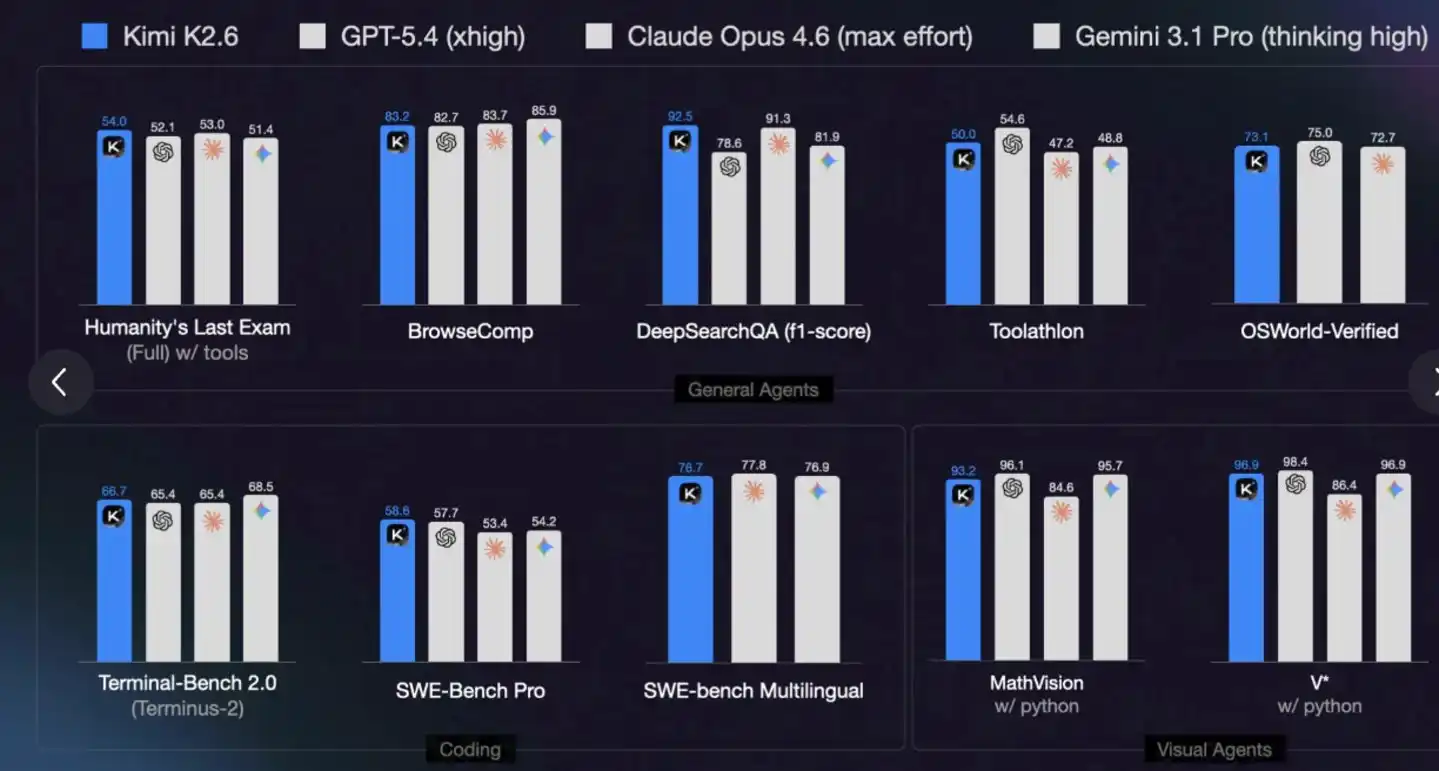
The second thing is benchmark comparisons. K2.6's official chosen references are GPT-5.4, Claude Opus 4.6, Gemini 3.1 Pro. All three are previous-generation flagships.

The same week, Anthropic released Claude Mythos, and Opus 4.7 just launched—both are a generation stronger than Opus 4.6. K2.6 didn't benchmark against them.

This is actually an active choice. Benchmarking against Mythos, K2.6 falls into the "catch-up" position; benchmarking against Opus 4.6, K2.6 falls into the "first tier" position. An $18 billion valuation needs the latter.

Kimi didn't really do this in the past. When K2 Thinking was released, the official ran full benchmarks, good and bad results, all released for developers to judge for themselves. That was the tech community's way—the community understands where you are strong and weak, and is willing to accept a model with obvious shortcomings but a clear roadmap.

Roadshow PPTs are not. Roadshow PPTs need a conclusion a fund manager can understand in 30 seconds: "on par with or superior to top international closed-source models." This sentence is verbatim from the K2.6 official blog.

The third thing is the Agent cluster and open-source dual track. K2.6 upgraded something called Claw Groups—a heterogeneous Agent ecosystem where Agents with different devices, different models, and different toolchains run in a collaborative space, with K2.6 acting as the scheduler. 300 sub-Agents in parallel, 4000 steps of collaboration, 5 days of autonomous operation.

These numbers are written for enterprise clients. Not for developers. For a developer, "300 Agents in parallel" has no practical meaning—they won't run 300 Agents in a local project. This configuration only makes sense for one type of client: large enterprises that need an Agent matrix to automate entire operational processes.

It's targeting the Salesforce story, not the HuggingFace story.

Meanwhile, K2.6 is fully open-sourced. Yang Zhilin said at the Zhongguancun Forum on March 26th that open source will be an absolute victory.

Open source + enterprise Agent clusters—this is a position between DeepSeek and Anthropic, half and half of both models. It sounds like a good story. But occupying both ends means having to prove both.

The capital market doesn't really care if these questions have answers. It only requires you to have a story for each line.

Price increase, benchmarking, Agent cluster—these three things together have an反常的共同点 (abnormal common point). None are for the tech community.

Kimi's underlying logic for releasing models in the past was—if developers like us, enterprise clients will eventually follow, and the capital market will follow even later. This playbook has a name: technical sincerity.

K2.6 isn't waiting. The price increase is a direct declaration of B-end pricing power; benchmarking against GPT-5.4 is preemptively securing a valuation position; Agent clusters and Claw Groups are the showroom for the enterprise service story.

Each thing corresponds to a question on the roadshow PPT: What is your commercialization capability? What is your benchmark position? What is your B-end moat?

Compressing the time from Preview to GA to 8 days is also this logic. Previous versions of the K2 series all went through 2-3 month preview periods, letting the community test enough, provide feedback, and iterate enough. K2.6 didn't give itself this space. It's not that the technology matured faster; the window won't wait.

An IPO in the second half of 2026 requires 4 to 6 months for filing, inquiry, hearing, roadshow, pricing, and cooling-off period according to HKEX procedures. Starting the roadshow in September means the product must be ready by April.

If GA isn't released in April, there's no window later.

K3 is the Real Grand Finale

But K2.6 is also not the strongest card Moonshot AI can play.

There is a very restrained sentence in the official blog—K2.6 is the "runway prepared for K3".

12-hour long-range coding, 300-Agent cluster, context compressor—these are not the final form of the K2 series; they are the execution layer infrastructure that a larger base model can support. Moonshot AI wouldn't spend effort making this work unless it was certain a larger model would consume these capabilities.

Rumors about K3 leaked on Reddit earlier, targeting a parameter scale of 3-4 trillion. Compared to the trillion-scale of the K2 series, this is a base leap.

If K3 can be released during the roadshow window—that is the real answer sheet. The runway paved by K2.6 allows K3 to take off.

The question is whether it can make it. How long does it take to train a 3-4 trillion parameter model? GPT-5 and Claude Opus 4.6 both had roughly 6-9 month pre-training cycles, plus several months for post-training and safety evaluation. Can Moonshot AI's existing compute—judging from the Alibaba Cloud cooperation and current cash reserves—compress this cycle to 5-6 months?

This bet is placed on K2.6.

Eight days from Preview to GA, Agent cluster expanding from 100 to 300 in one go, long-range execution stretching from hundreds of steps to 4000 steps—every move compresses time, making room for the possibility of K3.

If K3 can be released before August or September—that's the grand finale on the roadshow.

If it doesn't make it—K3 becomes a "model that can only be released after the IPO," and K2.6 has to shoulder the entire valuation narrative alone.

Moonshot AI is betting it can be done.

What Does the $18 Billion Valuation Anchor?

Back to valuation.

Three months ago, Moonshot AI was valued at $4.3 billion; two months ago, $5.5 billion; now, $18 billion.

It's not that Moonshot AI became four times stronger in these three months. It's that Zhipu and MiniMax went public and rose 4x, pushing the ceiling of the entire sector up. Zhipu's HK market cap is HK$305 billion, MiniMax's is HK$309.2 billion—both exceeding SenseTime's historical peak.

The valuation logic for these two is not "what the next-gen technology can do," but "how much AI assets can be priced in the Hong Kong market pool."

Moonshot AI's $18 billion valuation anchors the same thing. It is no longer proving it is the strongest Chinese AI company; it is proving it is a priceable Chinese AI company.

All of K2.6's moves—price increase, benchmarking, Agent cluster, open-source dual track—respond to this proposition.

But there is one thing K2.6 has not yet proven. Will Kimi's C-end users be willing to pay for the more expensive K2.6? Will paying subscribers churn to DeepSeek or MiniMax? How many enterprise clients are actually running Claw Groups, and how many just signed a POC?

These are numbers investors will definitely ask during the roadshow. K2.6 can only put the product out now. Whether it turns into numbers depends on the next three months.

When Zhipu went public, it submitted a prospectus where profits weren't yet positive; MiniMax did too. Investors accepted this story because the grand narrative of "Chinese AI assets" had just opened. Moonshot AI is half a year late. For the same question, Zhipu and MiniMax could say "we are validating," Moonshot AI must say "we are monetizing."

This pressure falls entirely on the three months between K2.6 and K3.

So back to the initial question—Is K2.6 Moonshot AI's final roadshow before the IPO?

No.

If K3 catches the roadshow window, K3 is the real grand finale. K2.6 is just the runway paved for it. If K3 misses the roadshow window, K2.6 has to carry the entire IPO narrative. Then it is Yang Zhilin's被迫提前开讲的第一场 (first, forced-to-start-early one).

Neither outcome was what Yang Zhilin wanted four months ago.

But everything that happened in these four months—Zhipu MiniMax IPO, valuation ceiling pushed up, window period compressed—forced a person who dislikes "rushing" to have to rush.

When K3 is released, it will be the second act.

Preguntas relacionadas

QWhat is the significance of the K2.6 model release for Moonshot AI's IPO plans?

AThe K2.6 model release is Yang Zhilin's first roadshow for Moonshot AI's planned IPO. It is a strategic move to demonstrate the company metrics crucial for valuation, such as enterprise pricing power, competitive positioning, and B2B capabilities, ahead of a potential listing in the second half of 2026.

QHow did Moonshot AI adjust its API pricing with the K2.6 release, and what was the strategic reason?

AMoonshot AI raised its API input price from $0.60 to $0.95 per million tokens, a 58% increase. This was a structured price hike designed to be friendly to enterprise clients with high cache hit rates (who saw a smaller increase) while passing the full increase to more casual, price-comparing users. The move was necessary to improve gross margin figures for the IPO prospectus and to align pricing with the high token consumption of the new Agent era.

QWhy did the K2.6 benchmark choose to compare itself to older models like GPT-5.4 instead of the latest ones?

AK2.6 was benchmarked against previous-generation flagship models like GPT-5.4 and Claude Opus 4.6 rather than the newer, stronger contemporaries (e.g., Claude Mythos) to position itself in the 'first tier' of models for its roadshow narrative. This creates a more favorable comparison for fund managers, supporting a valuation story of being 'on par with or superior to top international closed-source models'.

QWhat is the 'Claw Groups' feature in K2.6, and which audience is it targeting?

AClaw Groups is a feature for heterogeneous Agent ecosystems, allowing up to 300 different Agents across various devices, models, and toolchains to operate collaboratively with K2.6 as the scheduler. This targets enterprise clients, not developers, as it demonstrates a solution for large corporations seeking to automate full-process operations with an Agent matrix, akin to a Salesforce enterprise story.

QWhat is the relationship between the K2.6 release and the anticipated K3 model?

AK2.6 is described as the 'runway' for the much larger K3 model (rumored to be 3-4 trillion parameters). Features like long-context execution and the Agent cluster infrastructure are built to be consumed by a more powerful base model. The rushed 8-day preview-to-GA cycle for K2.6 is a bet that K3 can be ready in time to be the centerpiece of the IPO roadshow; if not, K2.6 must carry the entire valuation narrative alone.

Lecturas Relacionadas

SpaceX, OpenAI, Anthropic: The Three AI Giants Racing for IPO, Which One Is Worth Betting On?

SpaceX, OpenAI, and Anthropic are poised for historic IPOs within weeks, potentially raising a combined $180 billion—a sum exceeding the entire internet bubble's fundraising. The hosts of the Limitless Podcast argue this isn't just individual company financing but an unprecedented capital concentration for AI infrastructure, driven by an insatiable need for compute, data centers, power, and chips. SpaceX's IPO is notable for reportedly changing market index rules to allow faster inclusion, potentially funneling trillions in passive retirement funds into its stock, despite its unproven space-based data center business model. In contrast, Anthropic demonstrates explosive growth, with ARR reportedly hitting $45 billion and approaching profitability, fueled by strong enterprise adoption of products like Claude Code. Google's separate $80 billion raise highlights the immense capital pressure, even for giants. The discussion acknowledges bubble risks but leans optimistic. The hosts contend the massive spending is building essential physical infrastructure for the next technological era. A key bottleneck isn't capital but the real-world limits of chip manufacturing and construction speed. As long as demand for AI compute outstrips supply, this investment cycle represents a foundational build-out rather than a purely financial bubble. All three companies are seen as foundational bets on the future, with Anthropic often cited as the most immediately compelling due to its proven revenue trajectory.

marsbitHace 1 hora(s)

SpaceX, OpenAI, Anthropic: The Three AI Giants Racing for IPO, Which One Is Worth Betting On?

marsbitHace 1 hora(s)

From 'Old Guys' to 'New Favorites': How AI Is Revaluing Old Infrastructure from Dell to Nokia?

From "Vintage Tech" to "New AI Darlings": How AI Revalues Old Infrastructure One year ago, tech giants like Dell, Nokia, Cisco, and Western Data were seen as slow-growth, low-valuation stories, far from the AI spotlight dominated by players like Nvidia. Now, these legacy tech stocks are gaining market attention, sparking debate on whether this is genuine industry revaluation or a temporary narrative. As AI moves from model parameters to real-world data centers, the market is recognizing companies with proven delivery and infrastructure capabilities. This shift marks a change in the AI investment thesis: from pure model and GPU focus to the complex systems engineering required for deployment. Companies like Dell, HPE, and Corning are being revalued not for being "sexy" AI innovators, but for their decades of accumulated expertise in supply chains, enterprise delivery, and infrastructure—assets that have become critical in the AI buildout phase. The revaluation is unfolding across three key infrastructure lines: 1. **Servers & System Integration:** Dell and HPE are emerging as crucial system integrators or "general contractors" for AI data centers, translating GPU orders into complete, deployable server racks integrated with power, cooling, and networking. 2. **Networking & Connectivity:** AI's scale demands robust high-speed connections. Corning (fiber optics), Nokia (AI-RAN, 6G), and Cisco (data center switches) are gaining importance for enabling efficient data transfer within and between AI clusters. 3. **Storage:** Beyond high-speed memory (HBM/DRAM), the AI data explosion is driving demand for high-capacity hard drives (HDDs) from companies like Western Digital and Seagate to handle training data, logs, and cold storage cost-effectively. For this revaluation to be substantive and not just a narrative, three criteria are key: 1) Concrete AI-related order and revenue growth (e.g., Dell's AI server sales), 2) Upward revisions to company financial guidance, and 3) Sustainable improvements in profit quality, not just top-line revenue spikes. In essence, AI's transition to a real construction phase is re-pricing "old assets" against "new demand." The opportunity, however, is selective. Only those legacy firms that are demonstrably integrated into the capital expenditure chains of data center and enterprise AI deployment are likely to experience a true "logic re-rating" rather than just a temporary valuation bounce.

marsbitHace 1 hora(s)

From 'Old Guys' to 'New Favorites': How AI Is Revaluing Old Infrastructure from Dell to Nokia?

marsbitHace 1 hora(s)

The Merger of Codex and ChatGPT Marks the Beginning of a Major Reshuffle in Programming Tools

OpenAI is shifting its strategic focus from ChatGPT to Codex, merging them along with the browser tool Atlas into a unified desktop super-app. This move signals an internal belief that Codex, originally a programming tool, represents the next evolution of AI more than conversational models like ChatGPT. Over the past year, Codex's weekly active users have surged past 5 million. The key distinction is that while ChatGPT answers questions, Codex executes tasks. Enterprises increasingly value this ability to get work done over simply receiving advice. Consequently, Codex is attracting professionals beyond developers, including analysts, bankers, marketers, and product managers. OpenAI's reorganization and increased investment in Codex stem from recognizing that the future of AI competition lies in execution capabilities, not just conversation. The company is launching role-specific plugins (e.g., for data analysis, sales, design) to transform Codex into a broad knowledge work platform that automates and redefines white-collar workflows. Beyond being a tool, Codex reflects OpenAI's ambition to redefine software. New features like "Sites"—which generates interactive websites from documents—and collaborative "Annotations" aim to create a paradigm where the AI understands the goal and handles the tools and steps, functioning more like a digital colleague than traditional software. The ultimate goal is a unified experience where the user cares only about the completed task.

marsbitHace 1 hora(s)

The Merger of Codex and ChatGPT Marks the Beginning of a Major Reshuffle in Programming Tools

marsbitHace 1 hora(s)

Interpreting Investment Opportunities in the Age of Great Navigation, Invesco Great Wall Fund Releases '2026 Report on Chinese Enterprises Going Global'

Invesco Great Wall Fund has released its "2026 China Corporate Globalization Report," titled "The 'Great Navigation Era' of Chinese Enterprises." The report analyzes the new trends and investment opportunities as Chinese companies expand globally, moving from simple product exports to comprehensive overseas operations involving services, branding, and local production. Driven by factors like trade friction, the pursuit of higher profit margins abroad, and policy support, globalization is becoming essential for Chinese companies. The report outlines an evolution: from early product export ("Globalization 1.0") to the current "Globalization 2.0," characterized by overseas capacity, capital goods investment, consumer brand expansion, and service exports. Chinese firms' competitive advantages are highlighted, including a vast engineer talent pool, low-cost and robust infrastructure, and complete industrial clusters. Specific sectors with significant出海 potential are identified: * **Capital Goods** (e.g., engineering machinery, power equipment): Benefiting from global demand, especially in Belt & Road markets and the AI-driven power grid upgrade cycle. * **Consumer Brands**: Transitioning from cost to brand advantage, leveraging供应链 efficiency. * **Technology & Innovation**: Including AI applications, optical modules within global tech supply chains, and new energy vehicles focusing on local production. * **Pharmaceuticals**: Chinese biotech firms are becoming preferred partners for global pharma, with potential for breakthrough drugs in areas like oncology and weight loss. The report concludes that corporate globalization represents a sustained, core theme for China's capital markets, though companies must navigate challenges like geopolitics and localization.

marsbitHace 1 hora(s)

Interpreting Investment Opportunities in the Age of Great Navigation, Invesco Great Wall Fund Releases '2026 Report on Chinese Enterprises Going Global'

marsbitHace 1 hora(s)

Trading

Spot
Futuros

Artículos destacados

Qué es $S$

Entendiendo SPERO: Una Visión General Completa Introducción a SPERO A medida que el panorama de la innovación continúa evolucionando, la aparición de tecnologías web3 y proyectos de criptomonedas juega un papel fundamental en la configuración del futuro digital. Un proyecto que ha atraído la atención en este campo dinámico es SPERO, denotado como SPERO,$$s$. Este artículo tiene como objetivo reunir y presentar información detallada sobre SPERO, para ayudar a entusiastas e inversores a comprender sus fundamentos, objetivos e innovaciones dentro de los dominios web3 y cripto. ¿Qué es SPERO,$$s$? SPERO,$$s$ es un proyecto único dentro del espacio cripto que busca aprovechar los principios de descentralización y tecnología blockchain para crear un ecosistema que promueva la participación, la utilidad y la inclusión financiera. El proyecto está diseñado para facilitar interacciones de igual a igual de nuevas maneras, proporcionando a los usuarios soluciones y servicios financieros innovadores. En su esencia, SPERO,$$s$ tiene como objetivo empoderar a los individuos al proporcionar herramientas y plataformas que mejoren la experiencia del usuario en el espacio de las criptomonedas. Esto incluye habilitar métodos de transacción más flexibles, fomentar iniciativas impulsadas por la comunidad y crear caminos para oportunidades financieras a través de aplicaciones descentralizadas (dApps). La visión subyacente de SPERO,$$s$ gira en torno a la inclusividad, buscando cerrar brechas dentro de las finanzas tradicionales mientras aprovecha los beneficios de la tecnología blockchain. ¿Quién es el Creador de SPERO,$$s$? La identidad del creador de SPERO,$$s$ sigue siendo algo oscura, ya que hay recursos públicos limitados que proporcionan información de fondo detallada sobre su(s) fundador(es). Esta falta de transparencia puede derivarse del compromiso del proyecto con la descentralización, una ética que muchos proyectos web3 comparten, priorizando las contribuciones colectivas sobre el reconocimiento individual. Al centrar las discusiones en torno a la comunidad y sus objetivos colectivos, SPERO,$$s$ encarna la esencia del empoderamiento sin señalar a individuos específicos. Como tal, comprender la ética y la misión de SPERO sigue siendo más importante que identificar a un creador singular. ¿Quiénes son los Inversores de SPERO,$$s$? SPERO,$$s$ cuenta con el apoyo de una diversa gama de inversores que van desde capitalistas de riesgo hasta inversores ángeles dedicados a fomentar la innovación en el sector cripto. El enfoque de estos inversores generalmente se alinea con la misión de SPERO, priorizando proyectos que prometen avances tecnológicos sociales, inclusión financiera y gobernanza descentralizada. Estas fundaciones de inversores suelen estar interesadas en proyectos que no solo ofrecen productos innovadores, sino que también contribuyen positivamente a la comunidad blockchain y sus ecosistemas. El respaldo de estos inversores refuerza a SPERO,$$s$ como un contendiente notable en el dominio de proyectos cripto que evoluciona rápidamente. ¿Cómo Funciona SPERO,$$s$? SPERO,$$s$ emplea un marco multifacético que lo distingue de los proyectos de criptomonedas convencionales. Aquí hay algunas de las características clave que subrayan su singularidad e innovación: Gobernanza Descentralizada: SPERO,$$s$ integra modelos de gobernanza descentralizada, empoderando a los usuarios para participar activamente en los procesos de toma de decisiones sobre el futuro del proyecto. Este enfoque fomenta un sentido de propiedad y responsabilidad entre los miembros de la comunidad. Utilidad del Token: SPERO,$$s$ utiliza su propio token de criptomoneda, diseñado para servir diversas funciones dentro del ecosistema. Estos tokens permiten transacciones, recompensas y la facilitación de servicios ofrecidos en la plataforma, mejorando la participación y la utilidad general. Arquitectura en Capas: La arquitectura técnica de SPERO,$$s$ apoya la modularidad y escalabilidad, permitiendo la integración fluida de características y aplicaciones adicionales a medida que el proyecto evoluciona. Esta adaptabilidad es fundamental para mantener la relevancia en el cambiante paisaje cripto. Participación de la Comunidad: El proyecto enfatiza iniciativas impulsadas por la comunidad, empleando mecanismos que incentivan la colaboración y la retroalimentación. Al nutrir una comunidad sólida, SPERO,$$s$ puede abordar mejor las necesidades de los usuarios y adaptarse a las tendencias del mercado. Enfoque en la Inclusión: Al ofrecer tarifas de transacción bajas e interfaces amigables para el usuario, SPERO,$$s$ busca atraer a una base de usuarios diversa, incluyendo a individuos que anteriormente pueden no haber participado en el espacio cripto. Este compromiso con la inclusión se alinea con su misión general de empoderamiento a través de la accesibilidad. Cronología de SPERO,$$s$ Entender la historia de un proyecto proporciona información crucial sobre su trayectoria de desarrollo y hitos. A continuación se presenta una cronología sugerida que mapea eventos significativos en la evolución de SPERO,$$s$: Fase de Conceptualización e Ideación: Las ideas iniciales que forman la base de SPERO,$$s$ fueron concebidas, alineándose estrechamente con los principios de descentralización y enfoque comunitario dentro de la industria blockchain. Lanzamiento del Whitepaper del Proyecto: Tras la fase conceptual, se lanzó un whitepaper completo que detalla la visión, los objetivos y la infraestructura tecnológica de SPERO,$$s$ para generar interés y retroalimentación de la comunidad. Construcción de Comunidad y Primeras Interacciones: Se realizaron esfuerzos de divulgación activa para construir una comunidad de primeros adoptantes y posibles inversores, facilitando discusiones en torno a los objetivos del proyecto y obteniendo apoyo. Evento de Generación de Tokens: SPERO,$$s$ llevó a cabo un evento de generación de tokens (TGE) para distribuir sus tokens nativos a los primeros seguidores y establecer liquidez inicial dentro del ecosistema. Lanzamiento de la dApp Inicial: La primera aplicación descentralizada (dApp) asociada con SPERO,$$s$ se puso en marcha, permitiendo a los usuarios interactuar con las funcionalidades centrales de la plataforma. Desarrollo Continuo y Alianzas: Actualizaciones y mejoras continuas a las ofertas del proyecto, incluyendo alianzas estratégicas con otros actores en el espacio blockchain, han moldeado a SPERO,$$s$ en un jugador competitivo y en evolución en el mercado cripto. Conclusión SPERO,$$s$ se erige como un testimonio del potencial de web3 y las criptomonedas para revolucionar los sistemas financieros y empoderar a los individuos. Con un compromiso con la gobernanza descentralizada, la participación comunitaria y funcionalidades diseñadas de manera innovadora, allana el camino hacia un paisaje financiero más inclusivo. Como con cualquier inversión en el espacio cripto que evoluciona rápidamente, se anima a los posibles inversores y usuarios a investigar a fondo y participar de manera reflexiva con los desarrollos en curso dentro de SPERO,$$s$. El proyecto muestra el espíritu innovador de la industria cripto, invitando a una mayor exploración de sus innumerables posibilidades. Mientras el viaje de SPERO,$$s$ aún se desarrolla, sus principios fundamentales pueden, de hecho, influir en el futuro de cómo interactuamos con la tecnología, las finanzas y entre nosotros en ecosistemas digitales interconectados.

72 Vistas totalesPublicado en 2024.12.17Actualizado en 2024.12.17

Qué es $S$

Qué es AGENT S

Agent S: El Futuro de la Interacción Autónoma en Web3 Introducción En el paisaje en constante evolución de Web3 y las criptomonedas, las innovaciones están redefiniendo constantemente cómo los individuos interactúan con las plataformas digitales. Uno de estos proyectos pioneros, Agent S, promete revolucionar la interacción humano-computadora a través de su marco agente abierto. Al allanar el camino para interacciones autónomas, Agent S busca simplificar tareas complejas, ofreciendo aplicaciones transformadoras en inteligencia artificial (IA). Esta exploración detallada profundizará en las complejidades del proyecto, sus características únicas y las implicaciones para el dominio de las criptomonedas. ¿Qué es Agent S? Agent S se presenta como un marco agente abierto innovador, diseñado específicamente para abordar tres desafíos fundamentales en la automatización de tareas informáticas: Adquisición de Conocimiento Específico del Dominio: El marco aprende inteligentemente de diversas fuentes de conocimiento externas y experiencias internas. Este enfoque dual le permite construir un rico repositorio de conocimiento específico del dominio, mejorando su rendimiento en la ejecución de tareas. Planificación a Largo Plazo de Tareas: Agent S emplea planificación jerárquica aumentada por la experiencia, un enfoque estratégico que facilita la descomposición y ejecución eficiente de tareas complejas. Esta característica mejora significativamente su capacidad para gestionar múltiples subtareas de manera eficiente y efectiva. Manejo de Interfaces Dinámicas y No Uniformes: El proyecto introduce la Interfaz Agente-Computadora (ACI), una solución innovadora que mejora la interacción entre agentes y usuarios. Utilizando Modelos de Lenguaje Multimodal de Gran Escala (MLLMs), Agent S puede navegar y manipular diversas interfaces gráficas de usuario sin problemas. A través de estas características pioneras, Agent S proporciona un marco robusto que aborda las complejidades involucradas en la automatización de la interacción humana con las máquinas, preparando el terreno para una multitud de aplicaciones en IA y más allá. ¿Quién es el Creador de Agent S? Si bien el concepto de Agent S es fundamentalmente innovador, la información específica sobre su creador sigue siendo elusiva. El creador es actualmente desconocido, lo que resalta ya sea la etapa incipiente del proyecto o la elección estratégica de mantener a los miembros fundadores en el anonimato. Independientemente de la anonimidad, el enfoque sigue siendo en las capacidades y el potencial del marco. ¿Quiénes son los Inversores de Agent S? Dado que Agent S es relativamente nuevo en el ecosistema criptográfico, la información detallada sobre sus inversores y patrocinadores financieros no está documentada explícitamente. La falta de información disponible públicamente sobre las bases de inversión u organizaciones que apoyan el proyecto plantea preguntas sobre su estructura de financiamiento y hoja de ruta de desarrollo. Comprender el respaldo es crucial para evaluar la sostenibilidad del proyecto y su posible impacto en el mercado. ¿Cómo Funciona Agent S? En el núcleo de Agent S se encuentra una tecnología de vanguardia que le permite funcionar de manera efectiva en diversos entornos. Su modelo operativo se basa en varias características clave: Interacción Humano-Computadora Similar a la Humana: El marco ofrece planificación avanzada de IA, esforzándose por hacer que las interacciones con las computadoras sean más intuitivas. Al imitar el comportamiento humano en la ejecución de tareas, promete elevar las experiencias de los usuarios. Memoria Narrativa: Empleada para aprovechar experiencias de alto nivel, Agent S utiliza memoria narrativa para hacer un seguimiento de las historias de tareas, mejorando así sus procesos de toma de decisiones. Memoria Episódica: Esta característica proporciona a los usuarios una guía paso a paso, permitiendo que el marco ofrezca apoyo contextual a medida que se desarrollan las tareas. Soporte para OpenACI: Con la capacidad de ejecutarse localmente, Agent S permite a los usuarios mantener el control sobre sus interacciones y flujos de trabajo, alineándose con la ética descentralizada de Web3. Fácil Integración con APIs Externas: Su versatilidad y compatibilidad con varias plataformas de IA aseguran que Agent S pueda encajar sin problemas en ecosistemas tecnológicos existentes, convirtiéndolo en una opción atractiva para desarrolladores y organizaciones. Estas funcionalidades contribuyen colectivamente a la posición única de Agent S dentro del espacio cripto, ya que automatiza tareas complejas y de múltiples pasos con una intervención humana mínima. A medida que el proyecto evoluciona, sus posibles aplicaciones en Web3 podrían redefinir cómo se desarrollan las interacciones digitales. Cronología de Agent S El desarrollo y los hitos de Agent S pueden encapsularse en una cronología que resalta sus eventos significativos: 27 de septiembre de 2024: El concepto de Agent S fue lanzado en un documento de investigación integral titulado “Un Marco Agente Abierto que Usa Computadoras Como un Humano”, mostrando las bases del proyecto. 10 de octubre de 2024: El documento de investigación fue puesto a disposición del público en arXiv, ofreciendo una exploración profunda del marco y su evaluación de rendimiento basada en el benchmark OSWorld. 12 de octubre de 2024: Se lanzó una presentación en video, proporcionando una visión visual de las capacidades y características de Agent S, involucrando aún más a posibles usuarios e inversores. Estos marcadores en la cronología no solo ilustran el progreso de Agent S, sino que también indican su compromiso con la transparencia y la participación comunitaria. Puntos Clave Sobre Agent S A medida que el marco Agent S continúa evolucionando, varios atributos clave destacan, subrayando su naturaleza innovadora y potencial: Marco Innovador: Diseñado para proporcionar un uso intuitivo de las computadoras similar a la interacción humana, Agent S aporta un enfoque novedoso a la automatización de tareas. Interacción Autónoma: La capacidad de interactuar de manera autónoma con las computadoras a través de GUI significa un salto hacia soluciones informáticas más inteligentes y eficientes. Automatización de Tareas Complejas: Con su metodología robusta, puede automatizar tareas complejas y de múltiples pasos, haciendo que los procesos sean más rápidos y menos propensos a errores. Mejora Continua: Los mecanismos de aprendizaje permiten a Agent S mejorar a partir de experiencias pasadas, mejorando continuamente su rendimiento y eficacia. Versatilidad: Su adaptabilidad en diferentes entornos operativos como OSWorld y WindowsAgentArena asegura que pueda servir a una amplia gama de aplicaciones. A medida que Agent S se posiciona en el paisaje de Web3 y criptomonedas, su potencial para mejorar las capacidades de interacción y automatizar procesos significa un avance significativo en las tecnologías de IA. A través de su marco innovador, Agent S ejemplifica el futuro de las interacciones digitales, prometiendo una experiencia más fluida y eficiente para los usuarios en diversas industrias. Conclusión Agent S representa un audaz avance en la unión de la IA y Web3, con la capacidad de redefinir cómo interactuamos con la tecnología. Aunque aún se encuentra en sus primeras etapas, las posibilidades para su aplicación son vastas y atractivas. A través de su marco integral que aborda desafíos críticos, Agent S busca llevar las interacciones autónomas al primer plano de la experiencia digital. A medida que nos adentramos más en los reinos de las criptomonedas y la descentralización, proyectos como Agent S sin duda desempeñarán un papel crucial en la configuración del futuro de la tecnología y la colaboración humano-computadora.

471 Vistas totalesPublicado en 2025.01.14Actualizado en 2025.01.14

Qué es AGENT S

Cómo comprar S

¡Bienvenido a HTX.com! Hemos hecho que comprar Sonic (S) sea simple y conveniente. Sigue nuestra guía paso a paso para iniciar tu viaje de criptos.Paso 1: crea tu cuenta HTXUtiliza tu correo electrónico o número de teléfono para registrarte y obtener una cuenta gratuita en HTX. Experimenta un proceso de registro sin complicaciones y desbloquea todas las funciones.Obtener mi cuentaPaso 2: ve a Comprar cripto y elige tu método de pagoTarjeta de crédito/débito: usa tu Visa o Mastercard para comprar Sonic (S) al instante.Saldo: utiliza fondos del saldo de tu cuenta HTX para tradear sin problemas.Terceros: hemos agregado métodos de pago populares como Google Pay y Apple Pay para mejorar la comodidad.P2P: tradear directamente con otros usuarios en HTX.Over-the-Counter (OTC): ofrecemos servicios personalizados y tipos de cambio competitivos para los traders.Paso 3: guarda tu Sonic (S)Después de comprar tu Sonic (S), guárdalo en tu cuenta HTX. Alternativamente, puedes enviarlo a otro lugar mediante transferencia blockchain o utilizarlo para tradear otras criptomonedas.Paso 4: tradear Sonic (S)Tradear fácilmente con Sonic (S) en HTX's mercado spot. Simplemente accede a tu cuenta, selecciona tu par de trading, ejecuta tus trades y monitorea en tiempo real. Ofrecemos una experiencia fácil de usar tanto para principiantes como para traders experimentados.

960 Vistas totalesPublicado en 2025.01.15Actualizado en 2026.06.02

Cómo comprar S

Discusiones

Bienvenido a la comunidad de HTX. Aquí puedes mantenerte informado sobre los últimos desarrollos de la plataforma y acceder a análisis profesionales del mercado. A continuación se presentan las opiniones de los usuarios sobre el precio de S (S).

活动图片