JPMorgan Hit With Lawsuit Tied To $328 Million Crypto Ponzi Scheme

bitcoinistPublicado a 2026-03-13Actualizado a 2026-03-13

Resumen

In a proposed class action lawsuit, JPMorgan Chase is accused of enabling a $328 million crypto Ponzi scheme operated by Florida-based Goliath Ventures. The suit alleges the bank ignored red flags and allowed the firm to use its banking infrastructure to process around $250 million, despite Know Your Customer obligations. One plaintiff claims he lost $650,000, including retirement savings. Goliath’s CEO, Christopher Delgado, has been arrested on fraud and money laundering charges. A separate federal case also names Bank of America for its role. The lawsuit argues JPMorgan should have detected and stopped the fraudulent activity.

One of the first named plaintiffs in a new lawsuit against JPMorgan Chase says he lost $650,000 — including retirement savings — to an alleged $328 million crypto Ponzi scheme the bank helped keep running.

Robby Alan Steele is among more than 2,000 investors who say they were defrauded by Goliath Ventures, a Florida-based crypto investment firm that prosecutors say collected hundreds of millions of dollars under false pretenses.

JPMorgan Named As Sole Financial Institution For Goliath

A proposed class action filed Tuesday in the US District Court for the Northern District of California accuses JPMorgan of letting Goliath use its banking infrastructure to pull in investor funds while ignoring warning signs that something was wrong.
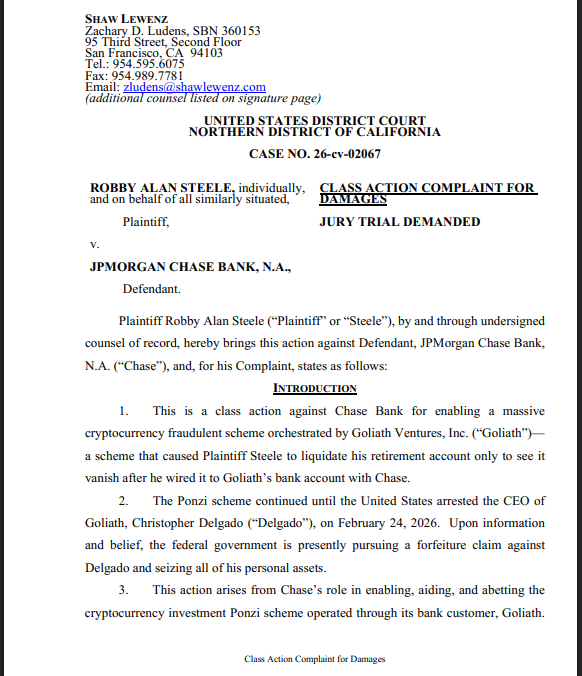
Source: Law.com

According to the complaint, JPMorgan was the only bank holding Goliath’s accounts from January 2023 through mid-2025 — the bulk of the scheme’s run.

During that stretch, roughly $250 million passed through a single JPMorgan account linked to Goliath. About $123 million of that was sent to Goliath’s wallets held at Coinbase.

Attorneys say the sheer volume moving through one account should have triggered scrutiny under federal banking rules that require institutions to know who their customers are and what those customers do with their money.

“Chase, by virtue of its Know Your Customer obligations, actually knew that Goliath was acting as a private equity cryptocurrency pool operator investing money for investors, without being licensed at all to sell these investments,” the complaint states.

BTCUSD now trading at $70,261. Chart: TradingView

Goliath, originally called Gen-Z Venture Firm, operated from January 2023 until January 2026, based on court documents. CEO Christopher Delgado was arrested on Feb. 24 by the US Attorney’s Office for the Middle District of Florida.

He faces wire fraud and money laundering charges. If convicted on all counts, he could spend up to 30 years in federal prison.

Bank Of America Also Appears In Federal Case

A separate federal criminal complaint names Bank of America as well. Prosecutors say Delgado was a co-signatory on a BOA business account used by Goliath, with at least one investor directed to that account by company representatives.

Investor funds, based on the government’s account, were routed through the JPMorgan account, the BOA account, or sent straight to Goliath’s Coinbase wallets — all controlled by Delgado.

The civil lawsuit was filed by attorneys from Shaw Lewenz, Sonn Law Group, and Schwartzbaum. Lead attorney Jordan Shaw said more complaints are coming as the team continues to identify people believed to be involved in the scheme.

Featured image from Unsplash, chart from TradingView

Preguntas relacionadas

QWhat is the main allegation against JPMorgan Chase in the lawsuit?

AThe lawsuit alleges that JPMorgan Chase allowed Goliath Ventures to use its banking infrastructure to collect investor funds while ignoring red flags that it was a Ponzi scheme, violating its Know Your Customer obligations.

QHow much money did the lead plaintiff, Robby Alan Steele, allegedly lose in the scheme?

ARobby Alan Steele allegedly lost $650,000, which included his retirement savings.

QWhat was the total amount of the alleged Ponzi scheme and how much passed through a single JPMorgan account?

AThe alleged Ponzi scheme totaled $328 million. Approximately $250 million passed through a single JPMorgan account linked to Goliath.

QWhat charges does Goliath Ventures CEO Christopher Delgado face?

AChristopher Delgado faces charges of wire fraud and money laundering. If convicted on all counts, he could face up to 30 years in federal prison.

QBesides JPMorgan, which other major bank is named in the federal case related to this scheme?

ABank of America is also named in a separate federal criminal complaint, as Delgado was a co-signatory on a BOA business account used by Goliath.

Lecturas Relacionadas

The Value Distribution of Stablecoins

**Summary: The Value Distribution of Stablecoins** The article argues that stablecoins are evolving from mere trading tools into broader channels for dollar access. It divides the stablecoin ecosystem into four layers to analyze how value is distributed: 1. **Issuance Layer:** Mints stablecoins, holds reserve assets, and captures the spread between reserve yield and user costs (e.g., Tether, Circle). This layer currently earns the largest profit margin. 2. **Infrastructure Layer:** Connects stablecoins to the traditional financial system, handling fiat on/off-ramps, banking integration, compliance (KYC/AML), and asset management (e.g., Bridge, BVNK). This is the "unglamorous" but critical work, building the essential bridges between crypto and real-world finance. 3. **Acquiring/Distribution Layer:** Integrates stablecoins into merchant systems, manages payment flows, and provides enterprise financial software (e.g., Stripe, Coinbase). They act as the access point for businesses. 4. **Application Layer:** The end-users and businesses that ultimately use stablecoins for payments, settlements, or as a store of value. They benefit from convenience but have little pricing power. The core thesis is that while the issuance layer currently dominates profits, the often-overlooked **infrastructure layer holds significant long-term potential**. The real challenge and barrier to mass adoption is not the on-chain transfer of stablecoins (which is simple), but the complex "last mile" integration into existing business workflows, banking systems, and regulatory frameworks across different countries. Companies in this layer are currently in a "land grab" phase, investing heavily to build networks, secure bank partnerships, and establish compliance pathways. While their position is currently pressured by the profitable issuers above and distribution platforms below, the article suggests that if stablecoins become a default financial rail for businesses, the infrastructure providers who have done the hard work of integration will ultimately gain strong pricing power and become entrenched, essential players.

marsbitHace 5 hora(s)

The Value Distribution of Stablecoins

marsbitHace 5 hora(s)

The Value Distribution of Stablecoins

The Value Distribution of Stablecoins The article argues that stablecoins are evolving from a mere trading tool into a broad "dollar channel." It analyzes the industry's value chain through four layers: 1. **Issuance Layer (e.g., Tether, Circle):** The top layer that mints stablecoins, holds reserve assets, and captures the thickest interest rate spread. 2. **Infrastructure Layer (e.g., Bridge, BVNK):** Connects stablecoins to the traditional financial system, handling critical but complex "dirty work" like fiat on/off-ramps, banking integration, compliance (KYC/AML), and cross-border settlement. 3. **Acquiring/Distribution Layer (e.g., Stripe, Coinbase):** Embeds stablecoins into merchant systems, manages payment flows, and integrates with enterprise software. 4. **Application Layer:** End-users and businesses that ultimately use stablecoins for payments, settlement, or storing value. The author posits that while the issuance layer currently captures the most profit, the most overlooked and potentially critical layer is infrastructure. The core challenge for stablecoin adoption isn't the on-chain transfer (which is simple), but bridging the gap between blockchain and the real-world financial system. This involves solving practical problems for businesses: fiat conversion, reconciliation, tax handling, and user onboarding. Infrastructure companies are currently in a difficult "land-grab" phase—building networks, securing banking relationships, and achieving compliance country-by-country. They face pressure from both the profitable issuance layer above and distribution platforms below. However, the author suggests this layer is building a crucial moat. Once stablecoins become a default business rail, the infrastructure players who have done the hard work of integration may gain significant, durable value and pricing power.

链捕手Hace 5 hora(s)

The Value Distribution of Stablecoins

链捕手Hace 5 hora(s)

Trading

Spot
Futuros

Artículos destacados

Cómo comprar ONE

¡Bienvenido a HTX.com! Hemos hecho que comprar Harmony (ONE) sea simple y conveniente. Sigue nuestra guía paso a paso para iniciar tu viaje de criptos.Paso 1: crea tu cuenta HTXUtiliza tu correo electrónico o número de teléfono para registrarte y obtener una cuenta gratuita en HTX. Experimenta un proceso de registro sin complicaciones y desbloquea todas las funciones.Obtener mi cuentaPaso 2: ve a Comprar cripto y elige tu método de pagoTarjeta de crédito/débito: usa tu Visa o Mastercard para comprar Harmony (ONE) al instante.Saldo: utiliza fondos del saldo de tu cuenta HTX para tradear sin problemas.Terceros: hemos agregado métodos de pago populares como Google Pay y Apple Pay para mejorar la comodidad.P2P: tradear directamente con otros usuarios en HTX.Over-the-Counter (OTC): ofrecemos servicios personalizados y tipos de cambio competitivos para los traders.Paso 3: guarda tu Harmony (ONE)Después de comprar tu Harmony (ONE), guárdalo en tu cuenta HTX. Alternativamente, puedes enviarlo a otro lugar mediante transferencia blockchain o utilizarlo para tradear otras criptomonedas.Paso 4: tradear Harmony (ONE)Tradear fácilmente con Harmony (ONE) en HTX's mercado spot. Simplemente accede a tu cuenta, selecciona tu par de trading, ejecuta tus trades y monitorea en tiempo real. Ofrecemos una experiencia fácil de usar tanto para principiantes como para traders experimentados.

290 Vistas totalesPublicado en 2024.12.12Actualizado en 2026.06.02

Cómo comprar ONE

Discusiones

Bienvenido a la comunidad de HTX. Aquí puedes mantenerte informado sobre los últimos desarrollos de la plataforma y acceder a análisis profesionales del mercado. A continuación se presentan las opiniones de los usuarios sobre el precio de ONE (ONE).

活动图片