Japan to Test Blockchain for Settling Stocks and Government Bonds

cryptonews.ruPublicado a 2026-08-26Actualizado a 2026-08-26

Resumen

Japan is preparing to launch a real-time settlement system for stock and government bond transactions based on blockchain technology. According to Nikkei, the authorities aim to have a project plan ready by early 2027. A working group including the FSA, the Ministry of Finance, the Bank of Japan, and financial sector representatives will be formed this summer to define the system's architecture and responsibilities. If approved, the infrastructure could become operational in the early 2030s. Currently, stock settlements in Japan occur two days after a trade, and government bond settlements the next day. Blockchain aims to virtually eliminate this delay, allowing sellers to receive funds and reinvest almost immediately. This initiative builds on existing experiments. In February, the FSA supported a demonstration project registering bonds, funds, and stock rights on a blockchain with settlements in stablecoins. The Bank of Japan is also testing the use of tokenized central bank reserves for blockchain settlements, including for securities. The new project could elevate these tests to a national infrastructure level, with potential future use for international transfers. Nikkei noted that the US and Europe lead in real-world asset tokenization, and there is a risk that foreign investors might shy away from Japanese markets if the technology lags. The global RWA segment (excluding stablecoins) is valued at $38.3 billion, with $15.6 billion in US government bonds.

Japan is preparing a real-time settlement system for stock and government bond transactions based on blockchain. The authorities aim to have a project plan ready by the beginning of 2027, writes Nikkei.

Settlements Without Delay

The project will involve the FSA, the Ministry of Finance, the Bank of Japan, and representatives from the financial sector. As early as this summer, they plan to establish a working group to determine the blockchain system's architecture, the responsibilities among participants, and the further development plan.

If the project receives final approval, the infrastructure could become operational in the early 2030s.

Currently, stock settlements in Japan occur two days after a trade is executed, and Japanese government bond settlements take place the next day. Blockchain is expected to virtually eliminate this delay: the seller will be able to receive funds and reinvest them almost immediately after the transaction.

Blockchain Already Under Testing

This is not the first experiment with the technology for the Japanese financial market. In February, the FSA reported supporting a demonstration project where rights to government and corporate bonds, investment funds, and stocks will be recorded on a blockchain, and settlements will be conducted using stablecoins.

The Bank of Japan is also conducting its own experiment on using tokenized central bank reserves for blockchain settlements. The regulator is considering scenarios including securities settlements.

The new initiative could elevate these experiments to the level of national infrastructure. In the future, Japanese authorities are also considering the possibility of using the system for international transfers.

Nikkei noted: The US and Europe are leading in the tokenization of real-world assets, and there is a risk that foreign investors and funds may abandon Japanese securities markets if the technology in the country lags behind.

The total volume of the RWA segment (excluding stablecoins) is $38.3 billion, of which $15.6 billion is accounted for by United States government bonds.
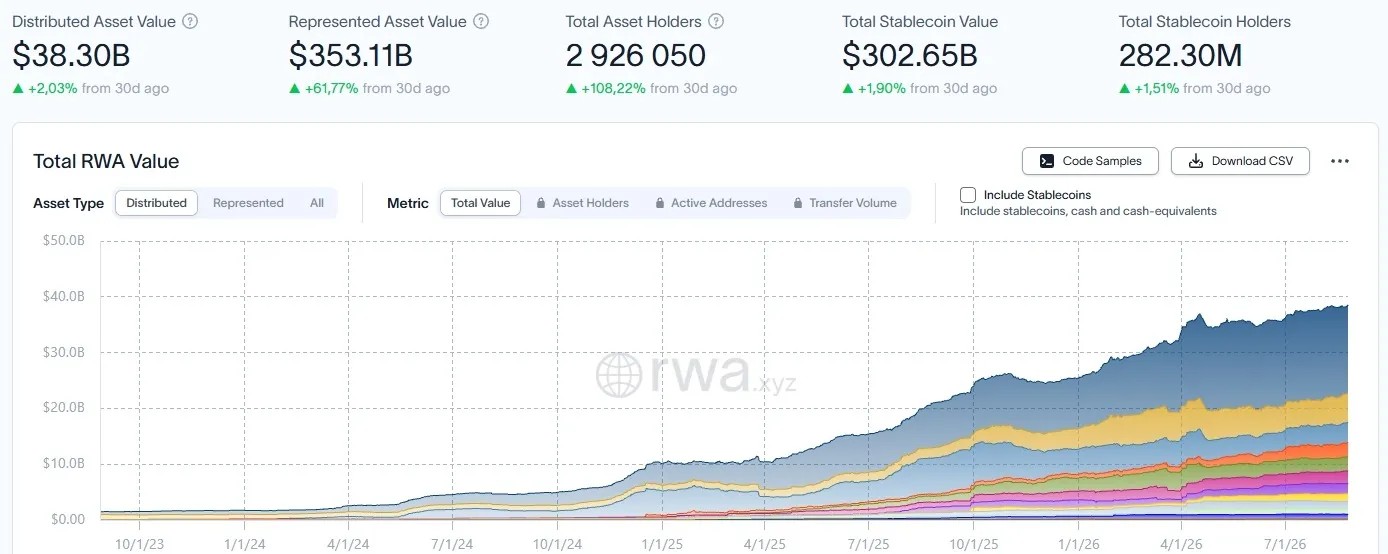
Source: RWA.xyz.

Recall that in the UK, it was forecasted that tokenization could add up to £33 billion per year to the economy over a 10-year horizon.

end-content

Preguntas relacionadas

QWhat is Japan preparing to test for stock and government bond settlement?

AJapan is preparing a system for real-time settlement of stock and government bond transactions using blockchain technology.

QWhich organizations are involved in the project to develop Japan's blockchain settlement system?

AThe organizations involved include the Financial Services Agency (FSA), the Ministry of Finance, the Bank of Japan, and representatives from the financial sector.

QWhat is the main benefit that blockchain technology is expected to provide for settlements in Japan's financial market?

AThe main benefit is that it should virtually eliminate the current settlement delays. Currently, stock settlements take two days, and government bond settlements take one day. With blockchain, sellers could receive and reinvest funds almost immediately after a transaction.

QAccording to the Nikkei, what risk is Japan trying to avoid by advancing its blockchain infrastructure?

AJapan is trying to avoid the risk that foreign investors and funds may avoid Japanese securities markets if the country's technology lags behind, as the U.S. and Europe are leading in the tokenization of real-world assets.

QWhat specific prior blockchain experiments in Japan are mentioned in the article?

AThe article mentions two prior experiments: 1) An FSA-supported demonstration project where rights to bonds, funds, and stocks would be recorded on a blockchain and settled using stablecoins. 2) The Bank of Japan's experiment using tokenized central bank reserves for blockchain-based settlements, potentially including securities settlements.

Lecturas Relacionadas

Hubei State-Owned Assets Achieve the Largest Return in History

After years of anticipation, Yangtze Memory Holdings Co., Ltd. (YMTC) has filed for an IPO on Shanghai's STAR Market, seeking to raise 33 billion yuan—the largest offering in the board's history. This move follows the recent listing of its peer, ChangXin Memory Technologies (CXMT), which reached a market valuation exceeding 4 trillion yuan. Dubbed the "twin stars of domestic memory," both companies, founded in 2016 in Hefei and Wuhan respectively, symbolize China's push for semiconductor self-sufficiency. YMTC's journey began with its predecessor, Wuhan Xinxin, established in 2006. Backed by substantial state investment from Hubei and Wuhan, it evolved into a national memory base. The company achieved key technological breakthroughs, and now ranks as the world's third-largest and China's top NAND Flash manufacturer by sales. Its recent financials are strong, with Q1 2026 revenue of 47.04 billion yuan and net profit of 33.38 billion yuan. Post-IPO, its market value is widely expected to surpass 1 trillion yuan. The potential windfall highlights the success of long-term, patient capital from Hubei's state-owned entities. Key shareholders like Hubei Changsheng, Xintech, and government-backed funds have supported YMTC through years of development. Their collective stake could be worth hundreds of billions after the listing. This model mirrors other successes in Wuhan, such as Huagong Tech, where local state investment during a low point later yielded massive returns. The story reflects a broader national trend of regional transformation through strategic, high-tech investments. Hefei's bet on CXMT, now worth over 3.7 trillion yuan, propelled the city's A-share market cap to 4th nationally, showcasing how a major firm can reshape an entire local industry ecosystem. Similarly, Wuhan's photoelectronics cluster, now worth over 850 billion yuan, aims to become a world-class hub. The takeaway is clear: in the reshuffling of Chinese cities, patient, courageous state investment in core technologies—from memory chips to advanced manufacturing—is proving to be a decisive factor, turning long-term visions into economic reality.

marsbitHace 25 min(s)

Hubei State-Owned Assets Achieve the Largest Return in History

marsbitHace 25 min(s)

The Myth of AI Investment Collapses

"The AI Investment Myth Bursts: The Swift Collapse of a $45 Billion Fund The high-flying hedge fund Situational Awareness (SA), founded by 24-year-old former OpenAI researcher Leopold Aschenbrenner, neared total collapse in late July. Once a Wall Street darling, the fund saw its assets under management rocket from $1.5 billion to $45 billion in under a year, driven by a massively leveraged bet on the AI boom. Its core strategy was a 'Texas hedge'—simultaneously buying stocks seen as AI beneficiaries (like chipmakers) and shorting those deemed AI victims (like certain software firms). In reality, both sides of this trade were dependent on unbroken market confidence in AI. This strategy generated staggering returns, peaking at 439% year-to-date. However, it concealed extreme concentration, high leverage (reportedly 3-to-1), and liquidity risks from illiquid private holdings like Anthropic. When semiconductor stocks corrected sharply in late July, SA's long positions plummeted. Simultaneously, its short bets failed as 'AI victim' stocks rose, causing losses on both sides. The fund faced immediate, massive margin calls. With minutes to spare before a forced liquidation by its prime brokers, SA sold its entire public market portfolio at a discount to Citadel on July 30, narrowly avoiding a market-wide cascade. The fund's value crashed from $45 billion to roughly $10 billion (excluding its remaining Anthropic stake). The episode exposes the systemic risks embedded in the frenzied, highly leveraged chase for AI returns. It serves as a stark reminder of the old Wall Street adage: markets can stay irrational longer than investors can stay solvent. The crisis shifts focus from Aschenbrenner's AI predictions to whether capital markets will continue ignoring such dangerous concentration and leverage in pursuit of the next 'sure thing' narrative."

marsbitHace 26 min(s)

The Myth of AI Investment Collapses

marsbitHace 26 min(s)

Trading

Spot
活动图片