This moment has been long awaited.
Recently, Yangtze Memory Holdings Co., Ltd. (abbreviated as YMTC Holdings) has had its IPO application on the STAR Market accepted and officially submitted its prospectus. For this IPO, YMTC Holdings plans to raise 33 billion yuan, making it poised to become the largest IPO in the history of the STAR Market.
This means YMTC Holdings is about to break the record recently set by CXMT Technology.
Looking back a month ago, CXMT Technology was listed on the STAR Market, with its market capitalization subsequently soaring to 4 trillion yuan. Interestingly, both CXMT Technology and YMTC Holdings were founded in 2016, one from Hefei and the other based in Wuhan, collectively known as the "Twin Stars of Domestic Memory." With the successful listing of CXMT Technology, the Hefei state-owned assets behind it have reaped a trillion-yuan return.
Now, it's Wuhan's turn.
The Next Trillion-Yuan IPO: A Win for Hubei State-Owned Assets
Let's start 20 years ago.
In 2006, Hubei Province and Wuhan City invested over ten billion yuan to establish Wuhan Xinxin Semiconductor Manufacturing Co., Ltd. (XMC), building Central China's first 12-inch integrated circuit production line, laying the foundation for the subsequent development of the integrated circuit industry.
By 2015, the development of memory chips was established as a national strategy. Subsequently, a national-level industrial investment fund and local funds worth hundreds of billions of yuan were established, and a wave of domestic production for memory chips swept in. To break the high monopoly of overseas companies, Hubei was entrusted with great expectations—the following year, the National Memory Base was established in Wuhan's Optics Valley, and based on XMC, YMTC Holdings was formed.
Since then, YMTC Holdings has progressed rapidly, from achieving a breakthrough from zero with its first 3D NAND flash memory chip, to the introduction of the Xtacking architecture, to the successful development of 128-layer 3D flash memory chips... a memory chip super unicorn rose from Optics Valley. According to TrendForce data calculations, from January to March 2026, YMTC Holdings ranked third globally and first in China in terms of both sales value and shipment volume among global NAND Flash manufacturers.
Amidst the AI computing power-fueled supercycle for memory, the Wuhan moment is arriving—recently, YMTC Holdings' STAR Market IPO application has been accepted, and it has officially submitted its prospectus. This time, it plans to raise 33 billion yuan, setting a new historical record for fundraising on the STAR Market.
This means YMTC Holdings will surpass CXMT Technology's 29.5 billion yuan to become the largest IPO in STAR Market history.
Some analysts estimate that YMTC Holdings' future market value may be comparable to that of CXMT Technology—after listing, CXMT Technology's market capitalization once surged to 4 trillion yuan. One piece of supporting evidence is that CXMT Technology successfully turned a profit in the first quarter of this year, with a net profit attributable to shareholders of 24.762 billion yuan; while YMTC Holdings performed even more impressively—achieving operating revenue of 47.042 billion yuan and net profit attributable to shareholders of 33.379 billion yuan for the same period.
However, due to differences in their specific market segments, competitive landscapes, and product portfolios, this is more of an extremely optimistic market prediction. A more common current judgment is that YMTC Holdings' market value will exceed one trillion yuan after listing.
With the release of YMTC Holdings' prospectus, more lesser-known stories behind it have emerged—the company's predecessor was Yangtze Memory Co., Ltd. (YMTC Ltd.), jointly established with capital contributions from Core Fly Technology, the National Integrated Circuit Industry Investment Fund (Phase I), Hubei Science and Technology Investment Group, and Guoxin Fund. Among them, Core Fly Technology, Hubei Science and Technology Investment Group, and Guoxin Fund are all local Hubei state-owned entities. At that time, the company's assessed net asset value was approximately 13.4 billion yuan.
Over the next ten years, YMTC Holdings rarely had public financing news, but Hubei's state-owned assets at various levels remained constant companions. According to the prospectus, there are currently 7 shareholders holding more than 1% of YMTC Holdings' shares—Hubei Changsheng, Core Fly Technology, National IC Fund (Phase I), National IC Fund (Phase II), Optics Valley Industry Investment, Guoxin Fund, and Yangtze River Industrial Group, holding 26.54%, 25.35%, 11.97%, 11.38%, 9.25%, 5.90%, and 2.53% respectively.
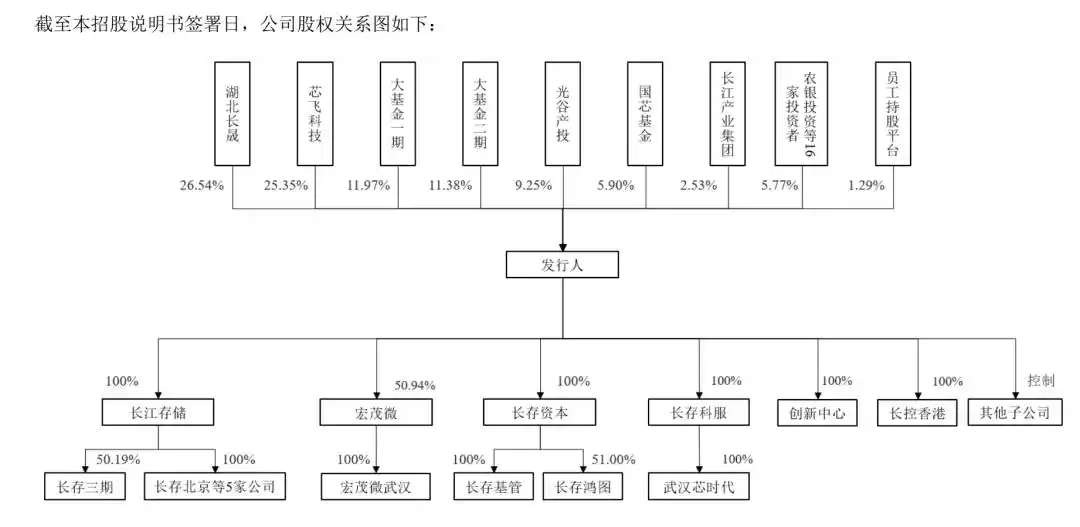
Five of these have Hubei state-owned asset backgrounds—upon deeper examination, the largest shareholder Hubei Changsheng is wholly owned by state-owned assets from Hubei Province, Wuhan City, and Wuhan East Lake High-tech Development Zone; Core Fly Technology is jointly funded by Hubei state-owned assets and the National IC Fund; Optics Valley Industry Investment is the professional industrial investment platform of Wuhan East Lake High-tech Development Zone; Guoxin Fund is also backed by Hubei state-owned assets at various levels; Yangtze River Industrial Group is 100% controlled by the Hubei Provincial State-owned Assets Supervision and Administration Commission.
A decade of companionship leads to today's turnaround. If YMTC Holdings achieves a market value of one trillion yuan after listing, the corresponding value of Hubei's state-owned assets system's shareholding would exceed hundreds of billions of yuan, constituting one of the most moving scenes of industrial cultivation.
Wuhan Booms, Producing Bull Stocks in Batches
Barring unforeseen circumstances, YMTC Holdings will become Hubei's first listed company with a trillion-yuan market capitalization.
This year, considerable attention has focused on Hubei and Wuhan. As the widely circulated "Optics Valley Seven Stars"—YMTC Holdings, Yangtze Optical Fibre and Cable (YOFC), Huagong Tech, Accelink Technologies, FiberHome Technologies, Guide Infrared, and CITIC Mobile—have all risen this year, becoming a true reflection of the explosion in Wuhan's optical communication industry.
Among them, Huagong Tech's market value exceeds 100 billion yuan, and its background also includes state-owned asset presence. Looking back to 2020, to further seize development opportunities, Huagong Tech decided to reform its university-affiliated enterprise separation, transferring part of its shares through a public solicitation of transferees.
Soon, Guohong Fund was selected. Examining its shareholder lineup—Wuhan Guochuang Innovation Investment Co., Ltd., Wuhan Industrial Development Fund Co., Ltd., and other Wuhan-based capital firms gathered. According to transaction details, Guohong Fund acquired approximately 19% of Huagong Tech's shares held by Huazhong University of Science and Technology Industry Group for about 4.291 billion yuan, becoming Huagong Tech's largest shareholder, with the actual controller concurrently changing to the Wuhan State-owned Assets Supervision and Administration Commission.
At that time, Huagong Tech had not yet unleashed its hard tech growth potential, with a market capitalization only in the range of 20-30 billion yuan, yet Wuhan state-owned assets firmly chose to enter.
Now, with Huagong Tech's market value exceeding one hundred billion yuan, that early persistence has been rewarded with a substantial return—based on Guohong Fund's 19% stake, the current corresponding market value of this portion of equity exceeds 19 billion yuan. Roughly estimated, Wuhan state-owned assets' acquisition of Huagong Tech has resulted in a paper profit of about 15 billion yuan.
From YMTC Holdings to Huagong Tech, the core of the story is the same: local state-owned assets made determined bets during low periods, provided long-term companionship, and ultimately waited for the era of hard tech explosion. According to Hubei Daily, "Over the past decade or so, state-owned assets at the provincial, municipal, and district levels have continuously increased their investment in the memory industry, with cumulative financial support exceeding 30 billion yuan. Even when the enterprise was experiencing long-term losses, state-owned shareholders still made additional investments."
This companionship is also seeing value realization. Represented by YMTC Holdings and Huagong Tech, Optics Valley has now gathered 16,000 optoelectronic information enterprises, hosting the world's largest R&D and manufacturing base for optical fibers and cables, the country's largest R&D and production base for optoelectronic devices, the country's advanced memory R&D and production base... all originating here.
A trillion-yuan industrial cluster is rising—currently, the total scale of Wuhan's optoelectronic information industry has exceeded 850 billion yuan. According to Wuhan's "15th Five-Year Plan," Wuhan will build two trillion-yuan clusters in optoelectronic information and life health, promoting optoelectronic information towards a world-class industrial cluster.
Major Reshuffling of Chinese Cities
This year marks a big year for IPOs, with many cities holding their heads high.
The most typical is Hefei. The story of its industrial turnaround by introducing BOE and Nio has long been津津乐道 for outsiders. Now, with the successful listing of CXMT Technology on the STAR Market, Hefei state-owned assets have once again made history.
Currently, CXMT Technology's latest market value exceeds 3.7 trillion yuan, ranking as the "number one" in A-share market value. According to the prospectus, Qinghui Jidian, Changxin Integration, Hefei Jixin, etc., collectively held approximately 45.16% of CXMT Technology's shares before issuance, with the Hefei state-owned assets system holding a combined stake of about 36.79%. Based on the latest market value calculation, the corresponding market value of Hefei state-owned assets' shareholding exceeds one trillion yuan.
For state-owned assets, financial returns are secondary; the more profound significance lies in the changes to the industrial ecosystem. After CXMT Technology settled in Hefei, a large number of semiconductor equipment, materials, and testing companies established nearby supporting facilities, gradually driving the growth and strengthening of Hefei's local industrial cluster. Currently, Hefei has gathered over 450 upstream and downstream integrated circuit enterprises, forming an industrial ecosystem covering the entire chain of design, manufacturing, packaging & testing, materials, and equipment.
Thus, Hefei rises—as of the close on July 27th, excluding CXMT Technology, the total market value of Hefei's other A-share listed companies is approximately 1.28 trillion yuan, ranking 19th among Chinese cities. Including CXMT Technology, the total market value of Hefei's A-share companies exceeds 4.56 trillion yuan, surpassing 15 cities including Suzhou, Hangzhou, Wuxi, Chengdu, Guangzhou, and Tianjin in one fell swoop, rising to 4th place nationally.
An investment can change a city's industrial destiny, an opportunity many cities might envy.
But the path is often difficult to replicate. It is important to know that over the past decade, CXMT Technology experienced sustained significant losses, yet Hefei state-owned assets remained constant companions, never withdrawing midway. YMTC Holdings was the same, not turning profitable until 2024. Before value realization, patience is required, along with the courage to take responsibility.
Especially in hard tech sectors like semiconductors and advanced manufacturing, it has never been about luck. Examples include Zhongji Innolight for Suzhou and New Eoptics Technology for Chengdu... all of which have stood the test of time.
Recently, the national regional GDP data for the first half of 2026 was released. Among them, the most noticeable is Anhui's 2.737 trillion yuan, making a comeback and returning to the national top ten. Additionally, Zhejiang, Shanghai, Beijing, Hubei, and others all had growth rates higher than the national average. The shifts in city rankings occur amidst each wave of industrial transformation.
A new round of city reshuffling has begun. As history has repeatedly proven: a company can change an industry, and an industry can change a city.
This article is from the WeChat public account "PEdaily2012" (ID: pedaily2012), author: Wu Qiong