January Crypto Market Analysis: Prices Decline, But Institutional Infrastructure Accelerates

marsbitPublicado a 2026-02-10Actualizado a 2026-02-10

Resumen

January 2026 presented a paradox in the crypto market: prices fell by 25%, yet infrastructure supporting institutional adoption accelerated. While Bitcoin dropped to a 10-month low near $73,000 and leveraged traders liquidated $2.2 billion in positions, institutional developments advanced rapidly. BlackRock identified digital assets as a key 2026 investment theme, DTCC launched production-level tokenization for U.S. Treasuries and equities, and Y Combinator announced it would fund startups in USDC. The sell-off was driven by macro shocks—not crypto-specific weakness—including stress in Japanese government bonds and the nomination of a hawkish Fed chair, triggering global deleveraging. Bitcoin correlated with risk assets rather than acting as a hedge, raising questions about its institutional role. Despite price volatility, regulatory clarity improved, and jurisdictions like Hong Kong and Dubai competed to attract crypto capital. Protocol development continued unabated, with Ethereum and Solana pushing scalability upgrades. However, security losses exceeded $370 million, highlighting operational risks. The divergence between price action and structural progress defines this cycle, indicating that institutional maturity is advancing independently of short-term valuations.

Author: Dhruvang Choudhari (AMINA Bank)

Compiled by: Deep Tide TechFlow

Deep Tide Introduction: January 2026 presented a paradox: crypto prices fell by 25%, but the infrastructure supporting institutional adoption was accelerating. While Bitcoin dropped to a ten-month low of $73,000, BlackRock listed digital assets as a decisive investment theme for 2026.

While leveraged traders liquidated $2.2 billion in positions, the Depository Trust and Clearing Corporation (DTCC) launched production-level tokenization for U.S. Treasuries and stocks. While sentiment indices reached extreme pessimism, Y Combinator announced it would begin funding startups in USDC.

AMINA Bank's analysis points out that this is not a rejection of digital assets, but a repricing within an evolving global monetary system. The divergence between price action and structural progress defines the current phase of the cycle.

Full Text Below:

Introduction

January 2026 presented a paradox: crypto prices fell by 25%, but the infrastructure supporting institutional adoption was accelerating.

While Bitcoin dropped to a ten-month low near $73,000, BlackRock listed digital assets as a decisive investment theme for 2026. While leveraged traders liquidated $2.2 billion in positions, the Depository Trust and Clearing Corporation (DTCC) launched production-level tokenization for U.S. Treasuries and stocks. While sentiment indices reached extreme pessimism, Y Combinator announced it would begin funding startups in USDC.

The first two months of 2026 marked a decisive shift in the digital asset market. What initially seemed like chaotic selling was actually a broad macro repricing driven by sovereign risk, changes in the monetary system, and forced unwinding of global leverage. Unlike previous crypto downturns, this event did not originate from within the digital asset ecosystem itself. It emerged from the outside.

January and February revealed a paradox that is now central to the institutional crypto era. Market prices deteriorated sharply, yet regulatory clarity, infrastructure deployment, and institutional commitment advanced at an unprecedented pace. This divergence between price action and structural progress defines the current phase of the cycle.

This update analyzes how the macroeconomic shock disrupted crypto market structure, why Bitcoin faces an identity challenge as a macro asset, and how institutional capital continues to build amidst volatility rather than retreat from it.

Institutional Expansion Amid Market Weakness

Despite deteriorating spot prices, institutional participation accelerated rather than slowed. This acceleration reveals a fundamental shift in how mature allocators approach digital assets: infrastructure maturity now matters more than price momentum.

Tokenization as a Core Strategy

BlackRock formally listed digital assets and tokenization as decisive investment themes for 2026, alongside AI, as structural drivers for capital markets.

At Franklin Templeton, innovation leadership described 2026 as the beginning of a wallet-native financial system, where stocks, bonds, and funds are held directly in digital wallets, rather than through traditional custody frameworks.

Y Combinator sent a key signal, announcing that starting with the Spring 2026 batch, startups may receive funding in USDC on Ethereum, Base, and Solana. Stablecoin settlements now typically clear in less than a second at a cost below $0.01, offering a clear advantage over cross-border fiat rails.

Reduced Regulatory Friction

Regulatory developments quietly removed long-standing structural barriers. The SEC rescinded previous accounting guidance that hindered banks from offering digital asset custody services. Simultaneously, the Depository Trust and Clearing Corporation (DTCC) launched a production-level tokenization program for U.S. Treasuries, large-cap stocks, and ETFs, confirming the legal equivalence between tokenized securities and traditional securities.

This marks a shift from experimental adoption to an upgrade of internal financial infrastructure.

Regional Competition for Crypto Capital

Jurisdictions are increasingly deploying policy as a competitive lever.

Hong Kong announced zero-tax incentives on qualified digital asset income for funds and family offices, positioning itself as a major institutional crypto hub in Asia. As of January 2026, 11 licensed virtual asset trading platforms are operating.

Meanwhile, Dubai continues to execute its blockchain-first government strategy, aiming for on-chain processing of 50% of public sector transactions by the end of 2026. Crypto penetration in the UAE has reached approximately 39%, representing over 3.7 million users.

Macroeconomic Shock Shattering the Calm

Understanding why institutions continue to build requires understanding what drove the sell-off. The relative stability of 2025 fostered expectations that crypto had entered a low-volatility, institutionally-anchored phase. These assumptions were shattered in January.

Japan and the Unwinding of Global Leverage

On January 20, 2026, the Japanese Government Bond (JGB) market entered a period of acute stress. The 30-year JGB yield surged over 30 basis points to 3.91%, its highest level in 27 years, following fiscal rhetoric from Prime Minister Sanae Takaichi that heightened concerns about debt sustainability. Japan's debt-to-GDP ratio has exceeded 250%, making it a focal point for global bond markets.

Figure 1: Japan 30-Year Government Bond Yield (Historical)
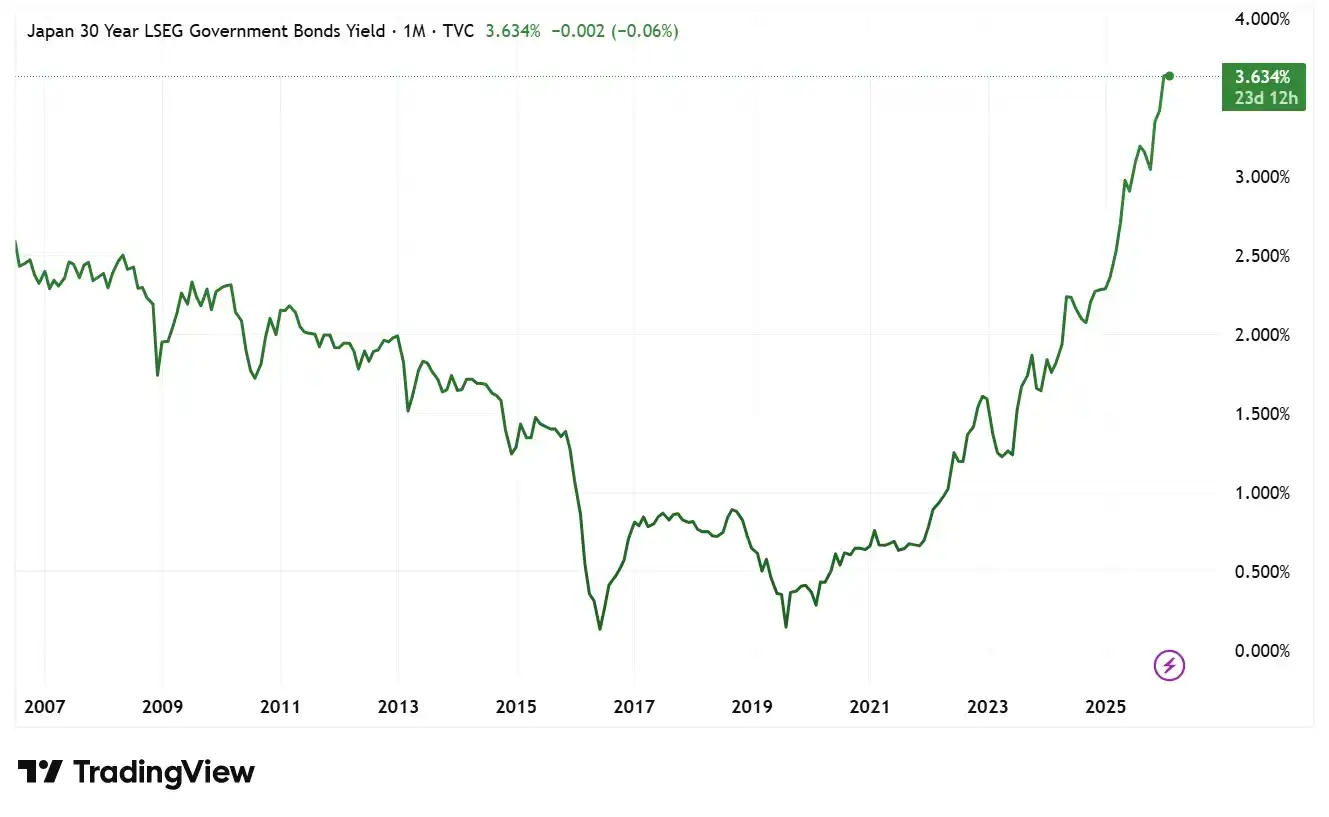
Source: TradingView

The immediate consequence was the rapid unwinding of the yen carry trade, one of the largest sources of cheap global leverage. As yen funding costs rose, investors were forced to liquidate risk assets to meet margin requirements. Bitcoin fell below $91,000 not due to crypto-specific weakness, but because it served as a liquidity proxy for balance sheet repair.

Warsh Nomination and Monetary Repricing

This pressure escalated on January 30th with the nomination of Kevin Warsh as the next Federal Reserve Chair. Warsh's long-standing preference for higher real interest rates and a significant reduction of the Fed's balance sheet was interpreted as a clear shift away from accommodative monetary policy.

Within 24 hours, the total cryptocurrency market capitalization fell by about $430 billion. Bitcoin fell approximately 7% in a single trading session, while Ethereum and high-beta altcoins experienced double-digit percentage pullbacks. This move reflected a repricing of global dollar liquidity expectations, not speculative panic.

Price Action and Bitcoin's Identity Crisis

The macro shock revealed an uncomfortable truth about Bitcoin's evolution as an institutional asset. The last week of January produced one of the most severe single-day dislocations of the institutional era.

On January 29th, Bitcoin fell from $96,000 to $80,000, a drop of approximately 15% in a single day. The crypto derivatives market liquidated over $2.2 billion in leveraged positions. The significance of this move lies not in its magnitude, but in its correlation characteristics.

Bitcoin failed to decouple from stocks, instead trading in sync with high-beta tech stocks. During a global deleveraging event, it behaved not as a defensive asset, but as a liquidity-sensitive risk instrument.

By early February, sentiment indicators reflected extreme pessimism. The Crypto Fear & Greed Index dropped to 19, and key technical levels, including the 0.786 Fibonacci retracement at $85,400, were decisively broken. The high $70,000s range became the market's primary structural support zone.

Figure 2: Bitcoin Price Decline Driven by Global Macro Events (Jan-Feb 2026)

Source: AMINA Bank

The correlation characteristics raise fundamental questions about Bitcoin's role in institutional portfolios. If it behaves as a high-beta tech proxy rather than a defensive hedge during stress, the allocation thesis must adjust accordingly. Yet, institutional commitment continues regardless, suggesting mature allocators are pricing Bitcoin's long-term structural role, not its short-term correlation behavior.

Protocol Evolution and Competitive Differentiation

While prices fell and macro conditions worsened, foundational layer development continued unabated. This demonstrates a key feature of the current cycle: infrastructure development has decoupled from price momentum.

Ethereum remains focused on scaling through execution efficiency, censorship resistance, and MEV mitigation. The upcoming Glamsterdam upgrade aims to increase the gas limit to 200 million, approaching a throughput of nearly 10,000 TPS theoretically.

Solana is pursuing aggressive performance enhancements. Its Alpenglow upgrade aims to reduce transaction finality from 12.8 seconds to approximately 100-150 milliseconds, positioning it as one of the fastest settlement layers in production.

These technical advancements continue regardless of market sentiment, reflecting long-term capital commitment and engineering development independent of price action.

Security Losses Highlight Operational Risks

Even as institutional infrastructure matures, security incidents highlight ongoing operational vulnerabilities. January 2026 recorded over $370 million in stolen funds, the highest monthly total in nearly a year. Over $311 million in losses stemmed from phishing and social engineering attacks, not smart contract failures.

The single largest event, exceeding $280 million, involved AI-generated voice impersonation targeting hardware wallet users. These incidents emphasize a structural shift in risk. Human and operational vulnerabilities now represent the primary attack surface for institutional crypto participants.

This pattern reinforces why custody frameworks operating under regulatory oversight offer competitive advantages beyond compliance. Operational security protocols, institutional-grade key management, and insurance frameworks have become mandatory requirements.

Conclusion

The retracement of January-February 2026 is not a rejection of digital assets, but a repricing within a changing global monetary system. Crypto now reacts directly to sovereign bond markets, central bank leadership, and geopolitical escalation. This sensitivity introduces volatility, but it also confirms integration.

Simultaneously, institutional adoption, regulatory clarity, and protocol development advanced during the sell-off. Tokenization shifted from narrative to deployed infrastructure, wallet-native finance from theory to implementation.

Early 2026 did not mark a collapse of the crypto market. It marked its first real stress test of institutional maturity. While prices failed the test, the underlying infrastructure passed with flying colors.

The divergence between price action and structural progress will not persist indefinitely, as institutional deployment, regulatory clarification, and infrastructure maturity will ultimately be reflected in market valuations.


Criptos en tendencia

Preguntas relacionadas

QWhat was the key paradox observed in the crypto market in January 2026 according to the article?

AThe key paradox was that while crypto prices fell by 25%, the infrastructure supporting institutional adoption was accelerating.

QWhich major financial institution listed digital assets as a definitive investment theme for 2026, alongside AI?

ABlackRock listed digital assets and tokenization as a definitive investment theme for 2026, alongside AI.

QWhat major macroeconomic event in Japan triggered a global deleveraging event that impacted crypto prices?

AAcute stress in the Japanese Government Bond (JGB) market, where 30-year JGB yields surged over 30 basis points to 3.91%, triggered a rapid unwinding of yen carry trades and forced liquidations of risk assets like crypto.

QWhat significant policy change did the SEC make regarding digital asset custody services?

AThe SEC rescinded previous accounting guidance that had prevented banks from offering digital asset custody services.

QHow did Bitcoin's price behavior during the January 2026 sell-off challenge its perceived role as an institutional asset?

ABitcoin failed to act as a defensive asset or decouple from equities. Instead, it traded in sync with high-beta tech stocks, behaving like a liquidity-sensitive risk tool during a global deleveraging event, which raised questions about its role in institutional portfolios.

Lecturas Relacionadas

7 Months After the Collapse of Huiwang, Southeast Asia's Escrow Platforms Undergo a Major Reshuffle

Following the collapse of Huione Pay—dubbed the "Alipay of Southeast Asia"—seven months ago, the region's underground financial guarantee platform sector is undergoing a significant reshuffle. This power vacuum has been swiftly filled by emerging platforms such as XinBi, Tiger/Navigator, JinBei (renamed JinBo), Dali/Tiancheng, and FullyLight. These platforms, operating largely via Telegram and offering services like escrow for illicit transactions, have absorbed the vast user base and markets left behind by Huione. While positioning themselves as "trust intermediaries," their primary clientele consists of networks involved in online scams, money laundering, illegal gambling, and even human trafficking. For instance, the Tiger/Navigator platform explicitly provides "escrow" services for kidnapping-for-ransom operations ("强押车交易"). Data underscores the immense scale: Huione alone processed over $103 billion in cryptocurrency payments and facilitated over $31 billion through its escrow market before its downfall, linking it to Cambodia's notorious Prince Group. Since its collapse, competitors have seen explosive growth. For example, the XinBi platform has accumulated over $1.6 billion in total USDT revenue, while platforms like NewPay, OkPay (under Dali), and FullyLight Wallet collectively processed over $4.8 billion in USDT in a single year. This ecosystem thrives in regions like Cambodia and Myanmar, where regulatory gaps allow these platforms to act as critical financial infrastructure for sprawling cybercrime industries, from scam compounds to online casinos. The article concludes that the moniker "Southeast Asian Alipay" is a misnomer, obscuring the platforms' fundamental role in enabling serious criminal enterprises rather than representing legitimate financial innovation.

Odaily星球日报Hace 1 min(s)

7 Months After the Collapse of Huiwang, Southeast Asia's Escrow Platforms Undergo a Major Reshuffle

Odaily星球日报Hace 1 min(s)

The Changing Landscape: What Are Crypto VCs Experiencing?

Title: The Shifting Landscape of Crypto Venture Capital The era of dedicated crypto venture capital funds is undergoing a significant transformation. Once essential for navigating the sector's complexity and high risk, these specialized funds are now facing an identity crisis as the market matures. This shift mirrors historical patterns in other specialized investment classes like cleantech and SPACs, where initial information advantages dissipate as technologies become mainstream and integrated into existing industry frameworks. The article argues that crypto is reaching a critical inflection point, transitioning from a "building phase" to an "integration phase." Major players like Stripe, BlackRock, and Visa now engage with crypto not for its novel mechanics but as a foundational financial infrastructure. Their needs—regulatory compliance, banking partnerships, distribution channels—align with traditional fintech, a domain easily understood by large, generalist funds like Sequoia and Founders Fund. This evolution creates a "barbell effect" within the VC landscape. On one end are massive, diversified platforms that can incorporate crypto as one vertical among many. On the other are small, nimble funds focused on niche, experimental projects. The middle ground—medium-sized dedicated crypto funds—is being squeezed out. Their typical fund size makes it impossible to generate sufficient returns solely from early-stage crypto bets, yet they cannot compete with giants for later-stage deals. Consequently, leading crypto-native firms like Paradigm and Framework Ventures are expanding into AI, robotics, and other sectors, driven partly by LP pressure for better returns amid a broader VC DPI crisis. Others, like Dragonfly and a16z, have narrowed their crypto focus predominantly to financial infrastructure like stablecoins, reframing the sector's core narrative. For crypto entrepreneurs, this consolidation presents challenges. While generalist funds offer larger checks and broader resources, crypto projects now compete fiercely with AI for attention and capital within these firms. Furthermore, the long-term, non-commercial foundational work that built the ecosystem—funded by dedicated crypto VCs—is less likely to attract generalist capital focused on direct returns. The conclusion is that "crypto investor" as a standalone category is becoming obsolete, akin to "internet investor." Crypto is becoming a baseline infrastructure layer. The future will see a barbell structure: large-scale growth financing handled by generalist funds, while pioneering, speculative projects are funded by small, specialized vehicles. The dedicated crypto funds of the 2017-2021 boom, which incubated core infrastructure, are giving way to this new, bifurcated reality.

Foresight NewsHace 19 min(s)

The Changing Landscape: What Are Crypto VCs Experiencing?

Foresight NewsHace 19 min(s)

As Consensus Accelerates, What Are Young Investors Betting On?

Title: As Consensus Forms Faster, What Are Young Investors Betting On? In the rapid evolution of tech investment, a new generation of young investors is navigating a landscape where AI, robotics, commercial aerospace, and quantum computing are advancing simultaneously. Traditional investment logic based on financial models is giving way to a need for deep technical understanding and the ability to act before industry consensus forms. An analysis of trends from the "WAIC FUTURE TECH" list of young investment leaders reveals key shifts in focus. The first major trend is the movement of AI from the digital screen into the physical world. Investment is shifting from large language models and chatbots towards embodied AI, robotics, AI hardware, and edge computing. While demonstrations generate excitement, the real challenge lies in achieving scalable, reliable, and cost-effective delivery in complex real-world environments like factories and logistics. Success depends not just on algorithms but on the integration of sensors, actuators, and control systems. Second, the competitive focus for large models is moving beyond raw capability toward building an "intelligence flywheel." The goal is to create self-reinforcing systems where user interaction generates data, improving the model, which in turn enhances the user experience and attracts more engagement. Companies that successfully embed AI into workflows to create these closed-loop systems can build lasting value that isn't easily erased by the next model upgrade. Third, facing a potential bottleneck in high-quality human-generated data, investors are looking at new underlying technologies. Reinforcement learning and self-play, as demonstrated by AlphaGo Zero, offer paths for AI to generate its own experience. Scientific foundation models, which aim to build general AI capabilities for fields like life sciences and materials discovery, represent a non-consensus direction that could unlock new frontiers of knowledge and data. Finally, in deep-tech areas like quantum computing, commercial aerospace, and space-based infrastructure, patient capital is essential. These fields have long, uncertain development and validation cycles involving complex engineering, supply chains, and regulations. Investment here requires a long-term view, focusing on foundational team capabilities and the eventual emergence of market demand, even if commercial returns are distant. Collectively, these trends illustrate how young investors are adapting to a new era. They are learning to make earlier, technically-informed judgments, balance hype with real-world viability, and provide the patient capital needed to build the deep-tech foundations of the future.

marsbitHace 47 min(s)

As Consensus Accelerates, What Are Young Investors Betting On?

marsbitHace 47 min(s)

Trading

Spot

Artículos destacados

Qué es $BANK

Banco AI: Un Paso Revolucionario en el Futuro de la Banca Introducción En una era marcada por avances rápidos en tecnología, Banco AI se sitúa en la intersección de la inteligencia artificial (IA) y los servicios bancarios. Este proyecto innovador busca redefinir el panorama financiero, mejorando la eficiencia operativa, las medidas de seguridad y las experiencias del cliente a través del poder de la IA. Al embarcarnos en esta exploración de Banco AI, profundizaremos en lo que implica el proyecto, sus dinámicas operativas, su contexto histórico y hitos significativos. ¿Qué es Banco AI? En su esencia, Banco AI representa una iniciativa transformadora destinada a integrar la inteligencia artificial en varias operaciones bancarias. Este proyecto aprovecha las capacidades de la IA para automatizar procesos, mejorar los protocolos de gestión de riesgos y mejorar la interacción con los clientes a través de servicios personalizados. Los objetivos principales de Banco AI incluyen: Automatización de Funciones Bancarias: Al aprovechar las tecnologías de IA, Banco AI tiene como objetivo automatizar tareas rutinarias, reduciendo la carga sobre los recursos humanos y mejorando la eficiencia. Mejora en la Gestión de Riesgos: El proyecto utiliza algoritmos de IA para predecir e identificar riesgos, fortaleciendo así las medidas de seguridad contra fraudes y otras amenazas. Personalización de Servicios Bancarios: Banco AI se centra en ofrecer productos y servicios financieros a medida al analizar datos y comportamientos de los clientes. Mejoramiento de la Experiencia del Cliente: La implementación de soluciones impulsadas por IA, como chatbots y asistentes virtuales, tiene como objetivo proporcionar a los usuarios interacciones más humanas, revolucionando la forma en que los clientes se relacionan con los bancos. Con estos objetivos, Banco AI se posiciona como un jugador crucial para hacer que la banca sea más eficiente, segura y centrada en el usuario. ¿Quién es el Creador de Banco AI? Los detalles sobre el creador de Banco AI siguen siendo desconocidos. Como tal, no se ha identificado a ninguna persona u organización específica en la información disponible. El anonimato que rodea el inicio del proyecto plantea preguntas, pero no resta valor a su ambiciosa visión y objetivos. ¿Quiénes Son los Inversores de Banco AI? Al igual que con el creador del proyecto, no se ha divulgado información específica sobre los inversores u organizaciones que apoyan a Banco AI. Sin esta información, es un desafío delinear el respaldo financiero y el apoyo institucional que podrían estar impulsando el proyecto hacia adelante. No obstante, la importancia de contar con una sólida base de inversión es fundamental para sostener el desarrollo en un campo tan innovador. ¿Cómo Funciona Banco AI? Banco AI opera en múltiples frentes innovadores, centrándose en factores únicos que lo diferencian de los marcos bancarios tradicionales. A continuación, se presentan las características operativas clave: Automatización: Al aplicar algoritmos de aprendizaje automático, Banco AI automatiza varios procesos manuales dentro de los bancos. Esto resulta en la reducción de costos operativos y permite que los trabajadores humanos redirijan sus esfuerzos hacia actividades más estratégicas. Gestión Avanzada de Riesgos: La integración de la IA en las prácticas de gestión de riesgos equipa a los bancos con herramientas para predecir con precisión amenazas potenciales como el fraude, garantizando que la información y los activos de los clientes permanezcan seguros. Recomendaciones Financieras Personalizadas: A través del aprendizaje continuo a partir de las interacciones con los clientes, los sistemas de IA desarrollan una comprensión matizada de las necesidades del usuario, lo que les permite ofrecer consejos adaptados sobre decisiones financieras. Interacciones Mejoradas con los Clientes: Al utilizar chatbots y asistentes virtuales impulsados por IA, Banco AI permite una experiencia más atractiva para el cliente, permitiendo a los usuarios resolver sus consultas rápidamente, reduciendo así los tiempos de espera y mejorando los niveles de satisfacción. En conjunto, estas características operativas posicionan a Banco AI como un pionero en el sector bancario, estableciendo nuevos parámetros para la entrega de servicios y la excelencia operativa. Línea de Tiempo de Banco AI Entender la trayectoria de Banco AI requiere mirar su contexto histórico. A continuación, se presenta una línea de tiempo que destaca hitos y desarrollos importantes: Inicios de 2010: La conceptualización de la integración de la IA en los servicios bancarios comenzó a ganar atención a medida que las instituciones bancarias reconocieron los posibles beneficios. 2018: Se produjo un aumento notable en la implementación de tecnologías de IA cuando los bancos comenzaron a utilizar herramientas de IA como chatbots para el servicio al cliente básico y sistemas de gestión de riesgos para mejorar la seguridad. 2023: La sofisticación de la IA continuó avanzando, con la introducción de IA generativa para tareas más complejas como el procesamiento de documentos y análisis de inversiones en tiempo real. Este año marcó un salto significativo en las capacidades que la tecnología de IA otorgó a los bancos. 2024-Estatus Actual: A partir de este año, Banco AI se encuentra en una trayectoria ascendente, con investigaciones y desarrollos en curso que pronto mejorarán las capacidades en las operaciones bancarias. La continua exploración de las aplicaciones de IA sugiere emocionantes desarrollos aún por venir. Puntos Clave Sobre Banco AI Integración de la IA en la Banca: Banco AI se centra en adoptar inteligencia artificial para optimizar los procesos bancarios y mejorar la experiencia del usuario. Enfoque en Automatización y Gestión de Riesgos: El proyecto enfatiza fuertemente estas áreas, con el objetivo de desplazar la carga de tareas rutinarias mientras mejora los marcos de seguridad a través de análisis predictivos. Soluciones Bancarias Personalizadas: Al aprovechar los datos de los clientes, Banco AI permite servicios bancarios adaptados a las necesidades individuales de los usuarios. Compromiso con el Desarrollo: Banco AI se mantiene comprometido con esfuerzos de investigación y desarrollo continuos, asegurando su adaptabilidad y relevancia continua a medida que la tecnología sigue evolucionando. Conclusión En resumen, Banco AI ejemplifica un paso crucial hacia adelante en la industria bancaria, aprovechando la inteligencia artificial para redefinir los paradigmas operativos, mejorar la seguridad y promover la satisfacción del cliente. A pesar de las lagunas en la información sobre el creador y los inversores, los objetivos claros y los mecanismos funcionales de Banco AI proporcionan una sólida base para su evolución continua. A medida que la tecnología de IA sigue avanzando y fusionándose con el sector bancario, Banco AI está bien posicionado para impactar significativamente el futuro de los servicios financieros, mejorando la forma en que entendemos e interactuamos con la banca.

186 Vistas totalesPublicado en 2024.04.06Actualizado en 2024.12.03

Qué es $BANK

Cómo comprar BANK

¡Bienvenido a HTX.com! Hemos hecho que comprar Lorenzo Protocol (BANK) sea simple y conveniente. Sigue nuestra guía paso a paso para iniciar tu viaje de criptos.Paso 1: crea tu cuenta HTXUtiliza tu correo electrónico o número de teléfono para registrarte y obtener una cuenta gratuita en HTX. Experimenta un proceso de registro sin complicaciones y desbloquea todas las funciones.Obtener mi cuentaPaso 2: ve a Comprar cripto y elige tu método de pagoTarjeta de crédito/débito: usa tu Visa o Mastercard para comprar Lorenzo Protocol (BANK) al instante.Saldo: utiliza fondos del saldo de tu cuenta HTX para tradear sin problemas.Terceros: hemos agregado métodos de pago populares como Google Pay y Apple Pay para mejorar la comodidad.P2P: tradear directamente con otros usuarios en HTX.Over-the-Counter (OTC): ofrecemos servicios personalizados y tipos de cambio competitivos para los traders.Paso 3: guarda tu Lorenzo Protocol (BANK)Después de comprar tu Lorenzo Protocol (BANK), guárdalo en tu cuenta HTX. Alternativamente, puedes enviarlo a otro lugar mediante transferencia blockchain o utilizarlo para tradear otras criptomonedas.Paso 4: tradear Lorenzo Protocol (BANK)Tradear fácilmente con Lorenzo Protocol (BANK) en HTX's mercado spot. Simplemente accede a tu cuenta, selecciona tu par de trading, ejecuta tus trades y monitorea en tiempo real. Ofrecemos una experiencia fácil de usar tanto para principiantes como para traders experimentados.

814 Vistas totalesPublicado en 2025.05.09Actualizado en 2026.06.02

Cómo comprar BANK

Discusiones

Bienvenido a la comunidad de HTX. Aquí puedes mantenerte informado sobre los últimos desarrollos de la plataforma y acceder a análisis profesionales del mercado. A continuación se presentan las opiniones de los usuarios sobre el precio de BANK (BANK).

活动图片













