Is Crypto Over? Don't Give Up, Liquidity Relief Is Coming

Odaily星球日报Publicado a 2026-02-02Actualizado a 2026-02-02

Resumen

The article "False Narratives....and Other Thoughts" by Raoul Pal addresses the current downturn in the crypto market, arguing against the mainstream narrative that the crypto cycle is over. Pal explains that the recent price decline in Bitcoin and other cryptocurrencies is not an isolated event but is correlated with a similar drop in SaaS stocks, as shown by comparative charts. He identifies the root cause as a temporary liquidity squeeze in the U.S. financial system, exacerbated by government shutdowns, TGA (Treasury General Account) rebuilding without monetary offset, and gold absorbing marginal liquidity that would otherwise support risk assets like crypto. Pal emphasizes that this liquidity crunch is temporary. He anticipates a resolution to the government shutdown soon, which will remove the last major obstacle to liquidity recovery. Following this, he expects a return of liquidity through measures such as eSLR adjustments, TGA drawdowns, fiscal stimulus, and eventual rate cuts. He advises investors to be patient, stressing that in a full market cycle, time is more critical than price movements. The article also corrects a misperception about potential Fed Chair Kevin Warsh, arguing he is not a hawk and would likely support rate cuts aligned with strategies to boost economic growth. Despite current market conditions, Pal remains highly optimistic about the crypto market's prospects through 2026, driven by anticipated pro-growth policies.

Original Author:Raoul Pal, CEO of Real Vision and GMI

Compiled by:CryptoLeo(@LeoAndCrypto)

This morning, Raoul Pal, CEO of Real Vision and GMI (Raoul Pal's investment bible), published an article titled "False Narratives....and Other Thoughts". Through data comparison and macro analysis, he explained the recent downturn and crisis in the crypto industry, indicating that the industry winter will soon pass, and everyone needs to be patient and not lose confidence in the industry. Odaily Planet Daily translates it as follows:

These were the insights I wrote for GMI over the weekend, hoping to bring you some confidence. I would have kept this content for GMI and Pro Macro discussions, but I know you all need this to ease your tense nerves.

Mainstream Narrative: Is Crypto Over?

The mainstream view is that Bitcoin and cryptocurrencies have crashed, this cycle is over, everything is finished, and it can't be like before. Cryptocurrencies have decoupled from other assets, this is CZ's fault, it's BlackRock's fault, etc. This is undoubtedly an attractive narrative trap, especially when mainstream coin prices are plummeting every day.

But yesterday, a GMI hedge fund client sent me a message asking if they should buy the dip in SaaS stocks, or, as everyone is saying, if Claude Code has already killed the SaaS industry.

So I started researching SaaS, and in the process, I found conclusions that debunk both the mainstream narrative about Bitcoin and the narrative about the SaaS industry. The charts for SaaS and BTC look exactly the same?
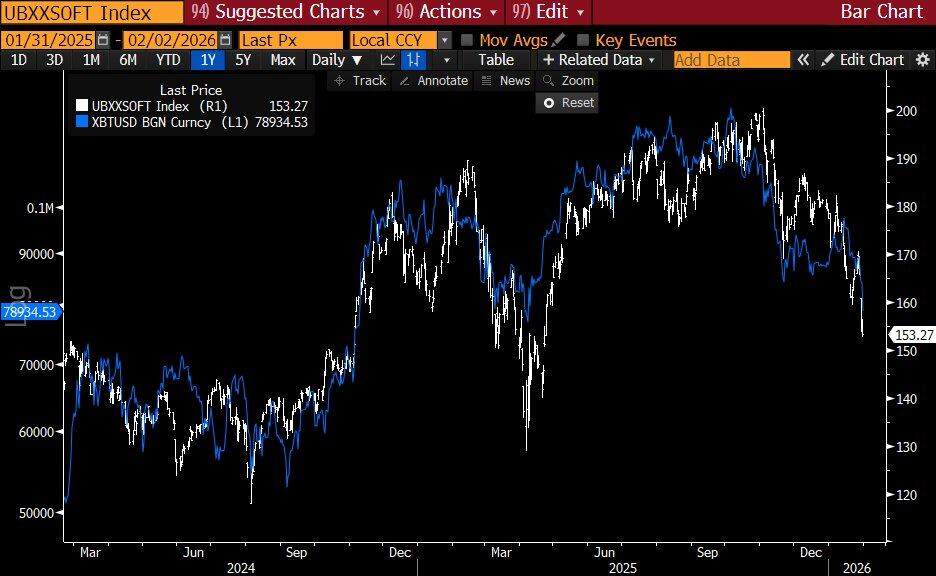
UBS SaaS Index vs. Bitcoin Trend

Indicating there is another factor that everyone is ignoring affecting this trend.

This factor is: Due to two shutdowns and issues with the US financial system's infrastructure (the reverse repo mechanism's liquidity was only fully replenished in 2024), US liquidity has been constrained. Therefore, the TGA (Treasury General Account) rebuilding in July and August had no corresponding monetary offset measures, leading to a reduction in liquidity.
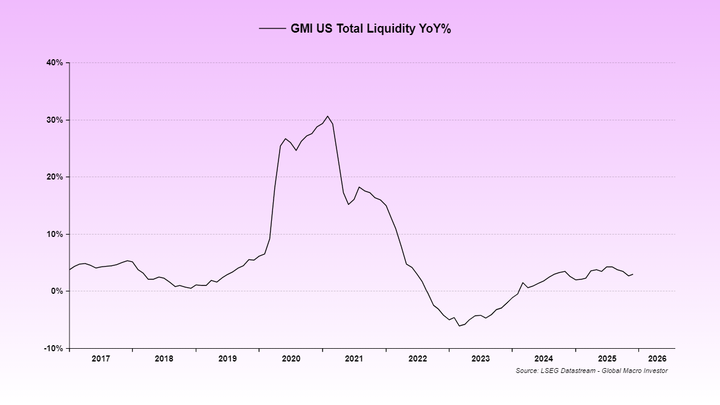
So far, the low liquidity is the reason the ISM Manufacturing Index has remained low.
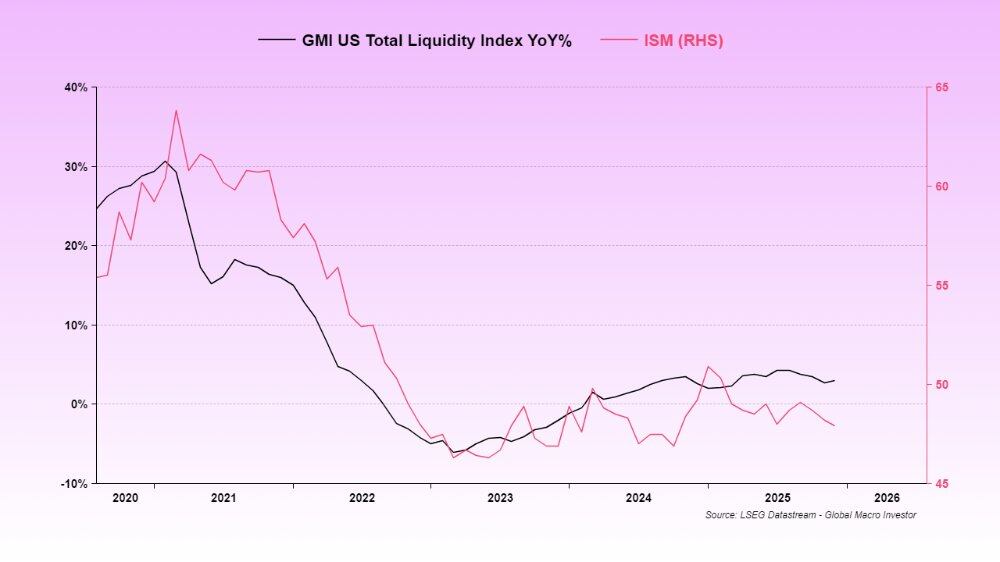
We usually use the Global Total Liquidity indicator because it has the highest long-term correlation with BTC and the Nasdaq, but at this stage, US Total Liquidity seems more important because the US is the main provider of global liquidity.

In this cycle, the GMI Global Total Liquidity Index leads the US Total Liquidity Index and is about to rebound (thus also driving the ISM index).
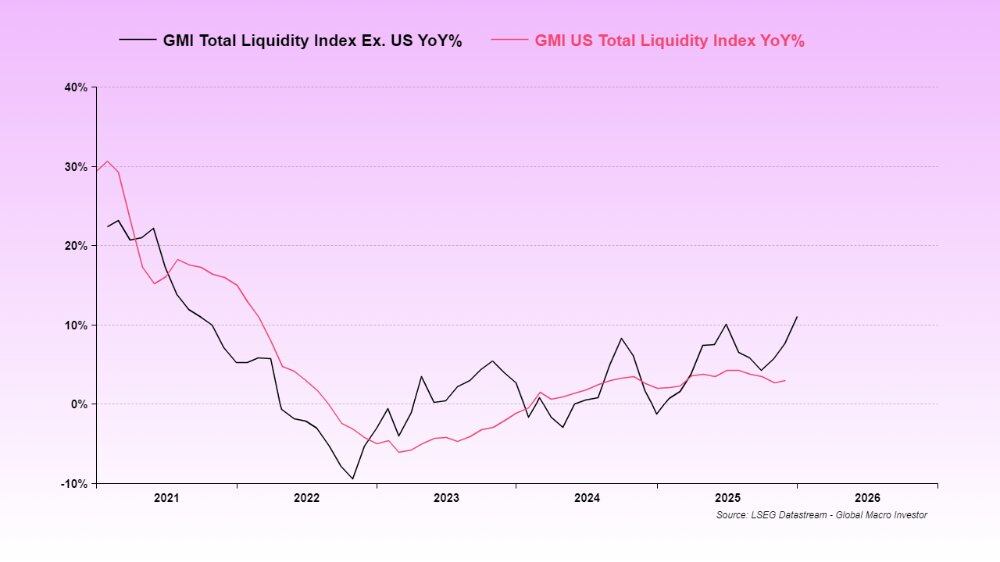
This is exactly what is affecting SaaS and BTC. Both assets are among the longest-duration assets in existence and have fallen due to the temporary withdrawal of liquidity.

Gold's rise has essentially sucked out the marginal liquidity from the system that might have flowed into the Bitcoin and SaaS markets. There isn't enough liquidity to support these assets, so high-risk assets are getting hit and falling. There's really no way around it.
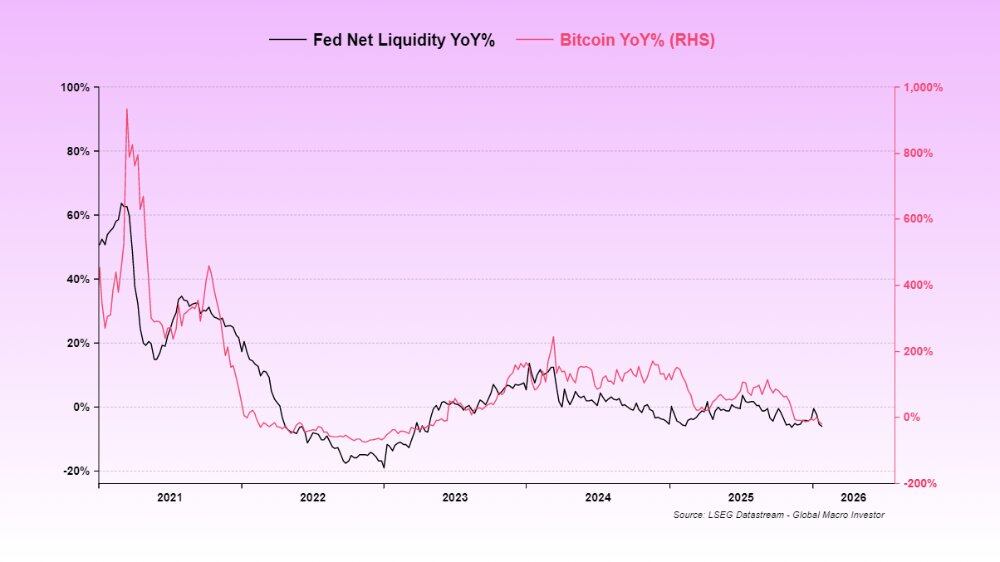
Now, the US government is happening again, and the Treasury Department has taken preventive measures: after the last government shutdown, no TGA funds were used, and instead, the asset scale was increased (i.e., further loss of liquidity). This is the crisis we are facing now. It has caused violent price fluctuations, and our beloved cryptocurrency still lacks liquidity.

However,种种迹象表明,this government shutdown will be resolved this week, which will clear the last liquidity obstacle.

Odaily Note: US House Speaker Johnson said in an interview on NBC News' "Meet the Press" on Sunday that he believes he has secured Republican support votes to ensure the shutdown of some government agencies ends by Tuesday.

I have mentioned the risks of this government shutdown many times before, but it will soon be over, and then we can continue to deal with the upcoming liquidity injection, which includes measures from eSLR, partial TGA回流 (TGA回流 likely means TGA runoff or drawdown, context suggests funds returning to system), fiscal stimulus, interest rate cuts, etc., all related to the mid-term elections.

Odaily Note: US regulators' bill to relax leverage ratio requirements to ease capital pressure on several major banks like Bank of America (BAC.US).

In a full trading cycle, time is often more important than price. Price can be hit hard, but as time passes and the cycle evolves, everything will be resolved and eventually settle.

This is why I have always emphasized "patience". Events need to develop. Focusing solely on profit and loss ratios will only affect your mental health, not your investment portfolio.

The Fed's False Narrative

Regarding interest rate cuts, another false narrative is that Kevin Warsh is a hawk. This is complete nonsense; these statements are mainly from over 18 years ago.

Warsh's job and mission were to execute the strategies of the Greenspan era. Both Trump and Besant have said (details not discussed here, but the main direction is rate cuts) to keep the economy hot and assume that the productivity gains from AI will suppress core CPI increases (just like the 1995-2000 era).

Odaily Note: Greenspan is one of the longest-serving chairs in Fed history. His advocated monetary policy (controlling inflation + promoting maximum employment) was highly flexible but practically more anti-inflation prioritized, while also actively injecting liquidity during crises.

He doesn't like the balance sheet, but the system is reserve-constrained, so he likely won't change its current practices, otherwise it would destroy the credit market.

Warsh will cut rates and do nothing else. He will not interfere with Trump and Besant's actions to manage liquidity through banks. Fed Governor Milan will likely forcefully push for a full eSLR cut to accelerate this process.

If you don't believe me, believe Druck ↓
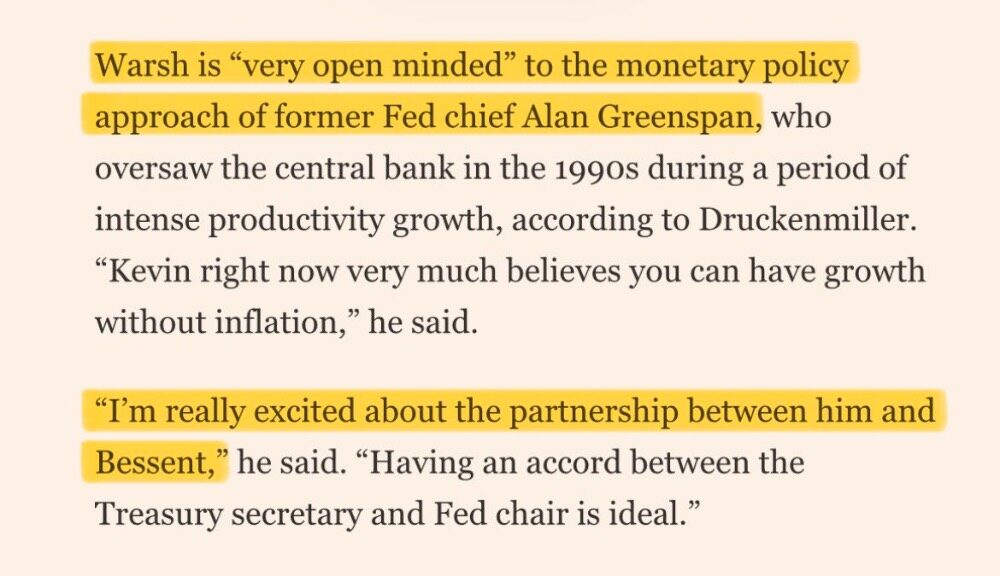
The above shows "investment guru" Stanley Druckenmiller's content on Warsh's monetary policy philosophy and his agreement with Besant upon becoming Fed Chair.

I know how difficult it is to hear optimistic narratives when the crypto market looks so dark. My SUI holdings are terrible, we don't know what or who to believe anymore. First, we have been through this many times before. When BTC falls 30%, altcoins can fall even 70%. But if they are high-quality alts, their rebound is also faster.

Mea Culpa (My Mistake)

GMI's mistake was not considering US liquidity as the current driving factor; usually, Global Total Liquidity dominates the entire cycle. But now the situation is clear, anything is possible.

The two are not unrelated. We just couldn't predict the combination punch of a series of events (reverse repo draining liquidity > TGA rebuilding > government shutdown > gold rising > another shutdown), or we failed to anticipate its impact.

It's almost over, and soon we can get back to normal work.

We cannot guarantee that every link is error-free (now with a deeper understanding), and we are still very bullish on the 2026 outlook because we understand the Trump/Besant/Warsh strategy. These three have repeatedly told us: we just need to listen and be patient. In full-cycle investing, time is more important than price.

If you are not a cycle investor and don't have such strong risk tolerance, that's completely fine. Everyone has their own style, but Julien (GMI Head of Macro Research) and I are not good at swing trading (we don't care about intra-cycle fluctuations), but we are proven and have a verifiable track record in full-cycle investing, leading the industry for the past 21 years. (Warning: We also make mistakes, like in 2009). Now is not the time to give up. Good luck, and let's achieve greater results in 2026.

Liquidity relief is on the way!

Preguntas relacionadas

QWhat is the main reason for the recent downturn in the crypto market according to Raoul Pal?

AThe main reason is the suppression of U.S. liquidity due to two government shutdowns and issues with the U.S. financial plumbing system, which was not fully offset by monetary measures, leading to a reduction in liquidity available for risk assets like crypto and SaaS stocks.

QWhat specific event does Raoul Pal point to as the catalyst that will soon resolve the liquidity crisis?

AHe points to the resolution of the current U.S. government shutdown, which is expected to be resolved imminently, as the event that will clear the final liquidity hurdle.

QHow does Raoul Pal characterize the relationship between time and price in a full market cycle?

AHe states that in a full cycle, time is more important than price. Price can be hit hard, but as time passes and the cycle plays out, things get resolved and eventually work themselves out.

QWhat was the key mistake that GMI made in its analysis, as admitted in the article?

AThe key mistake was not identifying U.S. liquidity as the current driving factor, as it is now more dominant than global aggregate liquidity in this part of the cycle, and failing to predict the combined impact of a series of events (RRP drain, TGA rebuild, shutdown, gold rally, another shutdown).

QWhat is the overall outlook for the crypto market in 2026 according to the author's conclusion?

AThe overall outlook for 2026 is very bullish, based on an understanding of the anticipated strategies of Trump, Besant, and a potential Fed Chair Warsh, which are expected to involve liquidity injections, fiscal stimulus, and rate cuts.

Lecturas Relacionadas

human.tech Launches Clean SDK for Privacy-First Web3 Apps

human.tech has launched the Clean SDK, a toolkit enabling developers to build privacy-first Web3 applications with transparent accountability. Released alongside Aztec's version 5, the SDK provides components for integrating zero-knowledge identity verification, sanctions screening, and private transactions, without developers handling sensitive user data or building compliance infrastructure from scratch. It uses zero-knowledge proofs and programmable verification to allow apps to confirm user legitimacy and sanctions compliance while keeping identities confidential. The first application built on the SDK, Shield, a privacy bridge to Aztec, also launched. It allows users to transfer assets privately while proving a unique human is behind each transfer and that funds have passed sanctions checks, as verified by a May 2026 audit. The SDK offers three core verification techniques: Proof of Innocence (sanctions screening against 23 sources), Proof of Personhood (simpler verification via Human Passport), and Proof of Clean Hands (higher-assurance zero-knowledge government ID checks). This allows apps to authenticate users and transactions without exposing personal data. Designed for Aztec builders, the SDK lets developers add programmable privacy to decentralized apps, eliminating the need to create their own verification and ZK infrastructure. Shield demonstrates its practical use for private bridges, but the SDK aims to enable a wider ecosystem of private, accountable financial apps and services. The launch addresses growing demand for infrastructure that balances privacy and accountability. The SDK avoids traditional identity databases, storing encrypted data off-chain, screening at both entry and exit points, and including a gated disclosure mechanism for legal requests. human.tech's products, including the Clean SDK, focus on using zero-knowledge technology to enable verifiable personhood and privacy in digital systems.

TheNewsCryptoHace 15 min(s)

human.tech Launches Clean SDK for Privacy-First Web3 Apps

TheNewsCryptoHace 15 min(s)

Unlocking $100 Million in Liquidity? Pump.fun's New Policy Tests the 5-Minute Pump Technique

Pump.fun, a popular meme coin launchpad, has introduced a new standard mechanism called BOOST. It aims to address a significant capital efficiency issue: when a newly launched token graduates from its initial bonding curve to a liquidity pool (LP), roughly 20% of its liquidity becomes permanently locked as "dead liquidity," estimated to waste over $100 million annually. Instead of locking these funds permanently, BOOST repurposes them. Upon a token's migration, approximately 20% of the settlement funds (e.g., 17.6 SOL or ~$2516 USDC) are used to buy back the token on the open market over a 5-minute period via a Time-Weighted Average Price (TWAP) mechanism. All purchased tokens are immediately burned. This creates a brief, systematic buy pressure immediately after migration, potentially generating a short-term price surge ("pump") while permanently reducing the token's circulating supply. The goal is to enhance the immediate post-launch trading experience, potentially increasing trader retention and sustainable protocol revenue, which funds ongoing token buybacks. However, concerns exist that this artificial 5-minute boost could lower the barrier for launching low-quality tokens and lead to steeper price crashes once the buy pressure stops, if followed by large sell-offs. The feature automatically applies to tokens migrating after July 21, 2024, but not to previously migrated tokens or those launched via the Mayhem AI Agent lab.

marsbitHace 22 min(s)

Unlocking $100 Million in Liquidity? Pump.fun's New Policy Tests the 5-Minute Pump Technique

marsbitHace 22 min(s)

Podcast Notes | Conversation with GSR Asset Management Head: To Determine if This Crypto Rally is Real, Just Watch the Lending Rates on Aave

Podcast Summary: Dialogue with GSR's Head of Asset Management: To Determine if This Crypto Rally is Real, Just Check Lending Rates on Aave Andy Baehr, Managing Director of Asset Management at GSR, discusses the current crypto market, characterizing it as stuck in a state of "ambivalence" with short-lived, unsustainable rallies. He outlines a simple framework: the market moves between "ambivalence" and "conviction" (sustained upward momentum). Currently, every rally resembles a single-stage rocket booster that quickly fizzles out. Baehr identifies three key signals to watch: 1) DeFi lending rates, 2) the potential passage of the CLARITY Act, and 3) the market forming a consensus on the "Fed hawkish peak." He emphasizes that the most immediate indicator for the sustainability of the recent CPI-triggered rally is the USDC borrowing rate on Aave, currently around 3.75%—close to U.S. Treasury yields. The absence of a credit spread indicates low leverage demand and a lack of market energy. He explains that a healthy, sustained rally requires layered buying pressure. Last year's rally progressed from an ETH short squeeze to crypto-native trader influx and finally to ETF inflows. Currently, this structure is missing. Other potential structural buyers like Digital Asset Treasury (DAT) companies are absent, and ETF flows have proven transient. Baehr notes that while small-cap crypto tokens outperformed large caps in Q2—a potential sign of capitation in major assets—capital is also flowing to more exciting opportunities like AI stocks and tech IPOs, leaving crypto sidelined. Regarding DeFi, he highlights that platforms like Aave provide a clear, real-time signal of leverage demand through their supply/demand-driven interest rates. A significant, sustained rate increase would signal genuine market conviction. He also observes the quiet emergence of fixed-income-like products and vaults in DeFi. On regulation, the probability of the CLARITY Act passing before the August 7th deadline has dropped linearly from 75% to below 40% on Polymarket. Baehr suggests its passage would be treated as a bullish surprise, a potent driver for price movement. However, political hurdles, including ethical clause debates and disclosures about the First Family's crypto profits, remain significant obstacles. Ultimately, the market awaits clarity on the Fed's terminal rate under Chair Warsh. Until the "Fed Solstice"—the point where the market collectively understands the peak of hawkish policy—sustained conviction will be difficult to achieve.

marsbitHace 53 min(s)

Podcast Notes | Conversation with GSR Asset Management Head: To Determine if This Crypto Rally is Real, Just Watch the Lending Rates on Aave

marsbitHace 53 min(s)

Trading

Spot
活动图片





