Is AAOI's P/S Ratio of 18.5 Expensive? Model Says 'Undervalued by 13%', Short Sellers Say '67% Bubble' — Who's Lying?

Publicado a 2026-08-17Actualizado a 2026-08-17

Resumen

The crucial question facing investors is whether the demand for its high-speed optical products and its planned capacity expansion can support the current revenue expectations. If this assumption proves untenable, the current valuation might resemble a value trap rather than a sound investment opportunity.

Applied Optoelectronics' stock has delivered many years of very strong upward momentum, but its low overall Value Score suggests the current share price may already reflect much of the market's optimism.

Over the past 5 years, Applied Optoelectronics' returns have been approximately 19 times the initial investment, which further focuses attention on how much upside the company may have left.

Recently, surging demand for the company's high-speed optical products (used to support AI and cloud data centers) may have raised investor expectations. However, any slowdown in demand or hiccups in planned capacity expansion could quickly affect what investors are willing to pay.

Applied Optoelectronics passes only 1 out of 6 valuation checks, so even considering its growth prospects, the company appears overvalued rather than undervalued on the whole.

The question now is whether Applied Optoelectronics' current valuation offers enough runway for reasonable returns after such a strong run-up.

Applied Optoelectronics returned 519.1% last year. Here's a look at how it stacks up across the Communications industry.

Is Applied Optoelectronics a Bargain Now?

For Applied Optoelectronics, the Price-to-Sales (P/S) ratio is a useful metric because the company is focused on revenue growth rather than established profitability.

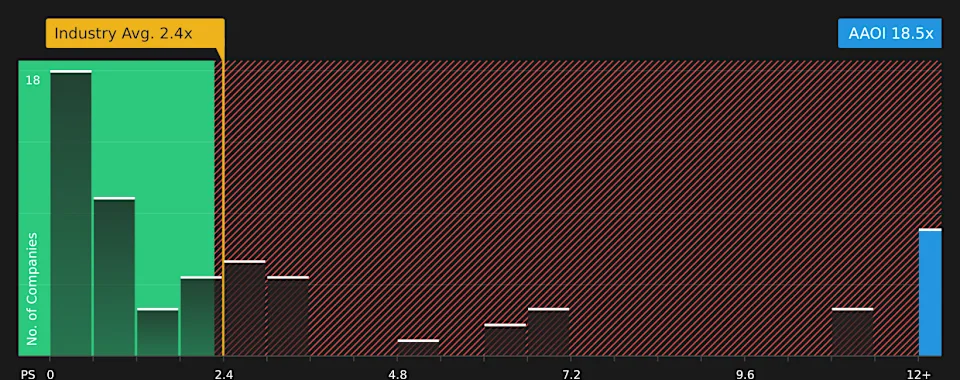
Applied Optoelectronics' P/S ratio is around 18.5x, significantly higher than the Communications industry average (~2.4x) and higher than the peer average (~7.0x). On a simple comparison, investors are paying much more per $1 of sales for this company than for many other communications stocks.

However, a more justified P/S ratio, considering the company's growth prospects, margins, size, and risk, is around 29.3x, which is still far above the current P/S. Despite the strong recent rally driven by AI-related policy news and revenue updates, the model indicates the current price does not fully reflect market expectations for Applied Optoelectronics based on revenue.

On a P/S basis, Applied Optoelectronics stock appears undervalued relative to where it should typically trade given its growth and risk profile.
The Applied Optoelectronics Narrative: What Must Hold True to Justify Today's Price?

The Simply Wall St Narratives series picks up Applied Optoelectronics' valuation puzzle, outlining what assumptions in growth, margins, and earnings must hold for the stock to be worth significantly more or less than its current price. Each article treats Applied Optoelectronics' implied fair value as a theory about the company's business that can be reassessed over time, not a one-time snapshot.

Currently, there is a stark divergence in views on Applied Optoelectronics, with a vast chasm between bullish and bearish theses on the stock.

Bull Thesis: Undervalued by 13%

"Growing demand from AI/machine learning workloads, video streaming, the Internet of Things, and the ongoing transition from copper to fiber in network infrastructure creates persistent tailwinds for the industry..."

Bear Thesis: Overvalued by 67%

"The case for going short is equally clear: the stock already reflects most of its upside potential..."

Summary

Applied Optoelectronics appears undervalued based on a customized Price-to-Sales (P/S) metric, but its low overall Value Score suggests most other metrics are not giving a clear endorsement. Recent high volatility in the share price implies market expectations are already elevated, warranting extra caution on relying on the P/S metric alone. The key question for investors is whether demand for its high-speed optical products and planned capacity expansion can support the current revenue expectations. If this assumption fails to hold, the current valuation might look more like a value trap than an investment opportunity.


Lecturas Relacionadas

The End of Old Cryptography: How Ethereum is Preparing for the Era of Quantum Computing

Ethereum developers have proposed a new system for handling staking deposits, aiming to future-proof the network against the potential threat of quantum computers. Currently, Ethereum's security relies on elliptic curve cryptography, which could be broken by sufficiently powerful quantum machines capable of deriving private keys from public ones. While estimates of the timeline for this threat vary, with Google research in March 2026 suggesting it could be closer than previously thought, major blockchains are proactively preparing. The new proposal introduces a more flexible deposit contract capable of accepting keys of various types and lengths, identified by a scheme label. It also changes how deposit data is communicated within the network's layers. Crucially, the transition plan involves a three-phase process to ensure a controlled and predictable shift, initially disabling new deposits, then re-enabling the current format, and finally permanently switching to new post-quantum cryptography in a future update. The proposal is currently a draft with no set implementation date. It represents a strategic move to build infrastructure in advance, rather than a direct solution for existing accounts. Analysis notes that Ethereum is structurally vulnerable to a "store now, decrypt later" attack, as public keys revealed in past transactions remain permanently on-chain. This proposal prepares for a signature algorithm change but does not address the risk to keys already exposed.

cryptonews.ruHace 4 min(s)

The End of Old Cryptography: How Ethereum is Preparing for the Era of Quantum Computing

cryptonews.ruHace 4 min(s)

Meta Faces a $1.4 Trillion Penalty: Algorithmic Recommendation in the Dock. Will the Rules Change in the Second Half of the Internet Era?

A landmark federal trial in Oakland, California, has begun against Meta, with 29 states accusing the company of harming children and teens through its social media platform designs. The states seek a potential maximum penalty of $1.4 trillion, calculated from alleged repeated violations of consumer protection laws and the Children's Online Privacy Protection Act (COPPA) involving millions of underage users. The core legal strategy bypasses the traditional shield of Section 230 by targeting Meta's own platform features—like its recommendation algorithms, infinite scroll, and "like" buttons—rather than user-generated content. The plaintiffs argue these designs are addictive and deceptive. Meta denies the claims, calling the penalty "unprecedented" and disputing the methodology. While the astronomical $1.4 trillion figure is seen as a starting point for negotiations, even a significantly reduced penalty in the hundreds of billions could establish a critical precedent. The case focuses on holding platforms legally responsible for their algorithmic designs. A ruling against Meta could force product changes, such as removing "likes" or imposing usage limits, and provide a legal template for similar suits against other tech giants like TikTok and YouTube. The trial's outcome may redefine accountability for algorithm-driven business models across the internet.

marsbitHace 14 min(s)

Meta Faces a $1.4 Trillion Penalty: Algorithmic Recommendation in the Dock. Will the Rules Change in the Second Half of the Internet Era?

marsbitHace 14 min(s)

A Precedent for the Prediction Markets: CFTC Aims to Prove Authority Over Polymarket via Criminal Case

A U.S. Army soldier, Gannon Ken Van Dyke, who earned $400,000 using non-public information on the crypto event-prediction platform Polymarket, is contesting the U.S. Commodity Futures Trading Commission's (CFTC) attempt to intervene in his criminal case. The CFTC, which initiated a separate civil suit against Van Dyke but has not pursued it to trial, seeks to submit arguments in the ongoing criminal proceeding. Van Dyke's lawyers filed a motion opposing this, arguing the CFTC is improperly trying to influence the criminal case as an outside expert rather than through its own lawsuit. They contend that event contracts traded on platforms like Polymarket are not swaps and thus fall outside the CFTC's jurisdiction, calling the regulator's tactics a procedural maneuver. Van Dyke faces criminal fraud charges for allegedly trading based on confidential information about potential regime change in Venezuela. His civil case with the CFTC is stayed pending the criminal trial, expected in late 2026 or early 2027. The court's decision on whether to allow the CFTC's intervention could set a precedent for how such event contracts are regulated. An AI analysis notes inconsistency in the CFTC's approach compared to a similar case involving a Google employee, raising questions about the legal strategy for the prediction market industry, which includes platforms like Kalshi. The outcome may define future regulatory standards for the entire market.

cryptonews.ruHace 18 min(s)

A Precedent for the Prediction Markets: CFTC Aims to Prove Authority Over Polymarket via Criminal Case

cryptonews.ruHace 18 min(s)

Trading

Spot
活动图片