Iran Launches Bitcoin-Based Maritime Insurance Platform 'HormuzSafe', Claims Annual Revenue Could Exceed $100 Billion

marsbitPublicado a 2026-05-20Actualizado a 2026-05-20

Resumen

Iran has launched "HormuzSafe," a Bitcoin-based maritime insurance platform for shipping through the Strait of Hormuz, aiming for potential annual revenue exceeding $10 billion. The platform, announced by Iranian semi-official media, offers "cryptographically verifiable insurance policies" settled in Bitcoin for Iranian shippers and cargo owners. However, its operational status is unconfirmed, and analysts highlight significant challenges including Bitcoin's price volatility, risks of violating U.S. sanctions, and the controversial background of some involved figures. This initiative is part of Iran's broader strategy to institutionalize control over the critical waterway—which handles roughly 20% of global seaborne oil trade—following its closure after U.S.-Israel airstrikes in late February. Iran has also established the Persian Gulf Strait Authority (PGSA) to manage traffic and fees. While positioning Bitcoin as a sanctions-resistant settlement layer, the platform faces skepticism regarding its technical feasibility, user adoption, and the potential for it to be confused with existing crypto-related shipping scams.

Shenchao Digest: Iran's Ministry of Economy has launched a Bitcoin-settled maritime insurance platform called 'Hormuz Safe', targeting Iranian shipowners and cargo owners transiting the Strait of Hormuz with 'cryptographically verifiable insurance policies'. Iranian state media claims the platform could generate over $100 billion in annual revenue.

However, independent verification of whether the platform is actually operational has not been obtained. Its feasibility faces severe challenges due to Bitcoin's high volatility, compliance risks from US sanctions, and the controversial background of its alleged backer, Babak Zanjani. This represents Iran's most prominent attempt to convert its military control over the Strait of Hormuz into a crypto-financial product.

Iran is attempting to turn one of the world's most critical maritime chokepoints into a Bitcoin-settled insurance market.

According to a Bloomberg report on May 18, Iran's semi-official Fars news agency, citing documents from the country's Ministry of Economic Affairs and Finance, reported that Iran has launched a Bitcoin-backed maritime insurance service named 'Hormuz Safe' for Iranian shipping companies and cargo owners wishing to pass through the Strait of Hormuz.

Fars stated that the plan could generate over $100 billion in revenue for Iran but did not provide a timeframe or operational details.

Since the US and Israeli airstrikes on Iran on February 28, Iran has effectively closed the Strait of Hormuz. In peacetime, the strait handles about 20% of global seaborne oil trade and 20% of liquefied natural gas exports.

The Iranian government and the Islamic Revolutionary Guard Corps (IRGC) have since sought to formalize control over the waterway, including charging tolls and other fees. The insurance service is the latest link in its chain of revenue-generating tools.

Crypto-Verified Policies, Bitcoin Instant Settlement

According to a screenshot of the 'Hormuz Safe' website shared by Fars, the platform claims to provide Iranian shipping companies and cargo owners with 'fast, verifiable digital insurance'. As reported by Bitcoin Magazine, coverage includes risks such as vessel inspection, seizure, and confiscation, but war damage claims are excluded.

Fars quoted the description from the website hormuzsafe.ir, stating that the platform will provide 'cryptographically verifiable insurance policies' for cargo transiting the Persian Gulf, the Strait of Hormuz, and surrounding waters, with payments settled in Bitcoin. Coverage begins the moment the cargo is confirmed on the blockchain, and the cargo owner will receive a signed receipt. The website currently appears inaccessible outside Iran.
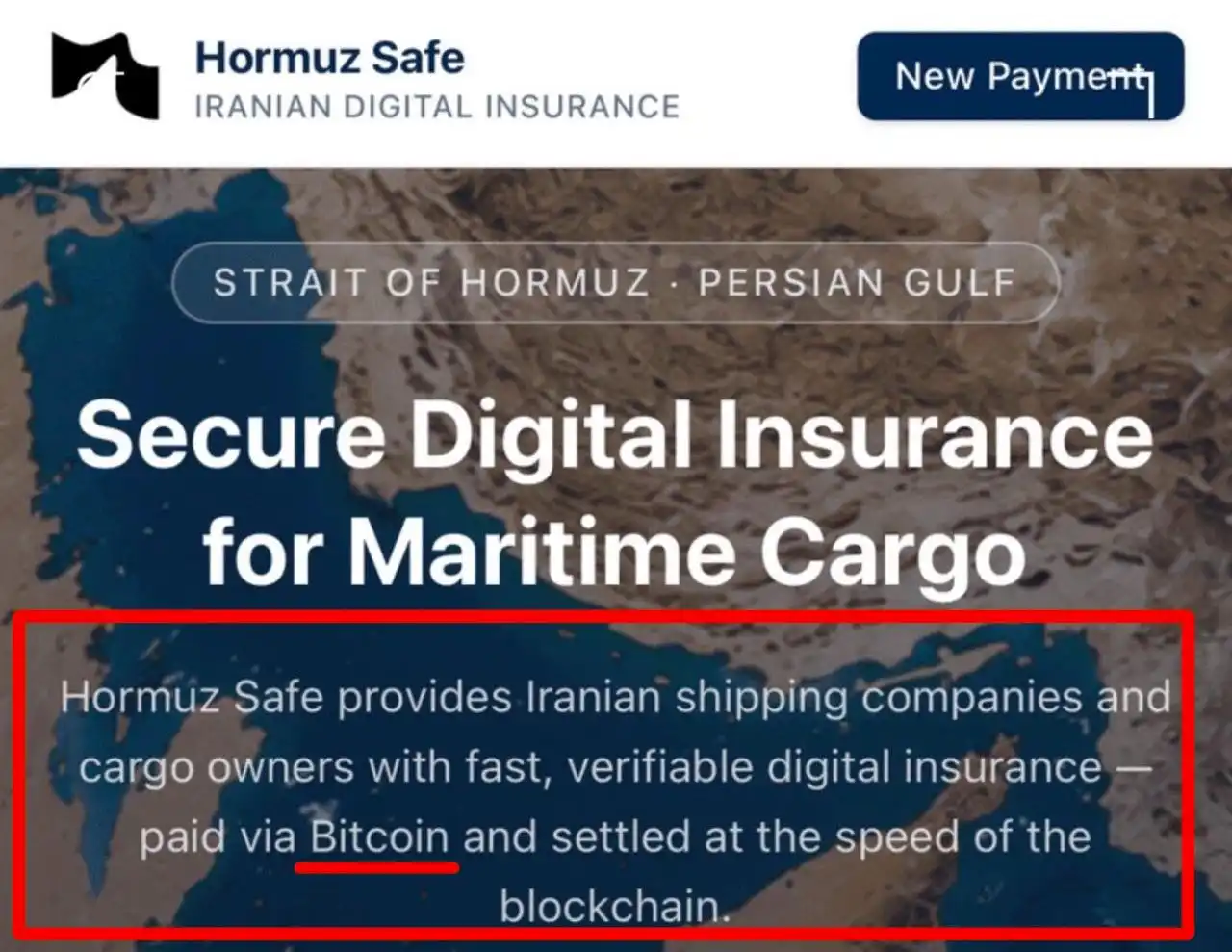
According to Bitcoin Magazine, Iran's Ministry of Economy began advancing this insurance plan from late April (early Ordibehesht in the Persian calendar). In April, Hamid Hosseini, spokesman for the Iranian Oil, Gas, and Petrochemical Products Exporters Union, told the Financial Times that shipping companies could settle Strait of Hormuz passage fees using non-dollar currencies like Bitcoin or Chinese Yuan.

Accelerating Institutionalization: From Tolls to Insurance Platform

Hormuz Safe is not an isolated move but the latest component of an entire institutional framework Iran is building around the Strait of Hormuz.

According to Bitcoin Magazine, in March 2026, the Iranian parliament passed the 'Strait of Hormuz Management Plan', formalizing into law the toll system operated by the IRGC since mid-March. Under this framework, the IRGC charges fees to ships passing through the strait; operators must submit information on vessel ownership, cargo type, destination, and crew to obtain a passage permit code.

Fees start at about $1 per barrel of oil, with fully loaded oil tankers facing charges up to $2 million, payable in Chinese Yuan.

On May 18, Iran's Supreme National Security Council announced the formal establishment of the 'Persian Gulf Strait Authority' (PGSA) and opened an official account on X.
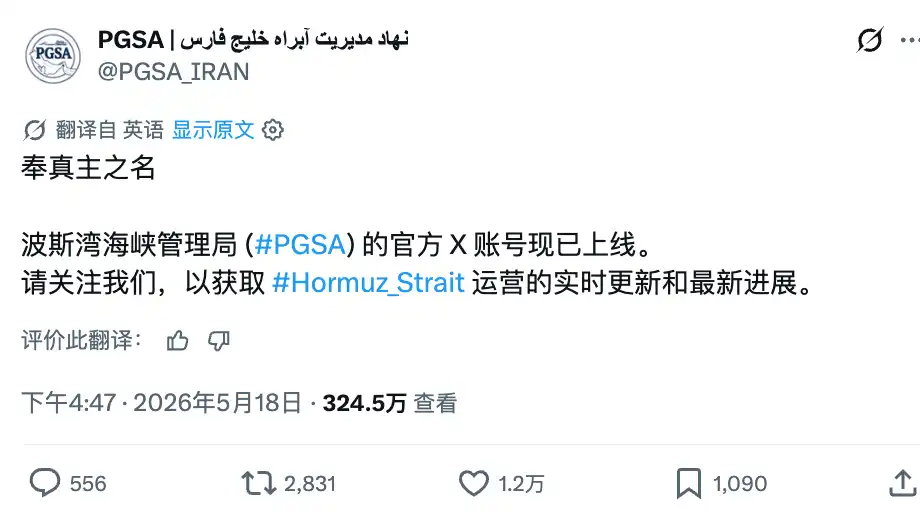
According to Euronews, the agency is positioned as an administrative entity to manage Strait of Hormuz traffic and collect tolls, operating in coordination with the IRGC Navy.

Ships must submit complete information, including ownership, insurance, crew lists, cargo declarations, and planned routes, via the PGSA's official email for approval and payment before receiving passage permits.

Ebrahim Azizi, chairman of the National Security and Foreign Policy Committee of the Iranian parliament, stated on X that only commercial vessels cooperating with Iran will benefit from this mechanism, and parties involved in US-Israeli military operations will be banned from using the route.

According to Windward intelligence analysis, as of May 18, strait traffic remains only about 38% of pre-conflict levels, with central Qeshm-Larak anchorage showing fixed dark vessel positioning for six consecutive days. Approximately 369 IRGC fast boats are concentrated in a single area about 30 nautical miles northeast of Khasab, shifting from coastal patrols to a presence in the main body of the strait.

Volatility, Sanctions Risks, and Shadow of Fraud

Several analysts have expressed skepticism about the practical feasibility of Hormuz Safe.

Bloomberg points out that, unlike stablecoins pegged to the US dollar, Bitcoin's price is highly volatile, limiting its adoption as a payment method. Foreign shipowners may be reluctant to use the mechanism for fear of violating US sanctions against Iran.

Ryan Yoon, senior analyst at Tiger Research, told Decrypt that the platform's technical and legal feasibility is 'highly questionable'; despite the announcement of its launch, no actual users have been confirmed. Shipping companies using Hormuz Safe would face the risk of 'immediate expulsion from the global financial system'.

Cake Wallet CEO Vikrant Sharma told BeInCrypto that Bitcoin can reduce some payment friction but is not a clean path to bypass the sanctions system. Liquidity at the scale of maritime insurance is a limiting factor. Activity on public blockchains can be monitored, and any exchange, broker, custodian, or counterparty tied to the US dollar brings compliance risks.

Sam Lyman, Research Director at the Bitcoin Policy Institute, explained Iran's logic from another angle: Bitcoin's core appeal lies in the fact that 'no one can freeze it'.

According to Decrypt, since the war began, crypto 'safe passage fee' scams have proliferated. Scammers impersonate Iranian authorities, demanding Bitcoin or USDT from ship operators. Hormuz Safe appears to be an independent national-level plan, but the line between genuine and fake is extremely blurred in the current environment.

The Bigger Picture: Iran Building a De-dollarized Maritime Financial System

According to Bitcoin Magazine data, Iran's crypto ecosystem was estimated at $7.8 billion in 2025, with IRGC-linked transactions accounting for about 50% of the country's total crypto volume (as of Q4 2025). The Iranian government has reportedly used mined Bitcoin to fund imports and hedge against oil revenue losses, with a stated national mining cost of about $1,300 per coin.

CoinDesk's analysis was quite precise: an insurance structure is more sophisticated than directly charging tolls. On paper, cargo owners are not paying for passage but purchasing insurance and financial responsibility certificates for sailing in waters that Tehran claims it can secure. This allows Iran to monetize its geographical advantage in a more palatable way.

A comment by Hacker News user everdrive received high votes in the tech community: The post-WWII US-led world order was partly built on the premise that the US military kept international waters open. Iran challenging the US at this level is astonishing. Everyone knew Iran had the capacity to close the strait if backed into a corner, but the arrival of this outcome still exposes serious policy-level miscalculations.

Regardless of whether Hormuz Safe ultimately operates at scale, the signal it sends is clear: Iran is building a complete set of administrative governance and financial infrastructure around the Strait of Hormuz, converting military blockade into a sustainable sovereign revenue mechanism, with Bitcoin serving as the settlement layer for this system.


Preguntas relacionadas

QWhat is 'Hormuz Safe' and what is its primary purpose?

A'Hormuz Safe' is a Bitcoin-based maritime insurance platform launched by Iran's Ministry of Economy. Its primary purpose is to offer 'cryptographically verifiable insurance policies' to Iranian shipping companies and cargo owners for voyages passing through the Strait of Hormuz, with settlements to be made in Bitcoin.

QWhat are the main challenges and risks associated with the 'Hormuz Safe' platform, according to the article?

AThe main challenges and risks include: Bitcoin's high price volatility making it an unstable payment method; the risk of users violating US sanctions against Iran, potentially leading to exclusion from the global financial system; unconfirmed operational status and user adoption; and concerns about the feasibility of its legal and technical framework.

QWhat institutional frameworks is Iran building around the Strait of Hormuz alongside the 'Hormuz Safe' platform?

AIran is building a broader institutional framework for the Strait of Hormuz, including the passage of the 'Strait of Hormuz Management Plan' in March 2026 to formalize transit fees, and the establishment of the 'Persian Gulf Strait Authority' (PGSA) in May 2026 to manage traffic and collect fees, operating alongside the Islamic Revolutionary Guard Corps (IRGC) Navy.

QHow is Iran reportedly using Bitcoin within its national economy according to the article?

AThe article states that Iran's crypto ecosystem was estimated at $7.8 billion in 2025, with IRGC-linked transactions accounting for about 50% of the country's total crypto volume. The government reportedly uses Bitcoin mined domestically (at a cost of around $1,300 per coin) to fund imports and hedge against losses in oil revenues.

QBeyond simple transit fees, what strategic advantage does the 'Hormuz Safe' insurance model offer Iran, according to analysts?

AAnalysts, such as from CoinDesk, note that the insurance model is more sophisticated than direct transit fees. It allows Iran to monetize its geographic control by having cargo owners pay for insurance and financial responsibility certificates for sailing in waters Tehran claims to secure, rather than directly paying a toll. This makes the revenue stream more palatable and packageable internationally.

Lecturas Relacionadas

Warsh's First Day in Office, Markets Deliver a 'Wake-up Call': Rate Hike Expected This Year

On his first day in office, newly inaugurated Federal Reserve Chairman Warsh received a stark market warning, with expectations now fully pricing in a 25-basis-point interest rate hike this year. The shift was triggered by hawkish remarks from Fed Governor Waller, who stated that inflation is now the key policy "driver" and that the odds of a hike or cut are evenly split. This sent short-term Treasury yields higher. Waller signaled a significant pivot in his stance, citing disappointing inflation and labor data. He suggested removing "easing bias" language from Fed statements and did not rule out future rate increases if inflation fails to recede, though he noted immediate action isn't warranted without signs of unanchored inflation expectations. Chairman Warsh faces immediate pressure at his first FOMC meeting in June. With the preferred inflation gauge at a three-year high, analysts warn that failing to hike could be interpreted as an implicit easing of policy. The geopolitical situation in the Middle East is adding to existing price pressures. The market's expectation for a hike contrasts sharply with earlier forecasts for multiple cuts. While long-term Treasury yields have been contained by lower energy prices recently, analysts note they remain under structural upward pressure. Warsh's swearing-in at the White House highlights political scrutiny over Fed independence. However, the market has made it clear that inflation is the most urgent challenge, leaving the new chairman little time to settle in.

marsbitHace 10 hora(s)

Warsh's First Day in Office, Markets Deliver a 'Wake-up Call': Rate Hike Expected This Year

marsbitHace 10 hora(s)

Has Microsoft Lost Its Way in the AI Race, and Can Copilot Bring It Back on Track?

Microsoft, once seen as an early AI frontrunner due to its investment in OpenAI, is navigating a strategic shift amid increased competition. Its initial reliance on OpenAI’s GPT models has been complicated by OpenAI’s growing ambitions as a direct competitor, rapid advancements from rivals like Claude and Gemini, and the disruptive rise of AI agents, which challenge its traditional SaaS business model. These factors contributed to stock declines and slower-than-expected adoption of its flagship Copilot products. In response, CEO Satya Nadella has taken a hands-on role in product development, signaling the urgency of change. Microsoft is pivoting from a model-centric strategy to a "model-agnostic" enterprise platform approach. It aims to become the foundational layer connecting various AI models—from OpenAI, Anthropic, or its own new "Superintelligence" team—with enterprise workflows, data, security, and cloud services. Recent organizational changes merged consumer and enterprise Copilot teams to accelerate innovation, exemplified by new products like Copilot Tasks and Copilot Cowork. However, this transformation comes at a high cost. Microsoft faces massive capital expenditures, potentially reaching ~$190 billion by 2026, to support AI infrastructure. While its platform strategy shows early signs of traction with growing Azure AI revenue, it must balance startup-like agility with the reliability expected by enterprise clients. The core challenge is no longer being the sole AI winner but defending its position as the essential enterprise software entry point amidst rapid technological commoditization and the shift towards always-on AI agents.

marsbitHace 10 hora(s)

Has Microsoft Lost Its Way in the AI Race, and Can Copilot Bring It Back on Track?

marsbitHace 10 hora(s)

Trading

Spot
Futuros

Artículos destacados

Qué es BITCOIN

Entendiendo HarryPotterObamaSonic10Inu (ERC-20) y Su Posición en el Espacio Cripto En los últimos años, el mercado de criptomonedas ha sido testigo de un aumento en la popularidad de las monedas meme, capturando el interés no solo de los comerciantes, sino también de aquellos que buscan compromiso comunitario y valor de entretenimiento. Entre estos tokens únicos se encuentra HarryPotterObamaSonic10Inu (ERC-20), un proyecto intrigante que mezcla referencias culturales en el tejido de las criptomonedas. Este artículo profundiza en los aspectos clave de HarryPotterObamaSonic10Inu, explorando sus mecanismos, ethos impulsado por la comunidad y su relación con el paisaje cripto más amplio. ¿Qué es HarryPotterObamaSonic10Inu (ERC-20)? Como su nombre sugiere, HarryPotterObamaSonic10Inu es una moneda meme construida sobre la blockchain de Ethereum, clasificada bajo el estándar ERC-20. A diferencia de las criptomonedas tradicionales que pueden enfatizar la utilidad práctica o el potencial de inversión, este token prospera en el valor de entretenimiento y la fuerza de su comunidad. El proyecto tiene como objetivo fomentar un entorno donde los usuarios comprometidos puedan reunirse, compartir ideas y participar en actividades inspiradas por diversos fenómenos culturales. Una característica notable de HarryPotterObamaSonic10Inu es su cero impuestos en las transacciones. Este atractivo elemento tiene como objetivo incentivar el comercio y la participación comunitaria, sin cargos adicionales que puedan disuadir a los comerciantes de pequeña escala. El suministro total de la moneda está establecido en mil millones de tokens, una cifra que marca su intención de mantener una circulación sustancial dentro de la comunidad. Creador de HarryPotterObamaSonic10Inu (ERC-20) Los orígenes de HarryPotterObamaSonic10Inu están algo envueltos en misterio; los detalles sobre el creador siguen siendo desconocidos. El desarrollo de este token carece de un equipo identificable o de un plan explícito, lo cual no es inusual dentro del sector de monedas meme. En cambio, el proyecto ha surgido de manera orgánica, con su progreso muy dependiente del entusiasmo y la participación de su comunidad. Inversores de HarryPotterObamaSonic10Inu (ERC-20) En cuanto a inversiones externas y respaldo, HarryPotterObamaSonic10Inu también sigue siendo ambiguo. El token no lista ninguna fundación de inversión conocida o apoyo organizacional significativo. En cambio, la savia del proyecto es su comunidad de base, que informa su crecimiento y sostenibilidad a través de la acción colectiva y el compromiso en el espacio cripto. ¿Cómo Funciona HarryPotterObamaSonic10Inu (ERC-20)? Como una moneda meme, HarryPotterObamaSonic10Inu opera principalmente fuera de los marcos tradicionales que a menudo rigen el valor de los activos. Hay varios aspectos distintivos que definen cómo funciona el proyecto: Transacciones Sin Impuestos: Sin tarifas impositivas en las transacciones, los usuarios pueden comprar y vender el token libremente sin preocuparse por costos ocultos. Compromiso Comunitario: El proyecto prospera en la interacción comunitaria, aprovechando plataformas de redes sociales para crear entusiasmo y facilitar la participación. Las discusiones, el intercambio de contenido y el compromiso son elementos cruciales que ayudan a expandir su alcance y fomentar la lealtad entre los seguidores. Sin Utilidad Práctica: Cabe señalar que HarryPotterObamaSonic10Inu no ofrece utilidad concreta dentro del ecosistema financiero. Más bien, se clasifica como un token principalmente para actividades de entretenimiento y comunitarias. Referencia Cultural: El token incorpora astutamente elementos de la cultura popular para atraer interés, conectando con entusiastas de los memes y seguidores de las criptomonedas por igual. HarryPotterObamaSonic10Inu ejemplifica cómo las monedas meme operan de manera diferente a los proyectos de criptomonedas más tradicionales, ingresando al mercado como construcciones sociales innovadoras en lugar de activos utilitarios. Cronología de HarryPotterObamaSonic10Inu (ERC-20) La historia de HarryPotterObamaSonic10Inu está marcada por varios hitos notables: Creación: El token surgió de un meme viral, capturando la imaginación de muchos entusiastas de las criptomonedas. Las fechas específicas de creación no están disponibles, subrayando su ascenso orgánico. Listado en Exchanges: HarryPotterObamaSonic10Inu ha llegado a varios exchanges, permitiendo un acceso y comercio más fácil por parte de la comunidad. Iniciativas de Compromiso Comunitario: Actividades continuas destinadas a mejorar la interacción comunitaria, incluyendo concursos, campañas en redes sociales y generación de contenido por parte de fanáticos y defensores. Planes de Expansión Futuros: La hoja de ruta del proyecto incluye el lanzamiento de una colección de NFT, mercancía y un sitio de comercio electrónico relacionado con sus temas culturales, involucrando aún más a la comunidad e intentando añadir más dimensiones a su ecosistema. Puntos Clave Sobre HarryPotterObamaSonic10Inu (ERC-20) Naturaleza Impulsada por la Comunidad: El proyecto prioriza la participación colectiva y la creatividad, asegurando que la involucración de los usuarios esté a la vanguardia de su desarrollo. Clasificación como Moneda Meme: Representa la epítome de las criptomonedas basadas en el entretenimiento, diferenciándose de los vehículos de inversión tradicionales. Sin Afiliación Directa con Bitcoin: A pesar de la similitud en el nombre del ticker, HarryPotterObamaSonic10Inu es distinto y no tiene relación con Bitcoin u otras criptomonedas establecidas. Enfoque en la Colaboración: HarryPotterObamaSonic10Inu está diseñado para crear un espacio para la colaboración y el intercambio de historias entre sus poseedores, proporcionando una vía para la creatividad y el vínculo comunitario. Perspectivas Futuras: La ambición de expandirse más allá de su premisa inicial hacia NFTs y mercancías describe un camino para que el proyecto potencialmente ingrese a avenidas más tradicionales dentro de la cultura digital. A medida que las monedas meme continúan capturando la imaginación de la comunidad de criptomonedas, HarryPotterObamaSonic10Inu (ERC-20) se destaca debido a sus lazos culturales y su enfoque centrado en la comunidad. Si bien puede no encajar en el molde típico de un token impulsado por la utilidad, su esencia radica en la alegría y la camaradería fomentadas entre sus seguidores, destacando la naturaleza en evolución de las criptomonedas en una era cada vez más digital. A medida que el proyecto continúa desarrollándose, será importante observar cómo las dinámicas comunitarias influyen en su trayectoria en el cambiante paisaje de la tecnología blockchain.

1.5k Vistas totalesPublicado en 2024.04.01Actualizado en 2024.12.03

Qué es BITCOIN

Cómo comprar BTC

¡Bienvenido a HTX.com! Hemos hecho que comprar Bitcoin (BTC) sea simple y conveniente. Sigue nuestra guía paso a paso para iniciar tu viaje de criptos.Paso 1: crea tu cuenta HTXUtiliza tu correo electrónico o número de teléfono para registrarte y obtener una cuenta gratuita en HTX. Experimenta un proceso de registro sin complicaciones y desbloquea todas las funciones.Obtener mi cuentaPaso 2: ve a Comprar cripto y elige tu método de pagoTarjeta de crédito/débito: usa tu Visa o Mastercard para comprar Bitcoin (BTC) al instante.Saldo: utiliza fondos del saldo de tu cuenta HTX para tradear sin problemas.Terceros: hemos agregado métodos de pago populares como Google Pay y Apple Pay para mejorar la comodidad.P2P: tradear directamente con otros usuarios en HTX.Over-the-Counter (OTC): ofrecemos servicios personalizados y tipos de cambio competitivos para los traders.Paso 3: guarda tu Bitcoin (BTC)Después de comprar tu Bitcoin (BTC), guárdalo en tu cuenta HTX. Alternativamente, puedes enviarlo a otro lugar mediante transferencia blockchain o utilizarlo para tradear otras criptomonedas.Paso 4: tradear Bitcoin (BTC)Tradear fácilmente con Bitcoin (BTC) en HTX's mercado spot. Simplemente accede a tu cuenta, selecciona tu par de trading, ejecuta tus trades y monitorea en tiempo real. Ofrecemos una experiencia fácil de usar tanto para principiantes como para traders experimentados.

4.9k Vistas totalesPublicado en 2024.12.12Actualizado en 2025.03.21

Cómo comprar BTC

Qué es $BITCOIN

ORO DIGITAL ($BITCOIN): Un Análisis Integral Introducción al ORO DIGITAL ($BITCOIN) ORO DIGITAL ($BITCOIN) es un proyecto basado en blockchain que opera en la red Solana, cuyo objetivo es combinar las características de los metales preciosos tradicionales con la innovación de las tecnologías descentralizadas. Aunque comparte un nombre con Bitcoin, a menudo referido como “oro digital” debido a su percepción como un refugio de valor, ORO DIGITAL es un token separado diseñado para crear un ecosistema único dentro del paisaje Web3. Su meta es posicionarse como un activo digital alternativo viable, aunque los detalles sobre sus aplicaciones y funcionalidades aún están en desarrollo. ¿Qué es ORO DIGITAL ($BITCOIN)? ORO DIGITAL ($BITCOIN) es un token de criptomoneda diseñado explícitamente para su uso en la blockchain de Solana. A diferencia de Bitcoin, que proporciona un papel de almacenamiento de valor ampliamente reconocido, este token parece centrarse en aplicaciones y características más amplias. Aspectos notables incluyen: Infraestructura Blockchain: El token está construido sobre la blockchain de Solana, conocida por su capacidad para manejar transacciones de alta velocidad y bajo costo. Dinámicas de Suministro: ORO DIGITAL tiene un suministro máximo limitado a 100 cuatrillones de tokens (100P $BITCOIN), aunque los detalles sobre su suministro circulante no se han divulgado actualmente. Utilidad: Si bien las funcionalidades precisas no están delineadas explícitamente, hay indicios de que el token podría ser utilizado para diversas aplicaciones, potencialmente involucrando aplicaciones descentralizadas (dApps) o estrategias de tokenización de activos. ¿Quién es el Creador de ORO DIGITAL ($BITCOIN)? En la actualidad, la identidad de los creadores y el equipo de desarrollo detrás de ORO DIGITAL ($BITCOIN) sigue siendo desconocida. Esta situación es típica entre muchos proyectos innovadores dentro del espacio blockchain, particularmente aquellos alineados con las finanzas descentralizadas y fenómenos de monedas meme. Si bien tal anonimato puede fomentar una cultura impulsada por la comunidad, intensifica las preocupaciones sobre la gobernanza y la responsabilidad. ¿Quiénes son los Inversores de ORO DIGITAL ($BITCOIN)? La información disponible indica que ORO DIGITAL ($BITCOIN) no tiene patrocinadores institucionales conocidos ni inversiones destacadas de capital de riesgo. El proyecto parece operar en un modelo de peer-to-peer centrado en el apoyo y la adopción de la comunidad en lugar de rutas de financiamiento tradicionales. Su actividad y liquidez se sitúan principalmente en intercambios descentralizados (DEX), como PumpSwap, en lugar de plataformas de trading centralizadas establecidas, lo que resalta aún más su enfoque de base. Cómo Funciona ORO DIGITAL ($BITCOIN) Los mecanismos operativos de ORO DIGITAL ($BITCOIN) pueden elaborarse en función de su diseño blockchain y atributos de red: Mecanismo de Consenso: Al aprovechar el único proof-of-history (PoH) de Solana combinado con un modelo de proof-of-stake (PoS), el proyecto asegura una validación de transacciones eficiente que contribuye al alto rendimiento de la red. Tokenómica: Si bien los mecanismos deflacionarios específicos no se han detallado extensamente, el vasto suministro máximo de tokens implica que podría atender microtransacciones o casos de uso nicho que aún están por definirse. Interoperabilidad: Existe el potencial de integración con el ecosistema más amplio de Solana, incluyendo varias plataformas de finanzas descentralizadas (DeFi). Sin embargo, los detalles sobre integraciones específicas permanecen no especificados. Cronología de Eventos Clave Aquí hay una cronología que destaca hitos significativos relacionados con ORO DIGITAL ($BITCOIN): 2023: El despliegue inicial del token ocurre en la blockchain de Solana, marcado por su dirección de contrato. 2024: ORO DIGITAL gana visibilidad al estar disponible para trading en intercambios descentralizados como PumpSwap, permitiendo a los usuarios comerciar contra SOL. 2025: El proyecto presencia actividad de trading esporádica y potencial interés en compromisos liderados por la comunidad, aunque no se han documentado asociaciones notables o avances técnicos hasta el momento. Análisis Crítico Fortalezas Escalabilidad: La infraestructura subyacente de Solana soporta altos volúmenes de transacciones, lo que podría mejorar la utilidad de $BITCOIN en varios escenarios de transacción. Accesibilidad: El potencial bajo precio de trading por token podría atraer a inversores minoristas, facilitando una participación más amplia debido a oportunidades de propiedad fraccionada. Riesgos Falta de Transparencia: La ausencia de patrocinadores, desarrolladores o un proceso de auditoría conocidos públicamente puede generar escepticismo sobre la sostenibilidad y confiabilidad del proyecto. Volatilidad del Mercado: La actividad de trading depende en gran medida del comportamiento especulativo, lo que puede resultar en una volatilidad de precios significativa y en incertidumbre para los inversores. Conclusión ORO DIGITAL ($BITCOIN) surge como un proyecto intrigante pero ambiguo dentro del ecosistema de Solana en rápida evolución. Si bien intenta aprovechar la narrativa del “oro digital”, su alejamiento del papel establecido de Bitcoin como refugio de valor subraya la necesidad de una diferenciación más clara de su utilidad y estructura de gobernanza previstas. La aceptación y adopción futura dependerán probablemente de abordar la actual opacidad y de definir sus estrategias operativas y económicas de manera más explícita. Nota: Este informe abarca información sintetizada disponible hasta octubre de 2023, y pueden haber ocurrido desarrollos más allá del período de investigación.

83 Vistas totalesPublicado en 2025.05.13Actualizado en 2025.05.13

Qué es $BITCOIN

Discusiones

Bienvenido a la comunidad de HTX. Aquí puedes mantenerte informado sobre los últimos desarrollos de la plataforma y acceder a análisis profesionales del mercado. A continuación se presentan las opiniones de los usuarios sobre el precio de BTC (BTC).

活动图片













