Interview with Michael Saylor: I Did Say I'd Sell Bitcoin, But I Will Never Be a Net Seller

marsbitPublicado a 2026-05-11Actualizado a 2026-05-11

Resumen

**Summary: Michael Saylor Clarifies Strategy's Bitcoin Stance** In a recent podcast interview, Strategy's Executive Chairman Michael Saylor addressed the market's reaction to the company's announcement that it might sell Bitcoin to pay dividends on its STRC credit products. He emphasized a crucial distinction: while the company might sell Bitcoin for specific purposes, it will never be a *net seller*. Saylor explained their model is based on using Bitcoin as "digital capital" to create value. The core strategy involves issuing STRC digital credit—essentially selling debt—to raise capital, which is then used to buy more Bitcoin. He estimates Bitcoin appreciates at roughly 40% annually. A small portion of these capital gains (e.g., ~2.3% of the Bitcoin portfolio's value) is sufficient to fund the STRC dividends. Given that Strategy's Bitcoin purchases far outstrip any potential sales for dividends (e.g., buying $3.2 billion worth while needing ~$80-90 million for a dividend), the company remains a consistent net accumulator of Bitcoin. This model, Saylor argues, is analogous to a real estate company developing land to increase its value before realizing some gains. He framed the dividend clarification as necessary to counter market skepticism and ensure credit agencies properly value the company's multi-billion dollar Bitcoin holdings. Saylor reiterated his personal advice: individuals should aim to be net accumulators of Bitcoin, spending it only if they can replenish and g...

Article Source: David Lin

Compiled by | Odaily Planet Daily (@OdailyChina); Translator | Azuma(@azuma_eth)
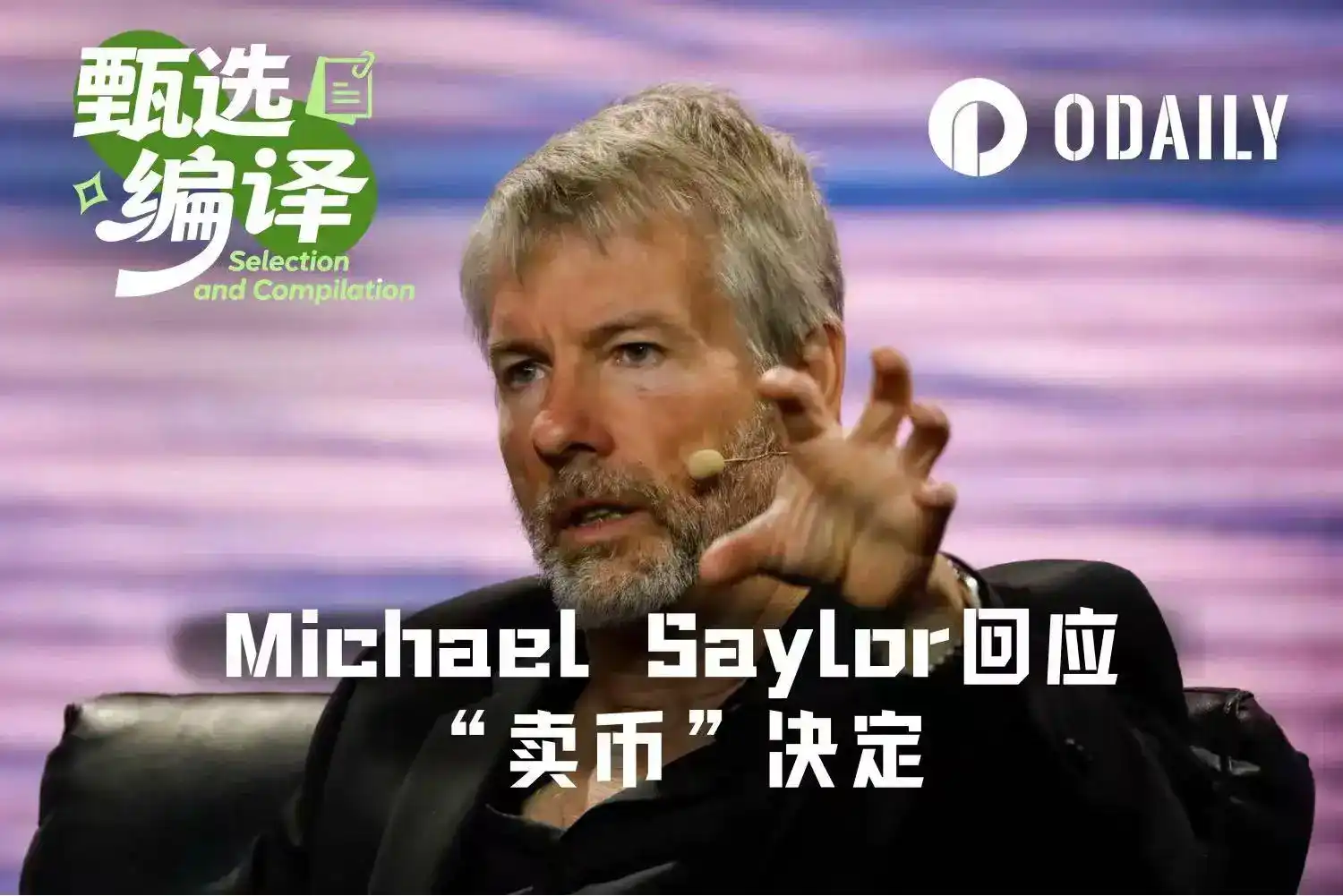
Editor's Note: During last Monday's earnings call, MicroStrategy first mentioned being "prepared to sell Bitcoin if necessary to pay dividends," a statement that immediately sparked intense market debate about its "abandonment of faith."

In response, MicroStrategy Executive Chairman Michael Saylor recently provided an in-depth analysis of the underlying logic behind this decision while appearing on David Lin's podcast, emphasizing that he only said "will sell," not "will be a net seller." Saylor also mentioned that MicroStrategy is leveraging Bitcoin's exceptional appreciation property as "digital capital" to achieve arbitrage by issuing digital credit instruments (like STRC), thereby ensuring the continuous net growth of its holdings. Below is the full content (edited) of the podcast, compiled by Odaily Planet Daily.

Podcast Interview

David Lin (Host A): It is my great honor to co-host this exciting interview with MicroStrategy Executive Chairman Michael Saylor, and my co-host is Bonnie Chang. We'll start with MicroStrategy's recent announcement and Michael Saylor's posts on social media. Bonnie, let's begin.

Bonnie Chang (Host B): Last week you announced something that shocked the entire world.

Michael Saylor: Uh, you're probably referring to our statement on the earnings call — we are prepared to sell Bitcoin if necessary to pay STRC dividends.

Bonnie Chang: I believe that was a carefully considered decision. What was the thinking behind it?

Michael Saylor: The most important point is that we want the market to understand that Bitcoin's capital gains can be used to fund credit dividends. When we sell $1 million worth of STRC credit products, we turn around and buy $1 million worth of Bitcoin. Our expectation for Bitcoin is about 30% annual appreciation, and in reality, it's closer to 40% per year. We can strip out roughly the initial 11% of those capital gains and pay that out as dividends.

The market was confused about what we would use to pay dividends. For most of history, we paid dividends by selling common stock (MSTR equity). MSTR equity is a derivative of Bitcoin and typically trades at a premium to Bitcoin. So, we were selling a Bitcoin derivative, but some people worried we might not be able to sell equity in the future.

Then there were bearish arguments saying we would have to sell equity; others said the company would never sell its Bitcoin. These arguments devolved into — 'Well, if they don't intend to sell Bitcoin, then Bitcoin must have no value, they can never sell it. And if they can't sell it, then we can't count Bitcoin as an asset on the balance sheet.'

If you own something worth $65 billion and people want to value it at zero, that's not great, right? We don't want credit rating agencies to think the company's assets are zero. We want them to think we have $65 billion in assets. Also, online there were these 'haters' constantly complaining it's a Ponzi scheme because we funded the preferred stock dividends by selling equity.

What we want to do is reinforce this business model — selling credit to invest in Bitcoin; over time, that investment appreciates faster than the dividends accumulate; then we realize those capital gains and pay the dividends.

We thought the best way to clarify this was to state clearly that 'the company will never need to sell common stock,' we can just sell Bitcoin, which has appreciated significantly, to pay dividends. That is essentially using capital gains to pay credit dividends.

I think it's like a real estate development company that raises money by issuing credit instruments, buys land at $10,000 an acre, develops it, making it worth $100,000 an acre, then realizes that capital appreciation. You could sell the land at $100,000 an acre, lease it after full development, or refinance it. No one questions a real estate development company that makes capital investments with credit proceeds, and we are doing the same thing with Bitcoin. We need to ensure the market understands this.

I became famous for saying 'never sell your Bitcoin,' which is why the internet exploded when they heard we might sell. But if I were more precise, it should be 'never be a net seller of Bitcoin.' It's just that 'never be a net seller' isn't as catchy or easy to spread.

I think in these times, even if we were to sell 1 Bitcoin, we would buy 10 to 20 more. So, you're talking about a situation of 'buy 10, sell 1, net buy 9.' Once people understand, it shouldn't be an issue anymore, but for now, it's a controversial topic.

Bonnie Chang: Can you explain how you can sell 1 Bitcoin while buying 10?

Michael Saylor: Yes. MicroStrategy's primary Bitcoin accumulation engine is STRC. We sold $3.2 billion worth of STRC in April, so we bought $3.2 billion worth of Bitcoin. The dividend is around $80 to $90 million. So, in this month where we raised $3 billion, we only need $80 or $90 million to pay the dividend — essentially, you're buying 30 Bitcoin while selling 1.

Our 'break-even rate' is roughly 2.3%. This means that if the credit debt we issue equals 2.3% of our Bitcoin holdings, then even if we sell Bitcoin to pay dividends, we will always be a net buyer of Bitcoin. Another point is, if Bitcoin appreciates 2.3% annually, we can pay dividends permanently and continuously create value, all without selling any common stock.

In the first four months of this year, we've already sold about $5 billion worth of STRC. At that rate, the issuance rate for the year will be 15% to 20%. As long as the company is growing, it will buy more Bitcoin than it sells. I anticipate that in every month and quarter going forward, we will be a net buyer of Bitcoin.

Bonnie Chang: I have another question. Many investors adhere almost religiously to the advice 'never sell Bitcoin.' Do you think they should still follow that advice?

Michael Saylor: Yes, I think you should be a 'net accumulator' of Bitcoin. When I said 'never sell your Bitcoin,' I meant if you're going to spend it on something, make sure you replenish it after spending.

Many crypto or Bitcoin believers say they want to buy things with Bitcoin. I'd say, fill the gap after spending. Don't be a net seller of Bitcoin because Bitcoin is capital. At the end of every year, you should have more Bitcoin than you started with.

To draw an analogy, if Google spends $1 billion building a data center and makes $10 billion from it, they net $9 billion. That doesn't crash the dollar market, right? No one gasps 'Google sold dollars to buy a data center.' The dollar will be fine; it doesn't undermine Google's business model. They spent $1 billion investing in the business — that's normal, it's rational. Sometimes you spend money to make more money.

So, if you spend 1 Bitcoin to make 10 Bitcoin, I think that's good for Bitcoin and good for the company... When equity capital markets are less liquid than the Bitcoin market, we want to be able to utilize that market.

Whenever a company takes options off the table, saying 'we will never ever do something,' whatever it is, regret is often the result. For example, if we said we 'absolutely will never repurchase our own stock, we will only sell stock,' then short sellers would hammer our stock down to $1. When the stock price is at a huge discount to net asset value (NAV), if we can buy it back, those short sellers would lose a lot. By exploiting their irrationality, we can make a lot of money.

So, what we were really saying on the earnings call is — we'll trade STRC for MSTR, we'll trade BTC for MSTR, we'll use BTC or MSTR to pay dividends, we'll do whatever is in the company's best interest. But over time, we expect to be a net accumulator of Bitcoin. This doesn't change how we trade assets day-to-day. Whether we sell credit debt, sell equity, or sell Bitcoin capital will depend on market conditions and mispricing.

The other thing we said yesterday is that we are prepared to repurchase our bonds. Currently, our corporate debt is trading cheap, undervalued, so it makes sense to buy it back, not to sell it. We won't sell undervalued assets; we will buy undervalued assets and arbitrage any opaque inefficiencies. If the market knows we will do this, the market will assign a fair value to all these assets. That benefits investors in all these instruments and, ultimately, that's our fiduciary duty.

David Lin: One of your biggest critics, Peter Schiff, wrote this morning: 'Yesterday, Saylor admitted MSTR (MicroStrategy) would sell Bitcoin if needed to pay STRC dividends. I think that pledge is meant to keep the so-called Ponzi scheme going a bit longer. But I'm guessing when push comes to shove, he'll opt to suspend the dividend and let STRC collapse rather than let Bitcoin collapse.' What is your response to that?

Michael Saylor: Peter thinks Bitcoin is a Ponzi scheme. Peter doesn't really like anything in this space. Bitcoin is 'digital capital,' and we've created a digital finance company by selling equity and credit instruments to buy that capital. I think Bitcoin will persist because it represents tokenized global economic wealth with full property rights.

We built a credit instrument, STRC, on top of it, which simply strips out volatility, reduces risk, and extracts or 'distills' yield from the digital capital. If you don't acknowledge Bitcoin as legitimate, you'll never acknowledge any derivative on it as legitimate. But for those who believe Bitcoin can store economic wealth in tokenized form, what we're doing is very straightforward.

STRC employs an overcollateralization model: for every $5 of Bitcoin, sell $1 of credit debt, and that $1 of credit debt has a clear yield. There are many people who believe Bitcoin is a legitimate asset but just can't stomach its volatility. They don't want to put money for their child's fall tuition into Bitcoin because they have to pay in 12 weeks. So, for them, digital credit makes a lot of sense because the principal is protected, more stable. Plus, they can get 3 to 4 times the yield of money markets through STRC, which is a trait of Bitcoin being superior to other capital assets, allowing us to pay this high dividend yield.

David Lin: Here's a theory I'd like to ask you about, then I'll hand it back to Bonnie. Some traders have noticed that whenever STRC pays a dividend, the ex-dividend price trades below par for a period (maybe a day or two). Once it reaches par, that's when MicroStrategy goes to buy Bitcoin. So, they've started 'front-running' by buying Bitcoin before STRC reaches par, betting that you and MicroStrategy will buy Bitcoin at par. Can you comment on that?

Michael Saylor: What happens near the dividend date is that demand for STRC is huge because there's about a 90-cent dividend after the record date. So, there are billions, tens of billions of dollars of STRC traded before the record date, and the day after the record date, it trades down 60 or 70 cents, then gradually recovers to par over the next week or two.

So that's normal. Those people are arbitrageurs. Their idea is that by tying up capital for about 12 days a year, they can capture roughly a 42% annualized yield. They have their own calculations. That's fine; it's good for us too because it creates liquidity and engagement, and it will continue.

As for the second idea, can you front-run the Bitcoin market? The Bitcoin derivatives market has $50 billion in daily volume. So, I don't think anyone has enough capital to move that market.

My view is that Bitcoin is a bit like 'the square of tech capital.' The factors driving the Bitcoin market are trade wars, hot wars, foreign policy, national situations, the Iranian situation in the Strait of Hormuz, then currency wars — like whether we expect SOFR to drop to 200 basis points or if the yield curve is being twisted. You can see that right now we are in a fairly tight monetary environment, so these macro factors are the main drivers of Bitcoin.

I can tell you as a fact, we have bought $100 million worth of Bitcoin in an hour, and it didn't move the price; we've bought $200 million in an hour, and it didn't move the price; we've bought $200 or $300 million in an hour and stopped, and the price actually went up.

So, no one has enough power to move the price of Bitcoin... Well, if you're going to throw $30 billion at the market in an afternoon, maybe. But I've spent a lot of money; we've bought more Bitcoin than anyone I know, we've probably bought $62 billion worth. I believe it's a global market with its own momentum.

So, statements about us being able to influence the price are flattering, but I don't think so.

Bonnie Chang: Why do you say the price doesn't budge when you buy so much Bitcoin?

Michael Saylor: Because the market liquidity is extremely deep. Suppose I were to buy $1 billion today; even that is only 1/50th of a $50 billion volume.

If you ask traders, they'll say spot market daily volume is sometimes $20 billion, and derivatives sometimes hit $80 billion. In a market with such deep liquidity, what is $100 million? That's the beauty of it. On the weekend, if you want to put on a $1 billion position with 20x leverage, you can do it in the Bitcoin market; if you want a $1 billion credit line within an hour, you can get it in the Bitcoin market.

I do think macro factors drive Bitcoin, and sometimes Bitcoin has a life of its own. Micro factors also drive it — I mean industry factors, like the formation of digital credit, the formation of bank credit, and investor sentiment towards Bitcoin assets. But I think Bitcoin is more powerful than all of us, and that's why we have confidence in it — because no single participant can prop it up or hold it back.

David Lin: If the Strait of Hormuz remains closed for the foreseeable future, several forces will intertwine. First, some say inflationary pressures will persist; second, the Fed may eventually need to cut rates because they are trapped by high inflation. So, what ultimately happens to liquidity? What happens to Bitcoin if the Fed remains trapped?

Michael Saylor: I think when you're facing tight monetary policy, high global trade tensions, and high geopolitical tensions due to foreign policy or war (whether in Ukraine or Iran), all of these are somewhat constraining; they are headwinds. I think when these reverse, they become tailwinds.

But regardless, Bitcoin will grind up. This is because the organic supply from miners is only about $10 to $12 billion per year, only 450 Bitcoin per day. Do the math yourself. Then, whenever we raise another $10 billion in capital, we've bought up the entire year's supply. So, if a bank creates $10 billion in credit, that's 'one turn of the axle'; if we sell $10 billion in STRC digital credit, that's 'a second turn of the axle'; when $10 billion flows into IBIT (BlackRock's Bitcoin spot ETF), that's 'a third turn of the axle.'

So, capital flows, digital credit, digital capital wrapper tools, and bank credit — all of these are driving the market's fundamentals, and they are all positive. Regardless of macro factors, you'll see continued adoption. The role of macro winds is just that, when we should grind up 30%, tailwinds make us surge to 50%, while headwinds somewhat slow us down.

David Lin: Has your logic for Bitcoin changed?

Michael Saylor: No change. But I would say it's now clear that Bitcoin is 'digital capital,' and over the past 12 months, one thing has become very clear — one of Bitcoin's killer applications is digital credit.

Many people have wondered, what is the killer app for a $1.5 trillion asset class with hundreds of billions in daily trading volume? The answer is: collateral for credit. Since digital capital is the best-performing capital asset (and it is), outperforming the S&P 500 by two to three times, then it follows that we can create the best-performing credit assets on top of this capital asset.

What we've seen over the past year is that STRC is the most liquid credit instrument; it's the most liquid preferred stock in the entire market and the largest preferred stock in the market. It has the highest Sharpe ratio. We've successfully created an instrument with a Sharpe ratio of 3 and a dividend yield of 11% to 12%.

The highest Sharpe ratio in stocks is Nvidia, around 1.7; the S&P 500 is about 0.9... nothing exceeds 1. Even the top hedge funds you can find can't exceed a Sharpe ratio of 2.2.

So, digital credit actually has better risk-adjusted returns than all other financial strategies and all publicly traded instruments in the public capital markets. I couldn't have told you this 12 months ago. But now the logic works — if Bitcoin is the best-performing capital, then convertible bonds backed by Bitcoin become the best-performing convertibles, and credit instruments like STRCh, become the best-performing preferred stock.

By the way, do you know what percentage of the preferred stock market we accounted for this year?

Bonnie Chang: I'd guess over 70%?

Michael Saylor: 60% of all preferred stock issued in the United States this year was issued by us. Last year and this year, we are the largest credit issuer in the US. We revived the preferred stock market; STRC has grown explosively.

So, I think what's novel is the idea of 'digital capital drives digital credit.' As you see on the show, digital credit is a stepping stone to digital currency. Because now there's a whole host of stable yield coins/tokens pegged to the dollar paying 8% or 9% yields. Apex created one, growing from 0 to $300 million in 8 weeks; Saturn created another, growing from 0 to $110 million in 6 weeks.

There's been an explosion of innovation in digital assets, crypto, and traditional finance driven by digital credit. And Bitcoin is the foundational rock that makes digital credit possible. That might be the most exciting thing this year.

Bonnie Chang: One last question. Did 'Have Space Suit—Will Travel' inspire you to go to MIT? Let's go back before MIT, before this book and Bitcoin. Say something to your younger self.

Michael Saylor: You know, when I was in first grade, my parents wanted to motivate me; they told me they'd give me 10 cents for every book I read. I was addicted to comic books at the time, and I remember comic books cost 25 cents each. So the calculation was, I had to read two and a half 'real books' to get one comic book. I was highly motivated.

That summer I read about 100 books. I'd go to the library and check out 10 at a time. Then I discovered science fiction, discovered Heinlein, Clark, and Asimov. I read 'The Moon is a Harsh Mistress' and 'Have Space Suit—Will Travel' before third grade. By third or fourth grade, I had devoured them all.

I'd say reading those science fiction books drove my intellectual development. Grade school boys are very impressionable. I remember in 'Have Space Suit—Will Travel,' the protagonist is an alpha male. He fixes a space suit, gets picked up by a ship, travels the universe, and saves humanity from 'bug-eyed monsters.' What's the reward for saving humanity? He gets a full scholarship to MIT. I thought, if MIT is good enough for the hero who saved humanity, it's probably good enough for me. So, come hell or high water, I was going there.

David Lin: If Elon Musk invited you to Mars, would you accept?

Michael Saylor: That would depend on what kind of vehicle he offers to take me there.

Preguntas relacionadas

QWhat is the key distinction Michael Saylor makes between selling Bitcoin and being a 'net seller' of Bitcoin for MicroStrategy?

AMichael Saylor clarifies that while MicroStrategy may sell some Bitcoin to pay dividends on its STRC credit product, the company will remain a 'net accumulator' or 'net buyer' of Bitcoin. This means for every Bitcoin sold, the company will buy back many more, ensuring its overall Bitcoin holdings increase over time. He uses the example of selling $1 in Bitcoin for dividends after buying $10 to $20 worth, resulting in a net gain.

QAccording to Saylor, what is the 'break-even rate' for MicroStrategy's STRC issuance, and what does it signify?

AThe 'break-even rate' is approximately 2.3%. It signifies that if MicroStrategy issues credit debt (like STRC) equal to 2.3% of its total Bitcoin holdings, the yield from that debt issuance will be sufficient to cover the dividend payments. Therefore, even if the company sells Bitcoin to pay those dividends, it can still be a perpetual net buyer of Bitcoin without needing to sell any equity, as long as Bitcoin appreciates at least 2.3% annually.

QHow does Michael Saylor characterize Bitcoin's primary 'killer app' that has become clear in the last 12 months?

ASaylor states that Bitcoin's primary 'killer app' is serving as collateral for 'Digital Credit.' He explains that as the best-performing capital asset, Bitcoin enables the creation of superior credit instruments. MicroStrategy's STRC, a digital credit tool, exemplifies this by offering high yields (11-12%) with a high Sharpe ratio, making it one of the top-performing preferred shares in the market.

QWhy does Michael Saylor believe individual or institutional buying pressure does not significantly move the Bitcoin market price?

ASaylor attributes this to the Bitcoin market's immense depth and liquidity. He cites daily trading volumes of hundreds of billions of dollars across spot and derivatives markets. Even large purchases by MicroStrategy (e.g., hundreds of millions in an hour) are a small fraction of the total daily volume. Therefore, he argues that macro factors like geopolitics and monetary policy, not individual actors, are the primary drivers of Bitcoin's price.

QWhat was the childhood inspiration that motivated Michael Saylor to attend MIT?

ASaylor was inspired by the science fiction book 'Have Space Suit—Will Travel' by Robert A. Heinlein. In the story, the protagonist saves humanity and is rewarded with a full scholarship to MIT. As a young boy, Saylor reasoned that if MIT was good enough for a fictional hero, it was good enough for him, which solidified his determination to attend the university.

Lecturas Relacionadas

"JUST 6th Anniversary x GasFree Super Carnival Month" Grandly Arrives: Enjoy "0" Gas Transfer Freedom & Share the 10,000 USDT Bonus Pool

The "JUST 6th Anniversary x GasFree Super Carnival Month" event has launched, celebrating the JUST ecosystem's six-year milestone within the TRON network. Running from May 18th to June 7th, the event features a 10,000 USDT prize pool and is designed to promote the GasFree smart wallet. GasFree, a key product of the JustLend DAO protocol, allows users to pay transaction fees directly with the token being transferred (e.g., USDT), eliminating the need to hold the network's native token (TRX) for gas. This innovation aims to simplify on-chain transactions and lower the entry barrier for new users. The carnival offers five main activities: 1. **GasFree Activation Challenge:** New users can earn random rewards (5.2-522 USDT) for activating GasFree and completing their first transfer. 2. **Transfer Rebate:** 200 users daily are randomly selected to receive a 100% rebate on their activation and transaction fees. 3. **Bitcoin Pizza Day Special:** A dedicated event with custom rewards to celebrate crypto culture. 4. **JUST 6th Anniversary Lucky Draw:** Special anniversary reward packages for lucky participants. 5. **Knowledge Quiz:** A trivia contest where users can win prizes by answering questions about JUST and GasFree. To participate, users need a compatible wallet like TronLink (recommended), Klever, Guarda, or NOW Wallet. They must then find the GasFree feature, fund it with USDT, and complete at least one USDT transfer to qualify for the rewards. The article highlights GasFree's significant adoption, reporting over 872 billion USD in cumulative transaction volume and more than 612 million USD in saved user fees since its launch. The event underscores JUST's commitment to enhancing the DeFi user experience by making on-chain interactions more accessible and cost-effective.

链捕手Hace 24 min(s)

"JUST 6th Anniversary x GasFree Super Carnival Month" Grandly Arrives: Enjoy "0" Gas Transfer Freedom & Share the 10,000 USDT Bonus Pool

链捕手Hace 24 min(s)

BNB Chain Releases Research Report, Exploring Post-Quantum Cryptography Migration Path for BSC

BNB Chain, a leading Layer-1 blockchain ecosystem, has released a research report exploring the potential migration path for BNB Smart Chain (BSC) to post-quantum cryptography. The study evaluates replacing traditional cryptographic systems with quantum-resistant alternatives, specifically examining the use of ML-DSA-44 for transaction signing and pqSTARK for aggregating validator consensus signatures. While quantum computers are not currently a practical threat to existing blockchain cryptography, the research represents a proactive effort to ensure long-term network security and infrastructure resilience. The report assessed several core areas of the BSC tech stack, including post-quantum transaction signing, validator signature aggregation, transaction validation, public key storage, and network performance under increased data loads. A key finding is that achieving post-quantum readiness is technically feasible today but requires significant trade-offs in scalability. Test data indicates: • Transaction size would increase from ~110 bytes to ~2.5 kilobytes. • Block size would grow from ~110 kilobytes to ~2 megabytes. • Native transfer TPS would decrease from 4,973 to 2,997. The primary performance bottleneck is not signature verification itself, but the increased network transmission overhead caused by larger transaction and block sizes. Conversely, the pqSTARK aggregation technology proved highly efficient, compressing validator signatures by an approximately 43:1 ratio, which helps manage consensus-layer overhead. The report notes that post-quantum alternatives for areas like P2P handshakes and KZG commitments were not within the scope of this evaluation and require further research and broader ecosystem coordination. BNB Chain emphasizes this work is a research-oriented exploration and not a response to any imminent security threat.

marsbitHace 1 hora(s)

BNB Chain Releases Research Report, Exploring Post-Quantum Cryptography Migration Path for BSC

marsbitHace 1 hora(s)

Trading

Spot
Futuros

Artículos destacados

Qué es BITCOIN

Entendiendo HarryPotterObamaSonic10Inu (ERC-20) y Su Posición en el Espacio Cripto En los últimos años, el mercado de criptomonedas ha sido testigo de un aumento en la popularidad de las monedas meme, capturando el interés no solo de los comerciantes, sino también de aquellos que buscan compromiso comunitario y valor de entretenimiento. Entre estos tokens únicos se encuentra HarryPotterObamaSonic10Inu (ERC-20), un proyecto intrigante que mezcla referencias culturales en el tejido de las criptomonedas. Este artículo profundiza en los aspectos clave de HarryPotterObamaSonic10Inu, explorando sus mecanismos, ethos impulsado por la comunidad y su relación con el paisaje cripto más amplio. ¿Qué es HarryPotterObamaSonic10Inu (ERC-20)? Como su nombre sugiere, HarryPotterObamaSonic10Inu es una moneda meme construida sobre la blockchain de Ethereum, clasificada bajo el estándar ERC-20. A diferencia de las criptomonedas tradicionales que pueden enfatizar la utilidad práctica o el potencial de inversión, este token prospera en el valor de entretenimiento y la fuerza de su comunidad. El proyecto tiene como objetivo fomentar un entorno donde los usuarios comprometidos puedan reunirse, compartir ideas y participar en actividades inspiradas por diversos fenómenos culturales. Una característica notable de HarryPotterObamaSonic10Inu es su cero impuestos en las transacciones. Este atractivo elemento tiene como objetivo incentivar el comercio y la participación comunitaria, sin cargos adicionales que puedan disuadir a los comerciantes de pequeña escala. El suministro total de la moneda está establecido en mil millones de tokens, una cifra que marca su intención de mantener una circulación sustancial dentro de la comunidad. Creador de HarryPotterObamaSonic10Inu (ERC-20) Los orígenes de HarryPotterObamaSonic10Inu están algo envueltos en misterio; los detalles sobre el creador siguen siendo desconocidos. El desarrollo de este token carece de un equipo identificable o de un plan explícito, lo cual no es inusual dentro del sector de monedas meme. En cambio, el proyecto ha surgido de manera orgánica, con su progreso muy dependiente del entusiasmo y la participación de su comunidad. Inversores de HarryPotterObamaSonic10Inu (ERC-20) En cuanto a inversiones externas y respaldo, HarryPotterObamaSonic10Inu también sigue siendo ambiguo. El token no lista ninguna fundación de inversión conocida o apoyo organizacional significativo. En cambio, la savia del proyecto es su comunidad de base, que informa su crecimiento y sostenibilidad a través de la acción colectiva y el compromiso en el espacio cripto. ¿Cómo Funciona HarryPotterObamaSonic10Inu (ERC-20)? Como una moneda meme, HarryPotterObamaSonic10Inu opera principalmente fuera de los marcos tradicionales que a menudo rigen el valor de los activos. Hay varios aspectos distintivos que definen cómo funciona el proyecto: Transacciones Sin Impuestos: Sin tarifas impositivas en las transacciones, los usuarios pueden comprar y vender el token libremente sin preocuparse por costos ocultos. Compromiso Comunitario: El proyecto prospera en la interacción comunitaria, aprovechando plataformas de redes sociales para crear entusiasmo y facilitar la participación. Las discusiones, el intercambio de contenido y el compromiso son elementos cruciales que ayudan a expandir su alcance y fomentar la lealtad entre los seguidores. Sin Utilidad Práctica: Cabe señalar que HarryPotterObamaSonic10Inu no ofrece utilidad concreta dentro del ecosistema financiero. Más bien, se clasifica como un token principalmente para actividades de entretenimiento y comunitarias. Referencia Cultural: El token incorpora astutamente elementos de la cultura popular para atraer interés, conectando con entusiastas de los memes y seguidores de las criptomonedas por igual. HarryPotterObamaSonic10Inu ejemplifica cómo las monedas meme operan de manera diferente a los proyectos de criptomonedas más tradicionales, ingresando al mercado como construcciones sociales innovadoras en lugar de activos utilitarios. Cronología de HarryPotterObamaSonic10Inu (ERC-20) La historia de HarryPotterObamaSonic10Inu está marcada por varios hitos notables: Creación: El token surgió de un meme viral, capturando la imaginación de muchos entusiastas de las criptomonedas. Las fechas específicas de creación no están disponibles, subrayando su ascenso orgánico. Listado en Exchanges: HarryPotterObamaSonic10Inu ha llegado a varios exchanges, permitiendo un acceso y comercio más fácil por parte de la comunidad. Iniciativas de Compromiso Comunitario: Actividades continuas destinadas a mejorar la interacción comunitaria, incluyendo concursos, campañas en redes sociales y generación de contenido por parte de fanáticos y defensores. Planes de Expansión Futuros: La hoja de ruta del proyecto incluye el lanzamiento de una colección de NFT, mercancía y un sitio de comercio electrónico relacionado con sus temas culturales, involucrando aún más a la comunidad e intentando añadir más dimensiones a su ecosistema. Puntos Clave Sobre HarryPotterObamaSonic10Inu (ERC-20) Naturaleza Impulsada por la Comunidad: El proyecto prioriza la participación colectiva y la creatividad, asegurando que la involucración de los usuarios esté a la vanguardia de su desarrollo. Clasificación como Moneda Meme: Representa la epítome de las criptomonedas basadas en el entretenimiento, diferenciándose de los vehículos de inversión tradicionales. Sin Afiliación Directa con Bitcoin: A pesar de la similitud en el nombre del ticker, HarryPotterObamaSonic10Inu es distinto y no tiene relación con Bitcoin u otras criptomonedas establecidas. Enfoque en la Colaboración: HarryPotterObamaSonic10Inu está diseñado para crear un espacio para la colaboración y el intercambio de historias entre sus poseedores, proporcionando una vía para la creatividad y el vínculo comunitario. Perspectivas Futuras: La ambición de expandirse más allá de su premisa inicial hacia NFTs y mercancías describe un camino para que el proyecto potencialmente ingrese a avenidas más tradicionales dentro de la cultura digital. A medida que las monedas meme continúan capturando la imaginación de la comunidad de criptomonedas, HarryPotterObamaSonic10Inu (ERC-20) se destaca debido a sus lazos culturales y su enfoque centrado en la comunidad. Si bien puede no encajar en el molde típico de un token impulsado por la utilidad, su esencia radica en la alegría y la camaradería fomentadas entre sus seguidores, destacando la naturaleza en evolución de las criptomonedas en una era cada vez más digital. A medida que el proyecto continúa desarrollándose, será importante observar cómo las dinámicas comunitarias influyen en su trayectoria en el cambiante paisaje de la tecnología blockchain.

1.5k Vistas totalesPublicado en 2024.04.01Actualizado en 2024.12.03

Qué es BITCOIN

Cómo comprar BTC

¡Bienvenido a HTX.com! Hemos hecho que comprar Bitcoin (BTC) sea simple y conveniente. Sigue nuestra guía paso a paso para iniciar tu viaje de criptos.Paso 1: crea tu cuenta HTXUtiliza tu correo electrónico o número de teléfono para registrarte y obtener una cuenta gratuita en HTX. Experimenta un proceso de registro sin complicaciones y desbloquea todas las funciones.Obtener mi cuentaPaso 2: ve a Comprar cripto y elige tu método de pagoTarjeta de crédito/débito: usa tu Visa o Mastercard para comprar Bitcoin (BTC) al instante.Saldo: utiliza fondos del saldo de tu cuenta HTX para tradear sin problemas.Terceros: hemos agregado métodos de pago populares como Google Pay y Apple Pay para mejorar la comodidad.P2P: tradear directamente con otros usuarios en HTX.Over-the-Counter (OTC): ofrecemos servicios personalizados y tipos de cambio competitivos para los traders.Paso 3: guarda tu Bitcoin (BTC)Después de comprar tu Bitcoin (BTC), guárdalo en tu cuenta HTX. Alternativamente, puedes enviarlo a otro lugar mediante transferencia blockchain o utilizarlo para tradear otras criptomonedas.Paso 4: tradear Bitcoin (BTC)Tradear fácilmente con Bitcoin (BTC) en HTX's mercado spot. Simplemente accede a tu cuenta, selecciona tu par de trading, ejecuta tus trades y monitorea en tiempo real. Ofrecemos una experiencia fácil de usar tanto para principiantes como para traders experimentados.

4.9k Vistas totalesPublicado en 2024.12.12Actualizado en 2025.03.21

Cómo comprar BTC

Qué es $BITCOIN

ORO DIGITAL ($BITCOIN): Un Análisis Integral Introducción al ORO DIGITAL ($BITCOIN) ORO DIGITAL ($BITCOIN) es un proyecto basado en blockchain que opera en la red Solana, cuyo objetivo es combinar las características de los metales preciosos tradicionales con la innovación de las tecnologías descentralizadas. Aunque comparte un nombre con Bitcoin, a menudo referido como “oro digital” debido a su percepción como un refugio de valor, ORO DIGITAL es un token separado diseñado para crear un ecosistema único dentro del paisaje Web3. Su meta es posicionarse como un activo digital alternativo viable, aunque los detalles sobre sus aplicaciones y funcionalidades aún están en desarrollo. ¿Qué es ORO DIGITAL ($BITCOIN)? ORO DIGITAL ($BITCOIN) es un token de criptomoneda diseñado explícitamente para su uso en la blockchain de Solana. A diferencia de Bitcoin, que proporciona un papel de almacenamiento de valor ampliamente reconocido, este token parece centrarse en aplicaciones y características más amplias. Aspectos notables incluyen: Infraestructura Blockchain: El token está construido sobre la blockchain de Solana, conocida por su capacidad para manejar transacciones de alta velocidad y bajo costo. Dinámicas de Suministro: ORO DIGITAL tiene un suministro máximo limitado a 100 cuatrillones de tokens (100P $BITCOIN), aunque los detalles sobre su suministro circulante no se han divulgado actualmente. Utilidad: Si bien las funcionalidades precisas no están delineadas explícitamente, hay indicios de que el token podría ser utilizado para diversas aplicaciones, potencialmente involucrando aplicaciones descentralizadas (dApps) o estrategias de tokenización de activos. ¿Quién es el Creador de ORO DIGITAL ($BITCOIN)? En la actualidad, la identidad de los creadores y el equipo de desarrollo detrás de ORO DIGITAL ($BITCOIN) sigue siendo desconocida. Esta situación es típica entre muchos proyectos innovadores dentro del espacio blockchain, particularmente aquellos alineados con las finanzas descentralizadas y fenómenos de monedas meme. Si bien tal anonimato puede fomentar una cultura impulsada por la comunidad, intensifica las preocupaciones sobre la gobernanza y la responsabilidad. ¿Quiénes son los Inversores de ORO DIGITAL ($BITCOIN)? La información disponible indica que ORO DIGITAL ($BITCOIN) no tiene patrocinadores institucionales conocidos ni inversiones destacadas de capital de riesgo. El proyecto parece operar en un modelo de peer-to-peer centrado en el apoyo y la adopción de la comunidad en lugar de rutas de financiamiento tradicionales. Su actividad y liquidez se sitúan principalmente en intercambios descentralizados (DEX), como PumpSwap, en lugar de plataformas de trading centralizadas establecidas, lo que resalta aún más su enfoque de base. Cómo Funciona ORO DIGITAL ($BITCOIN) Los mecanismos operativos de ORO DIGITAL ($BITCOIN) pueden elaborarse en función de su diseño blockchain y atributos de red: Mecanismo de Consenso: Al aprovechar el único proof-of-history (PoH) de Solana combinado con un modelo de proof-of-stake (PoS), el proyecto asegura una validación de transacciones eficiente que contribuye al alto rendimiento de la red. Tokenómica: Si bien los mecanismos deflacionarios específicos no se han detallado extensamente, el vasto suministro máximo de tokens implica que podría atender microtransacciones o casos de uso nicho que aún están por definirse. Interoperabilidad: Existe el potencial de integración con el ecosistema más amplio de Solana, incluyendo varias plataformas de finanzas descentralizadas (DeFi). Sin embargo, los detalles sobre integraciones específicas permanecen no especificados. Cronología de Eventos Clave Aquí hay una cronología que destaca hitos significativos relacionados con ORO DIGITAL ($BITCOIN): 2023: El despliegue inicial del token ocurre en la blockchain de Solana, marcado por su dirección de contrato. 2024: ORO DIGITAL gana visibilidad al estar disponible para trading en intercambios descentralizados como PumpSwap, permitiendo a los usuarios comerciar contra SOL. 2025: El proyecto presencia actividad de trading esporádica y potencial interés en compromisos liderados por la comunidad, aunque no se han documentado asociaciones notables o avances técnicos hasta el momento. Análisis Crítico Fortalezas Escalabilidad: La infraestructura subyacente de Solana soporta altos volúmenes de transacciones, lo que podría mejorar la utilidad de $BITCOIN en varios escenarios de transacción. Accesibilidad: El potencial bajo precio de trading por token podría atraer a inversores minoristas, facilitando una participación más amplia debido a oportunidades de propiedad fraccionada. Riesgos Falta de Transparencia: La ausencia de patrocinadores, desarrolladores o un proceso de auditoría conocidos públicamente puede generar escepticismo sobre la sostenibilidad y confiabilidad del proyecto. Volatilidad del Mercado: La actividad de trading depende en gran medida del comportamiento especulativo, lo que puede resultar en una volatilidad de precios significativa y en incertidumbre para los inversores. Conclusión ORO DIGITAL ($BITCOIN) surge como un proyecto intrigante pero ambiguo dentro del ecosistema de Solana en rápida evolución. Si bien intenta aprovechar la narrativa del “oro digital”, su alejamiento del papel establecido de Bitcoin como refugio de valor subraya la necesidad de una diferenciación más clara de su utilidad y estructura de gobernanza previstas. La aceptación y adopción futura dependerán probablemente de abordar la actual opacidad y de definir sus estrategias operativas y económicas de manera más explícita. Nota: Este informe abarca información sintetizada disponible hasta octubre de 2023, y pueden haber ocurrido desarrollos más allá del período de investigación.

83 Vistas totalesPublicado en 2025.05.13Actualizado en 2025.05.13

Qué es $BITCOIN

Discusiones

Bienvenido a la comunidad de HTX. Aquí puedes mantenerte informado sobre los últimos desarrollos de la plataforma y acceder a análisis profesionales del mercado. A continuación se presentan las opiniones de los usuarios sobre el precio de BTC (BTC).

活动图片














