Author: Zen, PANews
As the transitional arrangements for the Markets in Crypto-Assets (MiCA) Regulation enter their final stage, Europe's crypto industry has undergone a major institutional-level screening. After MiCA fully enters into force, platforms that previously relied on local registrations in member states, regulatory gaps, or transitional arrangements to serve European users must be brought under the EU's unified framework and obtain authorization as a Crypto-Asset Service Provider (CASP) to continue operating compliantly.
According to the Financial Times, as of July 1, only about 12% of crypto companies in the EU are approved to continue operating under the new rules, with authorized entities numbering 244. Many more platforms that failed to complete authorization in time have had to cease relevant crypto-asset services and exit the main compliance market table in Europe.
On this new table, Germany's position is particularly prominent. Germany currently has 57 MiCA-authorized crypto-asset service providers, accounting for about 23% of the EU's 244 authorizations, significantly leading other EU member states. Since MiCA allows licensed entities to provide services cross-border within the EU, this means Germany is not only one of the member states with the most authorizations but is also becoming a key compliance entry point for crypto platforms seeking access to the unified European market.
Furthermore, Germany is not merely a market "leading in license numbers"; it resembles a convergence point in the re-stratification of Europe's crypto finance, evolving from a regulatory gateway towards becoming a banking distribution hub and a participant in digital financial infrastructure.
Functional Regulation Enables Smooth MiCA Transition
Even before the EU's unified framework was implemented, Germany had already incorporated various aspects of crypto-assets—such as issuance, trading, brokerage, custody, and market order—into different regulatory systems covering banking, securities, payments, and capital markets. Precisely because of this existing foundation of functional regulation, when MiCA consolidated disparate rules into a unified EU framework, Germany was able to adopt the new rules relatively quickly and extend its existing domestic compliance pathways to a European scale.
Long before MiCA was formally implemented, Germany already had multiple crypto trading entry points for both retail users and institutional clients. These early platforms were not entirely outside regulatory oversight; instead, through licensed banking and agent structures, they were embedded into Germany's established financial services system.
For example, the early domestic Bitcoin trading platform Bitcoin.de was operated by Bitcoin Deutschland AG, which functioned as a "tied agent" of Fidor Bank to carry out related investment brokerage activities. This is an operational method within German financial regulation where an agent, which can be an independent company or individual, conducts specific business on behalf of a single licensed financial institution. Fidor Bank, a licensed German bank, acted as the responsible party in this structure, assuming corresponding regulatory responsibilities.
In contrast to this "embedded" compliance path, Börse Stuttgart Group, the operator of the Stuttgart Stock Exchange, chose to directly enter the arena, attempting to integrate crypto-asset trading into its own exchange, brokerage, and custody systems. In 2019, the group launched the BISON crypto trading app for retail users, providing a relatively simple buy/sell entry point. That same year, it launched BSDEX, Germany's first regulated digital asset trading platform, employing an order book and fixed trading rules aimed at more professional investors.
Beyond domestic platforms, Germany's regulatory framework also attracted international players. Coinbase's launch of Coinbase Germany serves as a typical case. In 2021, Coinbase Germany received approval from BaFin (the German Federal Financial Supervisory Authority) for crypto custody and trading-related licenses. BaFin, responsible for supervising banking, securities, insurance, and certain crypto financial services, granted licenses under Germany's new crypto regulatory regime introduced in 2020, covering crypto custody and trading.
These cases collectively illustrate that before MiCA's implementation, the focus of German regulators was on disaggregating and evaluating a platform's business activities. This involved multiple traditional German financial laws such as the German Banking Act, the German Securities Trading Act, and the payment services regulatory framework. BaFin's early documents on token classification also reflected this functional regulatory approach. It pointed out that whether a token constitutes a financial instrument, security, capital investment, or fund unit requires case-by-case judgment based on its specific structure and economic function.
Therefore, while Germany's regulatory foundation may not have been fully mature or perfect, by breaking down the key operations of crypto platforms into traditional financial legal systems, it had already "trained" a cohort of institutions in client due diligence, organizational governance, risk control, and regulatory reporting capabilities. It might not have been the most lenient regulatory market, but it benefited from clearer rule pathways, relatively complete financial infrastructure, and more predictable regulatory experience. For new platforms seeking entry into the European market, this is precisely Germany's appeal.
Banks Become Direct Entry Points for Crypto Services in Germany
In the global crypto market, traditional banking systems in many countries often maintain a distance from, or even oppose, the crypto industry. However, in the development of Germany's crypto market, banks have not only been participants in the compliance chain but have even become entry points for users to access crypto-assets.
Early on, Fidor Bank participated in the compliance structure of domestic platforms through its cooperation with Bitcoin.de. Subsequently, as the regulatory framework gradually became clearer, traditional financial institutions like Commerzbank and DekaBank also expanded their presence in crypto custody, trading, and institutional services.
It can be said that the trend of banks moving from behind-the-scenes roles to the forefront was already forming. The implementation of MiCA has further accelerated this shift, causing crypto services to enter banks' own retail channels more rapidly, becoming new entry points directly accessible to ordinary users.
The most direct case is DZ Bank, the German Central Cooperative Bank, a core bank within Germany's cooperative financial system and the second-largest bank in Germany by assets. In January 2026, DZ Bank announced receiving MiCAR authorization from BaFin to launch the crypto-asset service "meinKrypto."
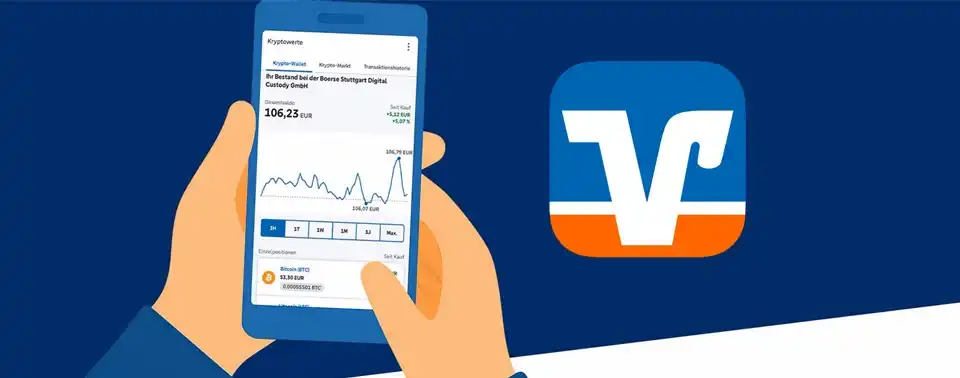
The product is designed as a wallet and trading interface integrated into the VR Banking App, targeting self-directed clients rather than being part of private banking investment advice. Once cooperative banks complete their MiCAR notifications and activate the relevant functions, they can allow clients to invest in crypto-assets through their familiar banking app.
Another pathway comes from the German savings bank system, Sparkassen. Sparkassen is a network of public savings banks covering numerous local bank branches and individual clients across Germany. DekaBank, a key securities services and asset management institution within this system, is often described as the "securities company" or capital markets service platform for the savings bank network.
According to public plans, the German savings bank system, via the DekaBank platform, will offer Bitcoin, Ethereum, and other crypto-asset trading services to private clients within mobile banking apps, with a target launch in the summer of 2026.
The significance of such changes lies in the altered distribution method for crypto services. For ordinary users, crypto-assets are no longer just high-risk products on external trading platforms; they are being placed within banking apps, customer accounts, and existing compliance processes.
From Trading Hub to European Digital Asset Infrastructure Hub
If trading platform licenses address "who can provide crypto services compliantly," and banking apps address "where ordinary users access crypto-assets," then a deeper question arises: Who will issue, custody, and settle future on-chain assets, and through what payment and settlement instruments will they enter the capital markets system? Germany's crypto strategy is extending from trading and retail entry points further into such underlying financial infrastructure.
Deutsche Börse Group is Germany's core exchange and market infrastructure group, with businesses spanning trading, clearing, data indices, investment management solutions, and post-trade services. Clearstream, part of its post-trade business segment, is primarily responsible for settlement, custody, and asset servicing after securities transactions are completed—essentially the back-office infrastructure ensuring trades are finalized and managing asset rights on an ongoing basis.
In June 2026, Clearstream announced the launch of its next-generation digital securities infrastructure, planned for phased rollout between 2026 and 2027. According to its announcement, the platform will cover the entire securities lifecycle—issuance, distribution, settlement, custody, asset servicing, liquidity, and financing—for both traditional securities and tokenized securities, targeting assets under the MiFID and MiCA frameworks. Clearstream also stated that the platform will support institutional client access to blockchain technology, crypto-assets, stablecoins, and security tokens, and will explore scenarios such as on-chain settlement, large-scale tokenization of securities, and collateral reuse of the same asset across multiple transactions.
For market infrastructure institutions like Deutsche Börse and Clearstream, tokenized securities, stablecoins, and crypto-assets are being integrated into a broader upgrade of capital market infrastructure. If these infrastructures gain regulatory approval and are widely adopted by institutional clients, German institutions will occupy a more advantageous position in the European digital asset market.
Additionally, the Euro stablecoin follows the same strategic line. The Amsterdam-based, European bank-backed Euro stablecoin project Qivalis aims to counter the dominance of US companies in digital payments and prepare for future asset tokenization. Founding members of Qivalis include European banks like DekaBank, DZ BANK, ING, BNP Paribas, BBVA, and UniCredit. The project plans to launch a regulated Euro stablecoin in the second half of 2026, subject to regulatory approval.
For Germany, the significance of this project lies not in Germany unilaterally leading a Euro stablecoin, but in the fact that Germany's banking system is already participating in the co-construction of European digital payment and tokenized financial infrastructure. DekaBank connects to the German savings bank system, and DZ Bank connects to the cooperative banking system. Their participation in Qivalis indicates that Germany's crypto strategy has extended into more foundational financial infrastructure areas like Euro stablecoins, on-chain payments, and the settlement of future tokenized assets.
Future competition in Europe's crypto industry will increasingly focus on licensing, bank partnerships, custody, settlement, tax transparency, and cross-border service capabilities—and Germany is precisely situated at the intersection of these competencies.