In a Losing Bear Market, Who Is Quietly Making a Fortune?

marsbitPublicado a 2026-04-10Actualizado a 2026-04-10

Resumen

In a bear market where most crypto participants are losing money, a few projects continue to generate significant revenue. A look at Defillama’s revenue rankings reveals that profitable projects share simple and clear revenue models, which fall into two main categories: spread and transaction fees. Spread-based revenue models, used by entities like Tether, Circle, Aave, and Lido, act as capital intermediaries. They profit from the difference between lower funding costs and higher returns from deployed capital, relying on the scale and duration of capital deposits. Transaction fee models, employed by platforms such as Hyperliquid, Polymarket, pump.fun, Aerodrome, and Jupiter, generate income by charging fees on trading activities. Their earnings depend on the size and frequency of transactions. Notable cases include Grayscale (traditional asset management fees), Chainlink (data service fees), and Titan Builder (which profited unusually from a major arbitrage incident). The analysis concludes that sustainable profitability in a bear market comes from straightforward revenue models combined with sophisticated product execution and operational excellence.

Author|Azuma(@azuma_eth)

The market continues to slump, with funds underperforming, protocols shutting down, whales staying silent, and retail investors bleeding... It seems like everyone from top to bottom in the industry is losing money. However, even in such a cold market environment, a very few projects are still running their money-printing machines at full throttle.

The latest example is Polymarket, which has fully opened its fee gates. Since recently expanding its fee scope and modifying its fee formula (Recommended reading: "Hardcore Analysis of Polymarket's Fee Formula: How Did the Extreme Rate of 90+% Pop Out?"), Polymarket's revenue generation capability has significantly surged; as of publication, Polymarket's total fee income has exceeded $24 million, with a single-day record of $1.5 million in revenue on April 2.
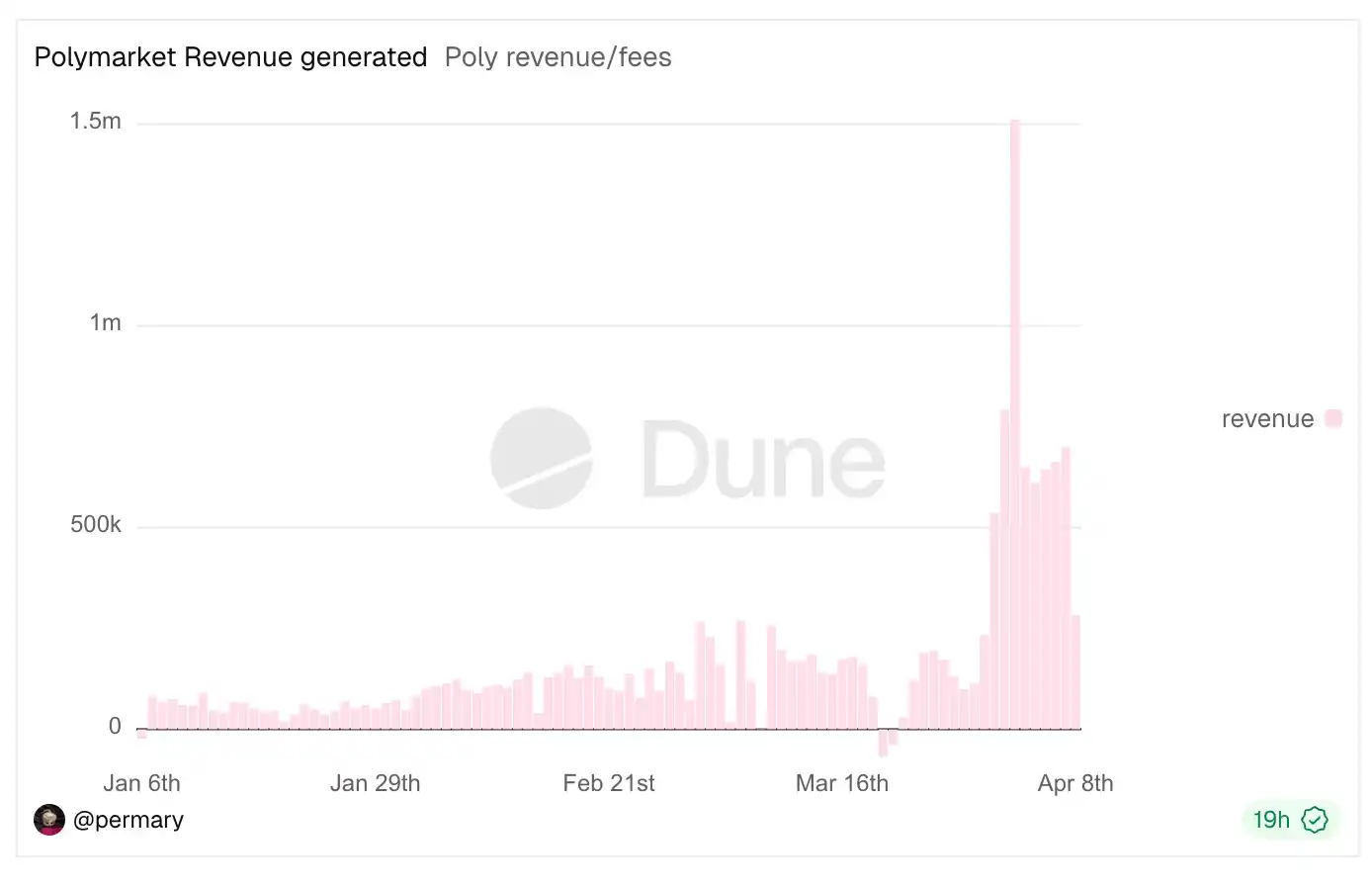
Taking this opportunity, the author checked the revenue rankings on Defillama to see which businesses are still making steady profits in the bear market, and the results were quite surprising: The core businesses and revenue sources of the listed projects are quite clear, even "simple."
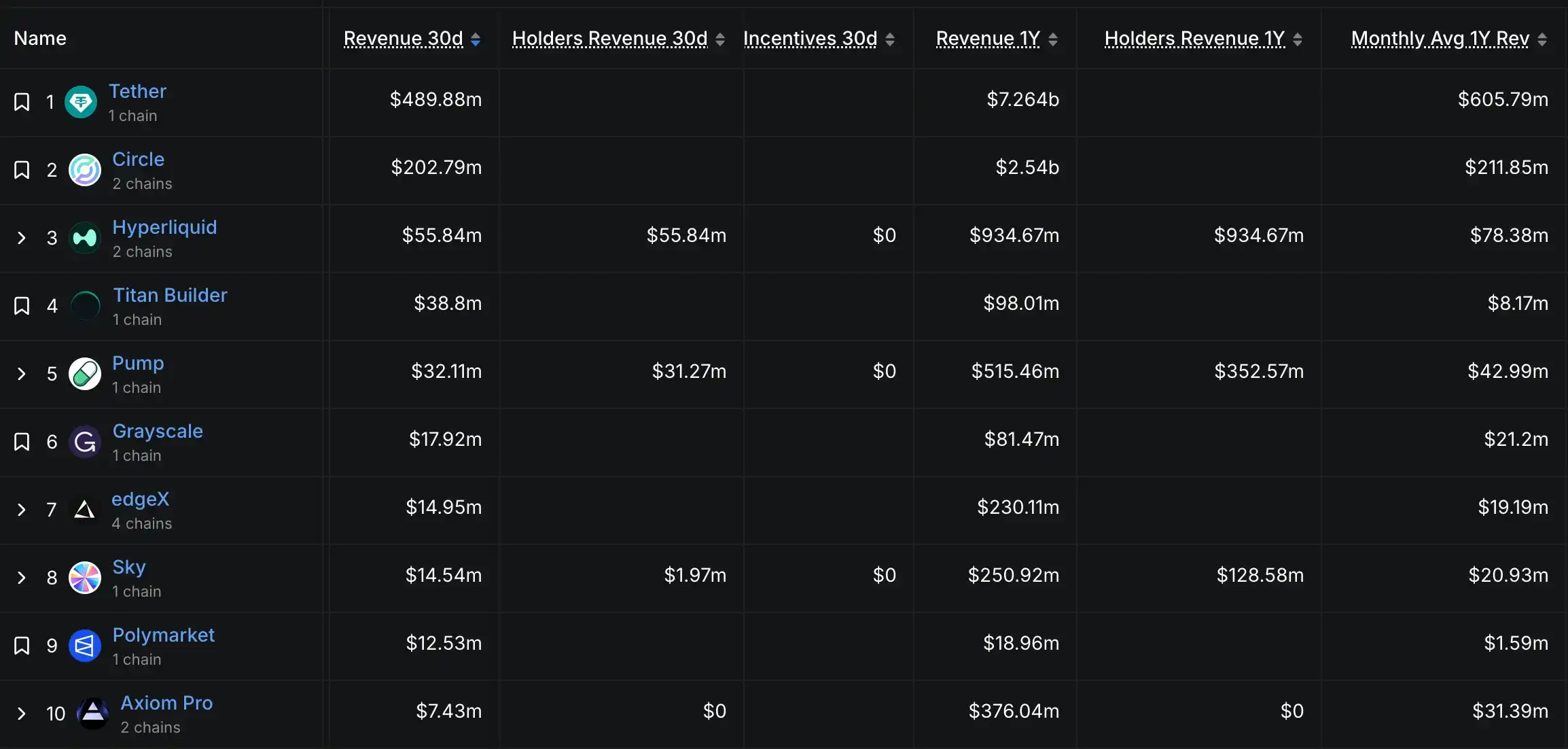
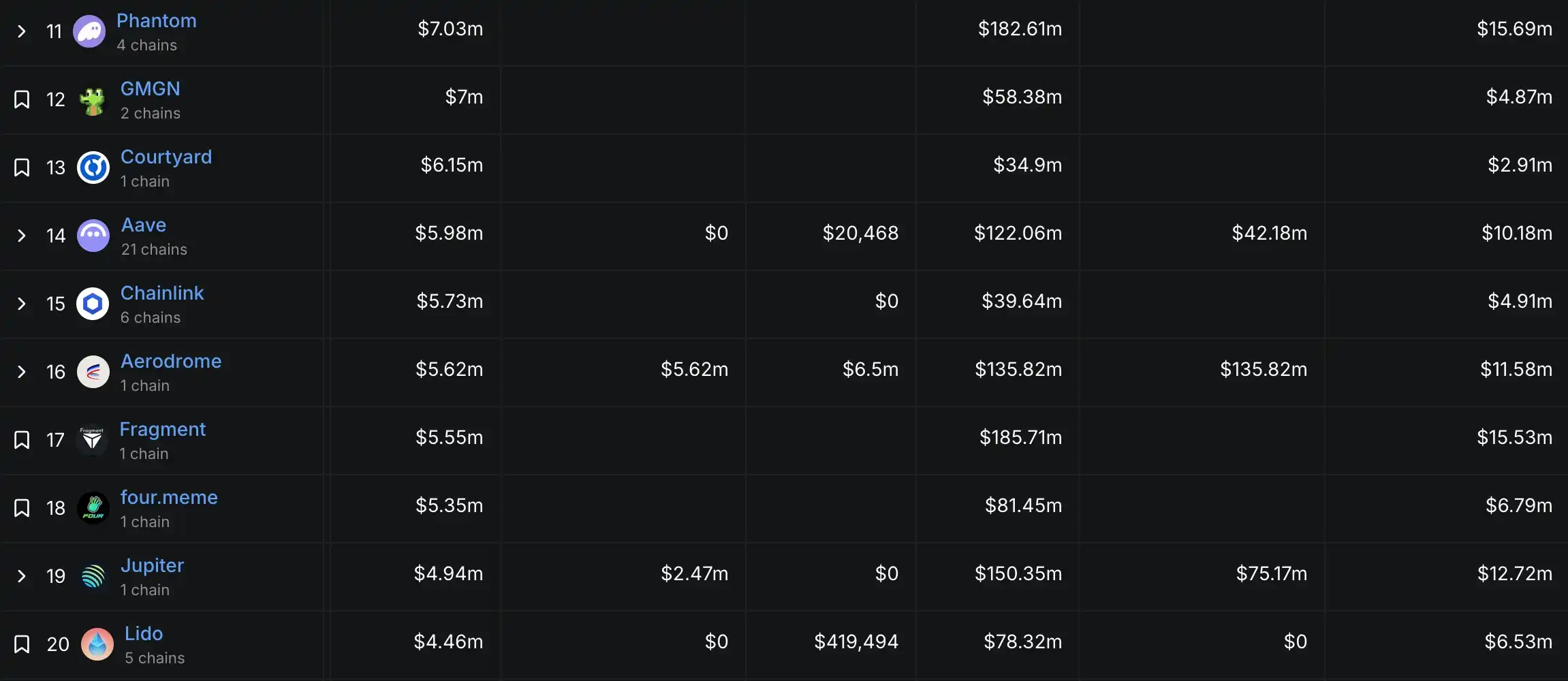
As shown above, I believe most players deeply involved in the crypto market could guess most of these names even without looking at the answers, and probably know exactly what they do. But when these names are neatly listed together, I suddenly realized that the main revenue sources of these profitable businesses are highly convergent, and can basically be summarized into two major categories: one is interest spread, and the other is transaction tax (fees).

First is interest spread, which is essentially acting as a "capital intermediary." The core logic is to absorb funds at a relatively low cost while deploying funds at a relatively high yield, using time to gradually accumulate the difference between the yield and the cost — the profit of such businesses depends on the scale and duration of the capital沉淀 (sedimentation), the larger the scale and the longer the time, the higher the profit.

Stablecoin issuers like Tether and Circle fall into this category. Their main income comes from the interest generated by deploying reserve funds into assets like U.S. Treasury bonds, while the costs mainly involve subsidies paid to partners and users. The difference between the two is the profit. Lending protocols like Aave also belong here; the spread is the difference between the relatively higher borrowing rate and the relatively lower deposit rate. Liquid staking services (LST) like Lido are no exception; they withhold a certain percentage from the native staking rewards as a service fee, which is also a form of interest spread.

Next is transaction tax. This type of business is easier to understand. As long as transaction-related activities (including token creation) occur, the business entity can "levy a tax" in the form of fees on each activity — the profit of such businesses depends on the transaction size per activity and the frequency of activities. The larger the size and the higher the frequency, the higher the profit.

Whether it's Hyperliquid and EdgeX focusing on perpetual contract trading, Polymarket focusing on event trading, pump.fun, GMGN, Axiom, and four.meme focusing on Meme trading, Aerodrome, Jupiter, and Phantom (whose main revenue comes from Swap fees on the wallet frontend) focusing on spot trading, or Courtyard and Fragment focusing on NFT trading (it's quite a surprise this category made the list), their primary revenue source is transaction tax.

The only few special cases in the rankings are Grayscale, Chanilink, and Titan Builder. Grayscale seems a bit out of place here; its core revenue comes from ETF and fund management fees, essentially a traditional asset management business focused on the cryptocurrency market. Chanilink is definitely worth mentioning; its main revenue comes from data service fees paid by projects calling its oracle (which can be categorized as a transaction tax to some extent). This is more like a To B on-chain SaaS business, but as you can see, the Matthew Effect in this path is more significant than in other tracks. Titan Builder is purely a sporadic phenomenon. It is a block builder service provider, not normally a particularly lucrative business. The reason it made the list is that Titan Builder got the biggest piece of the pie in last month's massive AAVE transaction sandwiching incident (see "50M USDT for 35K AAVE: How Did the Disaster Happen?").
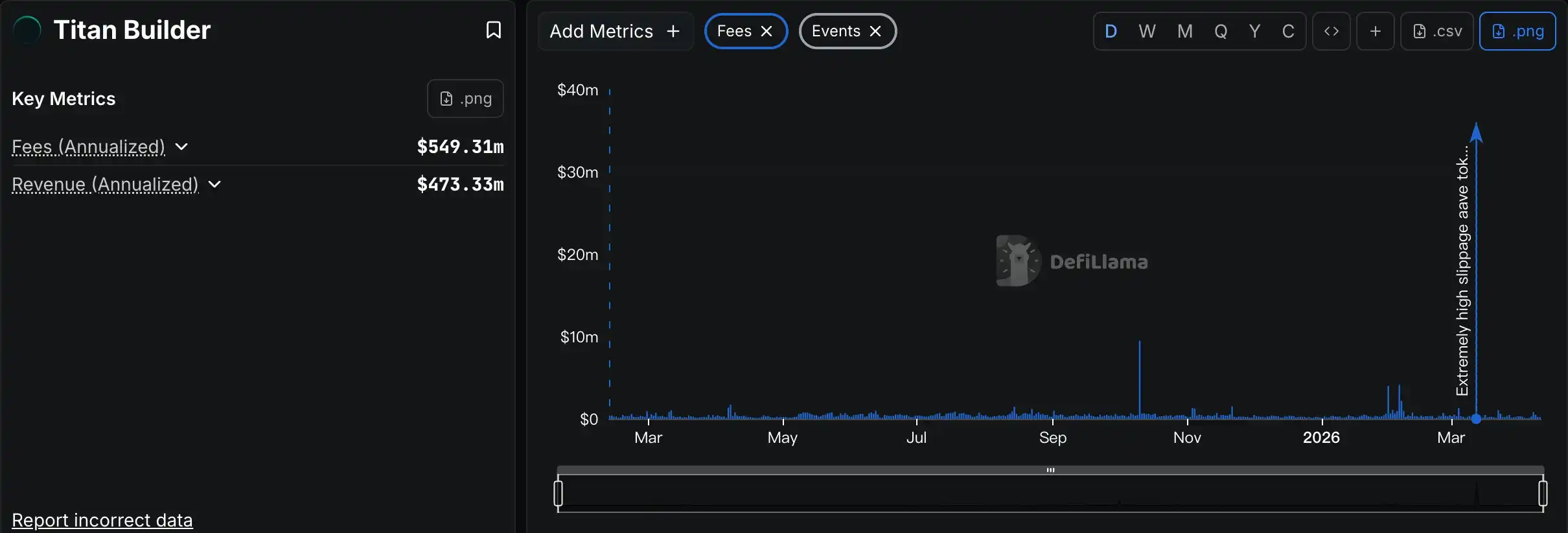
Odaily Note: See what it means to not open for business for three years, but eat for three years when you do.

So the conclusion is clear. The projects that continue to make money in the bear market are not those pursuing complex mechanisms and high-risk opportunities, but those that can operate continuously凭借 (relying on) simple and clear revenue models. In the still volatile cryptocurrency market, simpler revenue models have shown greater resilience and better withstand the test of market fluctuations.

However, a simpler revenue model absolutely does not mean these businesses are "easier to do." On the contrary, behind the simple revenue model often lie more complex product services and精细 (meticulous) operational management. This is where the leading players on the list have truly "competed" their way to differentiation. From interaction design, to liquidity accumulation, to risk management, to user communication and feedback... To stand out in the fierce competition of the存量 (stock) market, one must invest more effort into the product and service.

The crypto winter is not over yet. The projects that can truly survive and even profit are often those that flexibly combine simple revenue models with complex product services. Perhaps, this is the long-term code to穿越 (traverse) bull and bear markets.


Preguntas relacionadas

QWhat are the two main categories of revenue sources for profitable projects in the crypto bear market, as mentioned in the article?

AThe two main categories are spread (acting as a capital intermediary) and transaction tax (fees).

QWhich project set a single-day revenue record of $1.5 million on April 2nd, according to the article?

APolymarket set a single-day revenue record of $1.5 million on April 2nd.

QWhat is the core revenue source for stablecoin issuers like Tether and Circle, as explained in the article?

ATheir core revenue comes from the interest earned by deploying reserve funds into assets like U.S. Treasury bonds, minus the costs of subsidies to partners and users.

QName one project whose revenue primarily comes from data service fees for oracle calls, as highlighted in the article.

AChanilink primarily earns revenue from data service fees charged for project oracle calls.

QWhat does the article suggest is the key to surviving and profiting in the crypto bear market?

AThe key is combining simple revenue models with complex product services and refined operational management.

Lecturas Relacionadas

The King of Blind Date Attire in Korea: How SK Hynix Made a Comeback Against Samsung?

In South Korea's dating scene, SK Hynix employees are now highly sought after, a status shift fueled by the company's astronomical profits and employee bonuses, projected to reach up to 6.1 million RMB per person by 2027. This marks a dramatic reversal for the long-time second-place player in memory semiconductors, which has now surpassed its rival Samsung in annual operating profit. The turnaround story began in 2008 when a struggling Hynix, emerging from bankruptcy restructuring, took a risky bet by agreeing to develop High Bandwidth Memory (HBM) with AMD. At the time, HBM had no clear market beyond high-end graphics cards and was a costly, complex technology. Major players like Samsung, pursuing its own HMC technology, declined. For Hynix, with only memory as its core business, it was a gamble born of necessity. The pivotal moment came in 2012 when SK Group Chairman Chey Tae-won acquired Hynix. Defying industry downturns, he invested heavily in R&D and fabrication, sustaining the HBM project through over a decade of commercial uncertainty and internal challenges. A key break occurred around 2016-2017 when Samsung faced production issues supplying HBM2 for Google's TPU, allowing SK Hynix to gain a crucial foothold in the data center market. The AI explosion post-ChatGPT in 2022 was the catalyst, turning HBM into a critical bottleneck for AI accelerators like NVIDIA's GPUs. By 2025, SK Hynix captured 62% of the global HBM market, leaving Samsung at 17%. For the first time, its annual operating profit exceeded Samsung's. Analysts point to the "innovator's dilemma" to explain Samsung's miss: its vast, successful business portfolio made it risk-averse, preventing an all-in bet on the initially niche HBM technology. In contrast, SK Hynix, as a challenger with its back against the wall, had no choice but to commit fully. The story highlights how Korea's chaebol system allows for ultra-long-term bets beyond quarterly pressures. However, SK Hynix's lead isn't guaranteed. Samsung is aggressively catching up on HBM4, and challenges like customer concentration (heavy reliance on NVIDIA) and technical hurdles in advanced packaging remain. The narrative underscores a market truth: the greatest alpha often comes from betting on uncertain, long-term directions others dismiss, much like HBM in 2008.

marsbitHace 5 min(s)

The King of Blind Date Attire in Korea: How SK Hynix Made a Comeback Against Samsung?

marsbitHace 5 min(s)

Understanding Hash in One Article: The "Browser Miner" on Ethereum

Hash is an Ethereum-based ERC-20 token described as a "browser-minable post-quantum token." Its key features include enabling browser-based GPU mining without specialized hardware, a fixed supply cap of 21 million tokens, immutable and permissionless smart contracts with no team allocation or pre-mining, and an emphasis on post-quantum security using Keccak256 hashing. The mining mechanism is a simplified on-chain proof-of-work where miners solve unique challenges tied to their wallet address. Key design elements prevent answer theft, with epochs resetting every 100 blocks (~20 minutes) and a per-block minting limit. Emission follows a Bitcoin-like halving schedule every 100,000 mints, starting at 100 tokens per mint. Projections suggest all tokens could be mined within approximately 294 days if a target rate of one mint per minute is sustained. Hash emphasizes "post-quantum" security by leveraging hash-based primitives like Keccak256, which are considered more resistant to quantum attacks compared to elliptic-curve cryptography. While not a fully post-quantum asset, it aligns with Ethereum's broader post-quantum research narrative. The project completed its Genesis sale at $0.03 and began trading on Uniswap, with its price reaching around $0.19. The initial circulating supply is small, with 5% sold in Genesis and 5% allocated to liquidity. The majority (47.6% of total supply) is allocated to early-stage mining, leading to a front-loaded emission schedule. This structure, combined with low initial liquidity, makes Hash a high-volatility, high-risk project dependent on sustained miner participation and market demand to absorb new supply.

marsbitHace 19 min(s)

Understanding Hash in One Article: The "Browser Miner" on Ethereum

marsbitHace 19 min(s)

OpenAI's Largest Internal Wealth Creation: 600 People Cash Out a Total of $6.6 Billion, 75 Take Home the Maximum $30 Million Each

A Wall Street Journal report reveals OpenAI's unprecedented pre-IPO wealth creation. In a single employee stock sale last October, over 600 current and former employees sold shares, collectively cashing out approximately $6.6 billion. Due to high investor demand, the company tripled the individual sale cap to $30 million, with about 75 employees selling the maximum amount. This event represents the largest such transaction in tech industry history for a private company. OpenAI's valuation was $500 billion for this tender offer. Employees with over two years of tenure were eligible, allowing many post-ChatGPT hires their first liquidity event. The company's stock has reportedly grown over 100-fold in seven years. Following a restructuring, employees collectively hold about 26% of OpenAI. The scale of executive wealth is also staggering. In court testimony related to Elon Musk's lawsuit, President and co-founder Greg Brockman confirmed his OpenAI stake is worth around $30 billion. Analysis indicates about 165 current and former employees hold a combined ~$164.9 billion in equity, averaging nearly $1 billion per person in paper wealth. OpenAI's per-employee stock-based compensation is estimated to be 34 times the average of major tech firms before their IPOs. OpenAI continues its rapid ascent, closing a $122 billion funding round at an $852 billion valuation in March. With monthly revenue hitting $2 billion, over 900 million weekly ChatGPT users, and plans for a potential trillion-dollar IPO in late 2026, this wealth-creation engine shows no signs of stopping.

链捕手Hace 41 min(s)

OpenAI's Largest Internal Wealth Creation: 600 People Cash Out a Total of $6.6 Billion, 75 Take Home the Maximum $30 Million Each

链捕手Hace 41 min(s)

Trading

Spot
Futuros
活动图片




