If You Bought One Deep OTM Bitcoin Put Option Every Month Since 2018, Could You Make Money in the Long Run?

marsbitPublicado a 2026-03-16Actualizado a 2026-03-16

Resumen

Based on a systematic backtest from 2018 to 2026, this study examines the long-term profitability of a monthly strategy of buying one deep out-of-the-money (OTM) put option on Bitcoin (BTC) and Ethereum (ETH), with a target delta of 0.01 and a 30-day expiration. The results are highly divergent. The strategy is not a stable source of profit but a classic, path-dependent tail insurance tool characterized by extreme right skew, very low win rates, and severe drawdowns. For BTC, the strategy yielded a final total return of 97.62% (CAGR: 8.66%), while for ETH, it resulted in a -73.07% loss (CAGR: -14.78%). The performance difference is attributed to BTC's extreme payouts being sufficient to cover the long-term cost of premiums, whereas ETH's were not. Key characteristics of the strategy include: * Extremely low win rates (BTC: 2.04%, ETH: 1.02%). * Catastrophic maximum drawdowns (BTC: -97.24%, ETH: -93.82%). * The median trade return was -100% for both assets. * Profits are driven entirely by a few extreme winning trades, with the top 5 trades contributing over 10x the net profit for BTC. * Notably, not all major market crashes (e.g., March 2020, LUNA, FTX) resulted in profitable positions due to timing and strike price placement. Parameter sensitivity analysis showed that a delta of 0.02 offered a more balanced risk-return profile across metrics. The strategy is best suited for investors who can tolerate years of continuous losses, view it as portfolio insurance ra...

Author: Michel Athayde, Bitget Wallet BD Ambassador

Abstract

In traditional financial markets, consistently buying deep out-of-the-money (OTM) Put options is often seen as a typical "black swan insurance" strategy: it continuously loses premium payments during normal times, only to break even or make a large profit during extreme risk events. The question is, does this logic still hold in the more volatile and crash-prone crypto market?

The answer from this backtest is not straightforward. Based on historical data from 2018-01-01 to 2026-03-14, we systematically tested BTC and ETH: buying one fixed deep OTM Put every month, holding until expiration, with no market timing. The results show this is not a "stable money-making" strategy, but rather a tail risk insurance tool characterized by extreme right skew, very low win rate, and strong path dependency. Under the baseline portfolio, the final total return for BTC was 97.62%, while for ETH it was -73.07%; meaning the same logic can yield completely opposite long-term results on different assets.

Research Background

"Buying insurance long-term" has always been one of the most debated strategies. Proponents argue that what ultimately determines the fate of long-term capital is not daily fluctuations, but a few systemic crashes; opponents believe that paying premiums year after year is essentially using certain losses to bet on uncertain disasters.

The crypto market makes this debate more interesting. On one hand, the volatility of BTC and ETH is much higher than traditional assets, and sharp drops are not rare; on the other hand, extreme market movements occur more frequently, theoretically making it more suitable for tail risk hedging survival. Thus, a key question arises: if one does not time the market or judge cycles, but mechanically buys one deep OTM Put every month starting from 2018, can this "simplest" form of tail insurance ultimately make money in the long run?

Strategy Design

The rules for this test are very simple and strict. Open a position on the first calendar day of each month; if there is no raw data for that day, postpone to the next available trading day; buy 1 European-style Put, hold until expiration, no early profit-taking or stop-loss. The target Delta for the baseline portfolio is 0.01, expiration is 30 days later, initial capital is $2000, investing 2% of the current account net value each time. If the budget is insufficient to buy a full contract, scale the position according to the budget.

For sensitivity analysis, the backtest was extended to Delta 0.02, 0.05, investment proportions of 1%, 2%, 5%, and expiration days of 14, 30, 45, totaling 54 parameter combinations.

Backtest Methodology

Pricing used the Black-Scholes model, assuming a risk-free rate of 0, with the annualized volatility proxied by the past 30 days' daily return volatility. The strike price was not arbitrarily set but derived by inverting the target Delta. Data-wise, the daily samples for BTC and ETH both cover up to 2026-03-14. After cleaning, BTC has 3055 records, ETH has 3048 records, with no missing dates or closing prices needing repair. In the entire parameter grid, skipped trades were solely due to "expiration date exceeding the backtest end date," with no silent failures.

In other words, these conclusions are not based on a small sample or incomplete data, but on a complete historical review of BTC and ETH under the same set of rules.

Backtest Results

First, look at the baseline portfolio, the version closest to the proposition "buy one fixed deep OTM Put every month": Delta 0.01, invest 2%, hold for 30 days.

The results are highly divergent. BTC executed 98 trades in total, with a final total return of 97.62% and an annualized compound growth rate (CAGR) of 8.66%; ETH also executed 98 trades, but the total return was only -73.07%, with a CAGR of -14.78%. Looking solely at the conclusion, one could say: this strategy can make money long-term on BTC, but not on ETH.

But what is truly noteworthy is not the return itself, but its cost. The maximum drawdown for the BTC baseline portfolio was as high as -97.24%, and for ETH it reached -93.82%. The win rate for BTC was only 2.04%, and for ETH even lower at 1.02%. The median return per trade for both was -100%, and the worst trade for both was also -100%. This means that most of the time, this strategy doesn't "lose a little"; it loses the entire premium at expiration.
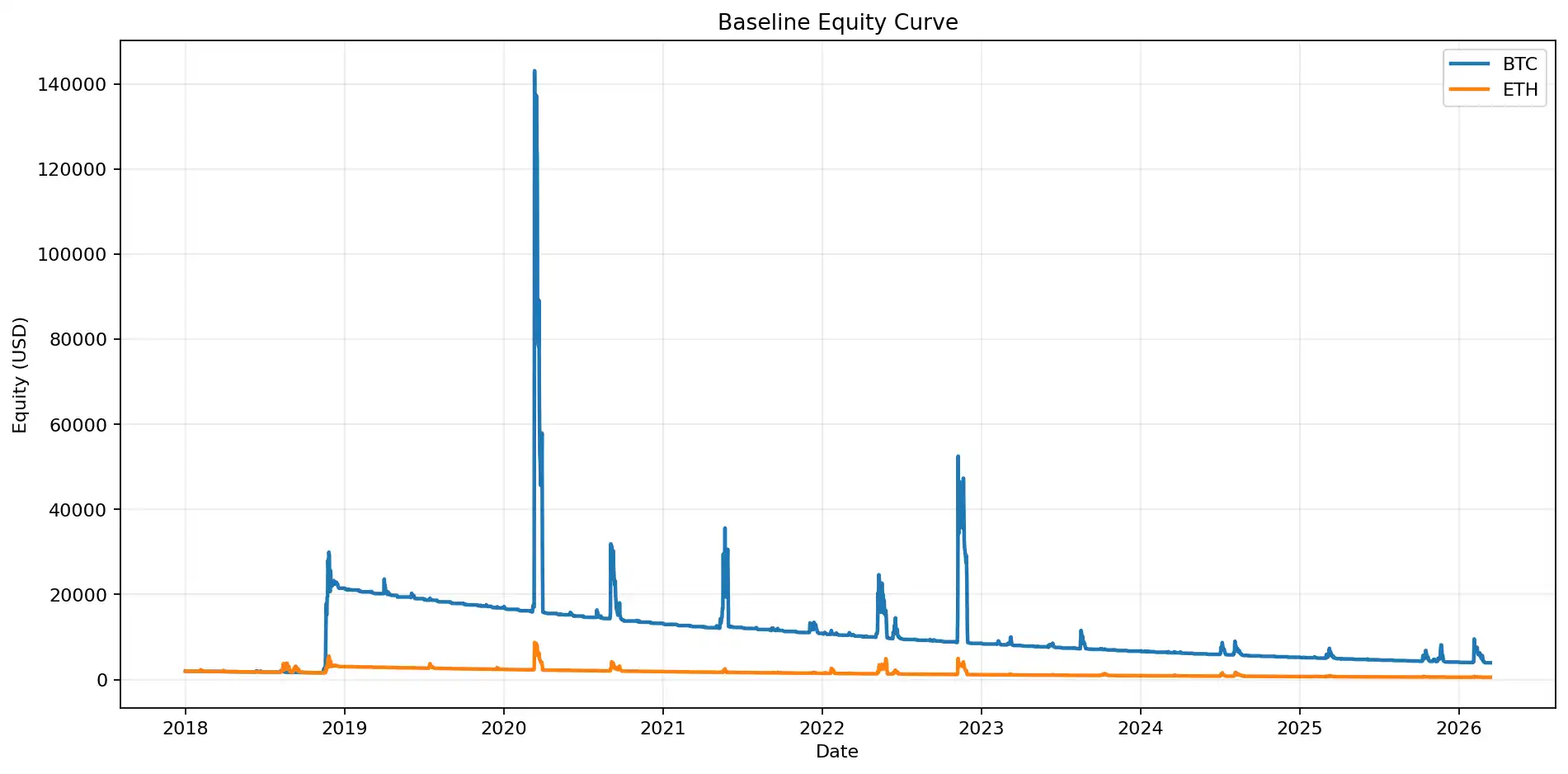
Figure 1: The equity curve of the baseline portfolio shows a clear divergence in long-term results between BTC and ETH. BTC ultimately achieved a positive return, while ETH's net value declined over the long term.
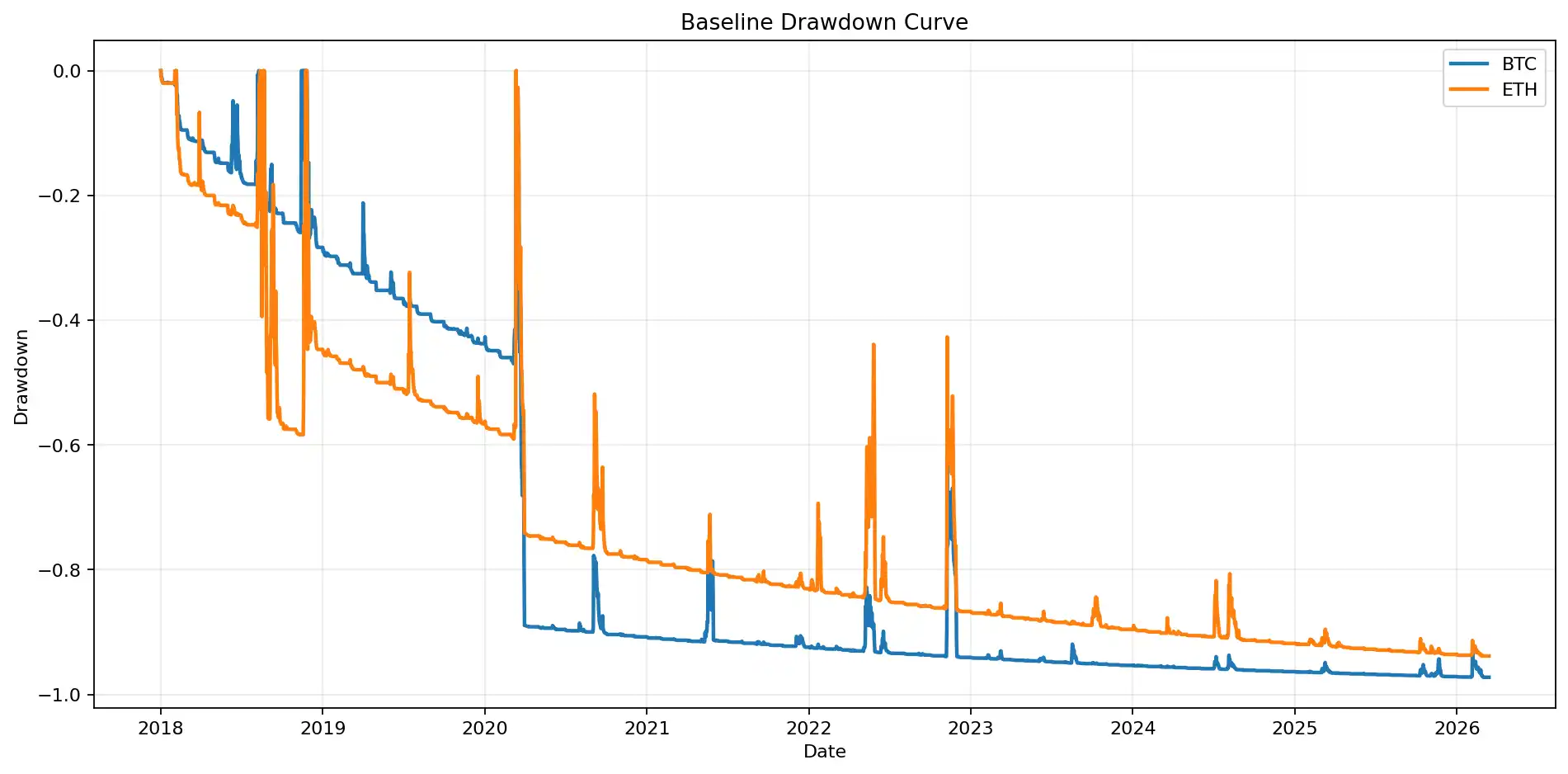
Figure 2: The drawdown curve illustrates that even if such strategies ultimately make money, they can remain deeply underwater for long periods. The maximum drawdown for the BTC baseline portfolio reached -97.24%, and for ETH it was -93.82%.

This is visually clear from the charts. The equity curve does not rise smoothly; instead, it lingers at low levels for long periods, occasionally pulled up by extreme profits in jumps. The drawdown curve remains deeply negative for extended periods. The histogram of single-trade returns is clearly left-skewed, densely clustered at -100%, with only a very few extreme large profits on the right. It is not a traditional "win-rate strategy" but a typical "positive skewness strategy."
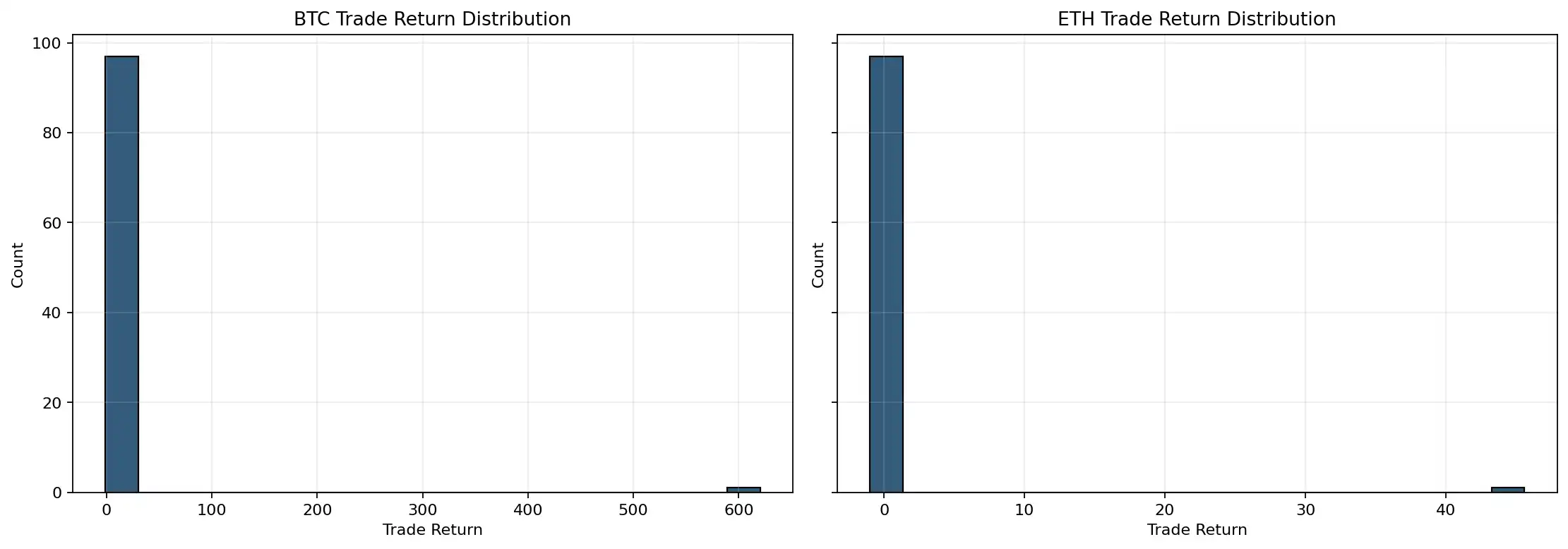
Figure 3: The distribution of single-trade returns is highly right-skewed. Premiums expire worthless in the vast majority of months; a few extremely profitable trades determine the long-term outcome.

Profit Source Analysis

The core feature of this strategy is that profits do not come from "making money in most months" but from "making a lot of money in very few months."

The proportion of profitable months for the BTC baseline portfolio was only 4.08%, and for ETH only 2.04%. The longest consecutive losing months for BTC reached 57 months, and for ETH it reached 87 months. This means that even if it ultimately makes money, an investor might have to endure years of continuous losses and the feeling of the strategy failing.

On the other hand, the single best trade return for the BTC baseline portfolio was over 620 times, and the average single trade return was pulled up to 5.36 by extreme profits; the skewness of the return distribution reached 9.90, and the kurtosis approached 98. The top 5 profitable trades contributed 10.54 times the total net profit for BTC. These numbers almost spell out the nature of this strategy: it doesn't make money through stable carry but relies on a few extreme moments to "reimburse" years of premiums at once.

ETH's structure has similar characteristics, but the problem is that ETH's extreme profits are insufficient to cover the long-term costs. Under the baseline portfolio, ETH paid a total premium of $2984.47 and recovered only $1523.06 at expiration, resulting in a Premium Burn Ratio of 48.97%; whereas BTC paid a total of $18903.47 and recovered $20855.85, resulting in a Premium Burn Ratio of -10.33%, indicating that on BTC, extreme events ultimately covered the premium losses and even left a surplus.
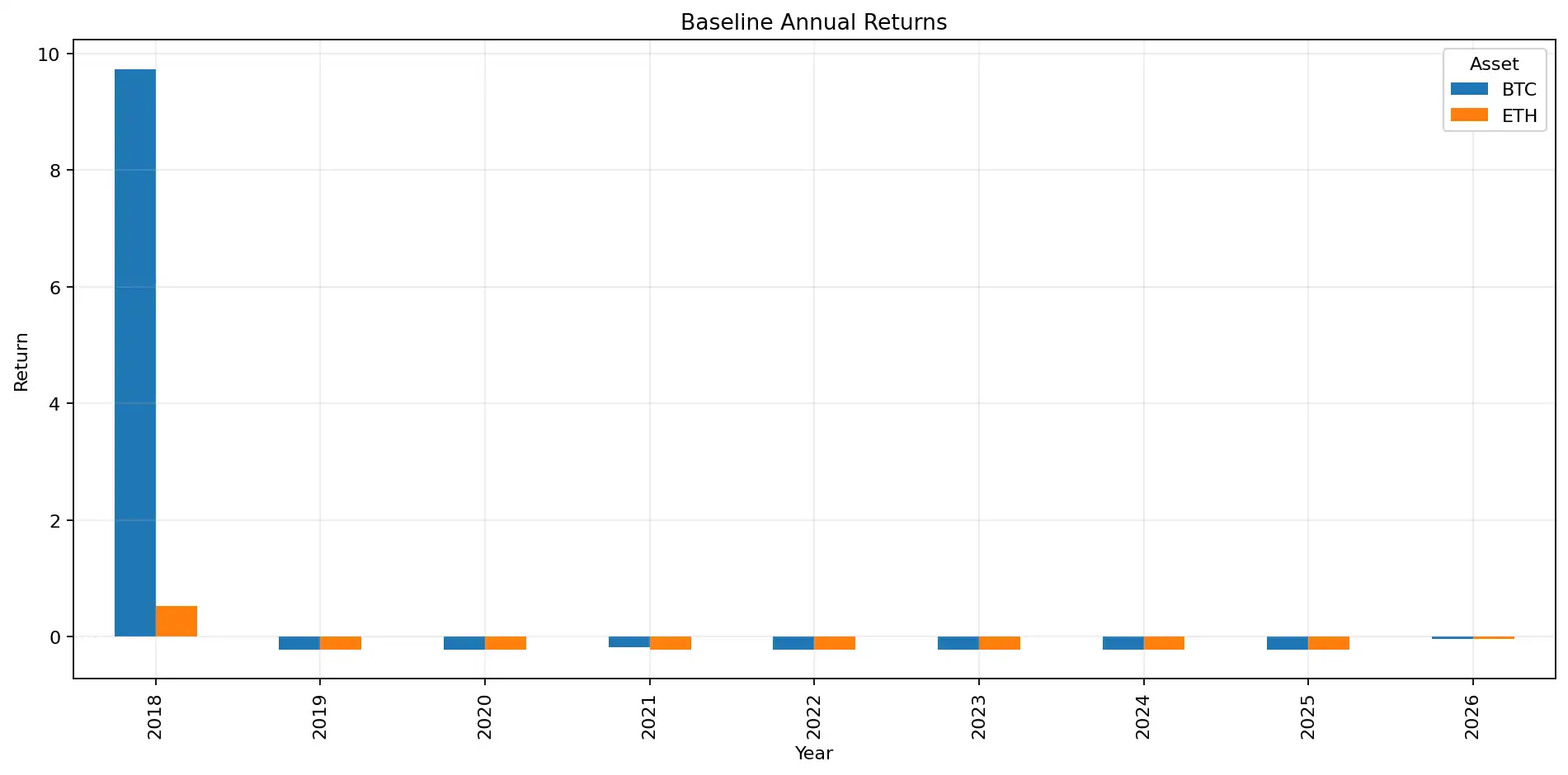
Figure 4: The extreme profit contribution chart shows that BTC's long-term profits are almost entirely driven by a few top trades, which is typical for tail insurance strategies.

Contribution of Extreme Market Conditions to Strategy Returns

A very interesting finding is that "a major market crash occurs" does not equal "your Put will definitely make money." Under the baseline portfolio, we specifically examined the performance of holdings around the March 2020 pandemic crash, the May 2021 crypto crash, the May 2022 LUNA event, and the November 2022 FTX event.

The results are not romantic. For BTC, only the May 2021 event window was profitable, with a single trade return of 127.09%, a recovery multiple of 2.27 times at expiration, contributing 15.87% to the total net profit. The holdings corresponding to March 2020, May 2022, and November 2022 all lost 100% of the premium. For ETH, it was more extreme: all four event windows resulted in 100% losses.

This shows that tail insurance is not "automatically profitable whenever a black swan occurs"; it highly depends on the entry timing, remaining time to expiration, and strike price level. Fixed monthly rolling purchases ensure you are "in the game long-term" but do not guarantee you "hold the most profitable contract at the right time."

BTC vs. ETH Performance Difference

Looking at the average results across the full parameter grid, BTC clearly outperforms ETH. The average total return for all parameter combinations for BTC was 1326.06%, with an average CAGR of 23.87% and an average Tail Insurance Score of 0.544; for ETH, these figures were 519.48%, 13.39%, and 0.362, respectively. In the baseline portfolio, BTC was positive and ETH was negative. This difference is also very evident in the net value comparison charts across different Deltas and durations.

More importantly, BTC's extreme profits are more capable of covering long-term premium costs, while ETH is more prone to remain in a state of "paying premiums long-term without necessarily getting paid back at critical moments." Simply put, when buying tail insurance, BTC is more like "insurance that pays out," while ETH is more like "insurance that is more expensive and harder to claim."
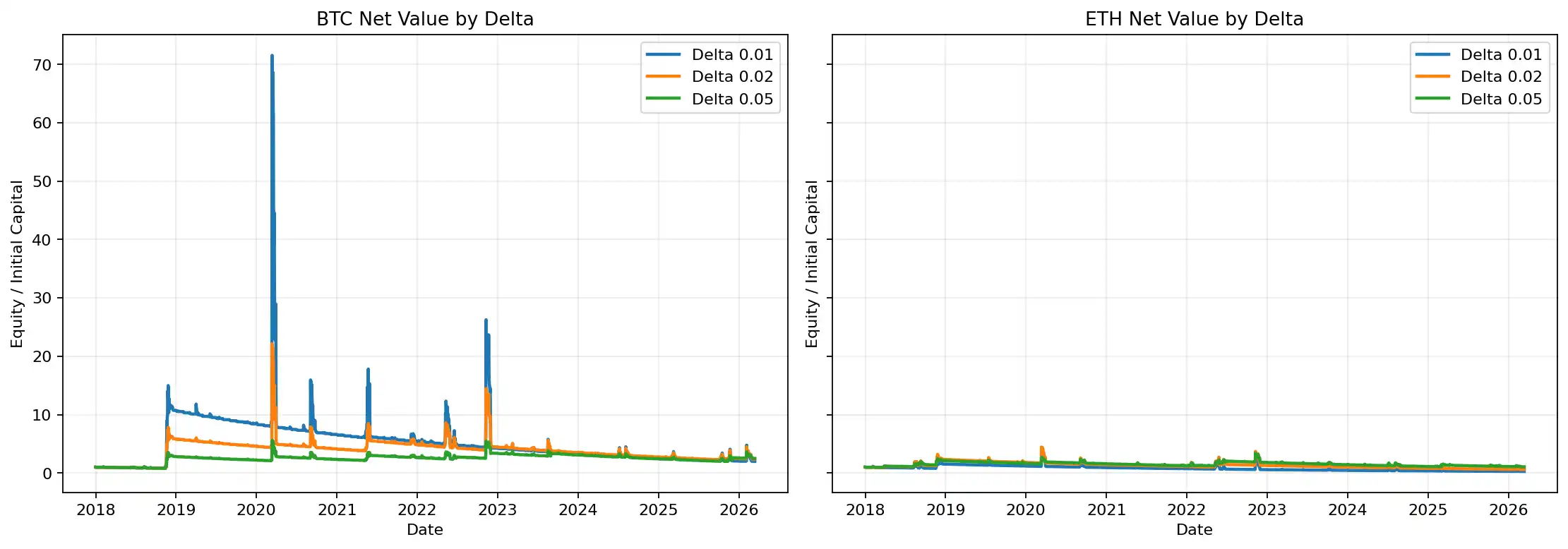
Figure 5: The baseline strategy comparison chart for BTC and ETH shows that although both assets experience extreme volatility, BTC's tail insurance efficiency is higher.

Parameter Sensitivity: Is Deeper Out-of-the-Money Better?

The parameter comparison results provide a more complete picture. Sorted by total return, the highest-yielding combination was for BTC: Delta 0.01, invest 2%, 45 days to expiration, achieving a total return of 9747.06%, corresponding to a CAGR of 74.99%. If looking only at "profitability," deeper OTM, longer duration, and适度杠杆 combinations perform extremely well on BTC.

But if considering risk constraints, the answer is not so simple. The combination with the lowest maximum drawdown was for ETH: Delta 0.05, invest 1%, 14 days, with a maximum drawdown of -37.89%. Looking at comprehensive average metrics, Delta 0.02 offers a better balance between Total Return, Calmar Ratio, and Premium Burn Ratio, making it the most "reasonable" Delta in this full parameter grid.

Figure 6: Net value curves for different Deltas show that the deeper the Delta, the more the strategy resembles typical black swan insurance; when Delta is slightly higher, more balanced combinations appear between returns and capital experience.

Figure 7: Comparison of different investment proportions说明, position size significantly amplifies return elasticity but also同步放大 long-term drawdown and path risk.

Strategy Advantages and Disadvantages

The advantages of this type of strategy are very distinct. First, simple structure, fixed rules, no reliance on subjective judgment. Second, extremely strong convexity; once extreme行情 are hit, the profit elasticity is astonishing. Third, its logic is completely different from mainstream long strategies; it is closer to a risk coverage tool in asset allocation rather than a directional trade.

But the disadvantages are equally harsh. First, the long-term capital experience is extremely poor; low win rate, long periods of drawdown, and consecutive years of losses are all possible. Second, it is highly sensitive to the "holding path"; even if the market crashes, you might not be holding the most profitable Put. Third, although this backtest is strict, it is still based on Black-Scholes and historical volatility proxy; implied volatility skew, liquidity, fees, and slippage in the real market would further affect live results.

What Type of Investor is This Strategy Suitable For?

It is more suitable for three types of people. First, institutional capital that treats it as portfolio insurance, not a primary profit strategy. Second, highly disciplined investors who can withstand years of "appearing to lose continuously." Third, those who explicitly want convex returns in extreme markets, not追求 daily high win rates.

It is not suitable for investors who view it as a "stable money-making model," nor for capital with short-term evaluation cycles that cannot tolerate long-term underwater performance. Because, as the backtest results show, even the ultimately profitable BTC baseline portfolio experienced a -97.24% maximum drawdown and 57 consecutive months of losses. Without极强的 capital endurance, this strategy is almost impossible to hold.

Final Conclusion

If you started buying one deep OTM Put every month since 2018, could you make money in the long run? The answer from this backtest is: Yes, but not in the普遍 sense of "yes." On BTC, the baseline portfolio ultimately achieved a 97.62% total return; on ETH, the same logic lost 73.07%. This means it is not a money-printing machine that works stably across assets and environments.

Is it a strategy purely reliant on extreme markets? Based on the backtest results, essentially yes. The extremely low win rate, the very low proportion of profitable months, the high skewness and kurtosis, and the overwhelming contribution of the top 5 profitable trades to the final net profit all indicate that it is not a strategy that "works hard long-term, collecting a salary monthly," but rather one that "pays premiums long-term, waiting for a few fateful moments."

If one must draw a more practical conclusion from these results, it is this: BTC is more suitable for this type of tail insurance than ETH; Delta 0.02 is a more balanced choice, as it offered better overall value in the full parameter comparison; and if investors seek more extreme convexity, Delta 0.01 remains the most aggressive and most "black swan insurance" like version.

In the end, consistently buying deep OTM Puts is not the most expensive strategy, nor the best strategy. It is more like an expensive but sometimes irreplaceable配置 tool. The question is never "is it worth buying," but rather whether you actually need this insurance, and whether you can withstand the long wait before the真正的理赔 arrives.

Preguntas relacionadas

QBased on the backtest, does consistently buying a deep out-of-the-money (OTM) put option on Bitcoin (BTC) every month since 2018 result in a net profit?

AYes, for Bitcoin, the benchmark strategy (Delta 0.01, 2% allocation, 30-day expiry) resulted in a total return of 97.62% and a Compound Annual Growth Rate (CAGR) of 8.66%.

QWhy did the same strategy perform so differently on Ethereum (ETH) compared to Bitcoin?

AThe strategy resulted in a -73.07% total return for ETH. The key difference is that the extreme profitable events on ETH were not large enough to cover the long-term cost of the premiums paid, whereas they were for Bitcoin.

QWhat are the main characteristics of the returns from this 'tail insurance' strategy?

AThe returns are characterized by extreme right skew, very low win rate (2.04% for BTC, 1.02% for ETH), and high kurtosis. The vast majority of trades lose 100% of the premium, while the entire net profit is driven by a very small number of extremely large winning trades.

QWhat was the most important factor identified for improving the strategy's risk-return profile?

AAdjusting the target Delta. While the deepest OTM puts (Delta 0.01) offered the highest potential returns, a Delta of 0.02 provided a better balance between total return, risk (Calmar Ratio), and premium burn ratio across the full parameter grid.

QWhat type of investor is this strategy most suitable for, according to the article?

AIt is suitable for three types of investors: 1) Institutional funds using it as portfolio insurance, not a primary strategy. 2) Highly disciplined investors who can withstand years of apparent losses. 3) Those seeking convex payoffs in extreme events, not high win rates. It is not suitable for investors seeking stable returns or those with short-term performance horizons.

Lecturas Relacionadas

Trading

Spot
Futuros

Artículos destacados

Qué es BITCOIN

Entendiendo HarryPotterObamaSonic10Inu (ERC-20) y Su Posición en el Espacio Cripto En los últimos años, el mercado de criptomonedas ha sido testigo de un aumento en la popularidad de las monedas meme, capturando el interés no solo de los comerciantes, sino también de aquellos que buscan compromiso comunitario y valor de entretenimiento. Entre estos tokens únicos se encuentra HarryPotterObamaSonic10Inu (ERC-20), un proyecto intrigante que mezcla referencias culturales en el tejido de las criptomonedas. Este artículo profundiza en los aspectos clave de HarryPotterObamaSonic10Inu, explorando sus mecanismos, ethos impulsado por la comunidad y su relación con el paisaje cripto más amplio. ¿Qué es HarryPotterObamaSonic10Inu (ERC-20)? Como su nombre sugiere, HarryPotterObamaSonic10Inu es una moneda meme construida sobre la blockchain de Ethereum, clasificada bajo el estándar ERC-20. A diferencia de las criptomonedas tradicionales que pueden enfatizar la utilidad práctica o el potencial de inversión, este token prospera en el valor de entretenimiento y la fuerza de su comunidad. El proyecto tiene como objetivo fomentar un entorno donde los usuarios comprometidos puedan reunirse, compartir ideas y participar en actividades inspiradas por diversos fenómenos culturales. Una característica notable de HarryPotterObamaSonic10Inu es su cero impuestos en las transacciones. Este atractivo elemento tiene como objetivo incentivar el comercio y la participación comunitaria, sin cargos adicionales que puedan disuadir a los comerciantes de pequeña escala. El suministro total de la moneda está establecido en mil millones de tokens, una cifra que marca su intención de mantener una circulación sustancial dentro de la comunidad. Creador de HarryPotterObamaSonic10Inu (ERC-20) Los orígenes de HarryPotterObamaSonic10Inu están algo envueltos en misterio; los detalles sobre el creador siguen siendo desconocidos. El desarrollo de este token carece de un equipo identificable o de un plan explícito, lo cual no es inusual dentro del sector de monedas meme. En cambio, el proyecto ha surgido de manera orgánica, con su progreso muy dependiente del entusiasmo y la participación de su comunidad. Inversores de HarryPotterObamaSonic10Inu (ERC-20) En cuanto a inversiones externas y respaldo, HarryPotterObamaSonic10Inu también sigue siendo ambiguo. El token no lista ninguna fundación de inversión conocida o apoyo organizacional significativo. En cambio, la savia del proyecto es su comunidad de base, que informa su crecimiento y sostenibilidad a través de la acción colectiva y el compromiso en el espacio cripto. ¿Cómo Funciona HarryPotterObamaSonic10Inu (ERC-20)? Como una moneda meme, HarryPotterObamaSonic10Inu opera principalmente fuera de los marcos tradicionales que a menudo rigen el valor de los activos. Hay varios aspectos distintivos que definen cómo funciona el proyecto: Transacciones Sin Impuestos: Sin tarifas impositivas en las transacciones, los usuarios pueden comprar y vender el token libremente sin preocuparse por costos ocultos. Compromiso Comunitario: El proyecto prospera en la interacción comunitaria, aprovechando plataformas de redes sociales para crear entusiasmo y facilitar la participación. Las discusiones, el intercambio de contenido y el compromiso son elementos cruciales que ayudan a expandir su alcance y fomentar la lealtad entre los seguidores. Sin Utilidad Práctica: Cabe señalar que HarryPotterObamaSonic10Inu no ofrece utilidad concreta dentro del ecosistema financiero. Más bien, se clasifica como un token principalmente para actividades de entretenimiento y comunitarias. Referencia Cultural: El token incorpora astutamente elementos de la cultura popular para atraer interés, conectando con entusiastas de los memes y seguidores de las criptomonedas por igual. HarryPotterObamaSonic10Inu ejemplifica cómo las monedas meme operan de manera diferente a los proyectos de criptomonedas más tradicionales, ingresando al mercado como construcciones sociales innovadoras en lugar de activos utilitarios. Cronología de HarryPotterObamaSonic10Inu (ERC-20) La historia de HarryPotterObamaSonic10Inu está marcada por varios hitos notables: Creación: El token surgió de un meme viral, capturando la imaginación de muchos entusiastas de las criptomonedas. Las fechas específicas de creación no están disponibles, subrayando su ascenso orgánico. Listado en Exchanges: HarryPotterObamaSonic10Inu ha llegado a varios exchanges, permitiendo un acceso y comercio más fácil por parte de la comunidad. Iniciativas de Compromiso Comunitario: Actividades continuas destinadas a mejorar la interacción comunitaria, incluyendo concursos, campañas en redes sociales y generación de contenido por parte de fanáticos y defensores. Planes de Expansión Futuros: La hoja de ruta del proyecto incluye el lanzamiento de una colección de NFT, mercancía y un sitio de comercio electrónico relacionado con sus temas culturales, involucrando aún más a la comunidad e intentando añadir más dimensiones a su ecosistema. Puntos Clave Sobre HarryPotterObamaSonic10Inu (ERC-20) Naturaleza Impulsada por la Comunidad: El proyecto prioriza la participación colectiva y la creatividad, asegurando que la involucración de los usuarios esté a la vanguardia de su desarrollo. Clasificación como Moneda Meme: Representa la epítome de las criptomonedas basadas en el entretenimiento, diferenciándose de los vehículos de inversión tradicionales. Sin Afiliación Directa con Bitcoin: A pesar de la similitud en el nombre del ticker, HarryPotterObamaSonic10Inu es distinto y no tiene relación con Bitcoin u otras criptomonedas establecidas. Enfoque en la Colaboración: HarryPotterObamaSonic10Inu está diseñado para crear un espacio para la colaboración y el intercambio de historias entre sus poseedores, proporcionando una vía para la creatividad y el vínculo comunitario. Perspectivas Futuras: La ambición de expandirse más allá de su premisa inicial hacia NFTs y mercancías describe un camino para que el proyecto potencialmente ingrese a avenidas más tradicionales dentro de la cultura digital. A medida que las monedas meme continúan capturando la imaginación de la comunidad de criptomonedas, HarryPotterObamaSonic10Inu (ERC-20) se destaca debido a sus lazos culturales y su enfoque centrado en la comunidad. Si bien puede no encajar en el molde típico de un token impulsado por la utilidad, su esencia radica en la alegría y la camaradería fomentadas entre sus seguidores, destacando la naturaleza en evolución de las criptomonedas en una era cada vez más digital. A medida que el proyecto continúa desarrollándose, será importante observar cómo las dinámicas comunitarias influyen en su trayectoria en el cambiante paisaje de la tecnología blockchain.

1.3k Vistas totalesPublicado en 2024.04.01Actualizado en 2024.12.03

Qué es BITCOIN

Cómo comprar BTC

¡Bienvenido a HTX.com! Hemos hecho que comprar Bitcoin (BTC) sea simple y conveniente. Sigue nuestra guía paso a paso para iniciar tu viaje de criptos.Paso 1: crea tu cuenta HTXUtiliza tu correo electrónico o número de teléfono para registrarte y obtener una cuenta gratuita en HTX. Experimenta un proceso de registro sin complicaciones y desbloquea todas las funciones.Obtener mi cuentaPaso 2: ve a Comprar cripto y elige tu método de pagoTarjeta de crédito/débito: usa tu Visa o Mastercard para comprar Bitcoin (BTC) al instante.Saldo: utiliza fondos del saldo de tu cuenta HTX para tradear sin problemas.Terceros: hemos agregado métodos de pago populares como Google Pay y Apple Pay para mejorar la comodidad.P2P: tradear directamente con otros usuarios en HTX.Over-the-Counter (OTC): ofrecemos servicios personalizados y tipos de cambio competitivos para los traders.Paso 3: guarda tu Bitcoin (BTC)Después de comprar tu Bitcoin (BTC), guárdalo en tu cuenta HTX. Alternativamente, puedes enviarlo a otro lugar mediante transferencia blockchain o utilizarlo para tradear otras criptomonedas.Paso 4: tradear Bitcoin (BTC)Tradear fácilmente con Bitcoin (BTC) en HTX's mercado spot. Simplemente accede a tu cuenta, selecciona tu par de trading, ejecuta tus trades y monitorea en tiempo real. Ofrecemos una experiencia fácil de usar tanto para principiantes como para traders experimentados.

4.7k Vistas totalesPublicado en 2024.12.12Actualizado en 2025.03.21

Cómo comprar BTC

Qué es $BITCOIN

ORO DIGITAL ($BITCOIN): Un Análisis Integral Introducción al ORO DIGITAL ($BITCOIN) ORO DIGITAL ($BITCOIN) es un proyecto basado en blockchain que opera en la red Solana, cuyo objetivo es combinar las características de los metales preciosos tradicionales con la innovación de las tecnologías descentralizadas. Aunque comparte un nombre con Bitcoin, a menudo referido como “oro digital” debido a su percepción como un refugio de valor, ORO DIGITAL es un token separado diseñado para crear un ecosistema único dentro del paisaje Web3. Su meta es posicionarse como un activo digital alternativo viable, aunque los detalles sobre sus aplicaciones y funcionalidades aún están en desarrollo. ¿Qué es ORO DIGITAL ($BITCOIN)? ORO DIGITAL ($BITCOIN) es un token de criptomoneda diseñado explícitamente para su uso en la blockchain de Solana. A diferencia de Bitcoin, que proporciona un papel de almacenamiento de valor ampliamente reconocido, este token parece centrarse en aplicaciones y características más amplias. Aspectos notables incluyen: Infraestructura Blockchain: El token está construido sobre la blockchain de Solana, conocida por su capacidad para manejar transacciones de alta velocidad y bajo costo. Dinámicas de Suministro: ORO DIGITAL tiene un suministro máximo limitado a 100 cuatrillones de tokens (100P $BITCOIN), aunque los detalles sobre su suministro circulante no se han divulgado actualmente. Utilidad: Si bien las funcionalidades precisas no están delineadas explícitamente, hay indicios de que el token podría ser utilizado para diversas aplicaciones, potencialmente involucrando aplicaciones descentralizadas (dApps) o estrategias de tokenización de activos. ¿Quién es el Creador de ORO DIGITAL ($BITCOIN)? En la actualidad, la identidad de los creadores y el equipo de desarrollo detrás de ORO DIGITAL ($BITCOIN) sigue siendo desconocida. Esta situación es típica entre muchos proyectos innovadores dentro del espacio blockchain, particularmente aquellos alineados con las finanzas descentralizadas y fenómenos de monedas meme. Si bien tal anonimato puede fomentar una cultura impulsada por la comunidad, intensifica las preocupaciones sobre la gobernanza y la responsabilidad. ¿Quiénes son los Inversores de ORO DIGITAL ($BITCOIN)? La información disponible indica que ORO DIGITAL ($BITCOIN) no tiene patrocinadores institucionales conocidos ni inversiones destacadas de capital de riesgo. El proyecto parece operar en un modelo de peer-to-peer centrado en el apoyo y la adopción de la comunidad en lugar de rutas de financiamiento tradicionales. Su actividad y liquidez se sitúan principalmente en intercambios descentralizados (DEX), como PumpSwap, en lugar de plataformas de trading centralizadas establecidas, lo que resalta aún más su enfoque de base. Cómo Funciona ORO DIGITAL ($BITCOIN) Los mecanismos operativos de ORO DIGITAL ($BITCOIN) pueden elaborarse en función de su diseño blockchain y atributos de red: Mecanismo de Consenso: Al aprovechar el único proof-of-history (PoH) de Solana combinado con un modelo de proof-of-stake (PoS), el proyecto asegura una validación de transacciones eficiente que contribuye al alto rendimiento de la red. Tokenómica: Si bien los mecanismos deflacionarios específicos no se han detallado extensamente, el vasto suministro máximo de tokens implica que podría atender microtransacciones o casos de uso nicho que aún están por definirse. Interoperabilidad: Existe el potencial de integración con el ecosistema más amplio de Solana, incluyendo varias plataformas de finanzas descentralizadas (DeFi). Sin embargo, los detalles sobre integraciones específicas permanecen no especificados. Cronología de Eventos Clave Aquí hay una cronología que destaca hitos significativos relacionados con ORO DIGITAL ($BITCOIN): 2023: El despliegue inicial del token ocurre en la blockchain de Solana, marcado por su dirección de contrato. 2024: ORO DIGITAL gana visibilidad al estar disponible para trading en intercambios descentralizados como PumpSwap, permitiendo a los usuarios comerciar contra SOL. 2025: El proyecto presencia actividad de trading esporádica y potencial interés en compromisos liderados por la comunidad, aunque no se han documentado asociaciones notables o avances técnicos hasta el momento. Análisis Crítico Fortalezas Escalabilidad: La infraestructura subyacente de Solana soporta altos volúmenes de transacciones, lo que podría mejorar la utilidad de $BITCOIN en varios escenarios de transacción. Accesibilidad: El potencial bajo precio de trading por token podría atraer a inversores minoristas, facilitando una participación más amplia debido a oportunidades de propiedad fraccionada. Riesgos Falta de Transparencia: La ausencia de patrocinadores, desarrolladores o un proceso de auditoría conocidos públicamente puede generar escepticismo sobre la sostenibilidad y confiabilidad del proyecto. Volatilidad del Mercado: La actividad de trading depende en gran medida del comportamiento especulativo, lo que puede resultar en una volatilidad de precios significativa y en incertidumbre para los inversores. Conclusión ORO DIGITAL ($BITCOIN) surge como un proyecto intrigante pero ambiguo dentro del ecosistema de Solana en rápida evolución. Si bien intenta aprovechar la narrativa del “oro digital”, su alejamiento del papel establecido de Bitcoin como refugio de valor subraya la necesidad de una diferenciación más clara de su utilidad y estructura de gobernanza previstas. La aceptación y adopción futura dependerán probablemente de abordar la actual opacidad y de definir sus estrategias operativas y económicas de manera más explícita. Nota: Este informe abarca información sintetizada disponible hasta octubre de 2023, y pueden haber ocurrido desarrollos más allá del período de investigación.

83 Vistas totalesPublicado en 2025.05.13Actualizado en 2025.05.13

Qué es $BITCOIN

Discusiones

Bienvenido a la comunidad de HTX. Aquí puedes mantenerte informado sobre los últimos desarrollos de la plataforma y acceder a análisis profesionales del mercado. A continuación se presentan las opiniones de los usuarios sobre el precio de BTC (BTC).

活动图片