I Dropped Out of High School, Learned with AI, and Made a Comeback as an OpenAI Researcher

深潮Publicado a 2025-12-17Actualizado a 2025-12-17

Resumen

The article tells the story of Gabriel Petersson, who dropped out of high school in Sweden and eventually became a research scientist at OpenAI working on the Sora video project. He achieved this through a self-directed, AI-powered learning method he calls "recursive knowledge filling." Instead of following a traditional "bottom-up" educational path, he starts with a concrete project and uses AI to deeply understand each component through relentless questioning. He treats AI not as a tool to generate answers, but as an infinitely patient tutor. For example, to learn about diffusion models, he began by asking an AI for the core concepts, then had it generate code. He then interrogated every part of that code, asking "why" and "how" until he built an intuitive understanding from the top down. This method allows him to rapidly acquire the essence of a subject in days rather than years. The author contrasts this with how most people use AI, which often leads to a decline in their own critical thinking and skills, as evidenced by research. The key difference is mindset: using AI as a "co-pilot for thinking" rather than an "answer generator." The article concludes with a five-step framework for applying this method to learn any subject and suggests that this approach could lead to a future of more "one-person companies" where individuals use AI to master multiple disciplines. The core advice is to never stop at the first answer—to keep asking questions.

Author: Jin Guanghao

A while ago, I attended an AI gathering in Shanghai.

The event itself covered a lot about AI implementation.

But what impressed me the most was a learning method shared by an investor veteran.

He said this method saved him and changed his criteria for evaluating people in investments.

What exactly is it? It's learning to "ask questions."

When you're interested in a question, go talk to DeepSeek, keep talking until it can't answer anymore.

This technique of "infinite questioning" was quite shocking to hear at the time, but after the event, I put it aside.

I didn't try it, nor did I think about it again.

Until recently, when I came across the story of Gabriel Petersson dropping out of school, using AI to learn, and joining OpenAI.

It suddenly dawned on me what that veteran meant by "asking to the end" in this AI era.
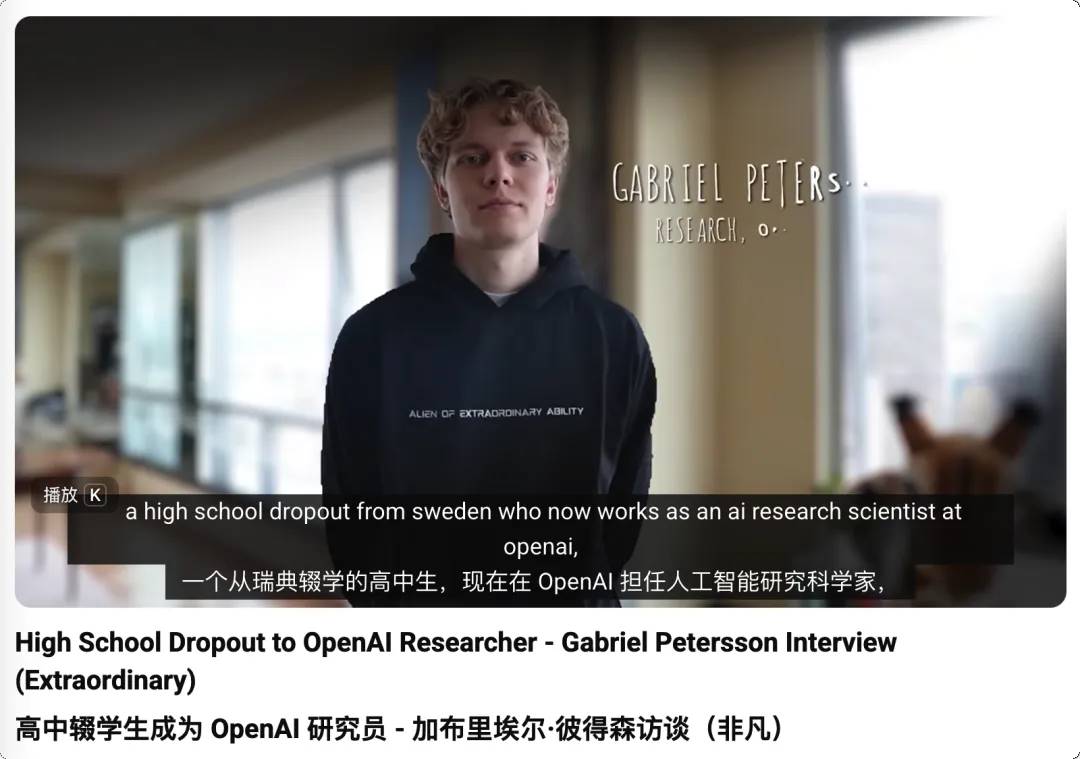
Gabriel's Interview Podcast | Image: YouTube

01 "High School Dropout" Makes a Comeback as OpenAI Researcher

Gabriel is from Sweden and dropped out of high school.
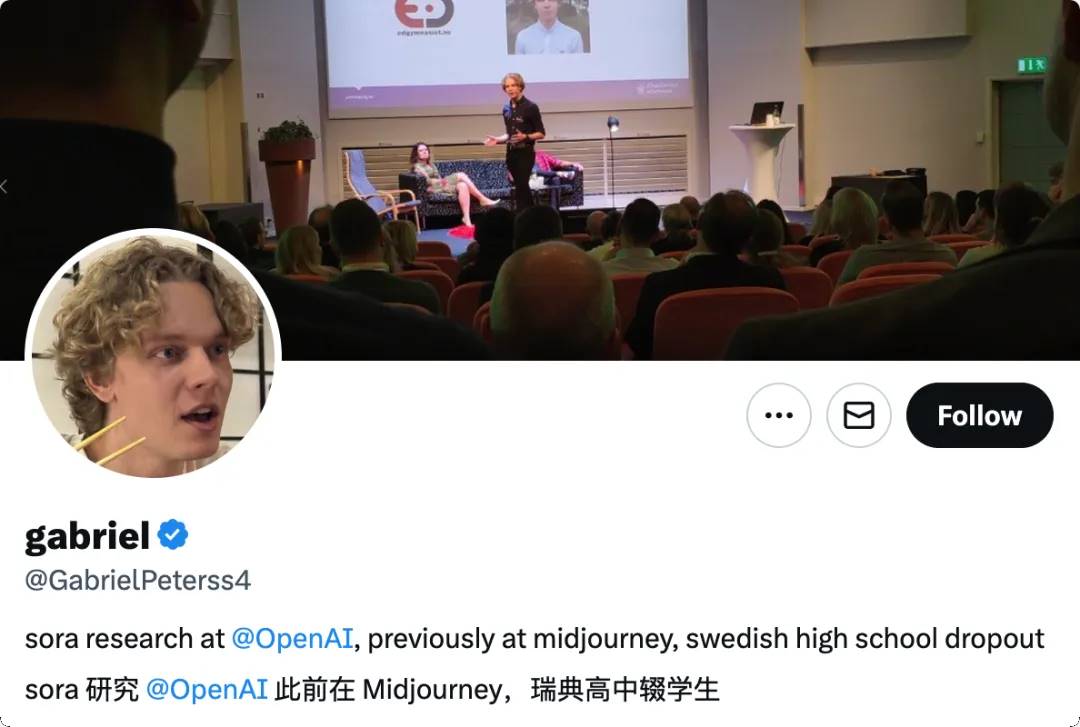
Gabriel's Social Media Profile | Image: X

He used to think he was too dumb to ever work in AI.

The turning point came a few years ago.

His cousin started a startup in Stockholm, working on an e-commerce product recommendation system, and asked him to help.

So Gabriel went. With little technical background and no savings, he even slept on the couch in the company's common lounge for a whole year during the early startup phase.

But he learned a lot that year. Not in school, but forced by the pressure of real problems: programming, sales, system integration.

Later, to optimize his learning efficiency, he switched to being a contractor, allowing him more flexibility in choosing projects, specifically seeking out the best engineers to collaborate with and actively seeking feedback.

When applying for a U.S. visa, he faced an awkward problem: this type of visa requires proof of "extraordinary ability" in the field, typically needing academic publications, paper citations, etc.

How could a high school dropout have these?

Gabriel came up with a solution: he compiled his high-quality technical posts from programmer communities as a substitute for "academic contributions." This proposal was actually approved by immigration.

After arriving in San Francisco, he continued to use ChatGPT to self-study math and machine learning.

Now he is a research scientist at OpenAI, working on building the Sora video model.

At this point, you must be curious, how did he do it?
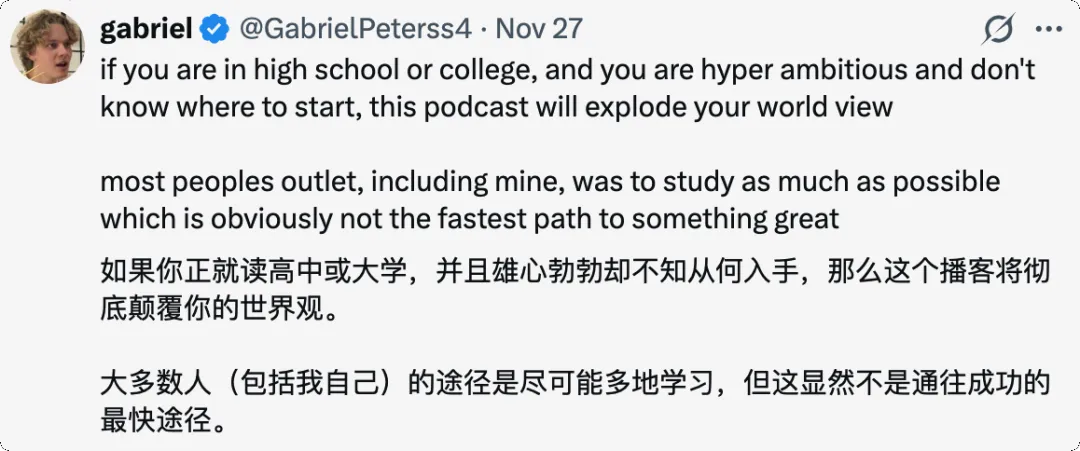
Gabriel's Viewpoint | Image: X

02 Recursive Knowledge Filling: A Counterintuitive Learning Method

The answer is "infinite questioning"—find a specific problem and solve it thoroughly with AI.

Gabriel's learning method is contrary to most people's intuition.

The traditional learning path is "bottom-up": build the foundation first, then learn applications. For example, to learn machine learning, you first need linear algebra, probability, calculus, then statistical learning, then deep learning, and finally you can touch actual projects. This process might take years.

His method is "top-down": start directly with a specific project, solve problems as they arise, and fill knowledge gaps when discovered.

He said in the podcast that this method was hard to promote before because you needed an omniscient teacher to always tell you "what to learn next."

But now, ChatGPT is that teacher.
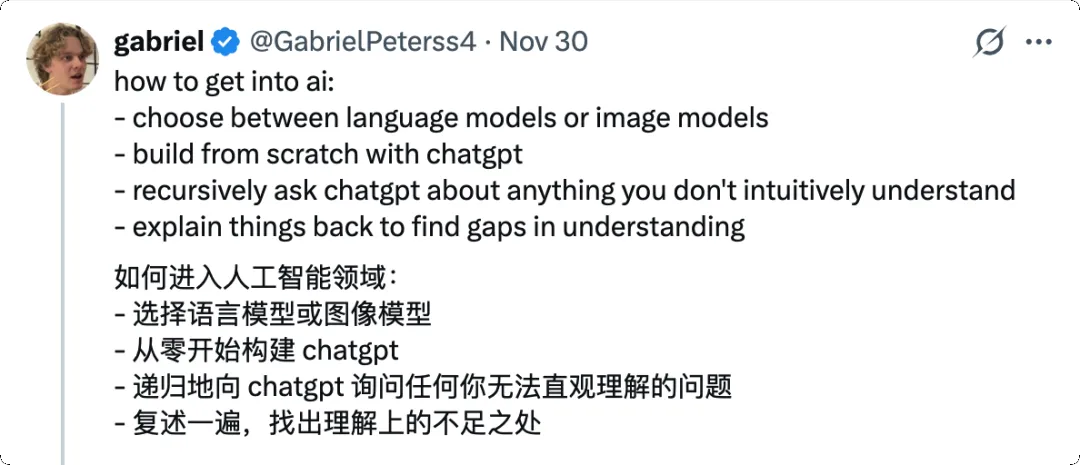
Gabriel's Viewpoint | Image: X

How exactly? He gave an example: how to learn diffusion models.

Step one, start with the macro concept. He asks ChatGPT: "I want to learn about video models, what's the core concept?" AI tells him: autoencoders.

Step two, code first. He asks ChatGPT to directly write a piece of diffusion model code. At first, many parts are incomprehensible, but that's okay, just get the code running first. Once it runs, you have a basis for debugging.

Step three, the core: recursive questioning. He asks questions about every module in the code.

Drill down layer by layer like this until the underlying logic is thoroughly understood. Then return to the previous layer and ask about the next module.

He calls this process "recursive knowledge filling."
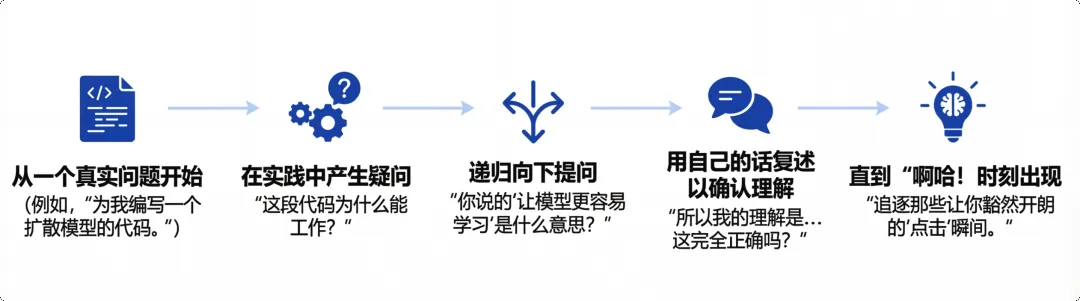
Recursive Knowledge Filling | Image: nanobaba2

This is much faster than studying step-by-step for six years; it might take just three days to build basic intuition.

If you're familiar with the Socratic method, you'll find this is essentially the same idea: approaching the essence of things through layered questioning, where every answer is the starting point for the next question.

Only now, he uses AI as the person being questioned, and since AI is nearly omniscient, it continuously expresses the essence of things in an easy-to-understand way to the questioner.

In fact, by adopting this approach, Gabriel performs "knowledge extraction" from AI, learning the essence of things.

03 Most of Us Using AI Are Actually Getting Dumber

After listening to the podcast, Gabriel's story made me wonder:

Why can he learn so well using AI, while many people feel they are regressing after using AI?

This isn't just my subjective feeling.

A 2025 Microsoft Research paper shows [1] that when people frequently use generative AI, their use of critical thinking significantly decreases.

In other words, we outsource our thinking to AI, and then our own thinking ability atrophies.

Skills follow the "use it or lose it" rule: when we use AI to write code, our ability to code by hand and brain quietly deteriorates.

The working style of "vibe coding" with AI seems efficient, but in the long run, the programmer's own skills decline.

You throw requirements to AI, it spits out a bunch of code, you run it, feel great. But if you turn off AI and try to write the core logic by hand, many find their minds blank.

A more extreme case comes from the medical field. A medical paper points out [2] that doctors' colonoscopy detection skills decreased by 6% three months after introducing AI assistance.

This number seems small, but think: this is real clinical diagnostic ability, concerning patients' health and lives.

So the question is: the same tool, why do some get stronger and some weaker?

The difference lies in what you treat AI as.

If you treat AI as a tool to do work for you, letting it write code, write articles, make decisions for you, then your ability will indeed degrade. Because you skip the thinking process and only get the result. Results can be copied and pasted, but thinking ability doesn't grow out of thin air.

But if you treat AI as a coach or mentor, using it to test your understanding, question your blind spots, force yourself to clarify vague concepts: then you are actually using AI to accelerate your learning cycle.

The core of Gabriel's method is not "let AI learn for me" but "let AI learn with me." He is always the one actively asking questions; AI just provides feedback and material. Every "why" is asked by himself, every layer of understanding is dug by himself.

This reminds me of an old saying: Give a man a fish, and you feed him for a day; teach a man to fish, and you feed him for a lifetime.
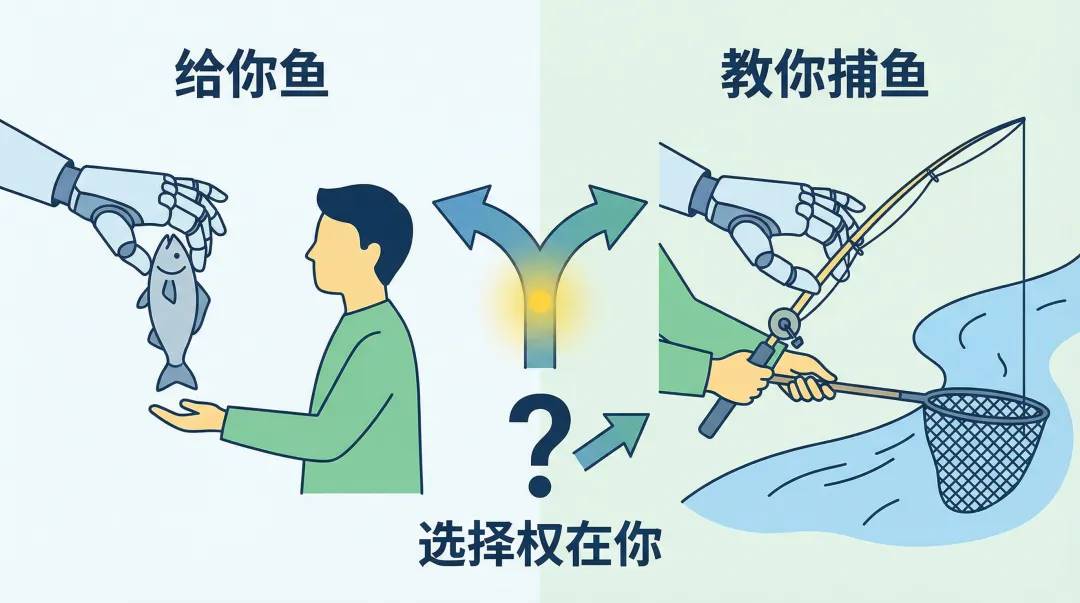
Recursive Knowledge Filling | Image: nanobaba2

04 Some Practical Insights

At this point, some might ask: I'm not in AI research, nor a programmer, what use is this method to me?

I think Gabriel's methodology can be abstracted into a more universal five-step framework. Everyone can use AI to learn any unfamiliar field.

1. Start from actual problems, not from chapter one of a textbook.

Whatever you want to learn, just start doing it, and fill in the gaps when you get stuck.

Knowledge learned this way has context and purpose, much more effective than memorizing concepts in isolation.
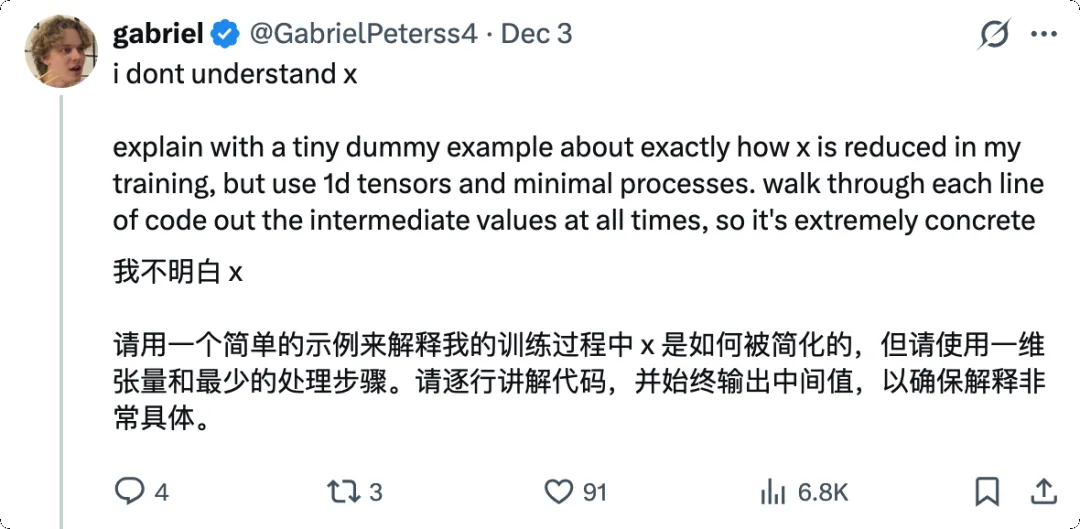
Gabriel's Viewpoint | Image: X

2. Treat AI as an infinitely patient tutor.

You can ask it any stupid question, have it explain the same concept in different ways, ask it to "explain like I'm five."

It won't laugh at you, nor will it get impatient.

3. Actively question until you build intuition. Don't settle for superficial understanding.

Can you restate a concept in your own words? Give an example not mentioned in the original text?

Explain it to a layperson? If not, keep asking.

4. There's a trap to be wary of: AI can also hallucinate.

During recursive questioning, if the AI explains a underlying concept wrong, you might go further down the wrong path.

So it's advised to cross-validate with multiple AIs at key nodes, ensuring the foundation of your questioning is solid.

5. Record your questioning process.

This forms reusable knowledge assets: next time you encounter a similar problem, you have a complete thought process to review.

In traditional观念, the value of tools lies in reducing resistance and improving efficiency.

But learning is恰恰相反: moderate resistance, necessary friction, is反而 the prerequisite for learning. If everything is too smooth, the brain enters power-saving mode and remembers nothing.

Gabriel's recursive questioning本质上 creates friction.

He constantly asks why, constantly pushes himself to the edge of not understanding, then slowly fills the gaps.

This process is uncomfortable, but it's this discomfort that truly embeds knowledge into long-term memory.

05 Future Career Trends

In this era, the monopoly of academic qualifications is being broken, but the cognitive threshold is invisibly rising.

Most people only use AI as an "answer generator," while a very few, like Gabriel, use AI as a "thinking exerciser."

Actually, similar uses have already appeared in different fields.

For example, on Jike, I see many parents using nanobanana to tutor their children. But they don't let AI give the answer directly; instead, they have AI generate解题 steps, showing the thinking process step by step, then analyze the logic of each step with the child.

This way, the child learns not the answer, but the method of solving the problem.

Prompt "Solve the given integral and write the complete solution on a whiteboard" | Image: nanobaba2

Others use features like Listenhub or NotebookLM to convert long articles or papers into podcast form, with two AI voices discussing, explaining, and questioning. Some think this is lazy, but others find that listening to the conversation and then going back to the original text actually improves comprehension efficiency.

Because the conversation naturally raises questions, forcing you to think: Do I really understand this point?
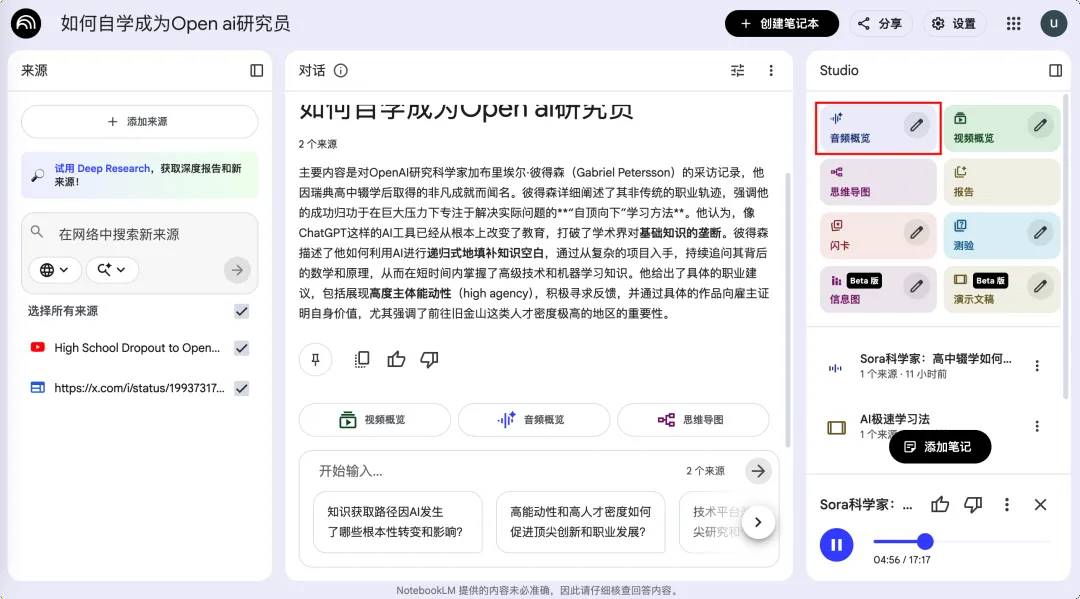
Gabriel's Interview Podcast to Podcast | Image: notebooklm

This points to a future career trend: specialized and versatile.

Before, to create a product, you needed to know front-end, back-end, design, operations, marketing. Now, you can, like Gabriel, use the "recursive gap-filling" method to quickly master 80% of the knowledge in your weak areas.

You were originally a programmer; by using AI to补全 design and business logic, you can become a product manager.

You were originally a good content creator; through AI, you can quickly补全 coding skills and become an independent developer.

Based on this trend, it can be inferred: "Perhaps, in the future, more 'one-person company' forms will appear."

06 Reclaim Your Initiative

Now, thinking back to that investor veteran's words, I understand what he really meant.

"Keep asking until it can't answer."

This phrase is a great mindset in the AI era.

If we are satisfied with the first answer AI gives, we are quietly degenerating.

But if we can, through questioning, force AI to explain the logic thoroughly, then internalize it into our own intuition: then AI truly becomes our external tool, not us becoming appendages of AI.

Don't let ChatGPT think for you; let it think with you.

Gabriel went from a dropout sleeping on a couch to an OpenAI researcher.

There's no secret in between, just tens of thousands of questions.

In this era full of anxiety about being replaced by AI, the most practical weapon might be:

Don't stop at the first answer, keep asking.

Criptos en tendencia

Preguntas relacionadas

QWhat is the core learning method Gabriel Petersson used to become an OpenAI researcher without a high school diploma?

AGabriel Petersson used a 'recursive knowledge filling' method, which involves starting with a practical project, using AI to ask infinite questions, and drilling down into each concept until he fully understood it, rather than following a traditional bottom-up learning path.

QHow does the 'recursive knowledge filling' method work in practice when learning a new concept like diffusion models?

AHe starts by asking AI for the core concepts, then gets code examples to run, and recursively questions every module in the code until he understands the underlying logic, filling knowledge gaps layer by layer.

QWhat negative effect can frequent use of generative AI have on human cognitive abilities, according to the article?

AFrequent use of generative AI can lead to a decline in critical thinking skills, as people outsource their thinking to AI, causing their own abilities to atrophy due to disuse.

QWhat is the key difference between using AI as a tool for outsourcing work versus using it as a learning coach?

AUsing AI as a tool for outsourcing work leads to skill degradation because it bypasses the thinking process, while using it as a coach involves active questioning and probing, which accelerates learning and deepens understanding.

QWhat future career trend does the article suggest is emerging due to AI-enabled learning methods like Gabriel's?

AThe article suggests a trend towards 'one-person companies,' where individuals can use AI to quickly master multiple domains, such as a programmer learning design and business logic to become a product manager or a content creator becoming an independent developer.

Lecturas Relacionadas

Must-Watch Events Next Week|CLARITY Act Could Face Senate Vote; SpaceX, Circle to Report Earnings (8.3-8.9)

**Summary: Key Events and Developments to Watch (August 3-9)** The upcoming week is marked by significant financial disclosures, key legislative deadlines, and notable product updates. **Major Financial Events:** Several companies are scheduled to release their Q2 2026 earnings. American Bitcoin (ABTC) will report on August 3, followed by SpaceX and Hut 8 Mining Corp. on August 4, and Circle on August 5. Notably, a significant portion of SpaceX shares (up to 12% of total shares) will be unlocked on August 6 following their earnings release. **Key Legislative Deadline:** The U.S. Senate faces an August 7 deadline to secure 60 votes for the CLARITY Act, a bipartisan bill aiming to establish a federal regulatory framework for cryptocurrencies. The Senate may hold a full vote on the bill during the week. **Economic Data:** The U.S. July Non-Farm Payrolls report will be released on August 7, providing crucial labor market data. **Technology & Product Updates:** * **Shutdowns:** DeFi portfolio tracker Zapper and wallet app Ctrl Wallet will cease operations on August 3. * **Upgrades:** LayerZero will deprecate its v1 relayers on August 3. XRP Ledger's new version 3.3.0, featuring five new functions, is expected next week. * **AI:** Elon Musk announced that the advanced Grok 4.6 AI model is set for release around August 7. * **Bitcoin:** The BIP-110 forced signaling for a potential Bitcoin network change is scheduled to begin around August 8. **Other Notable Events:** Chinese robotics firm Unitree Tech has set its preliminary price inquiry for its IPO for August 5. South Korean exchange Upbit will delist AQT and AERGO tokens on August 3.

marsbitHace 44 min(s)

Must-Watch Events Next Week|CLARITY Act Could Face Senate Vote; SpaceX, Circle to Report Earnings (8.3-8.9)

marsbitHace 44 min(s)

Stocks Are Plummeting More Sharply Than Cryptocurrencies. Where Has the Money Gone?

Stock Markets Plunge Deeper Than Cryptocurrencies: Where Did the Money Go? In late July, Seoul's Kospi index triggered circuit breakers for two consecutive days, plummeting over 40% from its June high. The collapse was led by heavyweight stocks like SK Hynix, whose record profits still disappointed investors, and devastating leveraged ETFs, with one major product losing over 83% of its value. This signaled a global, forced deleveraging targeting the most crowded trades. Interestingly, while stocks exhibited extreme volatility akin to crypto markets, Bitcoin rose nearly 15% in July after a prior steep drop. Analysis shows the money fleeing equities did not flow into Bitcoin. Instead, Bitcoin had already absorbed its sell-off in May-June, when U.S. spot Bitcoin ETFs saw historic outflows. The true safe-haven beneficiary was gold, whose price rose over 20% year-on-year, highlighting a decoupling between Bitcoin and gold as "digital gold." The sell-off was a targeted unwinding of leveraged positions in tech and semiconductors, accelerated by broker-dealer risk management and shifts in the AI narrative, including new competition from Chinese memory chipmakers. The retreat path was clear: from high-valuation tech stocks to cash and U.S. Treasuries, then to gold. For Bitcoin to attract sustained institutional inflows, conditions like eased global liquidity pressure, a "soft-landing" Fed rate cut, and U.S. regulatory clarity via legislation like the stalled CLARITY Act are needed. Currently, Bitcoin is not a safe haven but an already-cleared asset. Its low correlation with tech stocks, however, makes it a potential diversification play for institutional portfolios once the storm passes. The money isn't here yet, but the positioning is underway.

marsbitHace 44 min(s)

Stocks Are Plummeting More Sharply Than Cryptocurrencies. Where Has the Money Gone?

marsbitHace 44 min(s)

In Conversation with Ray Dalio: We Are Currently in an AI Bubble, with 1% of My Portfolio in Bitcoin

Ray Dalio, founder of Bridgewater Associates, warns in an interview that the current AI boom shows classic bubble characteristics, which could lead to significant economic downturns as seen in past cycles like 1929 or 2000. He explains that speculative enthusiasm, fueled by debt and overvaluation, often precedes a crash when rising rates or taxation force asset sales, causing widespread losses and recession. Dalio also outlines his "Big Cycle" theory, describing an approximate 80-year pattern where widening wealth gaps, massive government deficits, and shifting geopolitical power (like China's rise) create internal conflict and global instability. He emphasizes that we are in a late-cycle, transitional phase where traditional powers like the US and UK face decline. For personal wealth protection, Dalio advises diversification beyond cash into assets like stocks, bonds, real estate, and particularly gold, which he prefers over Bitcoin. While he holds about 1% of his portfolio in Bitcoin as a non-printable hard asset, he views gold as more secure from technological or governmental threats. Regarding AI's impact, Dalio believes it will disproportionately benefit capital owners, worsening inequality by replacing both physical and cognitive labor. He suggests that human intuition and emotional intelligence, combined with AI, will be key for future workers. On taxation, Dalio argues that wealth taxes are impractical and risk triggering asset sell-offs, reducing productive investment. He points to the UK as a cautionary example of debt, low productivity, and political strife. Geopolitically, Dalio foresees a more regionalized world, with the US showing weakness in prolonged conflicts like with Iran, akin to past imperial declines. The ideal outcome, he suggests, is coexisting powerful blocs (e.g., Americas, China-Asia Pacific) without major war.

marsbitHace 4 hora(s)

In Conversation with Ray Dalio: We Are Currently in an AI Bubble, with 1% of My Portfolio in Bitcoin

marsbitHace 4 hora(s)

Daily 7.2 Trillion KRW: Foreign Capital's Record Net Buying on Friday! Wall Street Says Headwinds for Korean Stock Fund Flows Have Subsided

South Korean stock market sees a dramatic shift in fund flows. On July 31, foreign investors made a record net purchase of approximately KRW 7.2 trillion in KOSPI stocks, marking a fundamental reversal from the persistent large-scale net outflows seen in previous months. This contributed to a significant narrowing of foreign net selling in July to KRW 9.8 trillion, down sharply from KRW 48.4 trillion in June and KRW 44.5 trillion in May. Simultaneously, domestic institutional pressure eased. South Korean pension funds and asset managers turned to a net buying position in July, purchasing KRW 1.0 trillion worth of KOSPI shares, contrasting with net sales in May and June. Market volatility is expected to be dampened by new financial regulations. Effective July 31, the Financial Services Commission tightened access for retail investors to single-stock leveraged ETFs by raising the minimum cash deposit requirement. Trading volumes for these products subsequently dropped to about 50% of their monthly average. Citigroup Research maintains its year-end KOSPI target of 10,000 points. The firm cites several supportive factors: the substantial easing of headwinds from capital outflows, a robust fundamental outlook for the semiconductor sector, historically low market valuations, strong economic fundamentals, and the potential for policy support from financial authorities if needed.

marsbitHace 4 hora(s)

Daily 7.2 Trillion KRW: Foreign Capital's Record Net Buying on Friday! Wall Street Says Headwinds for Korean Stock Fund Flows Have Subsided

marsbitHace 4 hora(s)

Trading

Spot

Artículos destacados

Cómo comprar O

¡Bienvenido a HTX.com! Hemos hecho que comprar O1 exchange (O) sea simple y conveniente. Sigue nuestra guía paso a paso para iniciar tu viaje de criptos.Paso 1: crea tu cuenta HTXUtiliza tu correo electrónico o número de teléfono para registrarte y obtener una cuenta gratuita en HTX. Experimenta un proceso de registro sin complicaciones y desbloquea todas las funciones.Obtener mi cuentaPaso 2: ve a Comprar cripto y elige tu método de pagoTarjeta de crédito/débito: usa tu Visa o Mastercard para comprar O1 exchange (O) al instante.Saldo: utiliza fondos del saldo de tu cuenta HTX para tradear sin problemas.Terceros: hemos agregado métodos de pago populares como Google Pay y Apple Pay para mejorar la comodidad.P2P: tradear directamente con otros usuarios en HTX.Over-the-Counter (OTC): ofrecemos servicios personalizados y tipos de cambio competitivos para los traders.Paso 3: guarda tu O1 exchange (O)Después de comprar tu O1 exchange (O), guárdalo en tu cuenta HTX. Alternativamente, puedes enviarlo a otro lugar mediante transferencia blockchain o utilizarlo para tradear otras criptomonedas.Paso 4: tradear O1 exchange (O)Tradear fácilmente con O1 exchange (O) en HTX's mercado spot. Simplemente accede a tu cuenta, selecciona tu par de trading, ejecuta tus trades y monitorea en tiempo real. Ofrecemos una experiencia fácil de usar tanto para principiantes como para traders experimentados.

458 Vistas totalesPublicado en 2026.06.19Actualizado en 2026.06.29

Cómo comprar O

Cómo comprar PROS

¡Bienvenido a HTX.com! Hemos hecho que comprar Pharos (PROS) sea simple y conveniente. Sigue nuestra guía paso a paso para iniciar tu viaje de criptos.Paso 1: crea tu cuenta HTXUtiliza tu correo electrónico o número de teléfono para registrarte y obtener una cuenta gratuita en HTX. Experimenta un proceso de registro sin complicaciones y desbloquea todas las funciones.Obtener mi cuentaPaso 2: ve a Comprar cripto y elige tu método de pagoTarjeta de crédito/débito: usa tu Visa o Mastercard para comprar Pharos (PROS) al instante.Saldo: utiliza fondos del saldo de tu cuenta HTX para tradear sin problemas.Terceros: hemos agregado métodos de pago populares como Google Pay y Apple Pay para mejorar la comodidad.P2P: tradear directamente con otros usuarios en HTX.Over-the-Counter (OTC): ofrecemos servicios personalizados y tipos de cambio competitivos para los traders.Paso 3: guarda tu Pharos (PROS)Después de comprar tu Pharos (PROS), guárdalo en tu cuenta HTX. Alternativamente, puedes enviarlo a otro lugar mediante transferencia blockchain o utilizarlo para tradear otras criptomonedas.Paso 4: tradear Pharos (PROS)Tradear fácilmente con Pharos (PROS) en HTX's mercado spot. Simplemente accede a tu cuenta, selecciona tu par de trading, ejecuta tus trades y monitorea en tiempo real. Ofrecemos una experiencia fácil de usar tanto para principiantes como para traders experimentados.

471 Vistas totalesPublicado en 2026.06.22Actualizado en 2026.06.29

Cómo comprar PROS

Qué es VERONA

I. Introducción al Proyecto VERONA es una blockchain construida para todos, en todas partes a través de la abstracción de cadenas. Utilizando su capa de Abstracción Generalizada, VERONA se distingue por integrar funcionalidades complejas de blockchain, como cuentas, firmas e interoperabilidad, directamente a nivel de protocolo. Este enfoque permite interactuar con aplicaciones de blockchain sin necesidad de entender las tecnologías subyacentes.1) Información Básica Nombre: VERONA (VERONA)III. Enlaces Relacionados Enlace al sitio web oficial: https://xion.burnt.com/ Libro Blanco: https://xion.burnt.com/whitepaper.pdf Exploradores: https://explorer.burnt.com/ Redes Sociales: https://x.com/burnt_xion Nota: La introducción del proyecto proviene de los materiales publicados o proporcionados por el equipo oficial del proyecto, que es solo para referencia y no constituye asesoramiento de inversión. HTX no se hace responsable de ninguna pérdida directa o indirecta resultante.

554 Vistas totalesPublicado en 2026.06.22Actualizado en 2026.06.22

Qué es VERONA

Discusiones

Bienvenido a la comunidad de HTX. Aquí puedes mantenerte informado sobre los últimos desarrollos de la plataforma y acceder a análisis profesionales del mercado. A continuación se presentan las opiniones de los usuarios sobre el precio de A (A).

活动图片