Hyperliquid: Why HYPE’s pullback from $38 could be healthy

ambcryptoPublicado a 2026-02-24Actualizado a 2026-02-24

Resumen

The recent pullback in Hyperliquid (HYPE) from its high of $38.42 is viewed as a healthy retracement within a broader bullish structure. Despite a cluster of long liquidations and a drop below $30, the weekly and daily charts maintain a bullish outlook. Key support is identified at the $24.3 level, which aligns with the 78.6% Fibonacci retracement and a daily chart imbalance. A break below $23.4 could signal weakening bullish momentum, while a drop under $20 would invalidate the bullish setup. However, strong fundamentals, capital inflows, and the defense of the $20 long-term support level suggest HYPE is poised for a potential rally.

In a recent report, the large cluster of long liquidations below $30 for Hyperliquid [HYPE] led AMBCrypto to conclude that there was potential for a drop below $28 to hunt down the long positions.

This has since come true, aided by the Bitcoin [BTC] drop to $64.3k on Sunday. Hyperliquid was attracting capital, with high capital inflows to the ecosystem. This boded well for the token and the DEX in the long-term.

Based on the evidence at hand, HYPE bulls were setting up for an explosive rally. The macro conditions and BTC volatility were challenges that could delay the upward move, but the fundamentals were strong.
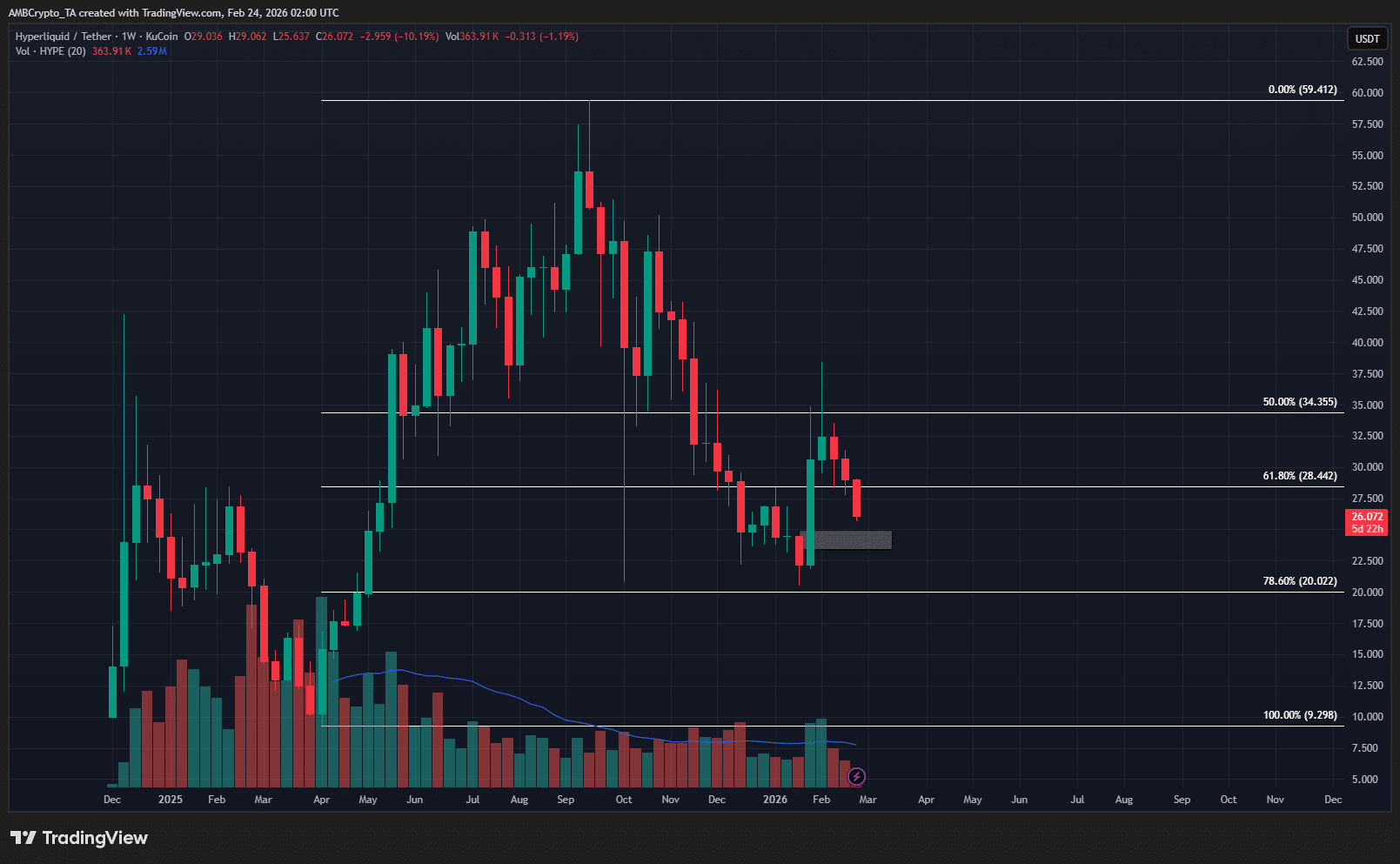
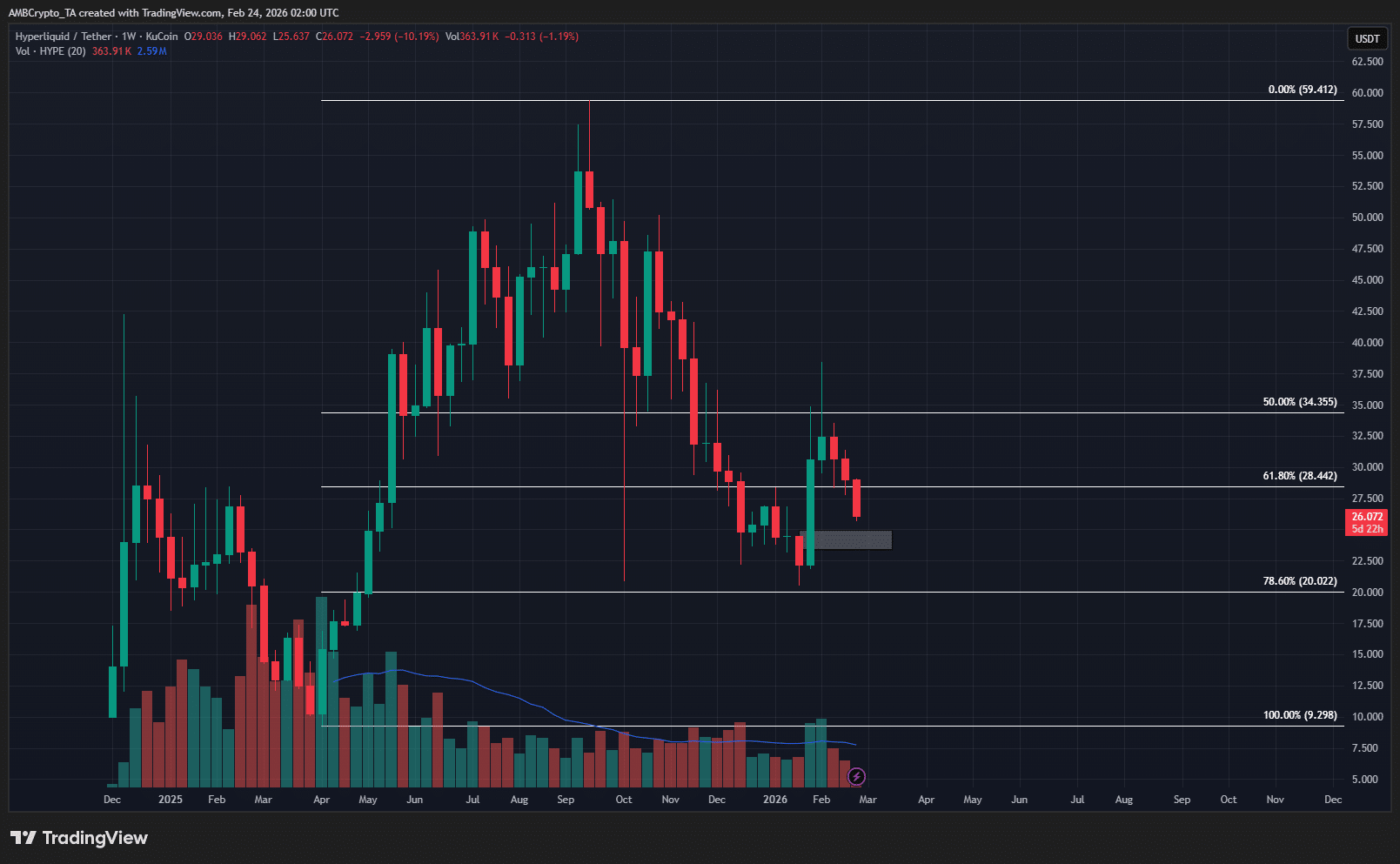
The 1-week chart has a bullish structure. The Fibonacci retracement levels showed that the fall to $20.48 in January was part of a retracement, with the golden pocket extending from $28.44 to $20.02.

Why you should think of buying this HYPE dip
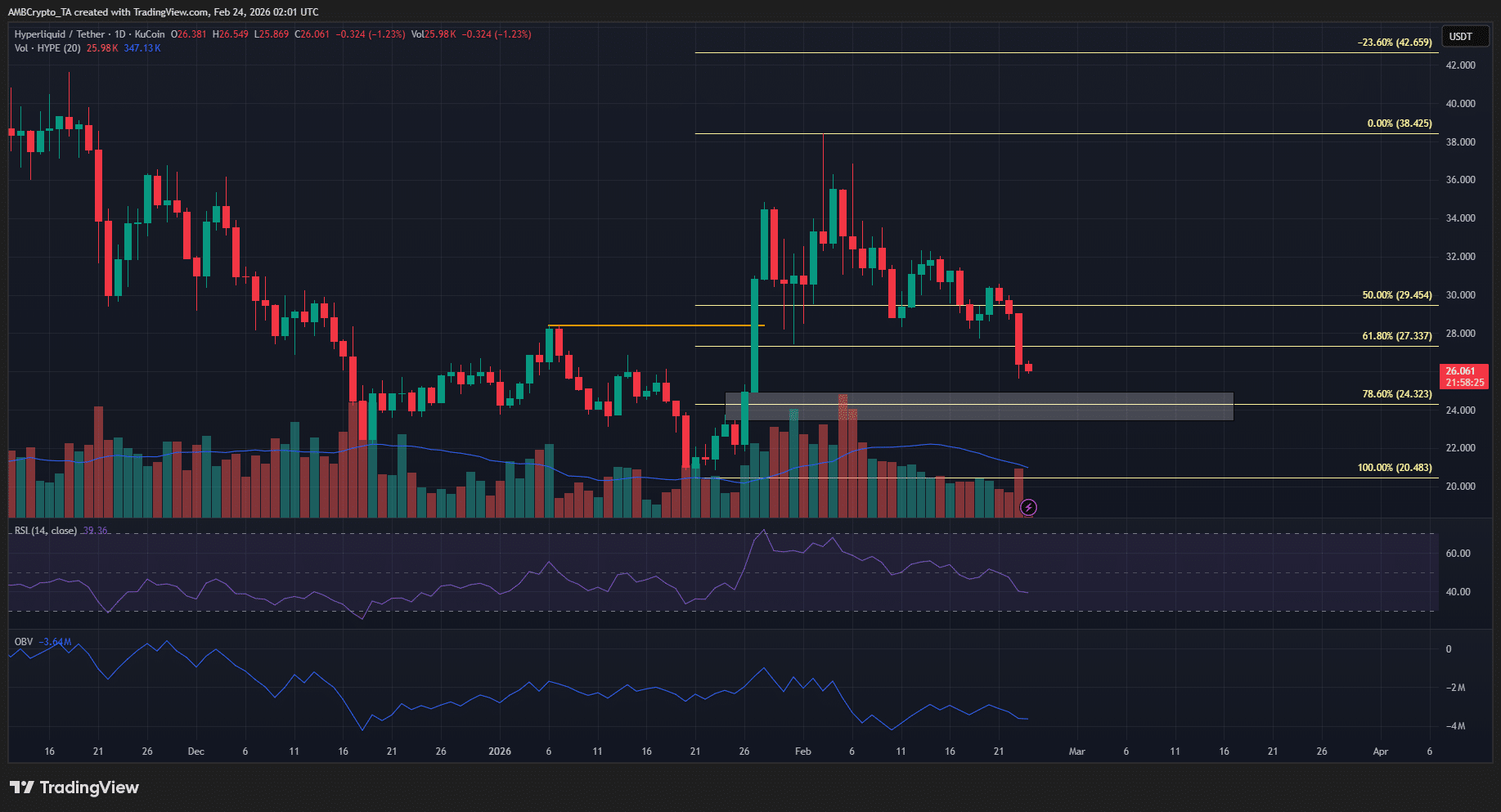
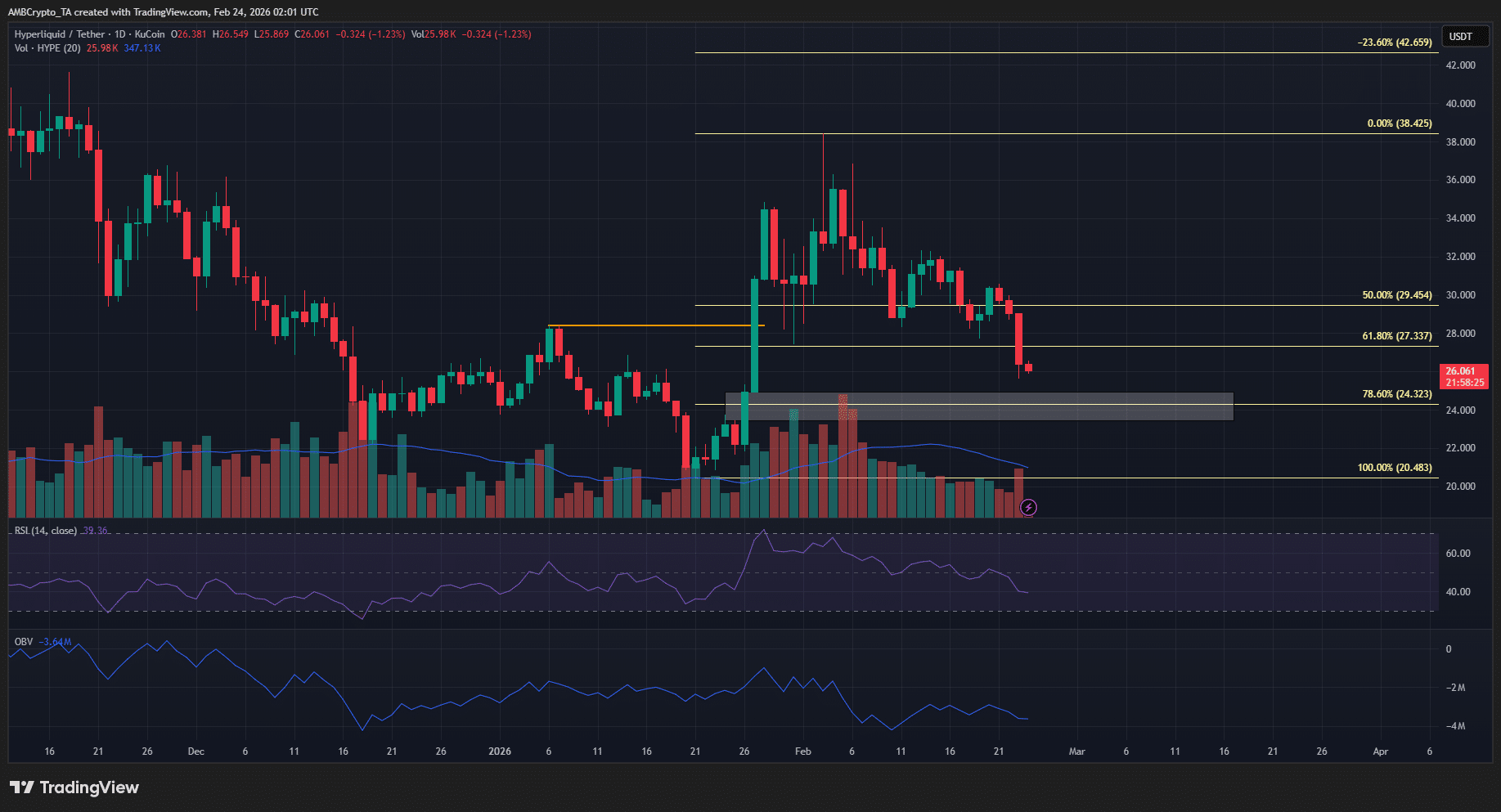
The 1-day chart showed a bullish swing structure in place for HYPE. This occurred after the lower high at $28.4, set in the first week of January, was breached. That rally reached $38.42 in the first week of February.

It also outperformed major crypto assets by a sizeable margin. However, traders who bet on a bullish continuation faced losses and liquidations as the DEX token retraced its rally, falling below $30 on the 10th of February.

Yet, this was part of a healthy retracement. HYPE swing traders and investors can wait for the $24.3 level to be defended before looking to go long. This level was the 78.6% Fibonacci retracement level for the bullish swing move.

It also has confluence with an imbalance on the daily chart (white box) that could get filled.

A drop below $23.4 would be an early sign that the bulls lacked the strength to drive a recovery. In this scenario, traders and long-term buyers need to prepare for the bullish setup to get invalidated.

A move below $20 would confirm bearish strength, and buyers will need to wait for an internal structure shift before looking to go long again.


Final Summary

  • The Hyperliquid volatility in February was a bullish structure shift and a subsequent retracement.
  • Given that the weekly structure was also bullish and the $20 was a long-term support, HYPE appears nearly ready for its next rally.

Disclaimer: The information presented does not constitute financial, investment, trading, or other types of advice and is solely the writer’s opinion.


Preguntas relacionadas

QWhat was the main reason behind Hyperliquid's [HYPE] recent drop below $30?

AThe drop was driven by a large cluster of long liquidations below $30, which was further aided by Bitcoin's decline to $64.3k.

QAccording to the article, why could HYPE's pullback be considered healthy?

AThe pullback is seen as a healthy retracement within a bullish structure, with key support levels like the 78.6% Fibonacci retracement at $24.3 providing potential buying opportunities.

QWhat key support level should HYPE watch for before considering a long position?

ASwing traders and investors should watch for the $24.3 level, which is the 78.6% Fibonacci retracement level and has confluence with a daily chart imbalance.

QWhat would invalidate the bullish setup for HYPE according to the analysis?

AA drop below $23.4 would indicate a lack of bullish strength, and a move below $20 would confirm bearish dominance, invalidating the bullish setup.

QWhat evidence suggests HYPE has strong long-term fundamentals despite recent volatility?

AHigh capital inflows into the Hyperliquid ecosystem and a bullish weekly chart structure indicate strong long-term fundamentals for both the token and the DEX.

Lecturas Relacionadas

Has the 'Digital Gold' Narrative for BTC Failed?

**Title: Has the "Digital Gold" Narrative for Bitcoin Failed?** The article argues that Bitcoin's "digital gold" narrative remains valid despite a recent sharp price decline (from a peak near $126k in Oct 2025 to briefly under $61k in Feb 2026). It presents a long-term investment framework based on three core points: **1. Viewing Bitcoin as an Asset:** Bitcoin is presented as a superior potential store of value compared to gold. Key arguments are its absolute scarcity (21 million cap), superior portability, and transparent auditability via its public ledger. While acknowledging its current use in early, volatile stages (~3-4% global adoption), the author draws parallels to the early, disruptive phases of the internet and e-commerce. **2. Understanding the Recent Downturn:** The current ~50% correction is framed as a predictable, consensus-driven cycle following its post-halving peak (the 2024 halving preceded the Oct 2025 high). A crucial factor is a historic "changing of hands": the influx of new institutional buyers via ETFs allowed early, low-cost holders (miners, OG believers) to take profits. The author notes that while severe, Bitcoin's historical drawdowns (e.g., 93% in 2011, 77% in 2021-22) have been progressively smaller, suggesting maturing holder structure and decreasing volatility over time. **3. The Long-Term Perspective:** The long-term thesis hinges on Bitcoin capturing a portion of gold's market value. With Bitcoin's market cap at ~$1.4 trillion (at $70k) versus gold's ~$20 trillion, significant upside potential exists if the "digital gold" narrative is partially realized. However, the author strongly cautions that short-term risks remain, the bottom is unpredictable, and high volatility is inherent. The real risk is not Bitcoin failing but poor personal position management (over-leverage, wrong capital) and a lack of deep understanding, which can force investors out during severe downturns. The conclusion uses Amazon's 95% crash post-2000 dot-com bubble and subsequent 42x recovery as an analogy. The ultimate question is not if Bitcoin's price will rise, but if an investor's strategy and conviction can withstand the volatility to see the long-term play out. The recent divergence (gold up, Bitcoin down) is posed not as a narrative failure, but as potential evidence of this ongoing, painful transition from a speculative asset to a mainstream allocation.

marsbitHace 7 hora(s)

Has the 'Digital Gold' Narrative for BTC Failed?

marsbitHace 7 hora(s)

Has BTC's 'Digital Gold' Narrative Failed?

The article discusses Bitcoin's "digital gold" narrative, its recent price drop, and long-term outlook through the perspective of "Jason". It argues the narrative is not a failure but that Bitcoin represents a superior, new asset class due to its fixed supply (21 million), portability, and auditability. The piece compares its current ~3-4% global adoption rate to early internet/e-commerce, suggesting significant growth potential. Regarding the 2025-2026 price decline (from ~$126k to briefly under $61k), the author views it as a predictable, consensus-driven sell-off within Bitcoin's ~4-year cycle post-halving, exacerbated by a major "handover" from early, low-cost holders to new institutional buyers via ETFs. A key observation is that historical peak-to-trough drawdowns have lessened over time (e.g., 93% in 2011 to ~50% in 2026), indicating maturing volatility as holder structure changes. For the long term, the author uses a simple framework: Bitcoin's total market cap (~$1.4T at $70k) is only about 7% of gold's (~$20T). Even capturing 30-50% of gold's value would imply substantial upside. However, the article strongly cautions against viewing this as investment advice, emphasizing extreme volatility and the critical importance of risk management, position sizing, and deep fundamental understanding to survive severe drawdowns. It concludes by drawing a parallel to Amazon's 95% crash in 2000 and subsequent 42x recovery, stressing that the key is surviving market cycles to realize long-term potential.

链捕手Hace 7 hora(s)

Has BTC's 'Digital Gold' Narrative Failed?

链捕手Hace 7 hora(s)

From Code to Cognition: A Ten-Thousand-Word Guide to the Evolution of the Robot Brain

"From Code to Cognition: The Evolution of Robot Brains" The journey of robotic intelligence has shifted dramatically from manually coded systems to AI-driven brains. For decades, robots relied on layered software stacks—perception, state estimation, planning, control—each handcrafted. While predictable, they lacked adaptability. The 2010s saw deep learning revolutionize perception (e.g., object detection) and control (via reinforcement learning), but learned skills remained narrow. The arrival of Large Language Models (LLMs) marked a turning point. LLMs acted as high-level planners, interpreting natural language instructions and generating sequences of actions for traditional robotic systems to execute. However, true integration came with Visual-Language-Action (VLA) models, which fused vision, language, and motion prediction into a single network. Pioneered by models like RT-2 and open-source projects like OpenVLA, VLAs enable robots to reason and act directly from visual input and commands. The most advanced humanoid robots now employ a "dual-brain" architecture: a slow-thinking, large VLA (System 2) for reasoning and planning, and a fast-reacting, small network (System 1) for high-frequency motion control, sometimes with an even lower-level System 0 for balance. This split balances cognition with the physics of real-time movement. Computation is split between onboard hardware (e.g., NVIDIA Jetson) for safety-critical control loops and cloud/edge servers for non-critical tasks like learning and interfaces. A crucial driver is the open-source ecosystem—models like GR00T and OpenVLA allow startups to build upon pre-trained brains and fine-tune them with their own data, accelerating development. Despite progress, current systems struggle with recovery from errors, sample inefficiency, and long-horizon tasks. This has spurred the rise of **World Models**—neural networks that predict the consequences of actions. By simulating possible futures before acting (like NVIDIA Cosmos or Meta V-JEPA), robots can plan, recover, and generalize better. This represents the next frontier: shifting intelligence from learned reactions to an internal model of physics and cause-and-effect. The field is rapidly evolving. While not yet at its "ChatGPT moment," the convergence of cheaper hardware, scalable simulation, and world models points toward robots that are increasingly capable, adaptive, and useful. The question is shifting from "what can robots do?" to "what *should* they do?"

marsbitHace 7 hora(s)

From Code to Cognition: A Ten-Thousand-Word Guide to the Evolution of the Robot Brain

marsbitHace 7 hora(s)

Trading

Spot
Futuros

Artículos destacados

Cómo comprar HYPE

¡Bienvenido a HTX.com! Hemos hecho que comprar Hyperliquid (HYPE) sea simple y conveniente. Sigue nuestra guía paso a paso para iniciar tu viaje de criptos.Paso 1: crea tu cuenta HTXUtiliza tu correo electrónico o número de teléfono para registrarte y obtener una cuenta gratuita en HTX. Experimenta un proceso de registro sin complicaciones y desbloquea todas las funciones.Obtener mi cuentaPaso 2: ve a Comprar cripto y elige tu método de pagoTarjeta de crédito/débito: usa tu Visa o Mastercard para comprar Hyperliquid (HYPE) al instante.Saldo: utiliza fondos del saldo de tu cuenta HTX para tradear sin problemas.Terceros: hemos agregado métodos de pago populares como Google Pay y Apple Pay para mejorar la comodidad.P2P: tradear directamente con otros usuarios en HTX.Over-the-Counter (OTC): ofrecemos servicios personalizados y tipos de cambio competitivos para los traders.Paso 3: guarda tu Hyperliquid (HYPE)Después de comprar tu Hyperliquid (HYPE), guárdalo en tu cuenta HTX. Alternativamente, puedes enviarlo a otro lugar mediante transferencia blockchain o utilizarlo para tradear otras criptomonedas.Paso 4: tradear Hyperliquid (HYPE)Tradear fácilmente con Hyperliquid (HYPE) en HTX's mercado spot. Simplemente accede a tu cuenta, selecciona tu par de trading, ejecuta tus trades y monitorea en tiempo real. Ofrecemos una experiencia fácil de usar tanto para principiantes como para traders experimentados.

198 Vistas totalesPublicado en 2024.12.11Actualizado en 2026.06.02

Cómo comprar HYPE

Discusiones

Bienvenido a la comunidad de HTX. Aquí puedes mantenerte informado sobre los últimos desarrollos de la plataforma y acceder a análisis profesionales del mercado. A continuación se presentan las opiniones de los usuarios sobre el precio de HYPE (HYPE).

活动图片