Hyperliquid Rally Stalls Near $30, Will HYPE Slide Further or Recover Toward $35?

bitcoinistPublicado a 2026-02-19Actualizado a 2026-02-19

Resumen

Hyperliquid's (HYPE) rally has stalled after failing to hold a breakout above $31, pulling back to a key support zone between $28 and $30. The token is now in a consolidation phase, with the $27.50–$28.50 region being critical support. A hold above this level could pave the way for a retest of $32.28 or even $35. However, a breakdown may lead to further declines toward $25–$26. Bearish signals are emerging, including a bearish MACD crossover and a more than 50% drop in weekly protocol revenue. Despite this, traders are watching for a potential bounce from support or a breakdown, which could determine the next directional move. Market sentiment remains cautious as volume declines, with price action near current levels seen as a decision zone.

Momentum around Hyperliquid cooled quickly this week after HYPE failed to hold a breakout above $31, sending the token back to a familiar battleground between buyers and sellers. With price hovering near key support, traders are now watching closely for signals that could define the next directional move.

Related Reading: Crypto Lobby Group Sounds Alarm Over Senate’s Crypto Bill Threat

The recent pullback reflects a broader consolidation trend that has defined price action for months, as shifting market sentiment, weakening technical momentum, and cooling network activity reshape short-term expectations.

Data tracked across major market platforms shows HYPE fluctuating within a well-established range, roughly $28 to $30. While the structure has offered predictable trading levels, repeated rejection near resistance suggests buyers are becoming cautious after recent gains.
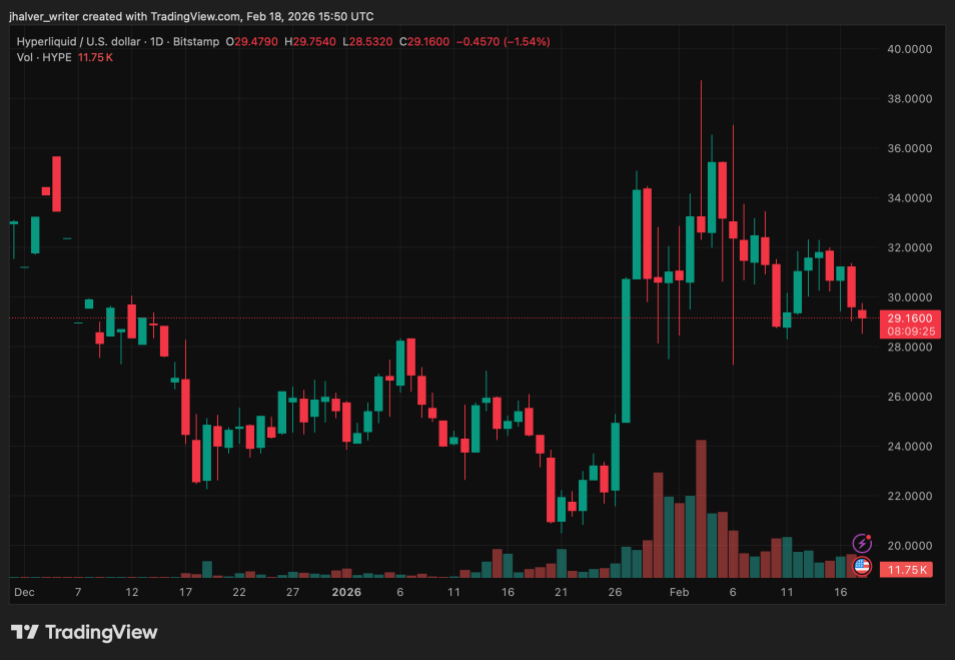
HYPE's price trends to the downside on the daily chart. Source: HYPEUSD on Tradingview

Range Trading Defines the Current Market

Hyperliquid (HYPE) briefly moved above $31 earlier this week before retracing, supporting resistance between $32 and $35. Analysts note that the $27.50–$28.50 region remains the most important support area, where buyers have consistently stepped in during recent volatility.

Holding above roughly $28.98 is viewed as critical for maintaining bullish continuation. A successful defense could allow a renewed attempt toward $32.28 and potentially $35 if momentum returns.

However, failure to hold this zone may expose the token to deeper downside, with projections pointing toward $25–$26 as the next support band. The consolidation comes after the token declined nearly 25% from its yearly high near $37.8, reflecting broader crypto market weakness and reduced risk appetite across digital assets.

Bearish Signals Emerge as Hyperliquid’s Activity Slows

Technical indicators are sending mixed signals. A bearish MACD crossover and weakening momentum readings suggest selling pressure has increased, while neutral RSI levels indicate the market has not yet reached oversold conditions.

Fundamentals have also softened. Weekly protocol revenue recently dropped more than 50%, alongside a decline in total value locked. Lower activity reduces the platform’s capacity to fund token buybacks, easing deflationary pressure that previously supported price recovery.

Despite this, market participants continue to monitor institutional developments around Hyperliquid, including expanding liquidity access through integrations and growing participation from larger traders.

Can HYPE Reclaim Momentum?

Short-term direction now depends largely on whether support near $28 holds. A bounce from this region could trigger renewed buying interest and reopen the path toward $34–$35. Conversely, a confirmed breakdown may accelerate losses if broader crypto market conditions remain weak.

Related Reading: Bitcoin ‘Ghost Whale’ Emerges: New Hong Kong Filer Tops Q4 IBIT Buys

Declining volume and cautious sentiment suggest traders are waiting for clearer confirmation. Price action near current levels is increasingly viewed as a decision zone, one that may determine whether HYPE resumes its upward trend or enters a deeper corrective phase.

Cover image from ChatGPT, HYPEUSD chart on Tradingview

Preguntas relacionadas

QWhat is the critical support level for Hyperliquid (HYPE) to maintain bullish continuation, according to the article?

AHolding above roughly $28.98 is viewed as critical for maintaining bullish continuation.

QWhat are the two potential price targets mentioned for HYPE if it successfully defends its key support and momentum returns?

AA renewed attempt toward $32.28 and potentially $35.

QWhat fundamental metrics have recently softened for the Hyperliquid protocol, contributing to the bearish pressure?

AWeekly protocol revenue recently dropped more than 50%, alongside a decline in total value locked.

QWhat technical indicator is mentioned as having a bearish crossover, suggesting increased selling pressure?

AA bearish MACD crossover.

QWhat broader market condition is cited as a factor in HYPE's decline from its yearly high?

ABroader crypto market weakness and reduced risk appetite across digital assets.

Lecturas Relacionadas

In Jinjiang, Fujian, a Storage Super Unicorn Lies Quiet

In Fujian's Jinjiang, a city known for sportswear, lies a quiet semiconductor giant: Fujian Jinhua Integrated Circuit Co. (JHICC). Once a promising domestic DRAM manufacturer alongside Yangtze Memory and ChangXin Memory Technologies (CXMT), its journey was derailed in 2018 when the U.S. placed it on an Entity List and filed criminal charges for alleged trade secret theft. This halted production for years. A turning point came in February 2024 when a U.S. federal court found JHICC not guilty. However, it had lost crucial time. While CXMT soared to become a top-valued A-share company in 2024, JHICC, with an estimated valuation of 80 billion RMB, was just restarting. Its current output is primarily customized DDR4 chips, not the advanced DDR5/HBM demanded for AI, but it still benefits from the broader memory chip upcycle. JHICC's story is tied to Chen Zhengkun, a veteran engineer who left Micron to lead the venture. Founded in 2016 with state-backed funding, JHICC partnered with Taiwan's UMC to develop DRAM technology. Rapid progress was cut short by the U.S. actions, which Micron initiated, partly due to its heavy reliance on the Chinese market. Post-sanctions, Chen's team worked to rebuild the production line with reduced reliance on U.S. technology. According to its records, JHICC achieved small-scale production and revenue growth under immense pressure. It now focuses on the stable "niche" DRAM market (e.g., TVs, routers) with a monthly capacity of ~40,000 wafers, aiming for 60,000 by 2026. It holds over 1,000 patents but remains on the Entity List. For Jinjiang, investing in JHICC was a bold industrial leap. The local government provided unwavering financial and logistical support during the crisis, helping the company survive. JHICC has become the anchor for a growing local semiconductor cluster. Though its scale lags behind domestic peers, JHICC's persistence symbolizes a hard-won foothold in a global market long dominated by Samsung, SK Hynix, and Micron. Having missed one boom, it seeks a place in the new AI-driven memory supercycle.

marsbitHace 2 hora(s)

In Jinjiang, Fujian, a Storage Super Unicorn Lies Quiet

marsbitHace 2 hora(s)

Trading

Spot
活动图片





