Hunting Ethereum Bulls: 'Whales' Suffer $7 Billion in Losses, Under Collective Scrutiny

marsbitPublicado a 2026-02-03Actualizado a 2026-02-03

Resumen

"Whale Hunt: Ethereum Bulls Lose $7 Billion as Market Watches" The crypto market is witnessing a dramatic showdown as two prominent Ethereum "whales," Tom Lee's BitMine and Jack Yi's (易理华) Trend Research, face massive, publicly visible losses on their massive ETH long positions. BitMine, a former Bitcoin miner turned Ethereum treasury, holds 4.285 million ETH (approx. 3.52% of supply) with an average cost of $3,837. With ETH's price plummeting to around $2,350, the company is sitting on an estimated $6.4 billion unrealized loss. Despite this, BitMine remains committed, holding significant cash reserves and generating over $1 million daily from staking yields. In stark contrast, Trend Research took a high-risk, leveraged approach. Using a loop of staking ETH on Aave, borrowing USDT, and buying more ETH, the fund amplified its long exposure. The recent crash from $3,000 to nearly $2,150 forced Trend Research into a desperate survival mode. To avoid mass liquidation, it sold 73,588 ETH (worth ~$169 million) to repay loans, realizing millions in losses and creating a negative feedback loop of selling pressure. Its total losses on the leveraged position reached $613 million. This public struggle highlights the peril of transparent, on-chain leverage, where positions become targets for the entire market. Paradoxically, while these whales bleed, on-chain data shows underlying strength: a record 30%+ of ETH's supply is now staked, indicating long-term conviction and a shift from ...

Author: Frank, Maiton MSX

Tom Lee and Jack Yi (Yi Lihua) probably haven't been sleeping well these past couple of days.

After all, if one were to choose the most dramatic protagonist for the early 2026 crypto market, it probably wouldn't be Bitcoin, nor some groundbreaking new narrative, but these two publicly roasted ETH "whales".

Onlookers never think a funeral is too big an affair.

These days, global investors are holding their breath, collectively watching the largest and most transparent batch of openly long positions in Ethereum's history struggle to survive amidst floating losses.

I. ETH 'Whales' Are Already Floating Losses of Tens of Billions of Dollars

The years repeat similar events, but the 'whales' change each time.

The term "whale," in the Web3 context, typically refers to institutions or individuals with substantial capital足以影响市场走向.

But in recent years, the positive connotation of this word has been continuously diluted by reality, morphing into not just a heavyweight presence, but more like the most visible, and easiest to spectate, target during extreme market volatility.

Over the past few days, the two most discussed ETH "whales" have been Tom Lee's BitMine (BMNR.M) and Jack Yi's (Yi Lihua) Trend Research. Although both are Ethereum (ETH) bulls, they represent two截然不同的 paths: the former is the treasury holding the most ETH, while the latter is an investment机构 openly adding leverage on-chain and publicly going long on ETH.

First, look at BitMine.

As one of the most representative Ethereum reserve companies, BitMine once高调 proposed a long-term goal to acquire approximately 5% of Ethereum's total supply. As of writing, the company has accumulated holdings of 4,285,125 ETH, with a market value接近 $10 billion.

According to ultra sound money statistics, the current total Ethereum supply is approximately 121.4 million coins, meaning BitMine has directly locked up about 3.52% of the circulating ETH supply. The pace of fulfilling this vision is nothing short of aggressive.

Remember, it was only after completing a $250 million private financing round in July 2025 that it officially initiated its "Ethereum Treasury" shift. That is, in less than half a year, BitMine completed the leap from a Bitcoin mining company to the world's largest ETH holder.
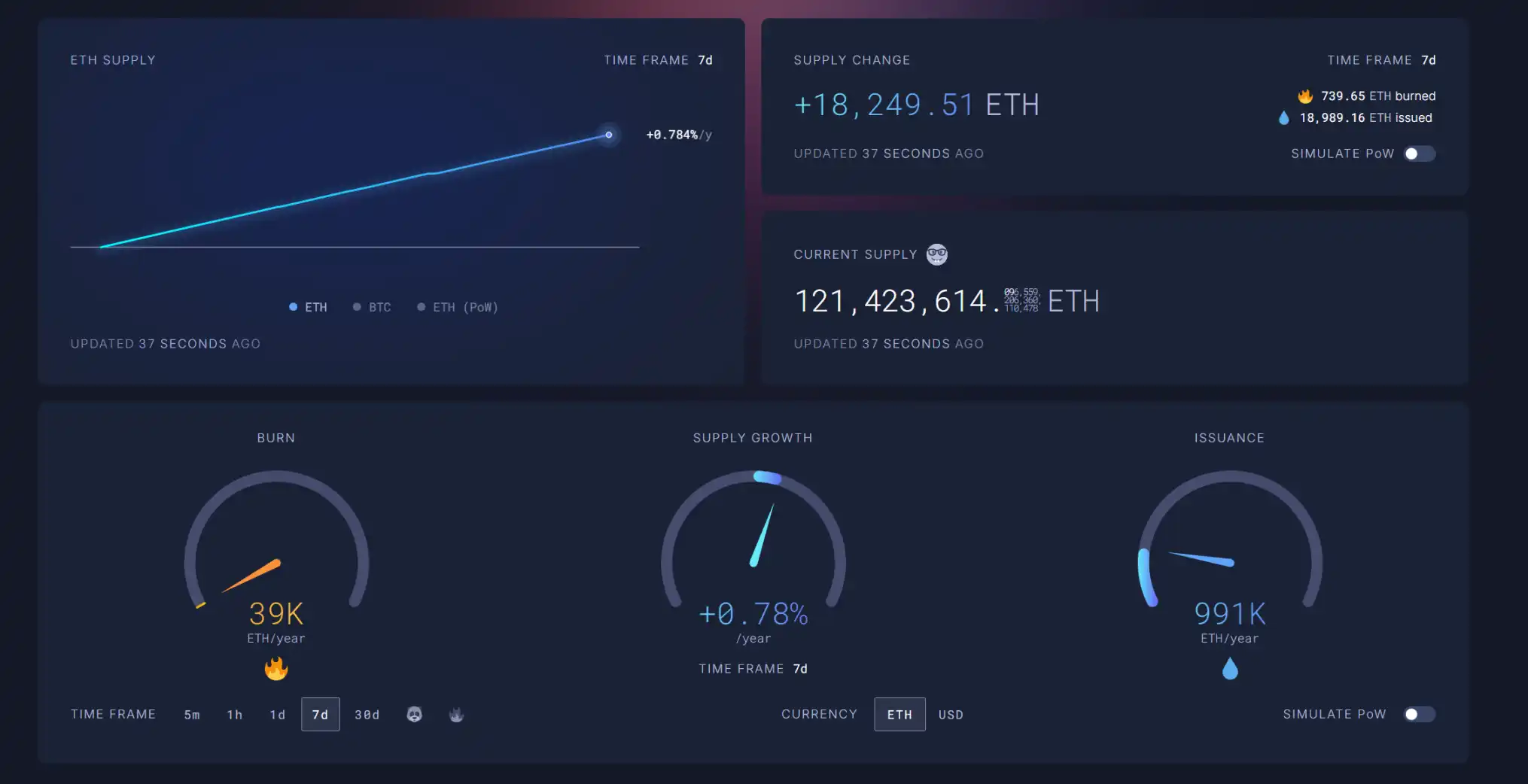
Source:ultra sound money

More notably, even as ETH broke below $3000 last week during the accelerating market collapse, BitMine chose to add positions against the trend, buying an additional 41,787 ETH (approx. $108 million) at around $2601, showing steadfast holding conviction.

But the problem随之而来—cost. Conviction has a price. BitMine's average ETH holding cost is approximately $3837, meaning that after ETH fell to around $2350, its paper losses have widened to about $6.4 billion.

This extremely aggressive "coin-based" transformation has also上演了一场极其癫狂的估值博弈 in the US stock secondary market.

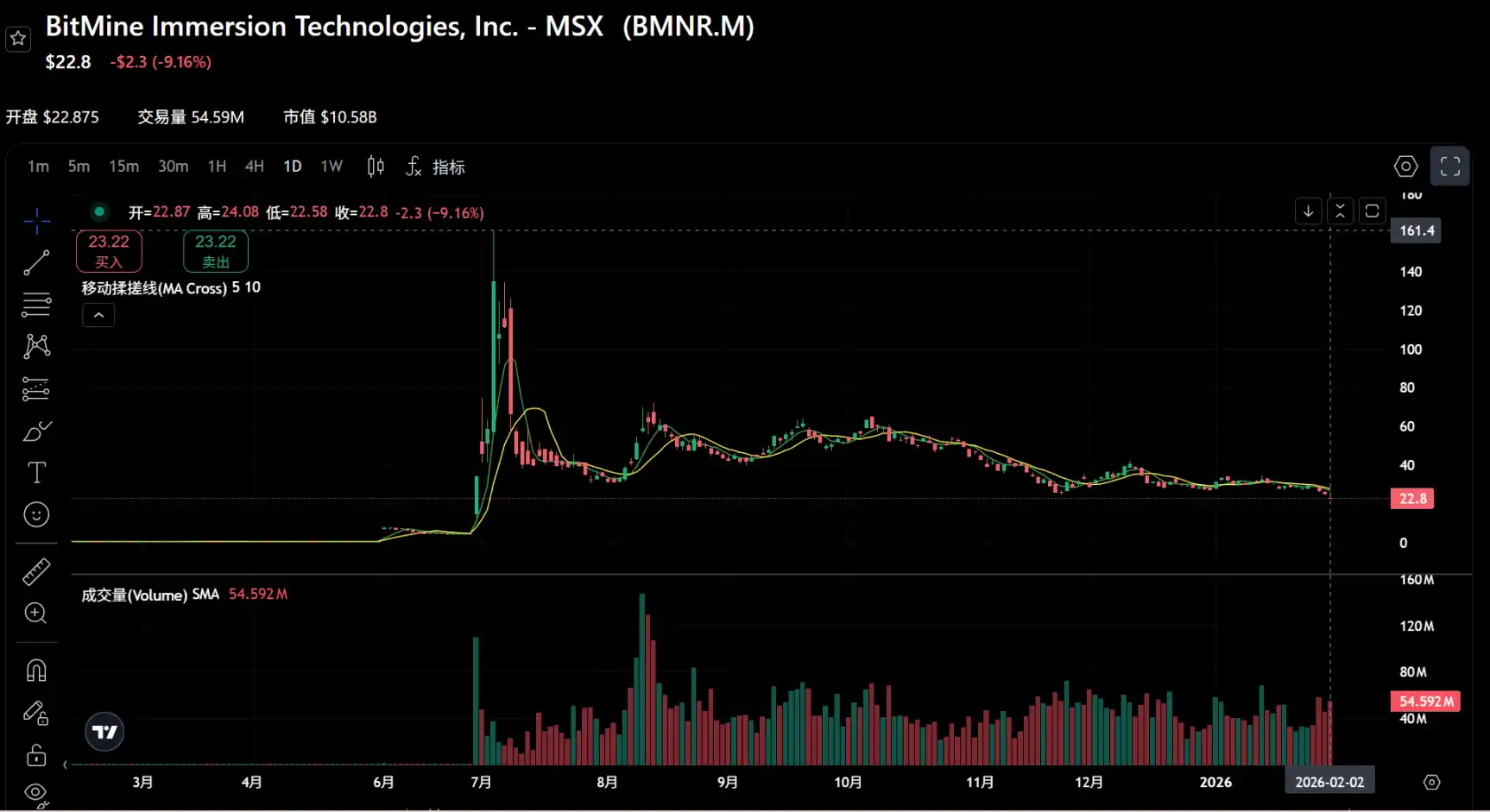
Looking back to July 2025, when BitMine first began disclosing its Ethereum acquisition strategy, its stock price (BMNR.M) hovered around $4. Subsequently, the stock price completed a leap from the floor to heaven within half a year, reaching a high of $161, becoming the most dazzling "Ethereum shadow stock" in the global capital markets.

However, succeed with Ethereum, fail with Ethereum. As the ETH price deeply retraced, the premium bubble of BitMine's stock price rapidly burst, and it has now plummeted to $22.8.
If BitMine represents the long-term spot path of trading time for space, then Jack Yi's Trend Research chose another, significantly riskier road.

Since November 2025, Trend Research has旗帜鲜明地 publicly gone long on ETH on-chain. Its core strategy is a typical "staking-borrowing-buying-restaking-borrowing" loop:

  • Stake held ETH into the on-chain lending protocol Aave;
  • Borrow the stablecoin USDT;
  • Use the USDT to buy more ETH;
  • Continuously循环 to amplify long exposure;

The actual logic of this operation is not complicated; it essentially uses existing ETH as collateral to borrow funds to buy more ETH, betting on leveraged gains during price increase.

This is undoubtedly a highly lethal strategy in a favorable market, but the risk stems precisely from this. Once the ETH price falls, the collateral value shrinks, the lending protocol will require additional margin, otherwise it will trigger forced liquidation, selling ETH at market price to repay the debt.

So when ETH plummeted from around $3000 to a low of approximately $2150 in just 5 days, this mechanism was forced into a "stress state." The chain随即呈现出一种颇具戏剧性的 "death by a thousand cuts"奇景:

To prevent positions from being forcibly liquidated, Trend Research continuously transferred ETH to exchanges, sold it for USDT, and then deposited the USDT back into Aave to repay loans, barely lowering the liquidation line and buying breathing room.

As of February 2nd, Trend Research had deposited 73,588 ETH (worth approx. $169 million) in multiple transactions to Binance for sale and loan repayment. The total loss on its ETH borrowing positions reached $613 million, including realized losses of $47.42 million and floating losses of $565 million. It currently still carries stablecoin leverage loans of approximately $897 million.

Especially during ETH's rapid descent through the $2300-$2150 range, the entire network was almost watching this "stop-loss survival" drama unfold in real-time—every ETH sold by Trend Research was both buying itself survival space and inadvertently handing new selling pressure to the market, tightening the noose around its own neck.

In other words, Trend Research almost killed itself.
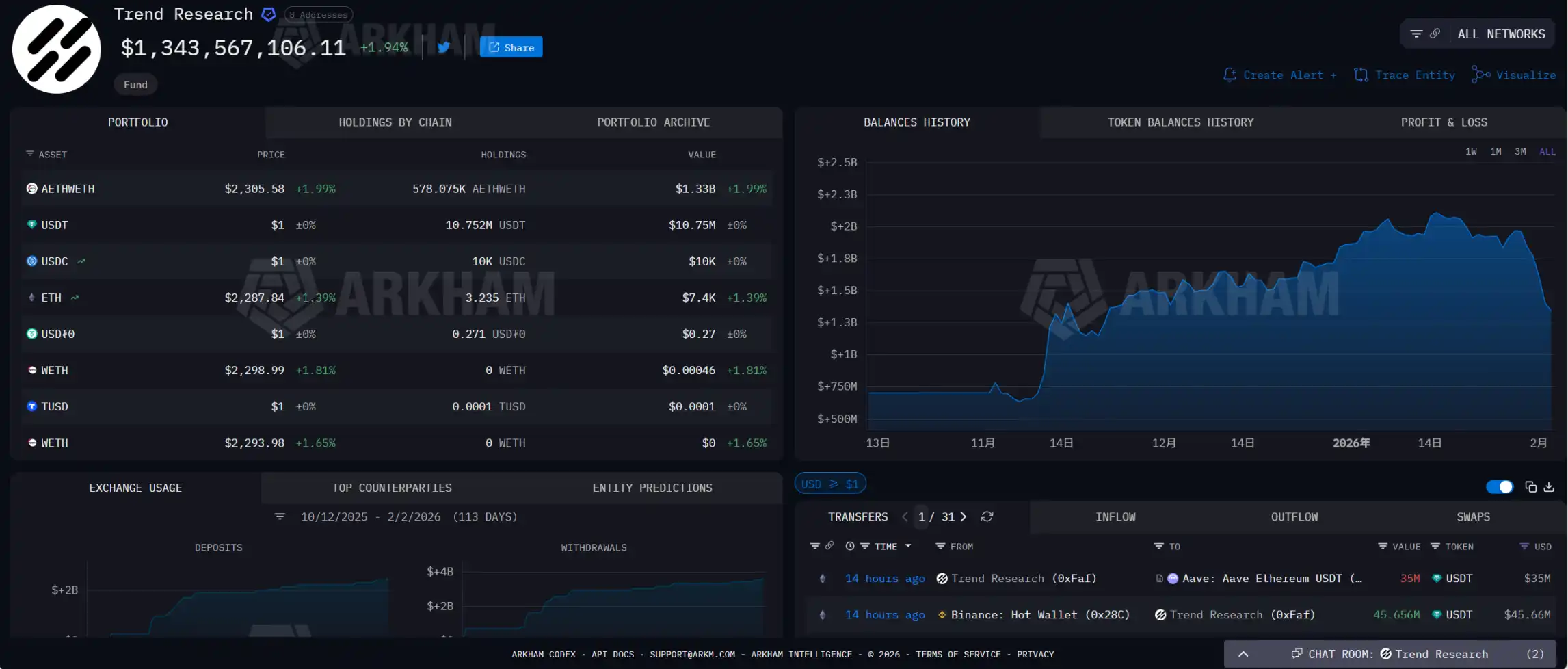
Source:Arkham

II. The 'Fire and Ice' Dichotomy Between On-Chain and Off-Chain

The吊诡 thing is, if we temporarily step back from the whales' tens of billions in paper losses and look at Ethereum from an on-chain structure rather than price itself, we find a reality almost opposite to secondary market sentiment—ETH on-chain is持续走热.

The Block statistics show that approximately 36.6 million ETH are currently staked on the Ethereum Beacon Chain, exceeding 30% of the network's circulating supply, hitting a new historical high.

Note that the previous staking rate record was 29.54%, set in July 2025. This round marks the first time Ethereum's staking rate has substantially crossed the 30% threshold since entering the PoS era.
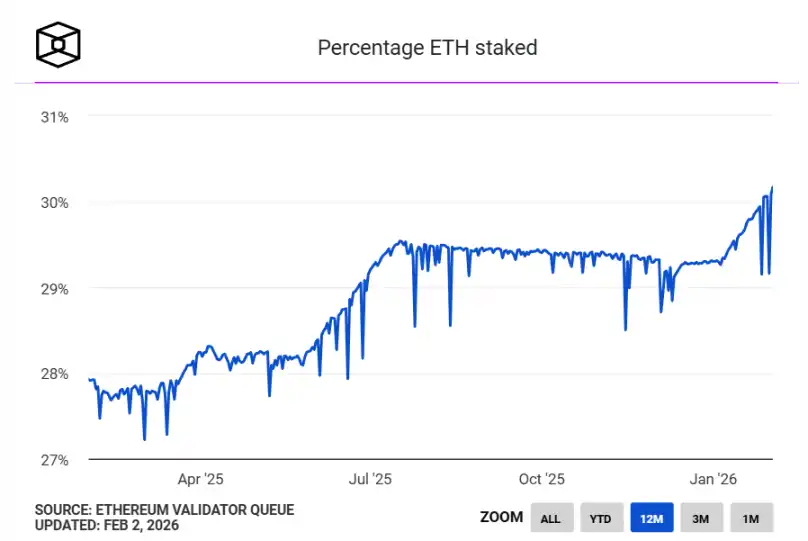
Source:The Block

From a financial supply and demand structure perspective, this change is highly significant.

A large amount of ETH being staked means it has actively exited the free流通 market,剧烈转型 from a "speculative currency" used for high-frequency trading and speculation into an "interest-bearing bond" with productive properties. In other words, ETH is no longer just Gas, a medium of exchange, or a speculative tool, but is increasingly扮演一种 "means of production" role—participating in network operation through staking and continuously generating yield.

Of course, heavyweight players like BitMine are part of this—BitMine has staked nearly 70% of its held ETH (approx. 2,897,459 coins) and is continuously adding more.

Simultaneously, the validator queue has seen微妙的变化. The exit queue is nearly empty, while the entry queue for staking continues to lengthen, with over 4.08 million ETH排队等待 "entering." In short, the current state is "exiting is smooth, but entering requires a 7-day wait."

This queue size has set a new high since the launch of Ethereum's PoS staking mechanism. And from a time dimension, the steep rise of this curve恰恰始于 December 2025.

This also coincides with the beginning of Trend Research's openly aggressive long positioning on ETH.
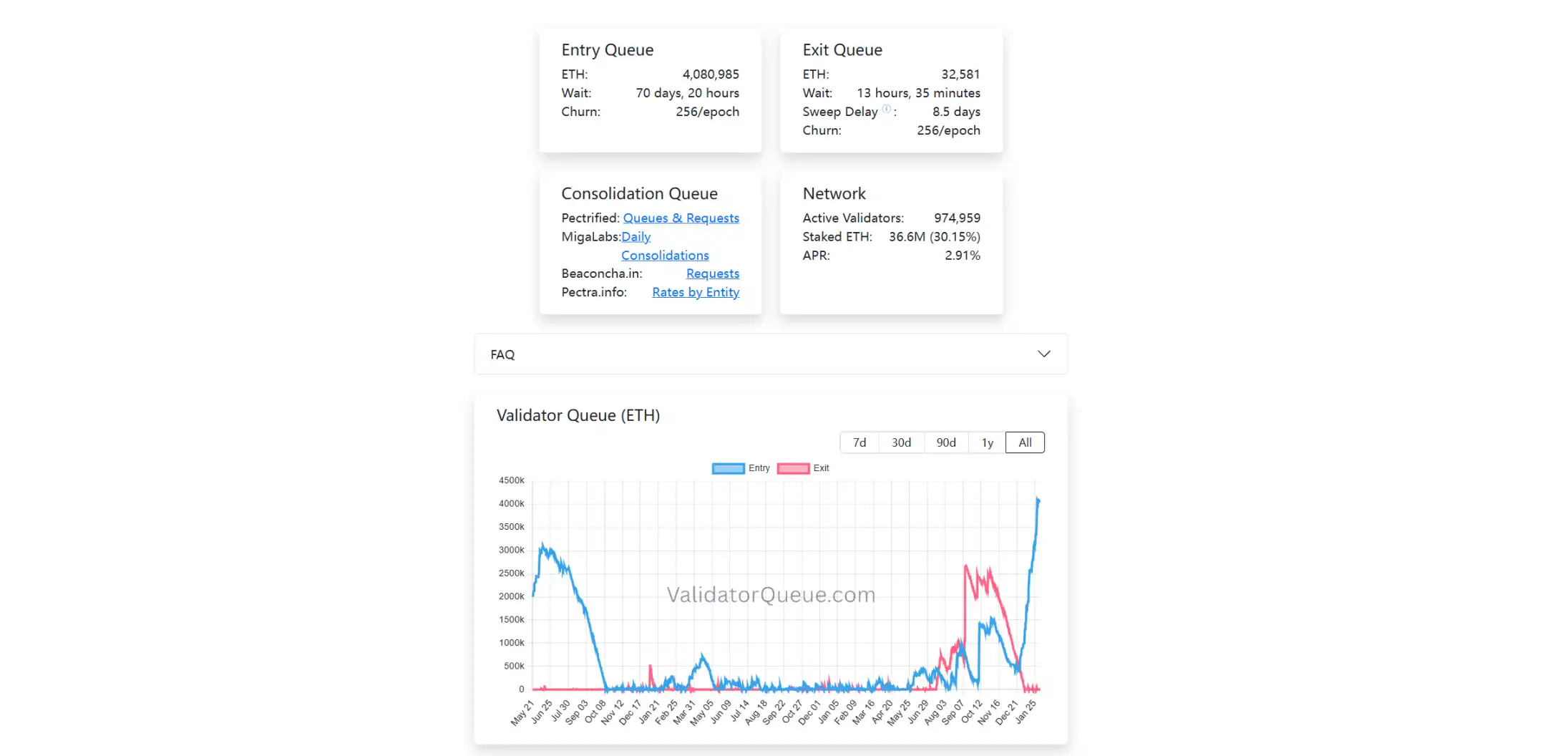
Source:Ethereum Validator Queue

It's important to emphasize that, unlike trading, staking is a low-liquidity, long-cycle配置方式 emphasizing stable returns. After all, once funds enter the staking queue, they意味着 giving up the possibility of flexible position adjustment and short-term speculation for a considerable time.

Therefore, as more and more ETH chooses to re-enter the staking system, it at least sends a clear signal: at the current stage, more and more participants are willing to accept long-term locking,主动承担 opportunity costs, in exchange for确定性 on-chain收益.

Thus, a highly tense structural picture emerges. On one side, nearly 1/3 of ETH is being continuously "hoarded," with源源不断的 ETH waiting off-field to be locked up; on the other side, secondary market liquidity is tightening, prices are under持续 pressure, whales are forced to stop losses, and positions are frequently exposed.

This clear divergence between on-chain and off-chain constitutes the most vivid "fire and ice" picture in the current Ethereum ecosystem.

III. The Openly Declared 'Whale,' Already on the Menu?

In traditional financial games, the cards are often not公开透明的. Things like position size, cost basis, leverage ratio, etc., can be hidden within tools like derivatives, OTC protocols, leveraging information asymmetry.

But on-chain, every transfer, every抵押, every liquidation line of a whale is exposed 24/7 to the entire market's view. Once you choose to openly declare a long position, you easily fall into a体力消耗战 of "proving Murphy's Law."

So from a game theory perspective, although Tom Lee and Jack Yi are both bulls and both have declared their hands, they stand at opposite ends of the risk curve.

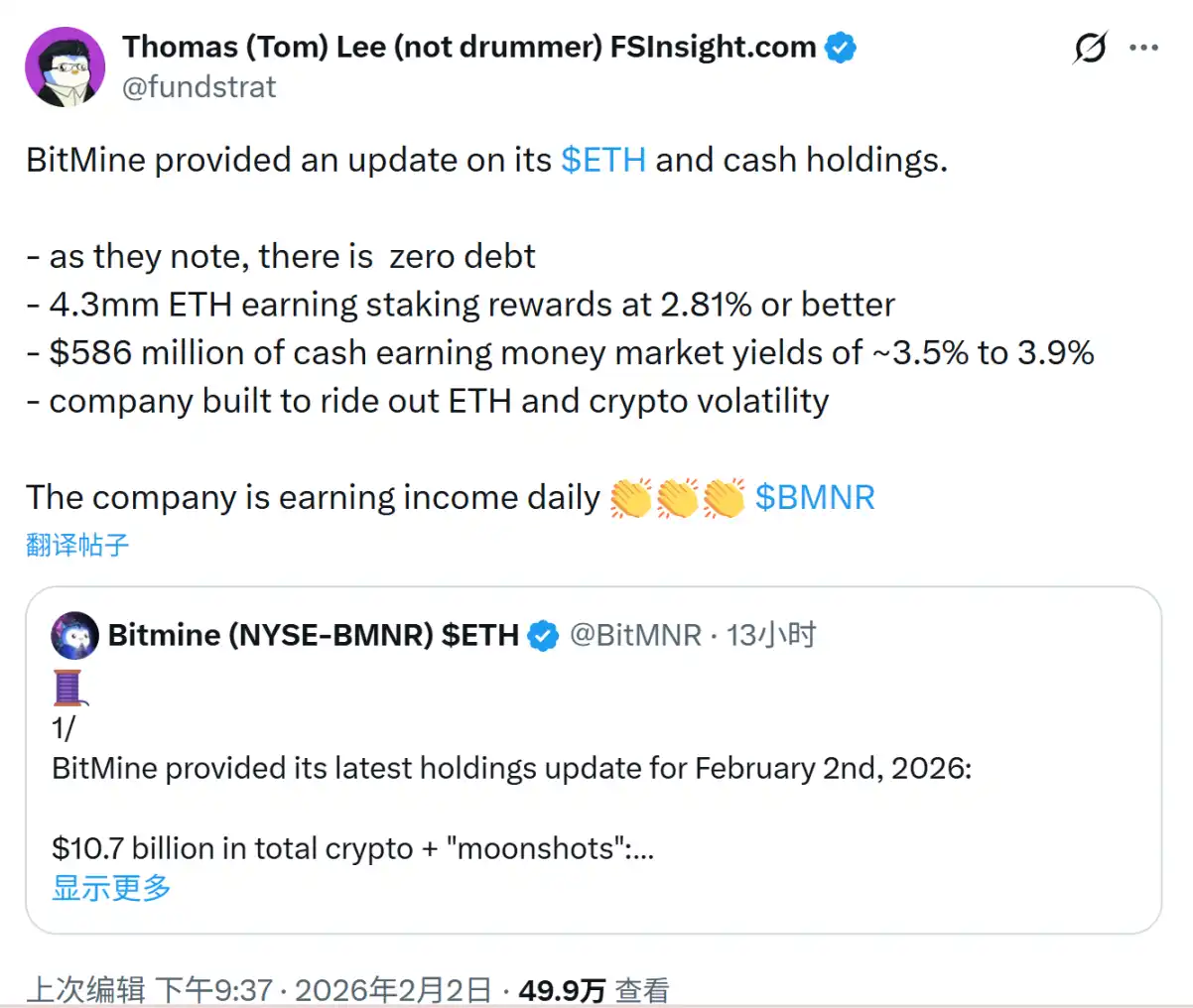
Tom Lee, despite a $6.4 billion paper loss, BitMine chose a "low leverage, high staking, zero debt" spot path. As long as no structural risk is triggered, he can choose to hold (HODL) within the time window, letting staking收益 slowly hedge the volatility.

The facts are indeed so. Contrary to most market imaginations, BitMine's structure is not激进. As Tom Lee emphasized in a social media post on February 2nd: They have $586 million in cash reserves, and 67% of their ETH is staked, generating over $1 million in daily cash flow. For him, the drop is just a缩水 of paper numbers, not the降临 of a survival crisis.
Jack Yi, however, added leverage through Aave's循环贷, thus陷入 the negative loop of "price drop - approach liquidation line - transfer ETH to sell - add margin - price drops again." This is like a全网围观 "performance art."

The shorts don't necessarily need to liquidate you; they just need to suppress the price → force position reduction → create passive selling pressure → trigger follow-on selling to complete a structural hunt.

This is why every repayment, every transfer by Trend Research is放大解读 as a sign of Jack Yi's confidence waning, whether he is about to capitulate. As of writing, Trend Research has stop-loss sold 73,588 ETH (worth approx. $169 million), and the liquidation price for its borrowing positions has been lowered to below $1800.

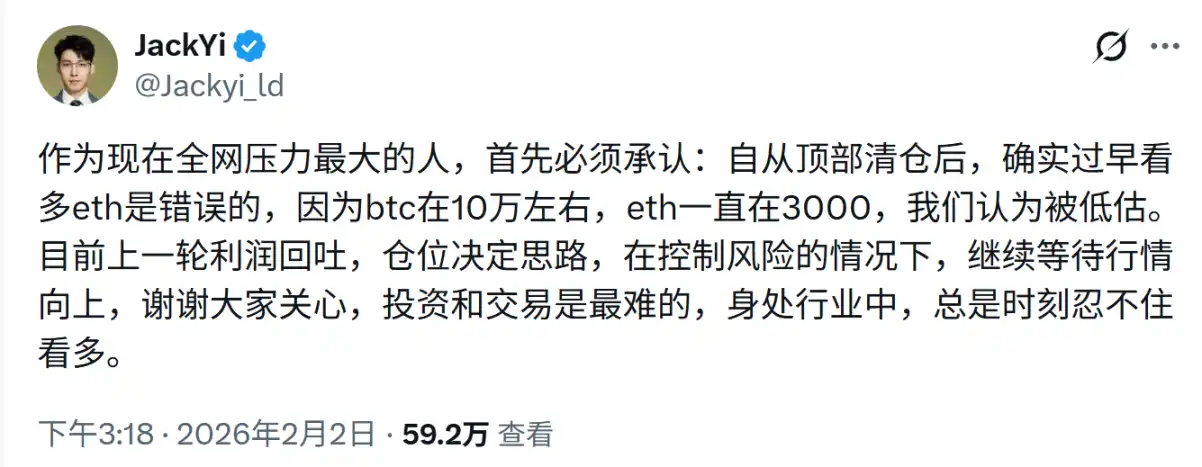
On the same day Tom Lee posted, Jack Yi also publicly reflected: As the person under the most pressure on the entire network right now, I must first admit that being bullish on ETH too early was a mistake... Currently, the profits from the last round have been given back. While controlling risk, I will wait for the market to move upward.
Ultimately, using on-chain循环贷 to go long is equivalent to laying your cards open for everyone to see. Whether there is truly organized targeted killing or not, when you publicize your position size, cost, leverage ratio, and liquidation line on-chain, you have already placed yourself on the sniper list of all共振 forces in the market.

Of course, to some extent, this is also a form of path dependency. After all, in April 2025, Jack Yi publicly called for going long on ETH when it fell to $1450, continuously added positions, and ultimately welcomed a rebound and profits, once becoming a "spiritual banner" for ETH bulls.

It's just that this time, the story's direction remains unknown, and Tom Lee's chances of winning are clearly greater.

In Conclusion

From Three Arrows Capital to FTX, to the now publicly spectated BitMine, the script never changes: all collapses begin with excessive arrogance regarding long-term certainty.

As Keynes's overused quote goes: "In the long run, we are all dead." Jack Yi's mistake was not in being long-term bullish on Ethereum, but in underestimating the残忍程度 of the market in its short-term irrational phases. From the moment he chose to openly add leverage, he had already sacrificed himself to this transparent algorithmic world.

But looking at it from another angle, this might be a necessary "great cleansing" for Ethereum. Every cycle needs such a whale fall process: whales being围观, leverage being squeezed out, path dependency being shattered,筹码重新分布.

Only after the necessary losses are stopped, and the necessary holding out is finished, can it truly advance lightly.


Preguntas relacionadas

QWhat is the main reason why Trend Research (led by Jack Yi) is facing significant pressure and public scrutiny?

ATrend Research is under significant pressure because it used a high-leverage strategy (recursive borrowing on Aave) to long ETH publicly on-chain. As ETH's price fell sharply, it neared liquidation levels, forcing them to sell ETH to repay loans and avoid being liquidated, creating a negative feedback loop of selling pressure and public scrutiny.

QHow does BitMine's approach to holding ETH differ fundamentally from Trend Research's strategy?

ABitMine holds a massive amount of ETH (over 4.2 million coins) as a long-term treasury asset with low leverage, high staking participation, and zero debt, allowing it to weather price volatility. In contrast, Trend Research uses a high-leverage, debt-fueled strategy on Aave, making it vulnerable to liquidations during price declines.

QWhat paradoxical on-chain data is presented in the article that contrasts with the negative price action of ETH?

ADespite the price decline, a record high of over 30% of ETH's circulating supply (more than 36.6 million ETH) is now staked on the Beacon Chain, indicating strong long-term conviction and a shift of ETH from a speculative asset to a productive, yield-generating one.

QAccording to the article, what is a key risk of making a large, public, leveraged long position on a transparent ledger like a blockchain?

AThe key risk is that your entire strategy—including position size, cost basis, leverage ratio, and liquidation price—is visible to everyone. This transparency makes you a target for market forces and potential 'sniping,' as others can trade against your known vulnerabilities.

QWhat financial metric does Tom Lee cite to demonstrate BitMine's resilience despite its massive paper losses on its ETH holdings?

ATom Lee cited that BitMine holds $586 million in cash reserves and that 67% of its ETH is staked, generating over $1 million in daily cash flow, providing a buffer against market volatility and allowing them to hold long-term.

Lecturas Relacionadas

Trading

Spot
Futuros

Artículos destacados

Qué es ETH 2.0

ETH 2.0: Una Nueva Era para Ethereum Introducción ETH 2.0, conocido ampliamente como Ethereum 2.0, marca una actualización monumental para la blockchain de Ethereum. Esta transición no es solo una mejora superficial; busca mejorar fundamentalmente la escalabilidad, seguridad y sostenibilidad de la red. Con un cambio del mecanismo de consenso intensivo en energía Prueba de Trabajo (PoW) a una Prueba de Participación (PoS) más eficiente, ETH 2.0 promete un enfoque transformador para el ecosistema blockchain. ¿Qué es ETH 2.0? ETH 2.0 es un conjunto de actualizaciones interconectadas y distintivas centradas en optimizar las capacidades y el rendimiento de Ethereum. La reestructuración está diseñada para abordar desafíos críticos que el mecanismo actual de Ethereum ha enfrentado, particularmente en lo que respecta a la velocidad de transacción y la congestión de la red. Objetivos de ETH 2.0 Los objetivos principales de ETH 2.0 giran en torno a mejorar tres aspectos clave: Escalabilidad: Con el objetivo de aumentar significativamente el número de transacciones que la red puede manejar por segundo, ETH 2.0 busca superar la limitación actual de aproximadamente 15 transacciones por segundo, potencialmente alcanzando miles. Seguridad: Las medidas de seguridad mejoradas son fundamentales para ETH 2.0, particularmente a través de una mejor resistencia contra ciberataques y la preservación del ethos descentralizado de Ethereum. Sostenibilidad: El nuevo mecanismo PoS está diseñado no solo para mejorar la eficiencia, sino también para reducir drásticamente el consumo de energía, alineando el marco operativo de Ethereum con consideraciones ambientales. ¿Quién es el Creador de ETH 2.0? La creación de ETH 2.0 se puede atribuir a la Fundación Ethereum. Esta organización sin fines de lucro, que desempeña un papel crucial en el apoyo al desarrollo de Ethereum, es liderada por el notable cofundador Vitalik Buterin. Su visión de un Ethereum más escalable y sostenible ha sido la fuerza motriz detrás de esta actualización, involucrando contribuciones de una comunidad global de desarrolladores y entusiastas dedicados a mejorar el protocolo. ¿Quiénes son los Inversores de ETH 2.0? Si bien los detalles sobre los inversores de ETH 2.0 no se han hecho públicos, se sabe que la Fundación Ethereum recibe apoyo de varias organizaciones e individuos en el ámbito de blockchain y tecnología. Estos socios incluyen firmas de capital de riesgo, compañías tecnológicas y organizaciones filantrópicas que comparten un interés mutuo en apoyar el desarrollo de tecnologías descentralizadas e infraestructura blockchain. ¿Cómo Funciona ETH 2.0? ETH 2.0 se distingue por introducir una serie de características clave que lo diferencian de su predecesor. Prueba de Participación (PoS) La transición a un mecanismo de consenso PoS es uno de los cambios más destacados de ETH 2.0. A diferencia de PoW, que se basa en la minería intensiva en energía para la verificación de transacciones, PoS permite a los usuarios validar transacciones y crear nuevos bloques de acuerdo con la cantidad de ETH que apuestan en la red. Esto conduce a una mayor eficiencia energética, reduciendo el consumo en aproximadamente un 99.95%, convirtiendo a Ethereum 2.0 en una alternativa considerablemente más verde. Cadenas Shard Las cadenas shard son otra innovación crítica de ETH 2.0. Estas cadenas más pequeñas operan en paralelo con la cadena principal de Ethereum, lo que permite que múltiples transacciones sean procesadas simultáneamente. Este enfoque mejora la capacidad general de la red, abordando las preocupaciones de escalabilidad que han afectado a Ethereum. Cadena Beacon En el núcleo de ETH 2.0 se encuentra la Cadena Beacon, que coordina la red y gestiona el protocolo PoS. Funciona como un organizador de cierta manera: supervisa a los validadores, asegura que los shards permanezcan conectados a la red y monitorea la salud general del ecosistema blockchain. Cronología de ETH 2.0 El viaje de ETH 2.0 ha estado marcado por varios hitos clave que trazan la evolución de esta importante actualización: Diciembre 2020: El lanzamiento de la Cadena Beacon marcó la introducción de PoS, preparándose para la migración hacia ETH 2.0. Septiembre 2022: La finalización de “La Fusión” representa un momento crucial en el que la red Ethereum se trasladó exitosamente de un marco PoW a uno PoS, anunciando una nueva era para Ethereum. 2023: El lanzamiento esperado de cadenas shard tiene como objetivo mejorar aún más la escalabilidad de la red Ethereum, consolidando a ETH 2.0 como una plataforma robusta para aplicaciones y servicios descentralizados. Características Clave y Beneficios Escalabilidad Mejorada Una de las ventajas más significativas de ETH 2.0 es su escalabilidad mejorada. La combinación de PoS y cadenas shard permite que la red expanda su capacidad, permitiendo acomodar un volumen mucho mayor de transacciones en comparación con el sistema heredado. Eficiencia Energética La implementación de PoS representa un gran paso hacia la eficiencia energética en la tecnología blockchain. Al reducir drásticamente el consumo de energía, ETH 2.0 no solo disminuye los costos operativos, sino que también se alinea más estrechamente con los objetivos de sostenibilidad global. Seguridad Mejorada Los mecanismos actualizados de ETH 2.0 contribuyen a mejorar la seguridad en toda la red. El despliegue de PoS, junto con las medidas de control innovadoras establecidas a través de cadenas shard y la Cadena Beacon, asegura un mayor grado de protección contra posibles amenazas. Costos Más Bajos para los Usuarios A medida que la escalabilidad mejora, los efectos sobre los costos de transacción también serán evidentes. Se espera que una mayor capacidad y una menor congestión se traduzcan en tarifas más bajas para los usuarios, haciendo que Ethereum sea más accesible para transacciones cotidianas. Conclusión ETH 2.0 marca una evolución significativa en el ecosistema blockchain de Ethereum. A medida que aborda problemas fundamentales como la escalabilidad, el consumo de energía, la eficiencia en las transacciones y la seguridad general, la importancia de esta actualización no puede ser subestimada. La transición a la Prueba de Participación, la introducción de cadenas shard y el trabajo fundamental de la Cadena Beacon son indicativos de un futuro donde Ethereum puede satisfacer las crecientes demandas del mercado descentralizado. En una industria impulsada por la innovación y el progreso, ETH 2.0 se erige como un testimonio de las capacidades de la tecnología blockchain para allanar el camino hacia una economía digital más sostenible y eficiente.

166 Vistas totalesPublicado en 2024.04.04Actualizado en 2024.12.03

Qué es ETH 2.0

Qué es ETH 3.0

ETH3.0 y $eth 3.0: Un Examen Profundo del Futuro de Ethereum Introducción En el paisaje en rápida evolución de las criptomonedas y la tecnología blockchain, ETH3.0, a menudo denotado como $eth 3.0, ha surgido como un tema de considerable interés y especulación. El término abarca dos conceptos principales que merecen aclaración: Ethereum 3.0: Esto representa una posible actualización futura destinada a aumentar las capacidades de la blockchain existente de Ethereum, enfocándose particularmente en mejorar la escalabilidad y el rendimiento. ETH3.0 Meme Token: Este proyecto de criptomoneda distinto busca aprovechar la blockchain de Ethereum para crear un ecosistema centrado en memes, promoviendo la participación dentro de la comunidad de criptomonedas. Comprender estos aspectos de ETH3.0 es esencial no solo para los entusiastas de las criptomonedas, sino también para aquellos que observan tendencias tecnológicas más amplias en el espacio digital. ¿Qué es ETH3.0? Ethereum 3.0 Ethereum 3.0 se presenta como una actualización propuesta para la red de Ethereum ya establecida, que ha sido la columna vertebral de muchas aplicaciones descentralizadas (dApps) y contratos inteligentes desde su inicio. Las mejoras previstas se concentran principalmente en la escalabilidad, integrando tecnologías avanzadas como sharding y pruebas de conocimiento cero (zk-proofs). Estas innovaciones tecnológicas tienen como objetivo facilitar un número sin precedentes de transacciones por segundo (TPS), potencialmente alcanzando millones, abordando así una de las limitaciones más significativas que enfrenta la tecnología blockchain actual. La mejora no es meramente técnica, sino también estratégica; está destinada a preparar la red de Ethereum para su adopción generalizada y utilidad en un futuro marcado por una mayor demanda de soluciones descentralizadas. ETH3.0 Meme Token En contraste con Ethereum 3.0, el ETH3.0 Meme Token se aventura en un ámbito más ligero y juguetón al combinar la cultura de memes de internet con la dinámica de las criptomonedas. Este proyecto permite a los usuarios comprar, vender e intercambiar memes en la blockchain de Ethereum, proporcionando una plataforma que fomenta la participación comunitaria a través de la creatividad y los intereses compartidos. El ETH3.0 Meme Token tiene como objetivo demostrar cómo la tecnología blockchain puede intersectarse con la cultura digital, creando casos de uso que son tanto entretenidos como financieramente viables. ¿Quién es el Creador de ETH3.0? Ethereum 3.0 La iniciativa hacia Ethereum 3.0 es impulsada principalmente por un consorcio de desarrolladores e investigadores dentro de la comunidad de Ethereum, incluyendo notablemente a Justin Drake. Conocido por sus ideas y contribuciones a la evolución de Ethereum, Drake ha sido una figura prominente en las discusiones sobre la transición de Ethereum a una nueva capa de consenso, denominada “Beam Chain.” Este enfoque colaborativo para el desarrollo significa que Ethereum 3.0 no es el producto de un creador singular, sino más bien una manifestación de ingenio colectivo centrado en avanzar la tecnología blockchain. ETH3.0 Meme Token Los detalles sobre el creador del ETH3.0 Meme Token son actualmente inidentificables. La naturaleza de los tokens de memes a menudo conduce a una estructura más descentralizada y dirigida por la comunidad, lo que podría explicar la falta de atribución específica. Esto se alinea con la ética de la comunidad cripto más amplia, donde la innovación a menudo surge de esfuerzos colaborativos en lugar de individuales. ¿Quiénes son los Inversores de ETH3.0? Ethereum 3.0 El apoyo a Ethereum 3.0 proviene principalmente de la Fundación Ethereum junto con una entusiasta comunidad de desarrolladores e inversores. Esta asociación fundamental proporciona un grado significativo de legitimidad y mejora la perspectiva de una implementación exitosa, ya que aprovecha la confianza y credibilidad construidas a lo largo de años de operaciones en la red. En el clima cambiando rápidamente de las criptomonedas, el apoyo de la comunidad juega un papel crucial en impulsar el desarrollo y la adopción, posicionando a Ethereum 3.0 como un contendiente serio para futuros avances en blockchain. ETH3.0 Meme Token Si bien las fuentes actualmente disponibles no proporcionan información explícita sobre las fundaciones o organizaciones de inversión que respaldan el ETH3.0 Meme Token, es indicativo del modelo de financiamiento típico para tokens de memes, que a menudo depende del apoyo de base y la participación comunitaria. Los inversores en tales proyectos suelen consistir en individuos motivados por el potencial de innovación impulsada por la comunidad y el espíritu de cooperación que se encuentra dentro de la comunidad cripto. ¿Cómo Funciona ETH3.0? Ethereum 3.0 Las características distintivas de Ethereum 3.0 radican en su implementación propuesta de sharding y tecnología zk-proof. Sharding es un método de particionamiento de la blockchain en piezas más pequeñas y manejables o “shards,” que pueden procesar transacciones de manera concurrente en lugar de secuencial. Esta descentralización del procesamiento ayuda a prevenir la congestión y asegura que la red permanezca receptiva incluso bajo una carga pesada. La tecnología de prueba de conocimiento cero (zk-proof) contribuye con otra capa de sofisticación al permitir la validación de transacciones sin revelar los datos subyacentes involucrados. Este aspecto no solo mejora la privacidad, sino que también aumenta la eficiencia general de la red. También se habla de incorporar una Máquina Virtual de Ethereum de conocimiento cero (zkEVM) en esta actualización, amplificando aún más las capacidades y utilidad de la red. ETH3.0 Meme Token El ETH3.0 Meme Token se distingue al capitalizar la popularidad de la cultura de memes. Establece un mercado para que los usuarios participen en el comercio de memes, no solo por entretenimiento sino también por el posible beneficio económico. Al integrar características como staking, provisión de liquidez y mecanismos de gobernanza, el proyecto fomenta un entorno que incentiva la interacción y participación de la comunidad. Al ofrecer una mezcla única de entretenimiento y oportunidad económica, el ETH3.0 Meme Token tiene como objetivo atraer a una audiencia diversa, que abarca desde entusiastas de las criptomonedas hasta conocedores casuales de memes. Línea de Tiempo de ETH3.0 Ethereum 3.0 11 de noviembre de 2024: Justin Drake insinúa la próxima actualización de ETH 3.0, centrada en mejoras de escalabilidad. Este anuncio significa el comienzo de las discusiones formales sobre la futura arquitectura de Ethereum. 12 de noviembre de 2024: Se espera que la propuesta anticipada para Ethereum 3.0 se desvele en Devcon en Bangkok, preparando el escenario para una mayor retroalimentación de la comunidad y posibles próximos pasos en el desarrollo. ETH3.0 Meme Token 21 de marzo de 2024: El ETH3.0 Meme Token se lista oficialmente en CoinMarketCap, marcando su incursión en el dominio público de las criptomonedas y mejorando la visibilidad de su ecosistema basado en memes. Puntos Clave En conclusión, Ethereum 3.0 representa una evolución significativa dentro de la red de Ethereum, enfocándose en superar las limitaciones en términos de escalabilidad y rendimiento a través de tecnologías avanzadas. Sus actualizaciones propuestas reflejan un enfoque proactivo hacia las demandas y la usabilidad futura. Por otro lado, el ETH3.0 Meme Token encapsula la esencia de la cultura impulsada por la comunidad en el espacio de las criptomonedas, aprovechando la cultura de memes para crear plataformas atractivas que fomentan la creatividad y participación del usuario. Comprender los distintos propósitos y funcionalidades de ETH3.0 y $eth 3.0 es fundamental para cualquiera interesado en los desarrollos en curso dentro del espacio cripto. Con ambas iniciativas abriendo caminos únicos, subrayan colectivamente la naturaleza dinámica y multifacética de la innovación en blockchain.

178 Vistas totalesPublicado en 2024.04.04Actualizado en 2024.12.03

Qué es ETH 3.0

Cómo comprar ETH

¡Bienvenido a HTX.com! Hemos hecho que comprar Ethereum (ETH) sea simple y conveniente. Sigue nuestra guía paso a paso para iniciar tu viaje de criptos.Paso 1: crea tu cuenta HTXUtiliza tu correo electrónico o número de teléfono para registrarte y obtener una cuenta gratuita en HTX. Experimenta un proceso de registro sin complicaciones y desbloquea todas las funciones.Obtener mi cuentaPaso 2: ve a Comprar cripto y elige tu método de pagoTarjeta de crédito/débito: usa tu Visa o Mastercard para comprar Ethereum (ETH) al instante.Saldo: utiliza fondos del saldo de tu cuenta HTX para tradear sin problemas.Terceros: hemos agregado métodos de pago populares como Google Pay y Apple Pay para mejorar la comodidad.P2P: tradear directamente con otros usuarios en HTX.Over-the-Counter (OTC): ofrecemos servicios personalizados y tipos de cambio competitivos para los traders.Paso 3: guarda tu Ethereum (ETH)Después de comprar tu Ethereum (ETH), guárdalo en tu cuenta HTX. Alternativamente, puedes enviarlo a otro lugar mediante transferencia blockchain o utilizarlo para tradear otras criptomonedas.Paso 4: tradear Ethereum (ETH)Tradear fácilmente con Ethereum (ETH) en HTX's mercado spot. Simplemente accede a tu cuenta, selecciona tu par de trading, ejecuta tus trades y monitorea en tiempo real. Ofrecemos una experiencia fácil de usar tanto para principiantes como para traders experimentados.

4.0k Vistas totalesPublicado en 2024.12.10Actualizado en 2025.03.21

Cómo comprar ETH

Discusiones

Bienvenido a la comunidad de HTX. Aquí puedes mantenerte informado sobre los últimos desarrollos de la plataforma y acceder a análisis profesionales del mercado. A continuación se presentan las opiniones de los usuarios sobre el precio de ETH (ETH).

活动图片













