How To Play The Bitcoin 4-Year Cycle For The Most Gains In The Bull Market

bitcoinistPublicado a 2026-05-25Actualizado a 2026-05-25

Resumen

A crypto analyst argues that Bitcoin's four-year cycle is still active, despite recent market debates suggesting it may be over. By examining past cycles from 2011-2014, 2015-2018, and 2019-2022, the analyst identifies a consistent pattern: a "Buy" year with declining prices, a "Hold" year of rising prices, a "Sell" year near the peak, and a final "Bear" year of market crash. The analyst applies this model to the current cycle, positioning 2023 as the Buy phase, 2024 as Hold, 2025 as Sell, and 2026 as the ongoing Bear phase, explaining Bitcoin's recent sideways and declining price action. Looking ahead, the analyst predicts the 2027-2030 cycle will follow the same pattern, with the next major accumulation opportunity potentially arriving in 2027. The conclusion is that the four-year cycle structure remains intact and is playing out as expected.

A crypto analyst is raising questions over whether the famous four-year cycle theory that has governed Bitcoin’s (BTC) market trajectory in the past is now dead. The expert has shared BTC’s price movements and investor trends to prove that the cycle theory is still very much alive and playing out in the current market cycle.

Analyst Says Bitcoin’s 4-Year Cycle Is Still Active

In an X post on May 23, Mags, a crypto analyst, has raised concerns about whether “the 4-year cycle is over” for Bitcoin. This debate has been spreading across the market for months now, with some experts, such as Strategy CEO Michael Saylor, stating that the four-year cycle has ended, while others believe it is still active.

Many crypto community members, in response to Mags’ post, also compared this cycle to past ones. They noted that the current BTC market is markedly different from previous cycles, due to the emergence of Spot ETFs, increased institutional flows, and broader adoption.

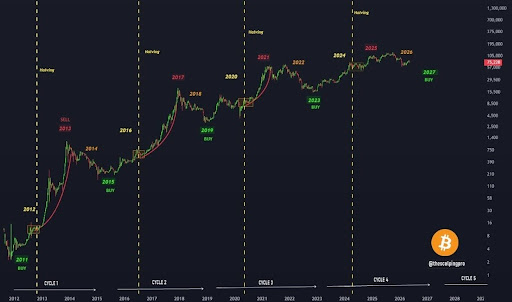
However, after examining and comparing these cycles himself, Mags noted that each one corresponds almost perfectly to the next. The analyst pointed to the 2011-2014 four-year cycle on his accompanying chart, highlighting how the market moved through distinct stages of investor activity and price movement during that period.
Source: Chart from Mags on X

In 2011, Bitcoin prices were declining, presenting a buying opportunity for investors. In the second year, Bitcoin began to rise, and investors simply held onto their tokens to allow them to grow. By 2013, prices had climbed to near peak levels, which the analyst noted was when most investors began selling their BTC. The fourth and final year of that cycle saw the market crash, and prices fall sharply. Mags described this as the bear market stage, marking the final stage before a fresh bull cycle began.

Notably, the same four-stage yearly trend was observed during the 2015-2018 and 2019-2022 cycles. Mags also stated that the cyclical theory is actively running in the current cycle, noting that Bitcoin has already moved through its Buy stage in 2023, Hold in 2024, and Sell phase in 2025. Based on this, Mags said that BTC is now in its bear market phase, coinciding with the cryptocurrency’s recent sideways movements and ongoing price declines.

What The Theory Says About The 2027-2030 Cycle

In his analysis, Mags went further to predict what the next cycle could look like after the current one ends. He suggested that the 2027-2030 cycle could follow a similar pattern, with Bitcoin potentially experiencing the same Buy, Hold, Sell, Bear market phases across each year.

He noted that if this structure holds, the next major accumulation window for investors and traders would arrive in 2027, a year ahead of the next anticipated bull run. Mags has pushed back against the speculation that the four-year cycle is dead, declaring that the structure “is still on track and everything is playing out perfectly.”


BTC trading at $77,435 on the 1D chart | Source: BTCUSDT on Tradingview.com

Criptos en tendencia

Preguntas relacionadas

QIs Bitcoin's 4-year cycle theory still active according to the crypto analyst Mags?

AYes, Mags states that the 4-year cycle theory is still active and is playing out perfectly in the current market cycle.

QWhat are the four distinct yearly stages described in the analyst's interpretation of the Bitcoin cycle?

AThe four distinct yearly stages are: Buy (Year 1 - price decline/buying opportunity), Hold (Year 2 - price rise/accumulation), Sell (Year 3 - near peak levels/most investors sell), and Bear Market (Year 4 - market crash/price decline).

QAccording to Mags' analysis, what phase is Bitcoin currently in within the 2023-2026 cycle?

AAccording to Mags, Bitcoin is currently in its Bear Market phase for the 2023-2026 cycle, coinciding with recent sideways movements and price declines.

QWhen does Mags predict the next major accumulation window for Bitcoin investors will occur?

AMags predicts the next major accumulation window for investors and traders will arrive in 2027.

QWhy are some in the crypto community debating if the 4-year cycle is over for Bitcoin?

ASome believe the current Bitcoin market is markedly different from past cycles due to factors like the emergence of Spot ETFs, increased institutional flows, and broader adoption, leading to the debate about the cycle's validity.

Lecturas Relacionadas

The Verdict in Choi Tae-won's Divorce Case: Revealing the Inheritance Undercurrent Behind SK Hynix's Trillion-Won Empire

SK Group Chairman Chey Tae-won's high-profile divorce case, involving a record 1.38 trillion won settlement, has drawn attention to the succession plans for Korea's second-largest conglomerate, especially its crown jewel, SK hynix. Unlike traditional chaebol scripts centered on the eldest son, Chey's three children from his marriage to former President Roh Tae-woo's daughter, Roh Soh-yeong, are carving distinct, non-traditional paths. Eldest daughter Chey Yun-jung (b. 1989) is seen as the most evident successor. With a scientific and consulting background, she holds executive roles at SK bioscience and SK Inc.'s growth support department, focusing on future strategy and biopharma. Her marriage is to an AI infrastructure entrepreneur, not a traditional business alliance. Second daughter Chey Min-jung (b. 1991) took a unique route, voluntarily serving as a South Korean naval officer, including an anti-piracy deployment. She later worked on policy and strategy for SK hynix in Washington D.C. before co-founding an AI-driven healthcare startup. She married a former U.S. Marine Corps officer, connecting her to U.S. defense and policy circles—networks crucial for a global semiconductor giant. The only son, Chey In-geun (b. 1995), who studied physics like his father, worked briefly at SK E&S before joining McKinsey. Despite fitting the traditional "heir" profile as the eldest son, he remains silent and holds no public position or shares in SK, suggesting the old succession playbook is obsolete. As SK hynix's valuation soars, becoming a geopolitical asset in the AI era, the heirs' legitimacy is no longer automatic. They must prove themselves in fields like AI biotech, global policy, and strategic consulting. Their marriages also reflect new elite networks in tech and defense, not old political alliances. Their inheritance is the complex challenge of navigating a globalized, tech-driven world, not just a corporate throne.

marsbitHace 6 hora(s)

The Verdict in Choi Tae-won's Divorce Case: Revealing the Inheritance Undercurrent Behind SK Hynix's Trillion-Won Empire

marsbitHace 6 hora(s)

From OpenSea to OpenRouter: Is Alex Atallah Repeating His 'Exit at the Peak' Playbook?

From OpenSea to OpenRouter: Is Alex Atallah Repeating His "Exit at the Peak" Playbook? According to the Wall Street Journal, payments giant Stripe is in talks to acquire the AI model aggregation platform OpenRouter in a potential deal valuing the company near $100 billion. This would mark founder Alex Atallah's second creation of a company reaching a $100 billion valuation, following his co-founding of NFT marketplace OpenSea. OpenRouter, founded just over three years ago, has grown rapidly by acting as a unified gateway for developers to access over 400 AI models. It currently has about 10 million users and processes over 200 trillion tokens monthly. While the platform's annualized revenue is around $50 million, its valuation has skyrocketed from $1.3 billion in March 2026. The potential acquisition by Stripe, a company OpenRouter's founder once likened it to, represents a major expansion into AI infrastructure for the payments leader. This move echoes Atallah's previous timing with OpenSea, where he departed before the NFT market's significant downturn. For OpenRouter, selling now may be strategic. Despite its scale, its business model—charging a 5-5.5% fee on AI inference calls—faces pressure from competition, open-source models, and potential price wars among model providers, limiting its profitability narrative for an IPO. A key asset for potential acquirers like Stripe is OpenRouter's vast repository of real-world AI usage data, which offers unique insights into model performance and developer preferences that are difficult to replicate. Whether this potential deal signifies a new valuation benchmark for AI infrastructure or another market peak signal remains to be seen.

链捕手Hace 7 hora(s)

From OpenSea to OpenRouter: Is Alex Atallah Repeating His 'Exit at the Peak' Playbook?

链捕手Hace 7 hora(s)

Trading

Spot

Artículos destacados

Cómo comprar 4

¡Bienvenido a HTX.com! Hemos hecho que comprar 4 (4) sea simple y conveniente. Sigue nuestra guía paso a paso para iniciar tu viaje de criptos.Paso 1: crea tu cuenta HTXUtiliza tu correo electrónico o número de teléfono para registrarte y obtener una cuenta gratuita en HTX. Experimenta un proceso de registro sin complicaciones y desbloquea todas las funciones.Obtener mi cuentaPaso 2: ve a Comprar cripto y elige tu método de pagoTarjeta de crédito/débito: usa tu Visa o Mastercard para comprar 4 (4) al instante.Saldo: utiliza fondos del saldo de tu cuenta HTX para tradear sin problemas.Terceros: hemos agregado métodos de pago populares como Google Pay y Apple Pay para mejorar la comodidad.P2P: tradear directamente con otros usuarios en HTX.Over-the-Counter (OTC): ofrecemos servicios personalizados y tipos de cambio competitivos para los traders.Paso 3: guarda tu 4 (4)Después de comprar tu 4 (4), guárdalo en tu cuenta HTX. Alternativamente, puedes enviarlo a otro lugar mediante transferencia blockchain o utilizarlo para tradear otras criptomonedas.Paso 4: tradear 4 (4)Tradear fácilmente con 4 (4) en HTX's mercado spot. Simplemente accede a tu cuenta, selecciona tu par de trading, ejecuta tus trades y monitorea en tiempo real. Ofrecemos una experiencia fácil de usar tanto para principiantes como para traders experimentados.

801 Vistas totalesPublicado en 2025.10.20Actualizado en 2026.06.02

Cómo comprar 4

Discusiones

Bienvenido a la comunidad de HTX. Aquí puedes mantenerte informado sobre los últimos desarrollos de la plataforma y acceder a análisis profesionales del mercado. A continuación se presentan las opiniones de los usuarios sobre el precio de 4 (4).

活动图片