How Much Longer Can Ethereum's Last Major Buyer Hold On?

链捕手Publicado a 2026-06-11Actualizado a 2026-06-11

Resumen

"The article analyzes the precarious position of Bitmine, currently the largest and most aggressive marginal buyer of Ethereum (ETH). Despite holding a massive position of approximately 5.66 million ETH (nearing its 5% supply target) and generating staking income, the company faces over $10 billion in unrealized losses due to a high average purchase price. With ETH prices depressed, its equity has plummeted nearly 90%. To sustain its buying spree, Bitmine recently issued $274 million in perpetual preferred shares with a 9.5% annual dividend. The core dilemma is whether staking yields (3-4%) can long-term support these high dividend obligations without significant ETH price appreciation. The article warns that once Bitmine achieves its 5% goal and potentially stops buying, the ETH market risks losing its key support pillar. Other institutional buyers, like ETH ETFs, have shown net outflows, while potential new demand from stablecoin legislation or RWA tokenization remains slow to materialize. The conclusion questions who will provide the next wave of sustained buying pressure to support ETH's price, highlighting a critical uncertainty for the asset's near-term trajectory."

As the crypto market continues to fall, BTC and ETH have once fallen to around $60,000 and $1,500, with both Strategy and Bitmine experiencing floating losses exceeding $10 billion. Just at the end of May, Strategy sold 32 BTC, breaking its long-standing narrative of not selling coins, marking the pressure testing phase for the model of financing purchases with debt.

Against this backdrop, Bitmine grandly announced the issuance of its Series A Perpetual Preferred Shares with a 9.5% annualized yield, raising approximately $274 million net. As of press time, Bitmine increased its holdings by 127,000 ETH last week and accumulated purchases of 125,000 ETH over the past three days. Its total holdings now stand at about 5.66 million ETH, less than 400,000 ETH away from its 5% target.

As the most persistent and aggressive marginal buyer of ETH in the current market, Bitmine continues to increase its holdings despite facing over ten billion dollars in unrealized losses. Now, even it needs to rely on preferred shares to replenish its flywheel. Once the financing market experiences changes and its coin-hoarding machine is forced to slow down, who will be left to support the price of Ethereum?

Reaching 5% Before Year-End, Then What?

Bitmine began accumulating ETH in the second half of last year, planning to complete its "5% Alchemy" plan within 5 years. Data shows that Bitmine raised $19.2 billion through 50 equity offerings between July 2025 and June 2026, with all funds used to purchase ETH.

As of press time, Bitmine's Ethereum holdings have reached approximately 5.66 million ETH, less than 400,000 ETH away from its 5% target, achieving over 90% of the plan's progress within a year.
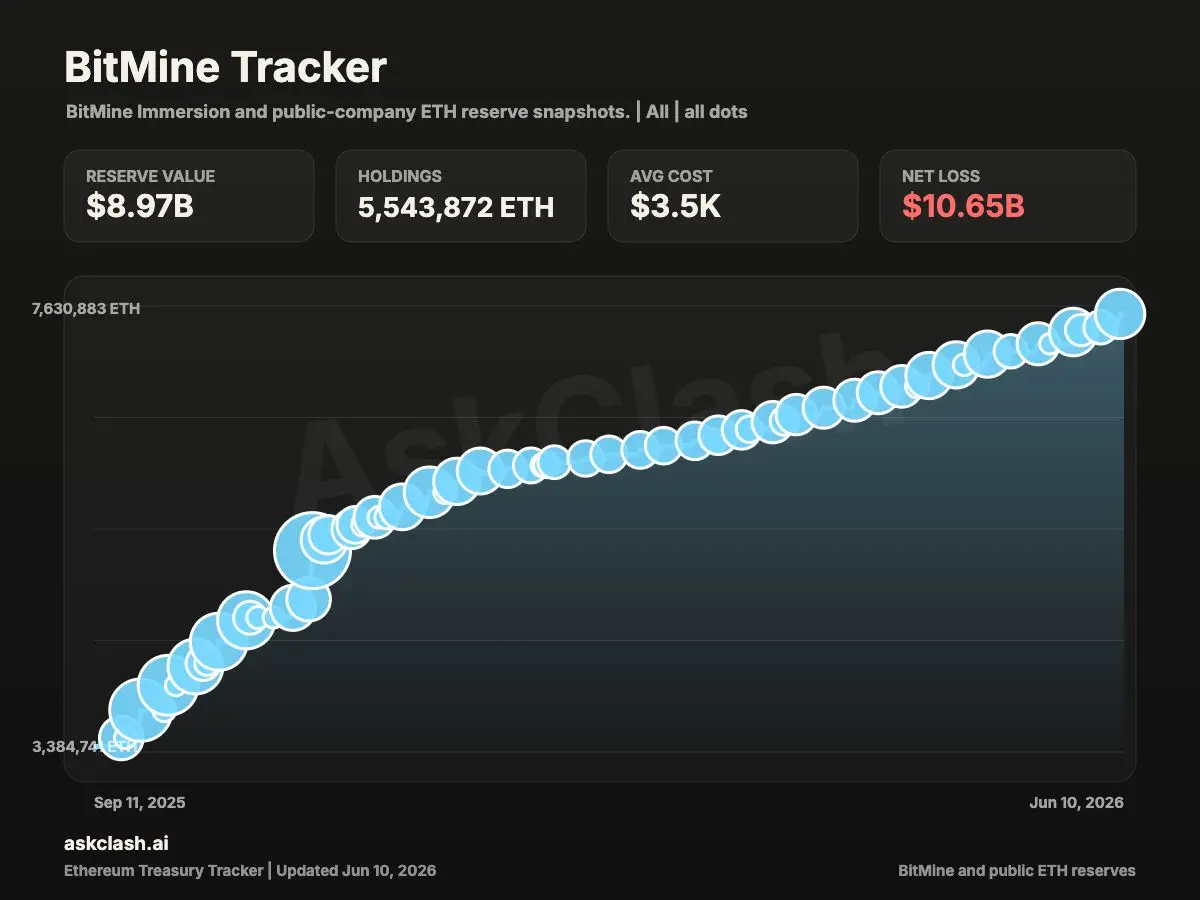
Among these, about 4.719 million ETH have been staked, accounting for over 85% of total holdings, with expected annualized staking returns ranging from $230 million to $296 million. This staking system is supported by the company's self-built MAVAN validator node network, considered the most critical structural design differentiating Bitmine from Strategy.

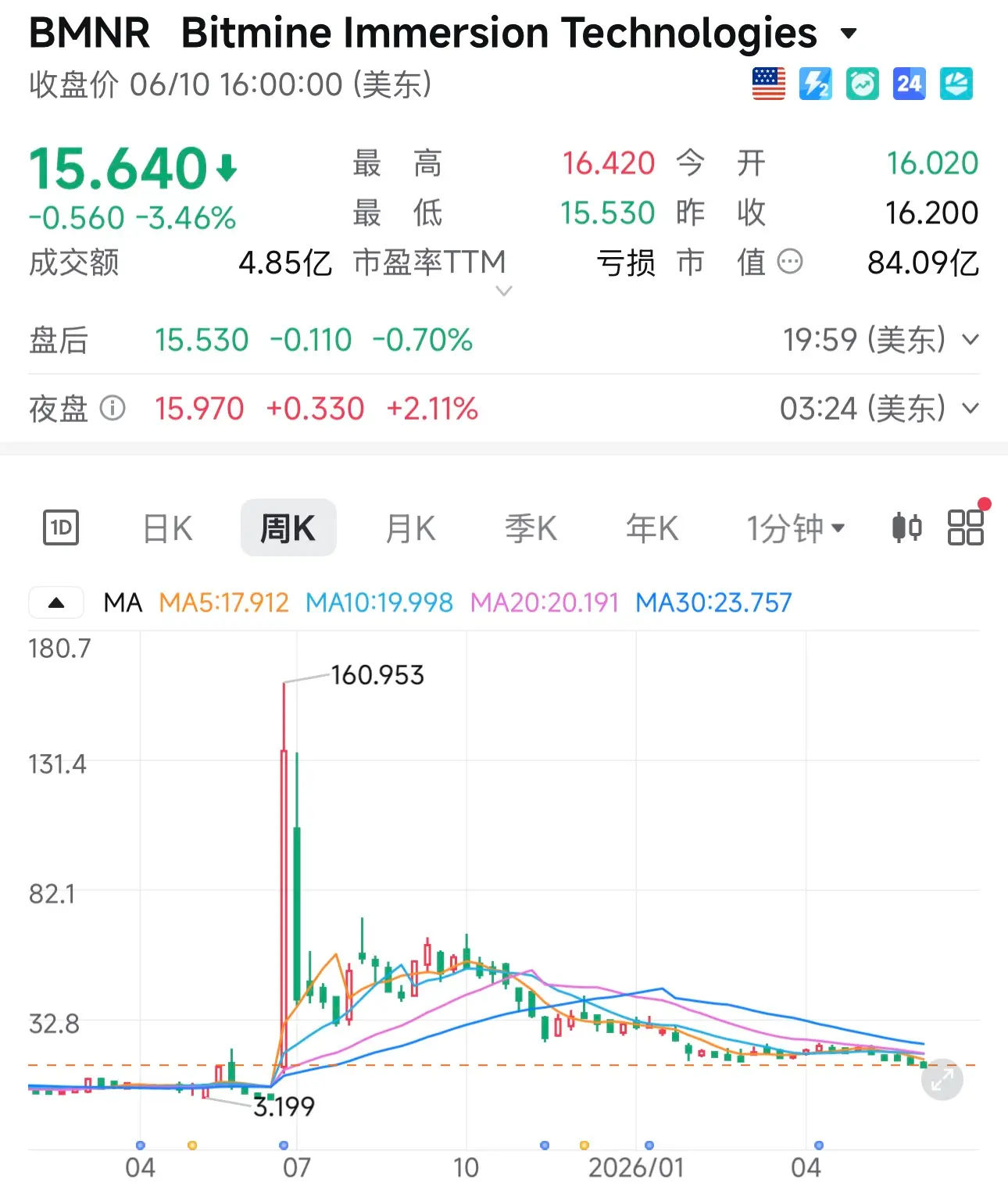
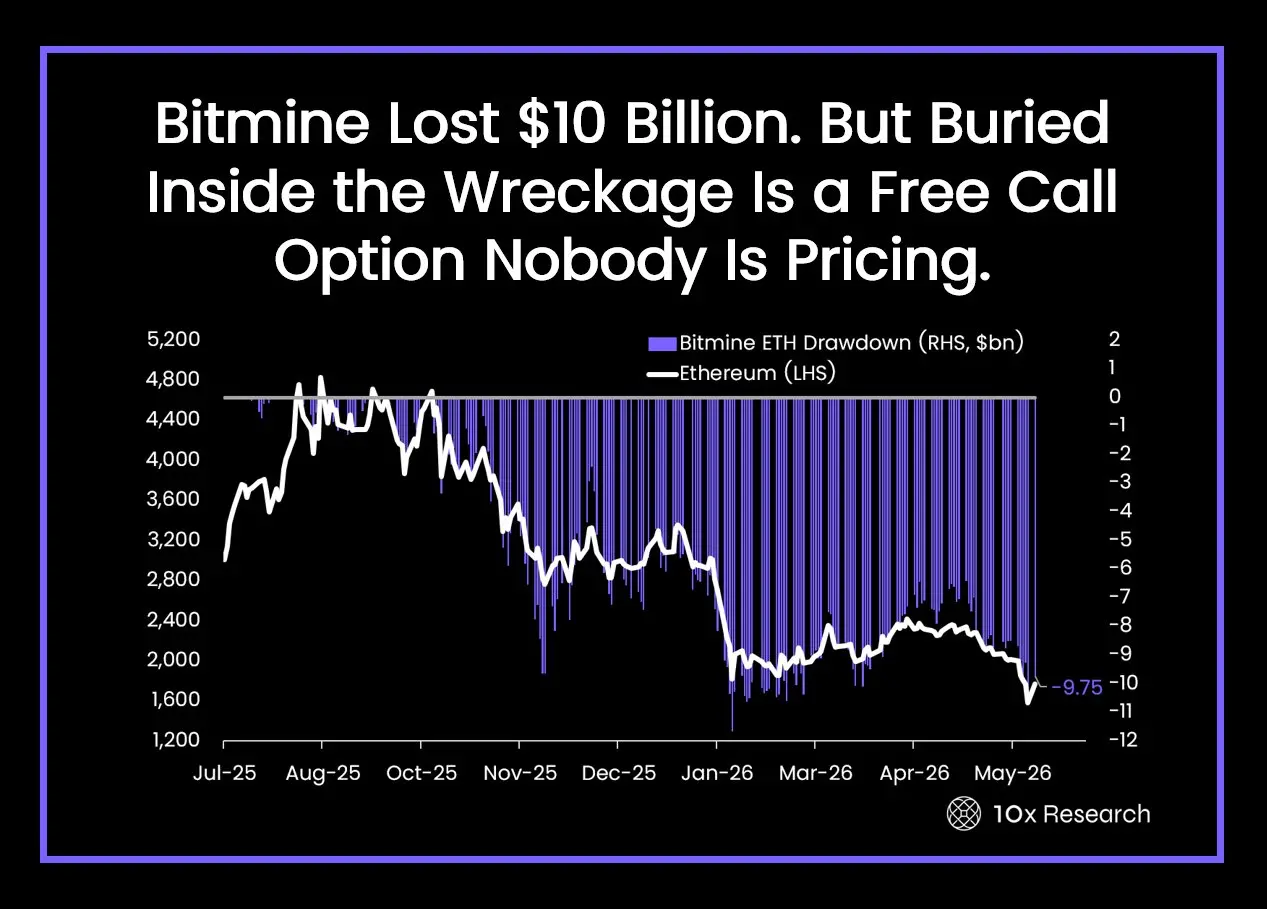
However, the cost of aggressive accumulation is also evident. With current ETH prices around $1,650, the company's average holding cost is as high as about $3,500. Its ETH treasury is valued at only about $9.3 billion, resulting in an overall company loss of $10.5 billion, a drawdown exceeding 50%. The company's stock price has plummeted nearly 90% from its peak.
10x Research points out that Bitmine's investors face two layers of losses: the floating loss from ETH's price drop is the first layer. The second layer is the approximately $4.6 billion premium investors paid for BMNR stock relative to the underlying ETH net asset value. Combined, these layers amplify the actual loss magnitude for shareholders.
Facing massive unrealized losses, Tom Lee characterizes this round of decline as superficial. He believes the existing financial system harbors a large amount of fake trading, whereas Ethereum has never had fraudulent transactions, with lower operating costs. On-chain transaction volume and daily active addresses have both hit record highs. The price correction is led by macro factors and leverage unwinding, with fundamentals undamaged. The longer-term bet is that AI agent systems will rely on blockchains to operate, ETH supply is continuously contracting, and Ethereum is the most direct beneficiary.

Tom Lee recently revealed that Bitmine is expected to complete its 5% target before the end of 2026, at which point it may no longer need to continue increasing holdings. He also mentioned the company may be formally included in the Russell 1000 index by the end of June, which, based on market cap calculations at the time, would bring at least $2.15 billion in passive fund buying pressure for BMNR.

How Can 3% Staking Returns Support 9.5% Dividends?

On June 5th, Bitmine completed pricing for its Series A Perpetual Preferred Shares: 3.5 million shares, issued at $80 per share, with a par value of $100, raising approximately $274 million net. The dividend yield is 9.5%, paid weekly in cash, and dividends continue to accrue even if undeclared by the board. Annualized dividend obligation is about $33.25 million based on par value.

Bitmine holds an early redemption right: it can redeem at 110% of par value within 18 months of issuance, at 105% between 18 months and 3 years, and at 100% after 3 years, with accrued but unpaid dividends also paid upon redemption.

At first glance, the math isn't hard. By the end of May, Bitmine had cumulatively staked 4.7 million ETH, with expected annualized staking returns of about $230 million to $296 million, which is 8 to 9 times the annualized dividend obligation.

However, the prediction exceeding $200 million is based on the assumption that the recent 4.7 million ETH are fully staked. According to the prospectus, for the six months ended February 28, 2026, the company's staking income was $11.18 million, annualized to about $22 million.

It's noteworthy that staking rewards are denominated in ETH, not USD. If ETH continues to fall, the company's staking income will shrink accordingly.

Here lies a fundamental difference between Bitmine and Strategy. BTC has no native yield; Strategy's STRC can only pay dividends through BTC price appreciation or selling coins, as detailed by ChainCatcher in the article "Strategy Cashes Out $2.5 Million as Bitcoin Market Cap Evaporates $80 Billion".

ETH's staking mechanism offers Tom Lee a different path: even if the price stays flat, staking rewards still generate income without touching the principal holdings. This is the real pressure-resistant advantage of the Bitmine model in the current bear market.

But this path may not be sustainable. Crypto KOL chenmo points out that in the early stages with low issuance, covering dividends with staking returns is manageable. However, as preferred share issuance scale continues to expand, the 3-4% staking yield is destined to be unable to cover the 9.5% annual interest. At that point, only a rise in ETH can maintain this logic.

Analyst Yuyue also noted that Strategy's model is already under pressure in the current market. Following up with preferred share issuance now, even if it's a short-term positive, may be interpreted by the market as a worse signal.

According to CointelegraphMT research, two details in the prospectus for this issuance are worth noting. The auditor was changed to KPMG on April 27th, with simultaneous disclosure of material weaknesses in internal controls. The audit is not yet complete, and financial data may be subject to restatement.

Additionally, the board has complete discretionary power over dividend payments. The only enforcement mechanism for preferred shareholders is the right to nominate two directors after 18 consecutive months without receiving dividends.

If Bitmine Stops Buying After 5%, Where Will ETH's Price Go?

On-chain analyst Yu Jin stated that at the current buying pace, the target could be reached as early as next month. So, will they continue buying after reaching it? If they stop, and this market's last staunch bull disappears, what will support ETH?

Bitmine has been the most consistent and aggressive marginal buyer in the ETH market over the past year. Other potential buying forces are scattered and weak. ETH spot ETFs saw a net outflow of $173 million overall last week. Although they briefly turned positive on June 8th after 17 consecutive days of outflows, the strength was far less than the previous outflow scale.

Meanwhile, Goldman Sachs reduced its ETH ETF holdings by about 70% in Q1 2026, and Harvard University's endowment fund completely liquidated its approximately $87 million ETHA holdings, selling all after holding for just one quarter. Details on institutional fund movements can be found in "Harvard and Other Institutions Liquidate, Six Core Talents Depart in One Month, What's Wrong with Ethereum?".

Furthermore, stablecoin legislation and institutional incremental demand brought by RWA tokenization are slow variables, difficult to fill a gap of Bitmine's scale in the short term.

Without an overall reversal in the crypto market, it can be foreseen that the treasury flywheel will become difficult to sustain. The transmission would be: ETH price continues to fall, BMNR stock price is under pressure, the premium relative to net assets narrows, the window for additional fundraising shrinks, the buying pace slows, and ETH further loses marginal support. This cycle doesn't even require Bitmine to actively sell a single ETH; the disappearance of buying power alone is sufficient.
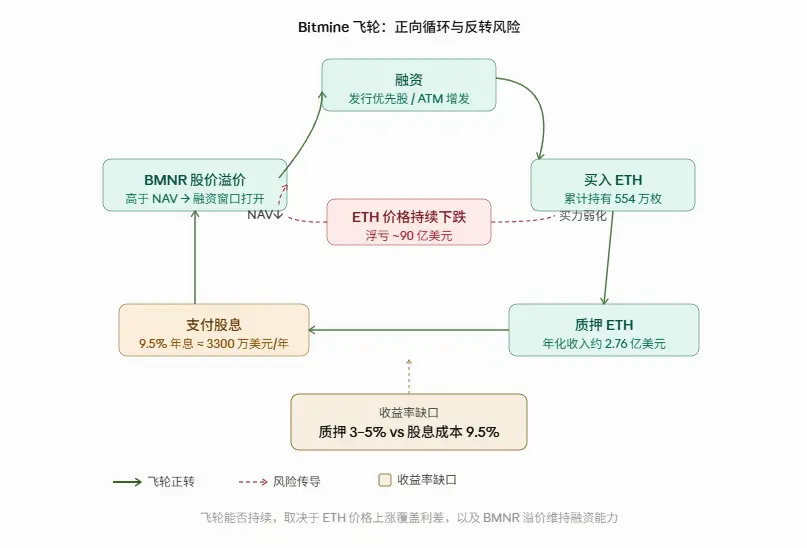
Image Source: AI Generated

In a pessimistic scenario, if the financing market's acceptance of preferred shares declines, BMNR continues to hit new lows, and buying slows significantly, ETH may explore the next key consensus level (around $1,000). DWF Labs co-founder Andrei Grachev believes Strategy and Bitmine have a great chance to create the largest market crash in cryptocurrency history. This is a tail risk judgment, not a baseline expectation.

In the baseline scenario, Bitmine maintains buying, staking returns provide a buffer, preferred shares are smoothly absorbed, and ETH consolidates and bottoms out in the $1,500 to $2,000 range. Despite Bitmine's heavy losses and ETH's difficulty recovering in the short term, a 10x Research report mentions that when a stock falls deep enough, the underlying asset becomes almost irrelevant. What investors are buying is essentially a pure option—a free call option on ETH's future rebound, which is not yet fully priced in by the market.

In an optimistic scenario, formal inclusion in the Russell 1000 brings passive funds, and the landing of stablecoin legislation like the GENIUS Act clears obstacles for institutional entry. Standard Chartered maintains its year-end 2026 ETH target price of $4,000, believing recent price declines do not reflect the continuous improvement in Ethereum's network fundamentals. It likens the current situation to Amazon's stage after the 2001 bubble burst—price temporarily disconnected from network value, but infrastructure building never stopped. The bank expects the ETH/BTC exchange rate to recover to about 0.08 by the end of this decade, with a target price of $40,000 by the end of 2030.

Conclusion

Ultimately, how long this financing can sustain Bitmine's flywheel comes down to the price of ETH. However, Bitmine's coin-buying itself is a crucial part of price support.

So the core question is: after Bitmine completes its 5% target and gradually fades out, who will take up the baton? Traditional institutions are withdrawing, ETF funds flow in and out, and real incremental demand from stablecoins and RWA has yet to materialize on a large scale.

Perhaps Ethereum is not short on narratives, but when the liquidity turning point will appear and where the new marginal buyers will come from are key questions determining ETH's price trend going forward.


Preguntas relacionadas

QWhat is Bitmine's primary strategy and goal in the Ethereum market, and what is its current progress?

ABitmine's strategy is to aggressively accumulate Ethereum (ETH) with the goal of holding 5% of the total ETH supply. They finance this through equity offerings. Currently, Bitmine holds approximately 5.66 million ETH, which is over 90% of their 5% target, requiring less than 400,000 ETH more to complete.

QWhat significant financial challenge is Bitmine currently facing, and how is it attempting to address it?

ABitmine is facing over $10.5 billion in unrealized losses due to ETH's price falling well below its average acquisition cost of around $3,500. To address this and continue its buying strategy, Bitmine recently issued perpetual preferred shares with a 9.5% annual dividend, raising approximately $274 million.

QWhat is a key structural difference between Bitmine and a company like Strategy, and what advantage does it provide in a bear market?

AA key difference is that Bitmine stakes its ETH holdings (over 85%), generating an estimated annual yield of $230-$296 million. Unlike Bitcoin held by Strategy, this provides a native yield stream that can help cover obligations without needing to sell the underlying asset or rely solely on price appreciation, offering an advantage in a bear market.

QWhat are the potential scenarios for ETH's price if Bitmine stops being a major buyer after reaching its 5% goal?

AIf Bitmine stops buying, several scenarios are outlined: 1) Pessimistic: If buying halts and financing dries up, ETH could fall towards $1,000. 2) Base case: ETH trades between $1,500-$2,000. 3) Optimistic: Factors like inclusion in the Russell 1000 index, positive legislation, and strong network fundamentals could lead to a significant price recovery, with targets like $4,000 by 2026 or even $40,000 by 2030 mentioned.

QWhat is the core dilemma or 'flywheel' problem highlighted for Bitmine's business model?

AThe core dilemma is a potential negative feedback loop: If ETH price falls, Bitmine's stock (BMNR) price suffers, making it harder to raise new funds through equity. This slows or stops their buying, which in turn removes a major source of buying pressure for ETH, potentially causing further price declines. This cycle can occur even without Bitmine actively selling any ETH.

Lecturas Relacionadas

Raising Interest Rates Is Not a Tech Killer, EPS Is: A Strategy for Discarding the Weak and Retaining the Strong After the AI Theme's Sharp Decline

**Summary: Rising Interest Rates Are Not the Killer of Tech; EPS Is: The "Keep the Strong, Ditch the Weak" Strategy After the AI Theme Plunge** The author argues that the sharp sell-off in tech and AI-related stocks, triggered by a strong US jobs report that heightened Fed rate hike fears, represents a "pullback to pick up passengers" rather than a "car crash." The true end of a tech bull market is not determined by an extra 25 basis point hike, but by industry overcapacity and the disproval of earnings per share (EPS) expectations. Historical analysis shows that during past rate hike cycles, the Nasdaq-100 often outperformed, provided EPS growth remained strong. The current phase is seen as a shift from a "broad narrative-driven rally" to a "focused verification stage" for AI. The investment strategy should be to "keep the strong, ditch the weak." * **Retain exposure** to high-conviction AI infrastructure leaders with clear order visibility, stable margins, strong cash flow, and upward EPS revisions (e.g., AI servers, advanced packaging, optical modules, key cloud suppliers). * **Reduce exposure** to high-beta, narrative-driven stocks with unclear profit paths (e.g., some quantum computing, space, or speculative chip stocks), especially on rebounds. Valuation concerns should focus on whether earnings can catch up to high multiples, not on high P/E alone. Crowded positioning signals a concentration into quality assets, not necessarily a market top. The upcoming Q2 earnings season will be a key validation point. The core principle is to hold stocks with proven EPS, while using macro events (CPI data, central bank meetings) to manage timing and risk.

marsbitHace 2 hora(s)

Raising Interest Rates Is Not a Tech Killer, EPS Is: A Strategy for Discarding the Weak and Retaining the Strong After the AI Theme's Sharp Decline

marsbitHace 2 hora(s)

The Largest IPO in History Ignites Heated Debate: Is SpaceX Worth $1.77 Trillion?

SpaceX's potential IPO is priced at $135 per share, aiming to raise $75 billion and valuing the company at approximately $1.77 trillion, which would make it the largest IPO in history. This valuation has sparked intense debate among investors. Bullish analysts, including major underwriters Goldman Sachs and Morgan Stanley, argue the valuation is justified by SpaceX's long-term potential. They see it not just as a rocket company but as a future leader in space infrastructure, with key growth drivers being Starlink satellite internet, low-cost rocket launches, and future AI-related ventures. They project revenues reaching hundreds of billions to trillions of dollars by 2030-2040. ARK Invest's model suggests a 2030 enterprise value could reach $2.5 trillion. Bearish analysts from independent research firms like Morningstar, PitchBook, and New Constructs contend the IPO price is excessively high, already pricing in unrealistic future growth. Using DCF and sum-of-the-parts models, they estimate fair value between $780 billion and $1.7 trillion, significantly below the IPO target. They highlight risks such as the speculative nature of AI projections, over-dependence on Elon Musk, high growth expectations, and corporate governance concerns. Trefis set a target price of just $79 per share. While both sides acknowledge SpaceX's unique position in commercial space, the core disagreement centers on whether the $135 share price offers a reasonable margin of safety or is overly optimistic. Despite the valuation controversy, reported strong demand for the IPO indicates significant market interest.

marsbitHace 3 hora(s)

The Largest IPO in History Ignites Heated Debate: Is SpaceX Worth $1.77 Trillion?

marsbitHace 3 hora(s)

Trading

Spot
Futuros

Artículos destacados

Qué es BITCOIN

Entendiendo HarryPotterObamaSonic10Inu (ERC-20) y Su Posición en el Espacio Cripto En los últimos años, el mercado de criptomonedas ha sido testigo de un aumento en la popularidad de las monedas meme, capturando el interés no solo de los comerciantes, sino también de aquellos que buscan compromiso comunitario y valor de entretenimiento. Entre estos tokens únicos se encuentra HarryPotterObamaSonic10Inu (ERC-20), un proyecto intrigante que mezcla referencias culturales en el tejido de las criptomonedas. Este artículo profundiza en los aspectos clave de HarryPotterObamaSonic10Inu, explorando sus mecanismos, ethos impulsado por la comunidad y su relación con el paisaje cripto más amplio. ¿Qué es HarryPotterObamaSonic10Inu (ERC-20)? Como su nombre sugiere, HarryPotterObamaSonic10Inu es una moneda meme construida sobre la blockchain de Ethereum, clasificada bajo el estándar ERC-20. A diferencia de las criptomonedas tradicionales que pueden enfatizar la utilidad práctica o el potencial de inversión, este token prospera en el valor de entretenimiento y la fuerza de su comunidad. El proyecto tiene como objetivo fomentar un entorno donde los usuarios comprometidos puedan reunirse, compartir ideas y participar en actividades inspiradas por diversos fenómenos culturales. Una característica notable de HarryPotterObamaSonic10Inu es su cero impuestos en las transacciones. Este atractivo elemento tiene como objetivo incentivar el comercio y la participación comunitaria, sin cargos adicionales que puedan disuadir a los comerciantes de pequeña escala. El suministro total de la moneda está establecido en mil millones de tokens, una cifra que marca su intención de mantener una circulación sustancial dentro de la comunidad. Creador de HarryPotterObamaSonic10Inu (ERC-20) Los orígenes de HarryPotterObamaSonic10Inu están algo envueltos en misterio; los detalles sobre el creador siguen siendo desconocidos. El desarrollo de este token carece de un equipo identificable o de un plan explícito, lo cual no es inusual dentro del sector de monedas meme. En cambio, el proyecto ha surgido de manera orgánica, con su progreso muy dependiente del entusiasmo y la participación de su comunidad. Inversores de HarryPotterObamaSonic10Inu (ERC-20) En cuanto a inversiones externas y respaldo, HarryPotterObamaSonic10Inu también sigue siendo ambiguo. El token no lista ninguna fundación de inversión conocida o apoyo organizacional significativo. En cambio, la savia del proyecto es su comunidad de base, que informa su crecimiento y sostenibilidad a través de la acción colectiva y el compromiso en el espacio cripto. ¿Cómo Funciona HarryPotterObamaSonic10Inu (ERC-20)? Como una moneda meme, HarryPotterObamaSonic10Inu opera principalmente fuera de los marcos tradicionales que a menudo rigen el valor de los activos. Hay varios aspectos distintivos que definen cómo funciona el proyecto: Transacciones Sin Impuestos: Sin tarifas impositivas en las transacciones, los usuarios pueden comprar y vender el token libremente sin preocuparse por costos ocultos. Compromiso Comunitario: El proyecto prospera en la interacción comunitaria, aprovechando plataformas de redes sociales para crear entusiasmo y facilitar la participación. Las discusiones, el intercambio de contenido y el compromiso son elementos cruciales que ayudan a expandir su alcance y fomentar la lealtad entre los seguidores. Sin Utilidad Práctica: Cabe señalar que HarryPotterObamaSonic10Inu no ofrece utilidad concreta dentro del ecosistema financiero. Más bien, se clasifica como un token principalmente para actividades de entretenimiento y comunitarias. Referencia Cultural: El token incorpora astutamente elementos de la cultura popular para atraer interés, conectando con entusiastas de los memes y seguidores de las criptomonedas por igual. HarryPotterObamaSonic10Inu ejemplifica cómo las monedas meme operan de manera diferente a los proyectos de criptomonedas más tradicionales, ingresando al mercado como construcciones sociales innovadoras en lugar de activos utilitarios. Cronología de HarryPotterObamaSonic10Inu (ERC-20) La historia de HarryPotterObamaSonic10Inu está marcada por varios hitos notables: Creación: El token surgió de un meme viral, capturando la imaginación de muchos entusiastas de las criptomonedas. Las fechas específicas de creación no están disponibles, subrayando su ascenso orgánico. Listado en Exchanges: HarryPotterObamaSonic10Inu ha llegado a varios exchanges, permitiendo un acceso y comercio más fácil por parte de la comunidad. Iniciativas de Compromiso Comunitario: Actividades continuas destinadas a mejorar la interacción comunitaria, incluyendo concursos, campañas en redes sociales y generación de contenido por parte de fanáticos y defensores. Planes de Expansión Futuros: La hoja de ruta del proyecto incluye el lanzamiento de una colección de NFT, mercancía y un sitio de comercio electrónico relacionado con sus temas culturales, involucrando aún más a la comunidad e intentando añadir más dimensiones a su ecosistema. Puntos Clave Sobre HarryPotterObamaSonic10Inu (ERC-20) Naturaleza Impulsada por la Comunidad: El proyecto prioriza la participación colectiva y la creatividad, asegurando que la involucración de los usuarios esté a la vanguardia de su desarrollo. Clasificación como Moneda Meme: Representa la epítome de las criptomonedas basadas en el entretenimiento, diferenciándose de los vehículos de inversión tradicionales. Sin Afiliación Directa con Bitcoin: A pesar de la similitud en el nombre del ticker, HarryPotterObamaSonic10Inu es distinto y no tiene relación con Bitcoin u otras criptomonedas establecidas. Enfoque en la Colaboración: HarryPotterObamaSonic10Inu está diseñado para crear un espacio para la colaboración y el intercambio de historias entre sus poseedores, proporcionando una vía para la creatividad y el vínculo comunitario. Perspectivas Futuras: La ambición de expandirse más allá de su premisa inicial hacia NFTs y mercancías describe un camino para que el proyecto potencialmente ingrese a avenidas más tradicionales dentro de la cultura digital. A medida que las monedas meme continúan capturando la imaginación de la comunidad de criptomonedas, HarryPotterObamaSonic10Inu (ERC-20) se destaca debido a sus lazos culturales y su enfoque centrado en la comunidad. Si bien puede no encajar en el molde típico de un token impulsado por la utilidad, su esencia radica en la alegría y la camaradería fomentadas entre sus seguidores, destacando la naturaleza en evolución de las criptomonedas en una era cada vez más digital. A medida que el proyecto continúa desarrollándose, será importante observar cómo las dinámicas comunitarias influyen en su trayectoria en el cambiante paisaje de la tecnología blockchain.

1.7k Vistas totalesPublicado en 2024.04.01Actualizado en 2024.12.03

Qué es BITCOIN

Cómo comprar BTC

¡Bienvenido a HTX.com! Hemos hecho que comprar Bitcoin (BTC) sea simple y conveniente. Sigue nuestra guía paso a paso para iniciar tu viaje de criptos.Paso 1: crea tu cuenta HTXUtiliza tu correo electrónico o número de teléfono para registrarte y obtener una cuenta gratuita en HTX. Experimenta un proceso de registro sin complicaciones y desbloquea todas las funciones.Obtener mi cuentaPaso 2: ve a Comprar cripto y elige tu método de pagoTarjeta de crédito/débito: usa tu Visa o Mastercard para comprar Bitcoin (BTC) al instante.Saldo: utiliza fondos del saldo de tu cuenta HTX para tradear sin problemas.Terceros: hemos agregado métodos de pago populares como Google Pay y Apple Pay para mejorar la comodidad.P2P: tradear directamente con otros usuarios en HTX.Over-the-Counter (OTC): ofrecemos servicios personalizados y tipos de cambio competitivos para los traders.Paso 3: guarda tu Bitcoin (BTC)Después de comprar tu Bitcoin (BTC), guárdalo en tu cuenta HTX. Alternativamente, puedes enviarlo a otro lugar mediante transferencia blockchain o utilizarlo para tradear otras criptomonedas.Paso 4: tradear Bitcoin (BTC)Tradear fácilmente con Bitcoin (BTC) en HTX's mercado spot. Simplemente accede a tu cuenta, selecciona tu par de trading, ejecuta tus trades y monitorea en tiempo real. Ofrecemos una experiencia fácil de usar tanto para principiantes como para traders experimentados.

5.1k Vistas totalesPublicado en 2024.12.12Actualizado en 2026.06.02

Cómo comprar BTC

Qué es $BITCOIN

ORO DIGITAL ($BITCOIN): Un Análisis Integral Introducción al ORO DIGITAL ($BITCOIN) ORO DIGITAL ($BITCOIN) es un proyecto basado en blockchain que opera en la red Solana, cuyo objetivo es combinar las características de los metales preciosos tradicionales con la innovación de las tecnologías descentralizadas. Aunque comparte un nombre con Bitcoin, a menudo referido como “oro digital” debido a su percepción como un refugio de valor, ORO DIGITAL es un token separado diseñado para crear un ecosistema único dentro del paisaje Web3. Su meta es posicionarse como un activo digital alternativo viable, aunque los detalles sobre sus aplicaciones y funcionalidades aún están en desarrollo. ¿Qué es ORO DIGITAL ($BITCOIN)? ORO DIGITAL ($BITCOIN) es un token de criptomoneda diseñado explícitamente para su uso en la blockchain de Solana. A diferencia de Bitcoin, que proporciona un papel de almacenamiento de valor ampliamente reconocido, este token parece centrarse en aplicaciones y características más amplias. Aspectos notables incluyen: Infraestructura Blockchain: El token está construido sobre la blockchain de Solana, conocida por su capacidad para manejar transacciones de alta velocidad y bajo costo. Dinámicas de Suministro: ORO DIGITAL tiene un suministro máximo limitado a 100 cuatrillones de tokens (100P $BITCOIN), aunque los detalles sobre su suministro circulante no se han divulgado actualmente. Utilidad: Si bien las funcionalidades precisas no están delineadas explícitamente, hay indicios de que el token podría ser utilizado para diversas aplicaciones, potencialmente involucrando aplicaciones descentralizadas (dApps) o estrategias de tokenización de activos. ¿Quién es el Creador de ORO DIGITAL ($BITCOIN)? En la actualidad, la identidad de los creadores y el equipo de desarrollo detrás de ORO DIGITAL ($BITCOIN) sigue siendo desconocida. Esta situación es típica entre muchos proyectos innovadores dentro del espacio blockchain, particularmente aquellos alineados con las finanzas descentralizadas y fenómenos de monedas meme. Si bien tal anonimato puede fomentar una cultura impulsada por la comunidad, intensifica las preocupaciones sobre la gobernanza y la responsabilidad. ¿Quiénes son los Inversores de ORO DIGITAL ($BITCOIN)? La información disponible indica que ORO DIGITAL ($BITCOIN) no tiene patrocinadores institucionales conocidos ni inversiones destacadas de capital de riesgo. El proyecto parece operar en un modelo de peer-to-peer centrado en el apoyo y la adopción de la comunidad en lugar de rutas de financiamiento tradicionales. Su actividad y liquidez se sitúan principalmente en intercambios descentralizados (DEX), como PumpSwap, en lugar de plataformas de trading centralizadas establecidas, lo que resalta aún más su enfoque de base. Cómo Funciona ORO DIGITAL ($BITCOIN) Los mecanismos operativos de ORO DIGITAL ($BITCOIN) pueden elaborarse en función de su diseño blockchain y atributos de red: Mecanismo de Consenso: Al aprovechar el único proof-of-history (PoH) de Solana combinado con un modelo de proof-of-stake (PoS), el proyecto asegura una validación de transacciones eficiente que contribuye al alto rendimiento de la red. Tokenómica: Si bien los mecanismos deflacionarios específicos no se han detallado extensamente, el vasto suministro máximo de tokens implica que podría atender microtransacciones o casos de uso nicho que aún están por definirse. Interoperabilidad: Existe el potencial de integración con el ecosistema más amplio de Solana, incluyendo varias plataformas de finanzas descentralizadas (DeFi). Sin embargo, los detalles sobre integraciones específicas permanecen no especificados. Cronología de Eventos Clave Aquí hay una cronología que destaca hitos significativos relacionados con ORO DIGITAL ($BITCOIN): 2023: El despliegue inicial del token ocurre en la blockchain de Solana, marcado por su dirección de contrato. 2024: ORO DIGITAL gana visibilidad al estar disponible para trading en intercambios descentralizados como PumpSwap, permitiendo a los usuarios comerciar contra SOL. 2025: El proyecto presencia actividad de trading esporádica y potencial interés en compromisos liderados por la comunidad, aunque no se han documentado asociaciones notables o avances técnicos hasta el momento. Análisis Crítico Fortalezas Escalabilidad: La infraestructura subyacente de Solana soporta altos volúmenes de transacciones, lo que podría mejorar la utilidad de $BITCOIN en varios escenarios de transacción. Accesibilidad: El potencial bajo precio de trading por token podría atraer a inversores minoristas, facilitando una participación más amplia debido a oportunidades de propiedad fraccionada. Riesgos Falta de Transparencia: La ausencia de patrocinadores, desarrolladores o un proceso de auditoría conocidos públicamente puede generar escepticismo sobre la sostenibilidad y confiabilidad del proyecto. Volatilidad del Mercado: La actividad de trading depende en gran medida del comportamiento especulativo, lo que puede resultar en una volatilidad de precios significativa y en incertidumbre para los inversores. Conclusión ORO DIGITAL ($BITCOIN) surge como un proyecto intrigante pero ambiguo dentro del ecosistema de Solana en rápida evolución. Si bien intenta aprovechar la narrativa del “oro digital”, su alejamiento del papel establecido de Bitcoin como refugio de valor subraya la necesidad de una diferenciación más clara de su utilidad y estructura de gobernanza previstas. La aceptación y adopción futura dependerán probablemente de abordar la actual opacidad y de definir sus estrategias operativas y económicas de manera más explícita. Nota: Este informe abarca información sintetizada disponible hasta octubre de 2023, y pueden haber ocurrido desarrollos más allá del período de investigación.

83 Vistas totalesPublicado en 2025.05.13Actualizado en 2025.05.13

Qué es $BITCOIN

Discusiones

Bienvenido a la comunidad de HTX. Aquí puedes mantenerte informado sobre los últimos desarrollos de la plataforma y acceder a análisis profesionales del mercado. A continuación se presentan las opiniones de los usuarios sobre el precio de BTC (BTC).

活动图片













