How Did BitMine, with Staked ETH Generating $46 Million in Steady Income, Still End Up in Massive Losses?

Foresight NewsPublicado a 2026-07-16Actualizado a 2026-07-16

Resumen

BitMine, a crypto asset manager, reported strong revenue growth in its fiscal Q3 2026, primarily from its Ethereum staking operations, which generated $45.7 million. However, the company posted a net loss of $83.6 million for the quarter. This significant loss was driven by a $92.1 million deficit from Ethereum derivative options trading, completely offsetting the staking income. The company is aggressively shifting from Bitcoin mining to accumulating Ethereum, financing this strategy almost entirely by issuing new common stock. This has led to substantial shareholder dilution, with the share count increasing by 149% over nine months. As of late May, BitMine held 5.42 million ETH with a massive unrealized loss of approximately $8.2 billion due to market depreciation. While the staking business provides a stable cash flow that covers core operational costs, profitability is pressured by high, fixed fees from long-term service agreements and growing administrative expenses. Although the company holds no traditional debt, its model heavily relies on continuous access to capital markets for equity financing to sustain its Ethereum accumulation. The company's long-term viability hinges on its ability to manage derivative risks, control costs, and benefit from a significant recovery in Ethereum's price.


Author: Oluwapelumi Adejumo

Translation: Chopper, Foresight News


BitMine aggressively built up its Ethereum holdings, attempting to transform them into a stable source of cash flow, with its staking business generating nearly $46 million in revenue last quarter.


However, a $92.1 million loss on derivatives and options completely offset these staking gains. Combined with persistently high asset management costs and the company's aggressive issuance of new shares, the profit potential for existing shareholders was significantly compressed.


The Q3 FY2026 financial report, for the period ending May 31, shows company revenue soared to $46.5 million from $2.1 million in the same period last year; 98% ($45.7 million) of this came from staking and node validation services. BitMine is accelerating its exit from Bitcoin mining to fully transition to an Ethereum treasury model.


Despite the substantial revenue growth, the company reported a net loss of $83.6 million for the quarter, a dramatic increase compared to a modest loss of $623,000 in the same period last year.


Massive Options Losses Wipe Out All Ethereum Staking Gains


The core factor dragging down this quarter's performance was the company's Ethereum derivatives and options trading strategy. BitMine incurred a combined loss of $92.1 million on Ethereum-related derivatives this quarter, approximately double the total revenue from its staking business during the same period. This included $78.6 million in net losses from expired option contracts and $14 million from exercised positions. Gains of only $534,000 from unsettled contracts provided negligible offset.


The company engaged in no derivatives trading during the same period last year, marking a qualitative leap in its asset management risk exposure. For the first nine months of the fiscal year, cumulative derivatives losses totaled $133.3 million, consisting of $79.3 million from exercised losses and $54.5 million from expired contracts, with only $515,000 in gains from unsettled positions. During the same period, staking and validation services generated only $56.9 million, making derivatives losses more than double the staking income.


BitMine stated that its options strategy primarily involves selling put options as part of its overall portfolio management. While selling puts can generate premium income and allow for asset accumulation at lower prices, it can result in massive losses if the market moves against the position and contracts are exercised under unfavorable conditions. The scale of this loss clearly demonstrates that the attempt to enhance returns with options has, for now, completely negated the stable income generated by the node staking business.


Simultaneously, the company's general and administrative expenses surged to $37.3 million from $744,000 a year ago. Management explained that the increase was primarily due to digital asset custody and management service fees, salary adjustments, and increased cash and stock-based compensation for directors.


Excluding changes in the valuation of crypto assets, staking income was sufficient to cover the quarter's cost of sales and administrative expenses. Even after adjusting for several non-cash items, the company's own adjusted non-GAAP net loss still reached $70.8 million. This financial report indicates that while the node validation business has generated a substantial and stable cash flow, the overall portfolio trading strategy continues to consume staking profits.


Continuous BMNR Share Issuance to Hoard Ethereum, Sharply Diluting Shareholder Equity


The funds for BitMine's large-scale Ethereum accumulation came almost entirely from public market offerings of common stock, with the cost fully borne by existing shareholders. In the nine months ending May 31, the company sold 340.7 million shares of BMNR common stock through its at-the-market offering program, raising $11.87 billion net of issuance costs; during the same period, it spent $11.69 billion purchasing Ethereum.


Shareholder equity was significantly diluted. The number of common shares outstanding increased by 149% over nine months, from 232.4 million as of August 31, 2025, to 579.7 million by the end of May 2026; issuance continued after the quarter ended, with total shares reaching 603.2 million as of July 9.


Fueled by equity financing, BitMine had accumulated holdings of 5.42 million Ethereum by May 31, with a combined acquisition cost of $19.05 billion; holdings had increased to 5.7 million Ethereum at the time of writing.
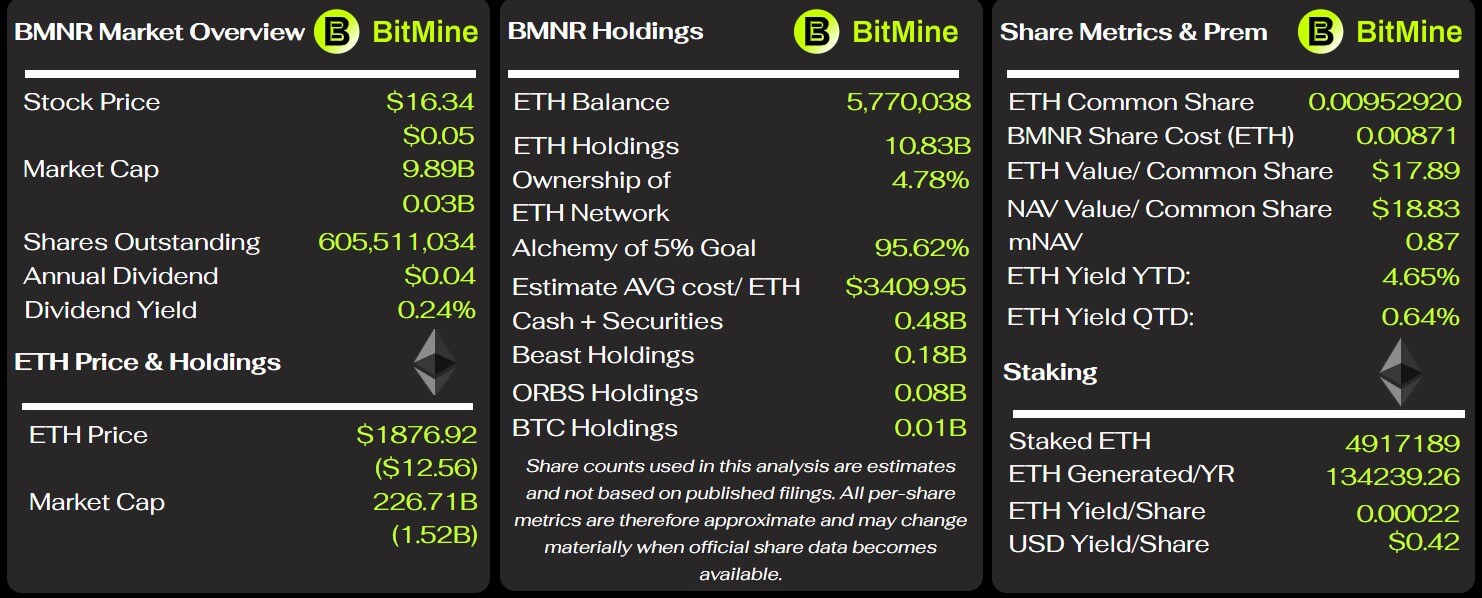

Key Metrics for BitMine, Source: BitMine Tracker


As of the end of May, this Ethereum portfolio was valued at only $10.86 billion, representing an unrealized loss of approximately $8.2 billion, a 43% decline from cost.


This portfolio devaluation was the primary source of the $9.04 billion unrealized loss on digital assets for the first nine months of the fiscal year, during which the company reported a cumulative net loss of $9.1 billion. The massive unrealized loss vividly illustrates that BitMine's share issuances purchased Ethereum at high prices, with all the risk borne by shareholders.


A shareholder meeting in January approved an increase in the company's authorized common shares from 500 million to 50 billion. This authorization does not obligate the company to issue all shares but grants management ample room to continue issuing stock for purchasing digital assets and other investments.


BitMine cautioned that its ability to expand its Ethereum holdings is highly dependent on continuous and unimpeded access to financing. A decline in Ethereum's price, weakness in the company's stock price, or a decrease in investor appetite for its offerings could all increase the cost of future financing or even restrict the company's ability to issue securities on favorable terms.


The viability of this business model depends not only on staking yields and future Ethereum price appreciation but also on shareholders accepting significant equity dilution and the portfolio carrying billions in unrealized losses, while continuously providing capital for the company's coin accumulation.


Long-Term Service Contracts Increase Staking Operating Costs, Compressing Profit Margins


BitMine relies on its staking business to hedge against portfolio price volatility, but accompanying long-term cooperation agreements generate fixed fees and profit-sharing, continuously compressing overall profitability. The company has a ten-year consulting agreement with third-party service provider Ethereum Tower, incurring an expense of $12.8 million this quarter, representing about 28% of the period's total staking revenue. Cumulative fees for the first nine months amounted to $37.5 million; the company estimates annual fees in the range of $40 to $50 million, calculated on a tiered basis against the total value of managed digital assets.


The agreement can only be terminated under a few specific conditions. If BitMine terminates without cause, it must pay Ethereum Tower 85% of all estimated service fees for the remaining contract term.


Furthermore, following its acquisition of node operator Pier Two, BitMine entered into a separate ten-year management services agreement. This agreement grants Ethereum Tower a 2% equity stake in the MAVAN platform, with monthly profit-sharing based on a percentage of the platform's native staking rewards. As of May 31, the company had not accrued any expenses related to this agreement, so the profit-sharing costs are not yet reflected in the staking business's income statement.


BitMine stated that the vast majority of its Ethereum is staked through MAVAN, and over the long term, staking rewards are expected to cover asset custody costs. Looking solely at the operational level this quarter, staking revenue did cover sales and administrative expenses excluding crypto asset valuation changes. However, the combination of a decade-long fixed consulting fee, future profit-sharing, and various other asset management expenses means that relying solely on staking income does not accurately reflect the business's true profitability.


Despite No Debt, BitMine's Dependence on Capital Markets Deepens


As of the end of May, BitMine's balance sheet showed extremely low leverage, with $340.3 million in cash, working capital of $433.1 million, and no traditional debt. Total assets were $11.63 billion, with total liabilities of only $30.1 million, and assets predominantly consisting of Ethereum and other digital assets. On paper, the company faces no immediate debt crisis, but operating activities used $287.6 million in cash during the first nine months. The company attributed the cash burn primarily to legal, consulting, and investment banking fundraising fees associated with expanding its Ethereum holdings.


After the quarter ended, BitMine issued an additional 3.5 million shares of its 9.5% annual perpetual preferred stock, BMNP, raising $273.8 million. While this offering supplemented short-term liquidity, it adds a new, rigid annual dividend expense of approximately $33.25 million for the preferred shares. Although this security is equity, not debt, it has priority over common shares in liquidation, and its high dividend continuously consumes company cash flow.


Management believes existing cash, expected operating cash flow, and the at-the-market offering facility are sufficient to fund operations for at least the next 12 months. This assessment assumes the capital markets remain open: if Ethereum prices remain depressed long-term, the company's stock price weakens, or investor appetite wanes, the company's financing costs will rise, and its operational flexibility will be constrained.


Synthesizing the latest financial report, BitMine presents a set of contradictory realities: On one hand, the company has established a mature staking business generating tens of millions in quarterly revenue, enough to cover core operational expenses. On the other hand, massive options losses completely devour staking profits, long-term contracts persistently increase management costs, and Ethereum accumulation relies entirely on share issuance, with the total share count more than doubling.


Therefore, BitMine's long-term economic viability depends on whether staking income can stably cover various asset management costs and options losses, whether the company can sustainably secure equity financing, and whether Ethereum's price can stage a significant recovery.

Criptos en tendencia

Preguntas relacionadas

QWhat was the main driver behind BitMine's significant increase in revenue for the fiscal year Q3 2026, and what percentage of total revenue did it constitute?

AThe significant increase in revenue was primarily driven by BitMine's Ethereum staking and node validation business, which generated approximately $45.7 million and constituted 98% of the total quarterly revenue of $46.5 million.

QHow did BitMine's derivatives trading strategy impact its overall financial performance in the reported quarter, and what was the nature of this strategy?

ABitMine's Ethereum derivatives trading strategy resulted in a loss of $92.1 million, completely negating the $45.7 million earned from staking. The strategy involved primarily selling put options to earn premiums and accumulate assets at lower prices, which backfired due to adverse market movements.

QHow did BitMine finance its large-scale accumulation of Ethereum, and what was the impact on existing shareholders?

ABitMine financed its Ethereum purchases almost entirely by issuing new common stock (BMNR) to the public market. Over nine months, it issued 340.7 million shares, raising $11.87 billion. This diluted existing shareholders' equity significantly, increasing the number of common shares outstanding by 149%.

QWhat are the key long-term costs associated with BitMine's staking operations that squeeze its profit margins?

AKey long-term costs include a 10-year consulting agreement with Ethereum Tower, costing $12.8 million in the quarter (28% of staking revenue), and a 10-year management services agreement related to the Pier Two acquisition, which will give Ethereum Tower 2% equity in the MAVAN platform and a share of future staking rewards.

QDespite having no traditional debt, what are the significant risks and dependencies in BitMine's financial model according to the article?

ABitMine's financial model is heavily dependent on continuous access to capital markets through equity financing to fund its Ethereum accumulation and operations. Risks include: high dilution for shareholders, massive unrealized losses on its Ethereum holdings ($8.2 billion), large mandatory costs from long-term service contracts, and vulnerability to declines in Ethereum's price or the company's stock price, which could hinder its ability to raise funds.

Lecturas Relacionadas

Are Meme Coins a Shortcut or a Trap? Robinhood Chain Faces a Crucial Decision

Robinhood Chain, the blockchain initiative by the brokerage platform, is experiencing a strong initial surge in activity. Key metrics include over 300,000 daily active addresses, daily DEX trading volume surpassing $1 billion (ranking second among public blockchains), and a TVL exceeding $3 billion. However, the article expresses significant concern that this growth is overwhelmingly driven by memecoin trading, as observed on the Robinhood Wallet. The author argues this is a dangerous shortcut. While memecoins can rapidly boost user numbers, trading volume, and liquidity, they often result in substantial investor losses, erode trust in the ecosystem, and risk cementing Robinhood's reputation as a speculative, meme-driven platform—a perception Wall Street already holds. The piece contrasts this path with that of Coinbase's Base chain, which has emphasized fostering applications with real utility and sustainable business models. It urges Robinhood Chain to avoid becoming a "memecoin chain" and instead focus its resources on substantial use cases, particularly the tokenization of real-world assets (RWA). The proposed strategic pivot is toward facilitating global access to tokenized stocks, RWA, and other real financial instruments through its chain. This aligns with crypto's original promise of democratizing finance and represents Robinhood's largest growth opportunity: tapping into over 100 million potential new international users beyond its nearing-saturation U.S. market. Success in this direction could drive significant future revenue and redefine the company's legacy beyond the meme-stock narrative. The core message is a plea to Robinhood's leadership: choose sustainable, value-creating finance over the fleeting and damaging allure of memecoins.

Foresight NewsHace 14 min(s)

Are Meme Coins a Shortcut or a Trap? Robinhood Chain Faces a Crucial Decision

Foresight NewsHace 14 min(s)

The Biggest Bull Market in History: Did It Cause 320,000 South Koreans to Go Bankrupt Overnight?

South Korea's stock market experienced extreme volatility in mid-2026, leading to massive losses for retail investors. The KOSPI index, driven heavily by semiconductor giants Samsung Electronics and SK Hynix, plunged about 25% from its June high, entering a technical bear market. On July 13 alone, SK Hynix shares crashed over 15%, its worst single-day drop in two decades, triggering margin calls for over 1.2 million leveraged散户 accounts. Approximately 320,000 of these were forcibly liquidated. The dramatic sell-off followed a historic bull run where the KOSPI had doubled in six months, with SK Hynix soaring 300%. This fueled a national投机 frenzy, with散户 extracting savings and taking on record leverage to chase AI and semiconductor stocks. However, data revealed that even during the rally, about 73% of散户 lost money in the top 50 most-traded stocks. The market's extreme concentration—Samsung and SK Hynix alone comprised half the KOSPI's市值—made it highly volatile. Five全市场熔断 occurred in just five weeks. The downturn sparked widespread distress, including reports of a suicide attempt and a stabbing linked to investment losses. A sharp rebound occurred on July 15, with the KOSPI soaring over 7%, but the episode highlighted the risks of a highly leveraged, sentiment-driven market. Analysts note a recurring pattern in Korea of rapid, narrative-driven booms and busts—from the Han River Miracle to internet stocks and now AI—driven by a "compressed modernity" and a pervasive "get-rich-quick" mentality among investors across all ages.

marsbitHace 23 min(s)

The Biggest Bull Market in History: Did It Cause 320,000 South Koreans to Go Bankrupt Overnight?

marsbitHace 23 min(s)

From Blockchain's First Share to the Edge of Delisting: Canaan Technology Trapped in a 'Fight for Survival'

Canaan Inc., once hailed as the "first global blockchain stock," is now fighting to avoid delisting from Nasdaq. On July 15, the company received a 180-day extension, until January 11, 2027, to regain compliance after its ADS price fell below $1 for 30 consecutive trading days. Its market cap has plummeted over 90% from its peak after its 2019 IPO. The financial picture is grim. Q1 2026 results showed a 24.3% year-over-year revenue decline to $62.7 million and a net loss of $88.7 million. The company recorded a gross loss, including approximately $25 million in non-cash inventory writedowns for its mining machines, signaling collapsing demand. Its Q2 revenue guidance is a weak $35-45 million. A costly strategic misstep contributed to its troubles. In June 2025, Canaan terminated its non-core AI chip business after years of development yielded minimal revenue but significant operating expenses, forcing a full retreat to its core Bitcoin mining hardware and proprietary mining operations. However, the core business faces intense pressure. The mining machine industry is highly cyclical and tied to Bitcoin's price. In the current "post-halving" environment with lower marginal returns, demand has cooled sharply. Canaan's product revenue crashed to $42.9 million in Q1 2026 from $164.9 million in Q4 2024. In response, management is pivoting from a pure hardware seller to a "computing power infrastructure service provider." It is expanding proprietary mining, with total hash rate in joint projects reaching 11 EH/s, and exploring energy integration projects like using mining heat for agriculture. It also secured $72 million in strategic investment in late 2025. Canaan's struggle reflects the broader crypto mining winter, where capital has shifted toward AI and high-performance computing. The company must now prove its viability within the 180-day grace period, with a potential reverse stock split on the table, as the market focuses on cash flow and profitability over mere narrative.

Foresight NewsHace 45 min(s)

From Blockchain's First Share to the Edge of Delisting: Canaan Technology Trapped in a 'Fight for Survival'

Foresight NewsHace 45 min(s)

New Fire Research Institute: Rising Middle East Tensions and Capital Outflows Put Short-Term Pressure on the Crypto Market

New Fire Institute Research: Crypto Market Under Short-Term Pressure Amid Rising Middle East Tensions and Capital Outflows **Market Recap:** US military strikes in the Middle East escalated tensions, driving oil prices and US Treasury yields higher while pressuring Asian risk assets. Against a backdrop of weaker gold and a strong US dollar, crypto market risk appetite faced external pressure. The total stablecoin market cap has shrunk by $10 billion since May, with a net outflow of $7.7 billion in June alone. Trading volume on South Korea's top five crypto exchanges hit a near-2.9-year low. Despite broad market pressure, Robinhood's L2 network saw over $70 million in ETH bridged in its first week, boosting optimism for the Ethereum ecosystem. Circle's approval to establish a US national trust bank also injected confidence into long-term compliant funding channels. A correction signal in the AI sector is notable, with US AI stocks pulling back over 30% from recent highs. Macro-geopolitical risks and shrinking on-chain liquidity suggest the crypto market is in a short-term, 'risk-off' defensive phase, with Bitcoin price fluctuating in a 'high-value range'. **Outlook:** The US Senate will review the *CLARITY Act* on July 20th, with its direction potentially reshaping the industry's compliance framework. Key debates center on ethics restrictions for government officials in crypto, developer liability, and stablecoin rewards. Escalating Middle East tensions could reignite inflation concerns, impacting Fed policy expectations. The Bank of Japan's likely rate hold in July may temporarily ease liquidity pressure from yen carry trades. Monitoring oil prices and the strong dollar's impact on risk assets is crucial. Notably, Hyundai Motor became the first major South Korean firm to adopt internal stablecoin transfers, accelerating the trend of traditional giants embracing Web3. **Market View:** The market is currently in a state of 'macro risk-off versus price action博弈'. With momentum limited by Middle East tensions and capital outflows, and with significant regulatory developments pending, sidelined capital is adopting a wait-and-see approach. The market is likely to maintain range-bound, liquidity-seeking consolidation in the near term.

marsbitHace 1 hora(s)

New Fire Research Institute: Rising Middle East Tensions and Capital Outflows Put Short-Term Pressure on the Crypto Market

marsbitHace 1 hora(s)

Trading

Spot

Artículos destacados

Qué es ETH 2.0

ETH 2.0: Una Nueva Era para Ethereum Introducción ETH 2.0, conocido ampliamente como Ethereum 2.0, marca una actualización monumental para la blockchain de Ethereum. Esta transición no es solo una mejora superficial; busca mejorar fundamentalmente la escalabilidad, seguridad y sostenibilidad de la red. Con un cambio del mecanismo de consenso intensivo en energía Prueba de Trabajo (PoW) a una Prueba de Participación (PoS) más eficiente, ETH 2.0 promete un enfoque transformador para el ecosistema blockchain. ¿Qué es ETH 2.0? ETH 2.0 es un conjunto de actualizaciones interconectadas y distintivas centradas en optimizar las capacidades y el rendimiento de Ethereum. La reestructuración está diseñada para abordar desafíos críticos que el mecanismo actual de Ethereum ha enfrentado, particularmente en lo que respecta a la velocidad de transacción y la congestión de la red. Objetivos de ETH 2.0 Los objetivos principales de ETH 2.0 giran en torno a mejorar tres aspectos clave: Escalabilidad: Con el objetivo de aumentar significativamente el número de transacciones que la red puede manejar por segundo, ETH 2.0 busca superar la limitación actual de aproximadamente 15 transacciones por segundo, potencialmente alcanzando miles. Seguridad: Las medidas de seguridad mejoradas son fundamentales para ETH 2.0, particularmente a través de una mejor resistencia contra ciberataques y la preservación del ethos descentralizado de Ethereum. Sostenibilidad: El nuevo mecanismo PoS está diseñado no solo para mejorar la eficiencia, sino también para reducir drásticamente el consumo de energía, alineando el marco operativo de Ethereum con consideraciones ambientales. ¿Quién es el Creador de ETH 2.0? La creación de ETH 2.0 se puede atribuir a la Fundación Ethereum. Esta organización sin fines de lucro, que desempeña un papel crucial en el apoyo al desarrollo de Ethereum, es liderada por el notable cofundador Vitalik Buterin. Su visión de un Ethereum más escalable y sostenible ha sido la fuerza motriz detrás de esta actualización, involucrando contribuciones de una comunidad global de desarrolladores y entusiastas dedicados a mejorar el protocolo. ¿Quiénes son los Inversores de ETH 2.0? Si bien los detalles sobre los inversores de ETH 2.0 no se han hecho públicos, se sabe que la Fundación Ethereum recibe apoyo de varias organizaciones e individuos en el ámbito de blockchain y tecnología. Estos socios incluyen firmas de capital de riesgo, compañías tecnológicas y organizaciones filantrópicas que comparten un interés mutuo en apoyar el desarrollo de tecnologías descentralizadas e infraestructura blockchain. ¿Cómo Funciona ETH 2.0? ETH 2.0 se distingue por introducir una serie de características clave que lo diferencian de su predecesor. Prueba de Participación (PoS) La transición a un mecanismo de consenso PoS es uno de los cambios más destacados de ETH 2.0. A diferencia de PoW, que se basa en la minería intensiva en energía para la verificación de transacciones, PoS permite a los usuarios validar transacciones y crear nuevos bloques de acuerdo con la cantidad de ETH que apuestan en la red. Esto conduce a una mayor eficiencia energética, reduciendo el consumo en aproximadamente un 99.95%, convirtiendo a Ethereum 2.0 en una alternativa considerablemente más verde. Cadenas Shard Las cadenas shard son otra innovación crítica de ETH 2.0. Estas cadenas más pequeñas operan en paralelo con la cadena principal de Ethereum, lo que permite que múltiples transacciones sean procesadas simultáneamente. Este enfoque mejora la capacidad general de la red, abordando las preocupaciones de escalabilidad que han afectado a Ethereum. Cadena Beacon En el núcleo de ETH 2.0 se encuentra la Cadena Beacon, que coordina la red y gestiona el protocolo PoS. Funciona como un organizador de cierta manera: supervisa a los validadores, asegura que los shards permanezcan conectados a la red y monitorea la salud general del ecosistema blockchain. Cronología de ETH 2.0 El viaje de ETH 2.0 ha estado marcado por varios hitos clave que trazan la evolución de esta importante actualización: Diciembre 2020: El lanzamiento de la Cadena Beacon marcó la introducción de PoS, preparándose para la migración hacia ETH 2.0. Septiembre 2022: La finalización de “La Fusión” representa un momento crucial en el que la red Ethereum se trasladó exitosamente de un marco PoW a uno PoS, anunciando una nueva era para Ethereum. 2023: El lanzamiento esperado de cadenas shard tiene como objetivo mejorar aún más la escalabilidad de la red Ethereum, consolidando a ETH 2.0 como una plataforma robusta para aplicaciones y servicios descentralizados. Características Clave y Beneficios Escalabilidad Mejorada Una de las ventajas más significativas de ETH 2.0 es su escalabilidad mejorada. La combinación de PoS y cadenas shard permite que la red expanda su capacidad, permitiendo acomodar un volumen mucho mayor de transacciones en comparación con el sistema heredado. Eficiencia Energética La implementación de PoS representa un gran paso hacia la eficiencia energética en la tecnología blockchain. Al reducir drásticamente el consumo de energía, ETH 2.0 no solo disminuye los costos operativos, sino que también se alinea más estrechamente con los objetivos de sostenibilidad global. Seguridad Mejorada Los mecanismos actualizados de ETH 2.0 contribuyen a mejorar la seguridad en toda la red. El despliegue de PoS, junto con las medidas de control innovadoras establecidas a través de cadenas shard y la Cadena Beacon, asegura un mayor grado de protección contra posibles amenazas. Costos Más Bajos para los Usuarios A medida que la escalabilidad mejora, los efectos sobre los costos de transacción también serán evidentes. Se espera que una mayor capacidad y una menor congestión se traduzcan en tarifas más bajas para los usuarios, haciendo que Ethereum sea más accesible para transacciones cotidianas. Conclusión ETH 2.0 marca una evolución significativa en el ecosistema blockchain de Ethereum. A medida que aborda problemas fundamentales como la escalabilidad, el consumo de energía, la eficiencia en las transacciones y la seguridad general, la importancia de esta actualización no puede ser subestimada. La transición a la Prueba de Participación, la introducción de cadenas shard y el trabajo fundamental de la Cadena Beacon son indicativos de un futuro donde Ethereum puede satisfacer las crecientes demandas del mercado descentralizado. En una industria impulsada por la innovación y el progreso, ETH 2.0 se erige como un testimonio de las capacidades de la tecnología blockchain para allanar el camino hacia una economía digital más sostenible y eficiente.

197 Vistas totalesPublicado en 2024.04.04Actualizado en 2024.12.03

Qué es ETH 2.0

Qué es ETH 3.0

ETH3.0 y $eth 3.0: Un Examen Profundo del Futuro de Ethereum Introducción En el paisaje en rápida evolución de las criptomonedas y la tecnología blockchain, ETH3.0, a menudo denotado como $eth 3.0, ha surgido como un tema de considerable interés y especulación. El término abarca dos conceptos principales que merecen aclaración: Ethereum 3.0: Esto representa una posible actualización futura destinada a aumentar las capacidades de la blockchain existente de Ethereum, enfocándose particularmente en mejorar la escalabilidad y el rendimiento. ETH3.0 Meme Token: Este proyecto de criptomoneda distinto busca aprovechar la blockchain de Ethereum para crear un ecosistema centrado en memes, promoviendo la participación dentro de la comunidad de criptomonedas. Comprender estos aspectos de ETH3.0 es esencial no solo para los entusiastas de las criptomonedas, sino también para aquellos que observan tendencias tecnológicas más amplias en el espacio digital. ¿Qué es ETH3.0? Ethereum 3.0 Ethereum 3.0 se presenta como una actualización propuesta para la red de Ethereum ya establecida, que ha sido la columna vertebral de muchas aplicaciones descentralizadas (dApps) y contratos inteligentes desde su inicio. Las mejoras previstas se concentran principalmente en la escalabilidad, integrando tecnologías avanzadas como sharding y pruebas de conocimiento cero (zk-proofs). Estas innovaciones tecnológicas tienen como objetivo facilitar un número sin precedentes de transacciones por segundo (TPS), potencialmente alcanzando millones, abordando así una de las limitaciones más significativas que enfrenta la tecnología blockchain actual. La mejora no es meramente técnica, sino también estratégica; está destinada a preparar la red de Ethereum para su adopción generalizada y utilidad en un futuro marcado por una mayor demanda de soluciones descentralizadas. ETH3.0 Meme Token En contraste con Ethereum 3.0, el ETH3.0 Meme Token se aventura en un ámbito más ligero y juguetón al combinar la cultura de memes de internet con la dinámica de las criptomonedas. Este proyecto permite a los usuarios comprar, vender e intercambiar memes en la blockchain de Ethereum, proporcionando una plataforma que fomenta la participación comunitaria a través de la creatividad y los intereses compartidos. El ETH3.0 Meme Token tiene como objetivo demostrar cómo la tecnología blockchain puede intersectarse con la cultura digital, creando casos de uso que son tanto entretenidos como financieramente viables. ¿Quién es el Creador de ETH3.0? Ethereum 3.0 La iniciativa hacia Ethereum 3.0 es impulsada principalmente por un consorcio de desarrolladores e investigadores dentro de la comunidad de Ethereum, incluyendo notablemente a Justin Drake. Conocido por sus ideas y contribuciones a la evolución de Ethereum, Drake ha sido una figura prominente en las discusiones sobre la transición de Ethereum a una nueva capa de consenso, denominada “Beam Chain.” Este enfoque colaborativo para el desarrollo significa que Ethereum 3.0 no es el producto de un creador singular, sino más bien una manifestación de ingenio colectivo centrado en avanzar la tecnología blockchain. ETH3.0 Meme Token Los detalles sobre el creador del ETH3.0 Meme Token son actualmente inidentificables. La naturaleza de los tokens de memes a menudo conduce a una estructura más descentralizada y dirigida por la comunidad, lo que podría explicar la falta de atribución específica. Esto se alinea con la ética de la comunidad cripto más amplia, donde la innovación a menudo surge de esfuerzos colaborativos en lugar de individuales. ¿Quiénes son los Inversores de ETH3.0? Ethereum 3.0 El apoyo a Ethereum 3.0 proviene principalmente de la Fundación Ethereum junto con una entusiasta comunidad de desarrolladores e inversores. Esta asociación fundamental proporciona un grado significativo de legitimidad y mejora la perspectiva de una implementación exitosa, ya que aprovecha la confianza y credibilidad construidas a lo largo de años de operaciones en la red. En el clima cambiando rápidamente de las criptomonedas, el apoyo de la comunidad juega un papel crucial en impulsar el desarrollo y la adopción, posicionando a Ethereum 3.0 como un contendiente serio para futuros avances en blockchain. ETH3.0 Meme Token Si bien las fuentes actualmente disponibles no proporcionan información explícita sobre las fundaciones o organizaciones de inversión que respaldan el ETH3.0 Meme Token, es indicativo del modelo de financiamiento típico para tokens de memes, que a menudo depende del apoyo de base y la participación comunitaria. Los inversores en tales proyectos suelen consistir en individuos motivados por el potencial de innovación impulsada por la comunidad y el espíritu de cooperación que se encuentra dentro de la comunidad cripto. ¿Cómo Funciona ETH3.0? Ethereum 3.0 Las características distintivas de Ethereum 3.0 radican en su implementación propuesta de sharding y tecnología zk-proof. Sharding es un método de particionamiento de la blockchain en piezas más pequeñas y manejables o “shards,” que pueden procesar transacciones de manera concurrente en lugar de secuencial. Esta descentralización del procesamiento ayuda a prevenir la congestión y asegura que la red permanezca receptiva incluso bajo una carga pesada. La tecnología de prueba de conocimiento cero (zk-proof) contribuye con otra capa de sofisticación al permitir la validación de transacciones sin revelar los datos subyacentes involucrados. Este aspecto no solo mejora la privacidad, sino que también aumenta la eficiencia general de la red. También se habla de incorporar una Máquina Virtual de Ethereum de conocimiento cero (zkEVM) en esta actualización, amplificando aún más las capacidades y utilidad de la red. ETH3.0 Meme Token El ETH3.0 Meme Token se distingue al capitalizar la popularidad de la cultura de memes. Establece un mercado para que los usuarios participen en el comercio de memes, no solo por entretenimiento sino también por el posible beneficio económico. Al integrar características como staking, provisión de liquidez y mecanismos de gobernanza, el proyecto fomenta un entorno que incentiva la interacción y participación de la comunidad. Al ofrecer una mezcla única de entretenimiento y oportunidad económica, el ETH3.0 Meme Token tiene como objetivo atraer a una audiencia diversa, que abarca desde entusiastas de las criptomonedas hasta conocedores casuales de memes. Línea de Tiempo de ETH3.0 Ethereum 3.0 11 de noviembre de 2024: Justin Drake insinúa la próxima actualización de ETH 3.0, centrada en mejoras de escalabilidad. Este anuncio significa el comienzo de las discusiones formales sobre la futura arquitectura de Ethereum. 12 de noviembre de 2024: Se espera que la propuesta anticipada para Ethereum 3.0 se desvele en Devcon en Bangkok, preparando el escenario para una mayor retroalimentación de la comunidad y posibles próximos pasos en el desarrollo. ETH3.0 Meme Token 21 de marzo de 2024: El ETH3.0 Meme Token se lista oficialmente en CoinMarketCap, marcando su incursión en el dominio público de las criptomonedas y mejorando la visibilidad de su ecosistema basado en memes. Puntos Clave En conclusión, Ethereum 3.0 representa una evolución significativa dentro de la red de Ethereum, enfocándose en superar las limitaciones en términos de escalabilidad y rendimiento a través de tecnologías avanzadas. Sus actualizaciones propuestas reflejan un enfoque proactivo hacia las demandas y la usabilidad futura. Por otro lado, el ETH3.0 Meme Token encapsula la esencia de la cultura impulsada por la comunidad en el espacio de las criptomonedas, aprovechando la cultura de memes para crear plataformas atractivas que fomentan la creatividad y participación del usuario. Comprender los distintos propósitos y funcionalidades de ETH3.0 y $eth 3.0 es fundamental para cualquiera interesado en los desarrollos en curso dentro del espacio cripto. Con ambas iniciativas abriendo caminos únicos, subrayan colectivamente la naturaleza dinámica y multifacética de la innovación en blockchain.

220 Vistas totalesPublicado en 2024.04.04Actualizado en 2024.12.03

Qué es ETH 3.0

Cómo comprar ETH

¡Bienvenido a HTX.com! Hemos hecho que comprar Ethereum (ETH) sea simple y conveniente. Sigue nuestra guía paso a paso para iniciar tu viaje de criptos.Paso 1: crea tu cuenta HTXUtiliza tu correo electrónico o número de teléfono para registrarte y obtener una cuenta gratuita en HTX. Experimenta un proceso de registro sin complicaciones y desbloquea todas las funciones.Obtener mi cuentaPaso 2: ve a Comprar cripto y elige tu método de pagoTarjeta de crédito/débito: usa tu Visa o Mastercard para comprar Ethereum (ETH) al instante.Saldo: utiliza fondos del saldo de tu cuenta HTX para tradear sin problemas.Terceros: hemos agregado métodos de pago populares como Google Pay y Apple Pay para mejorar la comodidad.P2P: tradear directamente con otros usuarios en HTX.Over-the-Counter (OTC): ofrecemos servicios personalizados y tipos de cambio competitivos para los traders.Paso 3: guarda tu Ethereum (ETH)Después de comprar tu Ethereum (ETH), guárdalo en tu cuenta HTX. Alternativamente, puedes enviarlo a otro lugar mediante transferencia blockchain o utilizarlo para tradear otras criptomonedas.Paso 4: tradear Ethereum (ETH)Tradear fácilmente con Ethereum (ETH) en HTX's mercado spot. Simplemente accede a tu cuenta, selecciona tu par de trading, ejecuta tus trades y monitorea en tiempo real. Ofrecemos una experiencia fácil de usar tanto para principiantes como para traders experimentados.

4.3k Vistas totalesPublicado en 2024.12.10Actualizado en 2026.06.02

Cómo comprar ETH

Discusiones

Bienvenido a la comunidad de HTX. Aquí puedes mantenerte informado sobre los últimos desarrollos de la plataforma y acceder a análisis profesionales del mercado. A continuación se presentan las opiniones de los usuarios sobre el precio de ETH (ETH).

活动图片