How an Anthropic Engineer Saved 300 Million Tokens in a Week: A Claude Code Caching Guide

marsbitPublicado a 2026-05-24Actualizado a 2026-05-24

Resumen

Anthropic engineers reveal how prompt caching in Claude Code dramatically reduces token consumption. By reusing already-processed context, cached tokens cost only 10% of regular input tokens. The author saved over 300 million tokens in a week, with 91 million cached tokens in a single day counted as roughly 9 million for billing. Caching works via prefix matching across three layers: system (instructions, tools), project (CLAUDE.md, rules), and conversation (chat history). As long as the beginning of a request matches cached content, Claude reuses it instead of reprocessing. Key points for users: - Claude Code's cache TTL is 1 hour (vs. 5 minutes for API/Sub-agents). Avoid pausing a session beyond this. - Switching models (including enabling "Opus plan" mode) breaks cache, forcing a full reprocess. - For task switching, use a clear session handoff instead of letting an old session expire. - Place large documents in Projects, not directly in chat, for better caching. High cache reuse benefits both users (longer sessions) and Anthropic (lower costs). Monitoring cache hit rates is crucial internally. By managing context as an asset and avoiding cache-breaking habits, users can make their Claude Code sessions more efficient and cost-effective.

Editor's Note: When many people use Claude Code, the most intuitive feeling is that Token consumption is too fast, and long sessions can easily eat up the quota. But from the perspective of an Anthropic engineer, what truly affects cost is often not how much code you write, but whether the system consistently reuses context that has already been processed.

The core of this article is how to save Tokens through caching mechanisms. The author reused over 300 million Tokens through caching in one week, with a single-day cache hit reaching 91 million. Since the cost of a cached Token is only 10% of a regular input Token, this means 91 million cached Tokens are billed roughly equivalent to 9 million regular Tokens. The reason Claude Code long sessions seem more "durable" isn't because the model works for free, but because a large amount of repeated context is successfully reused.

The key to prompt caching is "don't break the cache." Claude Code caches system prompts, tool definitions, CLAUDE.md, project rules, and conversation history in layers; as long as the prefix of subsequent requests remains consistent, Claude can directly read from the cache instead of reprocessing the entire context. Anthropic internally also monitors prompt cache hit rates because it affects not only user quotas but also directly impacts model service costs and operational efficiency.

For ordinary users, you don't need to understand all the underlying details, just master a few key habits: don't let a session sit idle for more than 1 hour; perform a clean session handoff when switching tasks; avoid frequently switching models; put large documents into Projects instead of repeatedly pasting them into the conversation.

This article is less about a Token-saving trick and more about providing a Claude Code usage approach closer to an engineer's mindset: treat context as an asset to manage, let the cache be continuously reused, and make long sessions do less repetitive computation.

The following is the original text:

I saved 300 million Tokens this week, 91 million in a single day, over 300 million in a week.
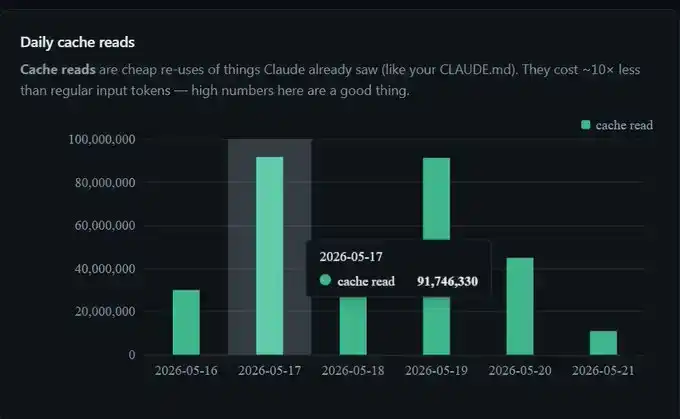
I didn't change any settings. This is just prompt caching working normally in the background.

But after I truly understood what caching is and how to avoid "breaking" it, with the same usage quota, my sessions could last longer. So, here is a compiled 80/20 introductory guide to Claude Code prompt caching, without delving into deep API-level details.

TL;DR

Cached Tokens cost only 10% of regular input Tokens. 91 million cached Tokens are billed approximately equivalent to 9 million Tokens.

Claude Code subscription cache TTL is 1 hour; API default is 5 minutes; Sub-agent is always 5 minutes.

Caching is divided into three layers: system, project, and conversation.

Switching models mid-conversation breaks the cache, including enabling "opus plan" mode.

How is caching actually billed?

Every cached Token costs 10% of a regular input Token.
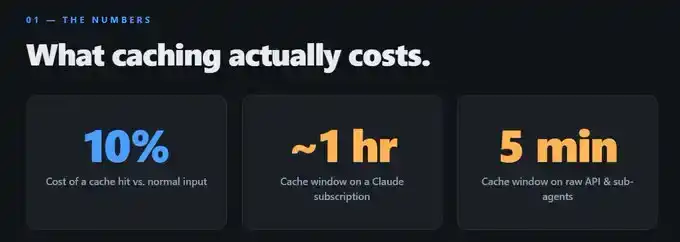
So, when my dashboard shows 91 million Tokens hitting cache on a particular day, the actual billing is roughly equivalent to processing only 9 million Tokens. This is also why, compared to having no cache, using Claude Code for long periods makes the session feel almost "free" to extend.

Two numbers on the dashboard are worth focusing on:

Cache create: The one-time cost incurred when writing content to the cache. It starts to take effect in the next round of conversation.
Cache read: Tokens Claude reuses from the cache, such as your CLAUDE.md, tool definitions, previous messages, etc. Cost is 10 times cheaper compared to reprocessing them as input.
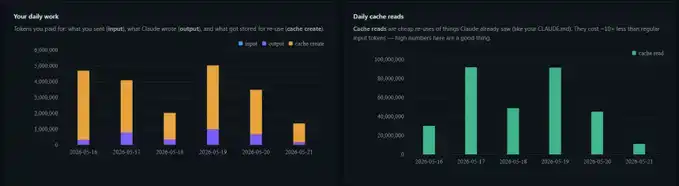
If your Cache read number is high, it means you are effectively utilizing the cache; if this number is low, it means you are repeatedly paying for the same context.

Anthropic's Thariq once said something that left a deep impression on me: "We actually monitor prompt cache hit rates, and if the hit rate gets too low, it triggers an alert, even declaring a SEV-level incident."

He also wrote a great X article. When cache hit rates are high, four things happen simultaneously: Claude Code feels faster, Anthropic's service costs decrease, your subscription quota seems more durable, and long coding sessions become more realistic.

But if the hit rate is low, everyone loses.
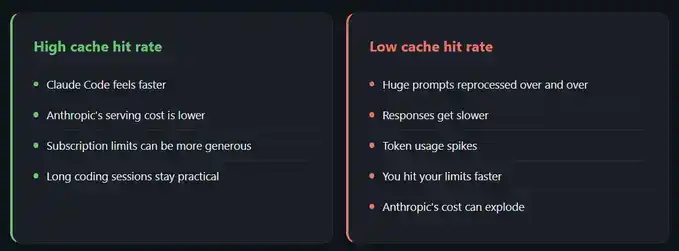
So, the incentives are actually aligned: Anthropic wants your cache hit rate higher, and you yourself want the hit rate higher. What truly holds things back are some seemingly insignificant habits that quietly reset the cache.

How does the cache grow with each conversation turn?

Caching relies on prefix matching.

Without getting too deep into technical details, you just need to understand one thing: as long as the content before a certain position is completely identical to what's already cached, Claude can reuse those cached Tokens.

A brand new session typically unfolds like this:
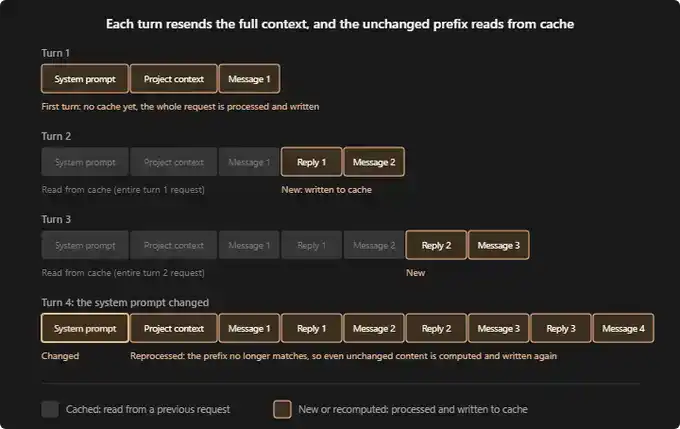
According to Claude Code documentation, a fresh session usually runs like this:

First conversation turn: No cache exists yet. The system prompt, your project context (like CLAUDE.md, memory, rules), and your first message are all processed from scratch and written to the cache.

Second conversation turn: All content from the first turn is now cached. Claude only needs to process your new reply and the next message. This round is much cheaper.

Third conversation turn: Same logic. Previous conversation remains in the cache, only the latest round of interaction needs reprocessing.

The cache itself can be divided into three layers:
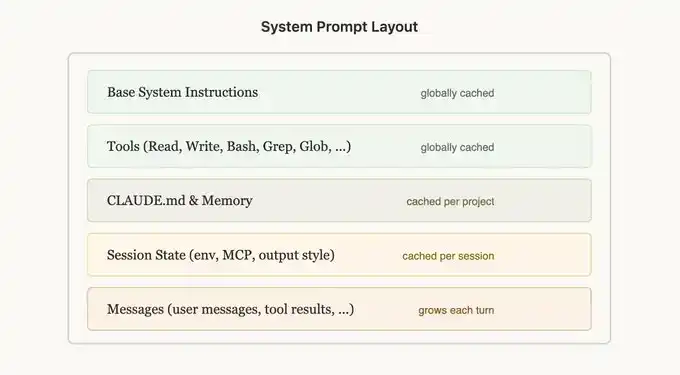
From Thariq's X article:

System layer: Includes base instructions, tool definitions (read, write, bash, grep, glob), and output style. This layer is cached globally.

Project layer: Includes CLAUDE.md, memory, project rules. This layer is cached per project.

Conversation layer: Includes replies and messages, growing with each conversation turn.

If anything in the system or project layer changes mid-session, everything must be recached from scratch. This is the most "expensive" operation. Imagine: you're already on the 16th message, then suddenly change the system prompt, or pause for an hour, all Tokens from message 1 onward need to be reprocessed.

The confusion between 1 hour and 5 minutes

This is the most easily misunderstood point.

Claude Code subscription: Default TTL is 1 hour.

Claude API: Default TTL is 5 minutes. You can pay a higher cost to increase it to 1 hour.
Sub-agent on any plan: Always 5 minutes.

Claude.ai web chat: Not officially documented. Likely same as subscription, but I haven't confirmed.

A few months ago, many people complained that Claude subscription quotas were being consumed too quickly. Some thought Anthropic had quietly reduced TTL from 1 hour to 5 minutes without notifying users. But that wasn't the case; Claude Code's TTL remains 1 hour.

The problem is, Claude Code and API documentation are kept separate, and these are two completely different things, leading to much confusion.

If you're running many Sub-agent workflows, or using the API directly, the 5-minute figure is important. But for 95% of Claude Code users, what really matters is that 1-hour window.

Three habits that cover 95% of users

The following are parts I find truly useful for daily use.

Don't pause too long

If you've been idle for more than an hour, previous content has mostly expired from the cache. Your next message will rebuild the cache. In such cases, instead of resuming an old session that has "gone cold," it's often cheaper to do a clean handoff and start a new session.

When switching tasks, just start fresh

/compact or /clear inherently break the cache, so it's better to use that moment for a true reset.

I made a session handoff skill to replace /compact. It summarizes what we've completed, what pending decisions remain, which files are most important, and where to continue next. Then I run /clear, paste this summary in, and can proceed as if nothing was interrupted.

The compact command sometimes runs slowly too. This handoff skill usually finishes in under a minute.

In Claude chat, put large documents into Projects

The caching mechanism on Claude.ai isn't officially documented in great detail, but Projects clearly use different optimizations compared to regular chat threads. So, if you need to paste large documents, it's better to put them in a Project rather than directly into the chat.

Which operations quietly break the cache?

A few things can completely reset the cache without obvious warning.

Switching models: Because caching relies on prefix matching, and each model has its own cache. Switching models means the next request will read the full history with no cache hits.

"Opus plan" mode: This setting uses Opus for planning and Sonnet for execution. I recommended it in some token optimization videos for a reason. But it's important to understand that each plan switch is essentially a model switch, meaning the cache must be rebuilt. In the long run, it still helps extend session quota, but you need to know what's happening under the hood.

Editing CLAUDE.md mid-session is okay: This change doesn't take effect immediately; it applies on the next restart. Therefore, the currently running cache isn't affected.

My free Token dashboard

The screenshot I showed earlier is from a token dashboard.
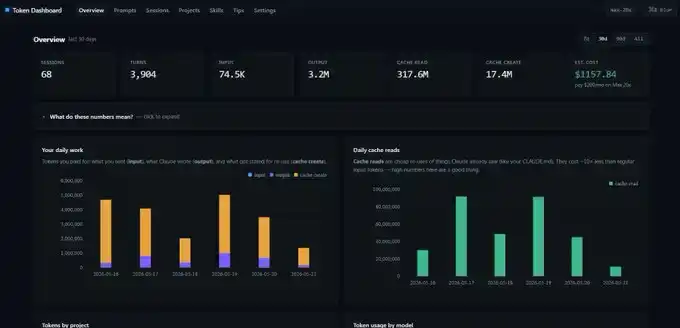
It's a simple GitHub repo. You give the link to Claude Code, have it deploy locally on localhost, and it will read all your past session records instead of starting statistics from scratch. You immediately see daily input, output, cache create, and cache read data.

One thing to note: this dashboard counts Token data on your local device. If you switch from desktop to laptop, the numbers won't match exactly. Each device has its own statistical view.

Summary

Prompt caching is something you can research deeply. Thariq's article covers it more completely than here; if you want the full picture, it's worth reading.

But you don't need to understand all the details to benefit. You just need to grasp the key 80/20: cached Tokens are 10 times cheaper than regular Tokens; Claude Code TTL is 1 hour; switching models breaks the cache; making a clean handoff between tasks is usually more cost-effective than forcing an old session back to life after it "expires."


Criptos en tendencia

Preguntas relacionadas

QWhat is the core mechanism described in the article for significantly reducing Claude Code costs?

AThe core mechanism is prompt caching, where previously processed context (system prompts, tool definitions, project files, conversation history) is stored and reused. If a new request's prefix matches the cached content, Claude reads from the cache instead of reprocessing, costing only 10% of a standard input token.

QWhat is the key financial benefit of high cache read rates mentioned in the article?

ATokens read from the cache are billed at only 10% of the cost of standard input tokens. This means high cache read rates make a Claude Code subscription last significantly longer, as repeated context is not fully re-processed and paid for.

QWhat are the three main layers of prompt caching in Claude Code, according to the article?

AThe three layers are: 1. System Layer (global cache for base instructions, tool definitions like read/write/bash, and output style). 2. Project Layer (cached per project, includes CLAUDE.md, memory, project rules). 3. Conversation Layer (cached per session, includes the growing history of messages and replies).

QWhat is the single most common user action that will completely reset the prompt cache in an active Claude Code session?

ASwitching the model mid-conversation. Because cache relies on prefix matching and each model has its own cache, switching models forces Claude to reprocess the entire context from scratch with no cache hits.

QWhat practical habit does the author recommend for switching tasks to better preserve caching benefits?

APerform a clear session handoff instead of letting a session idle past the TTL. The author uses a custom 'session handoff skill' to summarize progress, pending decisions, and key files before using /clear. This summary is pasted into the new session, providing continuity while allowing a fresh, efficiently cached session to begin.

Lecturas Relacionadas

In Conversation with Ray Dalio: We Are Currently in an AI Bubble, with 1% of My Portfolio in Bitcoin

Ray Dalio, founder of Bridgewater Associates, warns in an interview that the current AI boom shows classic bubble characteristics, which could lead to significant economic downturns as seen in past cycles like 1929 or 2000. He explains that speculative enthusiasm, fueled by debt and overvaluation, often precedes a crash when rising rates or taxation force asset sales, causing widespread losses and recession. Dalio also outlines his "Big Cycle" theory, describing an approximate 80-year pattern where widening wealth gaps, massive government deficits, and shifting geopolitical power (like China's rise) create internal conflict and global instability. He emphasizes that we are in a late-cycle, transitional phase where traditional powers like the US and UK face decline. For personal wealth protection, Dalio advises diversification beyond cash into assets like stocks, bonds, real estate, and particularly gold, which he prefers over Bitcoin. While he holds about 1% of his portfolio in Bitcoin as a non-printable hard asset, he views gold as more secure from technological or governmental threats. Regarding AI's impact, Dalio believes it will disproportionately benefit capital owners, worsening inequality by replacing both physical and cognitive labor. He suggests that human intuition and emotional intelligence, combined with AI, will be key for future workers. On taxation, Dalio argues that wealth taxes are impractical and risk triggering asset sell-offs, reducing productive investment. He points to the UK as a cautionary example of debt, low productivity, and political strife. Geopolitically, Dalio foresees a more regionalized world, with the US showing weakness in prolonged conflicts like with Iran, akin to past imperial declines. The ideal outcome, he suggests, is coexisting powerful blocs (e.g., Americas, China-Asia Pacific) without major war.

marsbitHace 3 hora(s)

In Conversation with Ray Dalio: We Are Currently in an AI Bubble, with 1% of My Portfolio in Bitcoin

marsbitHace 3 hora(s)

Daily 7.2 Trillion KRW: Foreign Capital's Record Net Buying on Friday! Wall Street Says Headwinds for Korean Stock Fund Flows Have Subsided

South Korean stock market sees a dramatic shift in fund flows. On July 31, foreign investors made a record net purchase of approximately KRW 7.2 trillion in KOSPI stocks, marking a fundamental reversal from the persistent large-scale net outflows seen in previous months. This contributed to a significant narrowing of foreign net selling in July to KRW 9.8 trillion, down sharply from KRW 48.4 trillion in June and KRW 44.5 trillion in May. Simultaneously, domestic institutional pressure eased. South Korean pension funds and asset managers turned to a net buying position in July, purchasing KRW 1.0 trillion worth of KOSPI shares, contrasting with net sales in May and June. Market volatility is expected to be dampened by new financial regulations. Effective July 31, the Financial Services Commission tightened access for retail investors to single-stock leveraged ETFs by raising the minimum cash deposit requirement. Trading volumes for these products subsequently dropped to about 50% of their monthly average. Citigroup Research maintains its year-end KOSPI target of 10,000 points. The firm cites several supportive factors: the substantial easing of headwinds from capital outflows, a robust fundamental outlook for the semiconductor sector, historically low market valuations, strong economic fundamentals, and the potential for policy support from financial authorities if needed.

marsbitHace 3 hora(s)

Daily 7.2 Trillion KRW: Foreign Capital's Record Net Buying on Friday! Wall Street Says Headwinds for Korean Stock Fund Flows Have Subsided

marsbitHace 3 hora(s)

Thanks to Dice Rolls, Bitcoin Keys Are Stored Offline, But Not Everyone Will Do It

The article discusses using dice rolls to generate secure Bitcoin wallet seeds, providing entropy independent of potentially flawed hardware random number generators. It explains that each fair dice roll offers about 2.585 bits of entropy, with around 50 rolls needed for a standard 12-word seed phrase and 99+ recommended for higher security. This method gained attention after a vulnerability was revealed in some Coldcard hardware wallets, where a faulty firmware RNG (dating back to 2021) compromised generated keys. The analysis notes that while a dice-generated main seed was safe from this specific flaw, other Coldcard functions (like creating paper wallets, backup keys, or passwords) could still be vulnerable if they used the defective RNG. The piece argues that while dice-based entropy is technically robust, the manual process is error-prone, tedious, and unrealistic for most new users, who might make mistakes in recording or inputting rolls. It concludes that while manual entropy generation should remain an option for advanced users, the long-term goal is to develop reliable, user-friendly hardware and software that securely generates randomness without requiring specialized knowledge. Coldcard users are advised to check their firmware version and replace any secondary secrets (like paper wallet keys) created with vulnerable devices, while also considering multi-signature setups with devices from different manufacturers for added security.

cryptonews.ruHace 8 hora(s)

Thanks to Dice Rolls, Bitcoin Keys Are Stored Offline, But Not Everyone Will Do It

cryptonews.ruHace 8 hora(s)

Trading

Spot

Artículos destacados

Cómo comprar PEOPLE

¡Bienvenido a HTX.com! Hemos hecho que comprar ConstitutionDAO (PEOPLE) sea simple y conveniente. Sigue nuestra guía paso a paso para iniciar tu viaje de criptos.Paso 1: crea tu cuenta HTXUtiliza tu correo electrónico o número de teléfono para registrarte y obtener una cuenta gratuita en HTX. Experimenta un proceso de registro sin complicaciones y desbloquea todas las funciones.Obtener mi cuentaPaso 2: ve a Comprar cripto y elige tu método de pagoTarjeta de crédito/débito: usa tu Visa o Mastercard para comprar ConstitutionDAO (PEOPLE) al instante.Saldo: utiliza fondos del saldo de tu cuenta HTX para tradear sin problemas.Terceros: hemos agregado métodos de pago populares como Google Pay y Apple Pay para mejorar la comodidad.P2P: tradear directamente con otros usuarios en HTX.Over-the-Counter (OTC): ofrecemos servicios personalizados y tipos de cambio competitivos para los traders.Paso 3: guarda tu ConstitutionDAO (PEOPLE)Después de comprar tu ConstitutionDAO (PEOPLE), guárdalo en tu cuenta HTX. Alternativamente, puedes enviarlo a otro lugar mediante transferencia blockchain o utilizarlo para tradear otras criptomonedas.Paso 4: tradear ConstitutionDAO (PEOPLE)Tradear fácilmente con ConstitutionDAO (PEOPLE) en HTX's mercado spot. Simplemente accede a tu cuenta, selecciona tu par de trading, ejecuta tus trades y monitorea en tiempo real. Ofrecemos una experiencia fácil de usar tanto para principiantes como para traders experimentados.

553 Vistas totalesPublicado en 2024.12.12Actualizado en 2026.06.02

Cómo comprar PEOPLE

Discusiones

Bienvenido a la comunidad de HTX. Aquí puedes mantenerte informado sobre los últimos desarrollos de la plataforma y acceder a análisis profesionales del mercado. A continuación se presentan las opiniones de los usuarios sobre el precio de PEOPLE (PEOPLE).

活动图片












