Housing Price "Shorting Tool" Emerges as Polymarket Launches Real Estate Prediction Market

marsbitPublicado a 2026-01-06Actualizado a 2026-01-06

Resumen

Polymarket, a prediction market platform, has partnered with real estate data provider Parcl to launch a new prediction market for US housing prices. The collaboration will utilize Parcl’s daily housing price indices as a verifiable and transparent data source to settle market outcomes on Polymarket. Users can trade on whether prices in specific high-liquidity U.S. cities—such as New York, Miami, and San Francisco—will rise or fall over monthly, quarterly, or annual periods. All trading is done using USDC on the Polygon blockchain. This initiative effectively creates a “shorting tool” for real estate, allowing participants to hedge against or speculate on local housing market downturns without needing to buy or sell physical property. The move introduces a liquid, crypto-native trading layer for real estate price expectations—a market traditionally known for its illiquidity and high transaction costs. The launch has positively impacted Parcl’s native token PRCL, which saw a price increase of over 150% following the announcement.

Author | Asher(@Asher_ 0210)

The credibility of "everything is predictable" continues to rise.

On the evening of January 5th, the on-chain real estate platform Parcl announced a collaboration with the prediction market Polymarket, aiming to introduce Parcl's daily housing price index into Polymarket's new real estate prediction market. Following this news, Parcl's token PRCL saw a short-term surge of over 150%, currently retracting slightly to $0.042, with a market cap of $19 million.
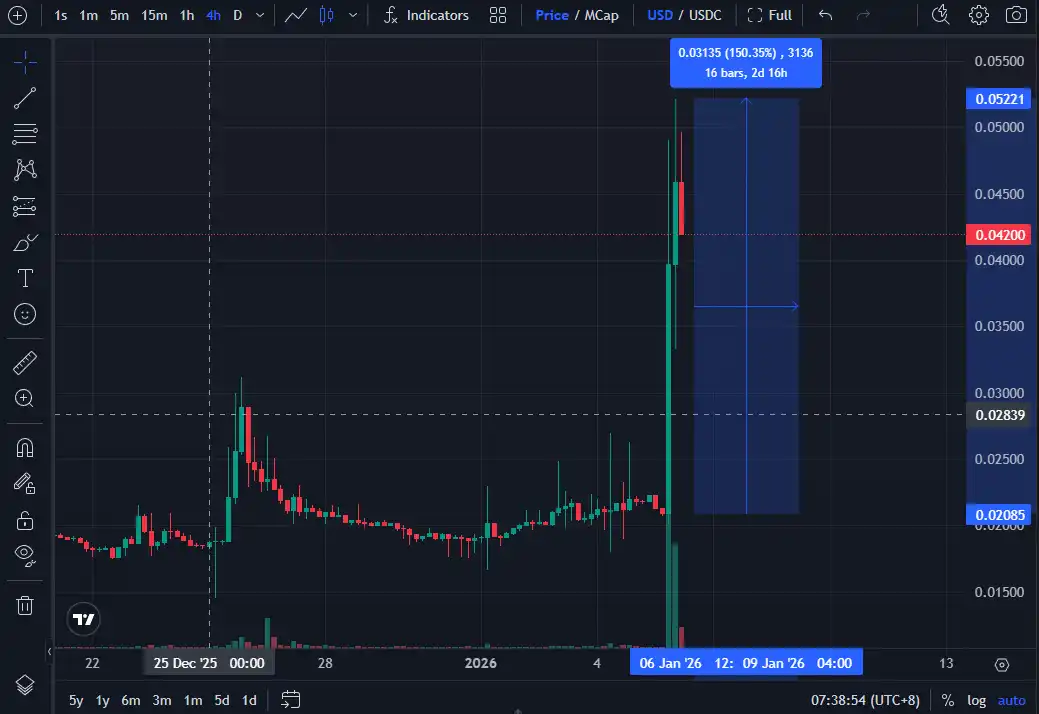
PRCL Price Chart

Operational Details of Polymarket's Real Estate Prediction Market Section

Collaboration Details:

  • Parcl provides daily housing price indices as an independent, transparent reference data for market settlement;
  • Polymarket is responsible for listing and operating the markets, where users can trade using USDC on the Polygon chain;
  • Market settlements are based on Parcl's publicly verifiable index, avoiding the delays (typically monthly) and subjectivity of traditional real estate data.

Market Types:

  • Predicting whether housing prices will rise/fall within a month, quarter, or year;
  • Threshold markets: e.g., whether housing prices exceed a specific level;
  • Each market is linked to Parcl's dedicated settlement page, displaying final values, historical data, and index calculation methods.

Coverage:

  • Initially starting with high-liquidity U.S. cities, such as New York, Miami, San Francisco, Austin, etc.;
  • Subsequently expanding to more cities and market types based on user demand.

Example Display:

Currently, this section has only listed 7 monthly real estate prediction events, with low liquidity. The event with the highest trading volume, "U.S. Los Angeles Housing Agent Price on February 1st," has only $3,700.
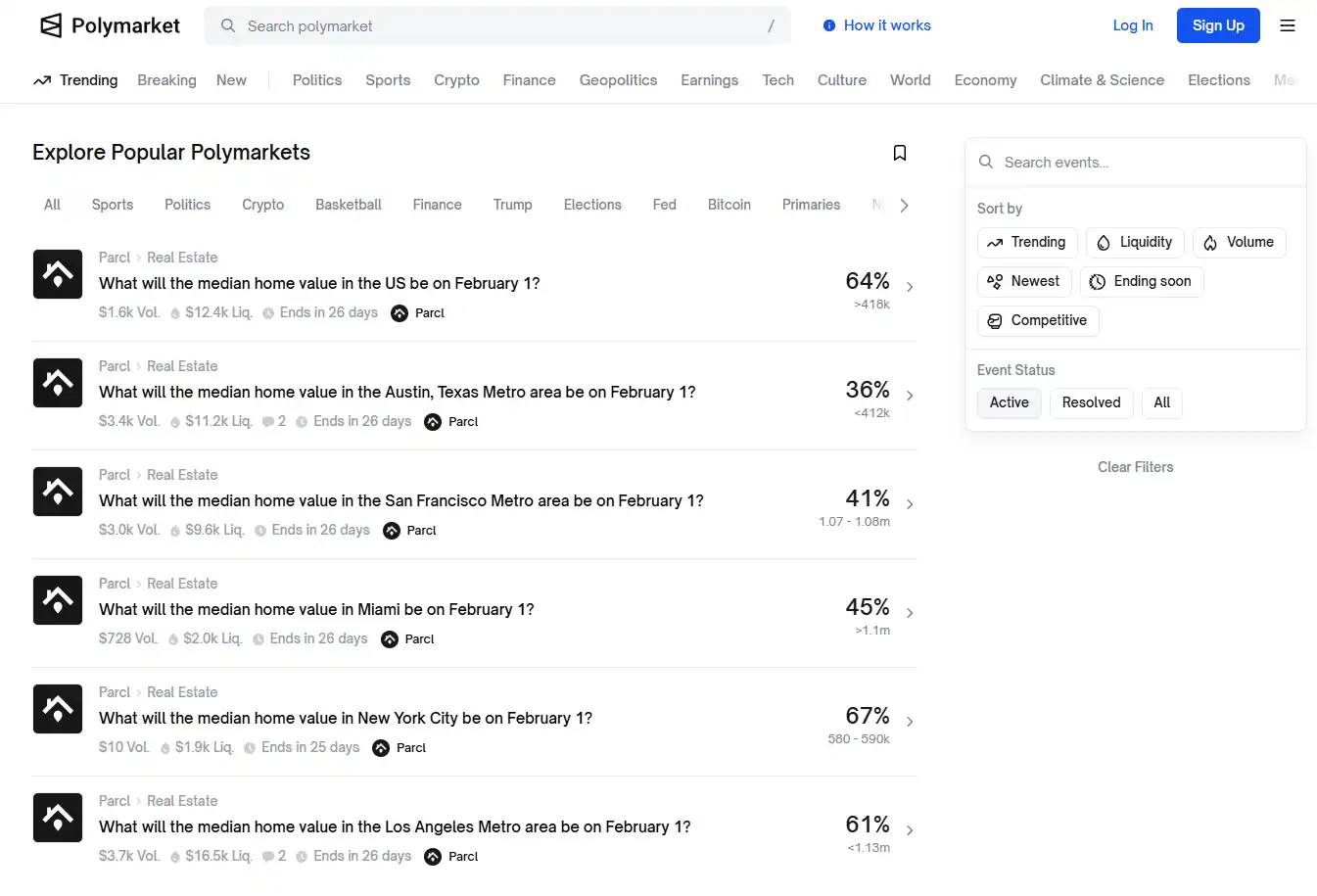
Polymarket's New Real Estate Prediction Market Section

In traditional real estate markets, whether bullish or bearish, such expectations are difficult to express directly, let alone form continuous market signals. Polymarket's introduction essentially separates "judgments on housing prices" from asset transactions. As long as there is a clear settlement standard, expectations themselves can be priced independently.

The Real Estate Market Finally Sees a "Shorting Tool"

An easily overlooked fact is that the potential demand for real estate-related markets does not only come from native speculators.

In the traditional financial system, "falling housing prices" are almost a risk that cannot be directly hedged. Whether holding property or having asset structures and income sources highly dependent on a city's real estate cycle, the practical response is often to continue holding or directly sell physical assets—high transaction costs, long cycles, and a lack of flexible intermediate options. As KOL 0xMarioNawfal (@RoundtableSpace) stated: "This is far more than just betting; it's about bringing liquidity to one of the world's most illiquid markets. Imagine housing prices are at historic highs, and you expect a crash but can't sell your house—now you can hedge and short the market."

The introduction of prediction markets abstracts the decline in housing prices into a tradable risk judgment. When housing prices are high and market expectations begin to weaken, the trend of real estate prices itself can be priced separately without having to dispose of underlying assets for risk management.

Through Polymarket, the downside risk of real estate prices is abstracted into a tradable judgment rather than requiring the disposal of physical assets. From this perspective, Polymarket's real estate prediction market is closer to a simplified macro hedging mechanism than a mere speculative game around rises and falls. It does not change the liquidity structure of real estate assets themselves but provides a tradable layer that can reflect expectations in real-time for a long-term illiquid market.

Polymarket CMO Matthew Modabber stated: "Prediction markets are best suited for events with clear, verifiable data. Parcl's daily housing price index provides us with a transparent, consistent settlement foundation. Real estate should become a first-class category in prediction markets."

The collaboration between Polymarket and Parcl also introduces traditional real estate price signals into the crypto system: Originally low-frequency, closed, and high-barrier assets are broken down into settleable, verifiable, and tradable index results, resembling stock indices or crypto derivatives. This may be a more practical and demand-aligned implementation path in the RWA narrative.


Preguntas relacionadas

QWhat is the main purpose of the collaboration between Parcl and Polymarket?

AThe collaboration aims to introduce Parcl's daily housing price indices into Polymarket's new real estate prediction markets, providing an independent and transparent reference for market settlements.

QHow does the real estate prediction market on Polymarket function in terms of settlement?

AMarket settlements are based on Parcl's publicly verifiable index data, which avoids the delays (typically monthly) and subjectivity of traditional real estate data.

QWhat types of markets are available in Polymarket's real estate prediction section?

AThe markets include predicting whether housing prices will rise or fall within monthly, quarterly, or annual periods, as well as threshold-based markets, such as whether prices will exceed specific levels.

QWhy is the introduction of real estate prediction markets significant for risk management?

AIt allows users to hedge against or speculate on housing price declines without needing to dispose of physical assets, providing a tool to directly trade and price the risk of falling real estate values.

QWhich US cities are initially covered in Polymarket's real estate prediction markets?

AThe initial coverage includes high-liquidity US cities such as New York, Miami, San Francisco, and Austin, with plans to expand to more cities based on user demand.

Lecturas Relacionadas

From Shouting 150 Dollars to Liquidating HYPE in Just Three Days, How Much Credibility Does Arthur Hayes Have Left?

How much of Arthur Hayes's market credibility remains? Recently, the "godfather of crypto perpetual swaps" and BitMEX co-founder has faced public criticism, including accusations from on-chain investigator ZachXBT about creating exit liquidity for his followers. Starting last week, Hayes executed multiple sudden sell-offs. He had repeatedly publicly predicted the HYPE token would reach $150. After a $100,000 bet defending Hyperliquid on June 1st, he announced just three days later that he had completely sold his HYPE and NEAR holdings, successfully exiting near the peak. He also sold ZEC and WLD. His sale of WLD appeared to be a classic "pump and dump" maneuver. On June 3rd, he publicly set a $10 target for WLD, causing its price to surge over 35%. By June 6th, he announced he had sold his WLD, citing "anomalous" SpaceX pre-IPO price action, which triggered a sharp price drop. On June 9th, Hayes published a lengthy article explaining his actions, citing factors like rising energy costs and a potential AI bubble burst. Consequently, his family office, Maelstrom, now holds positions in US energy producers and only core crypto assets BTC and ETH, having sold AI-related stocks and non-core cryptocurrencies. This pattern is not new. In 2025, he similarly touted HYPE before selling it at what turned out to be a cycle peak, only to repurchase it at the next cycle's low. Similar scenarios played out with tokens like ETHFI and ENA. Long-term observers have developed a strategy: ignore Hayes's public statements but closely monitor his on-chain actions—be cautious following his buys, but decisively follow his sells. If he continues these tactics, especially as seen with the WLD case, his market credibility risks being permanently damaged. As Hayes himself admitted in his latest article, "I remain an unapologetic gambler."

marsbitHace 17 min(s)

From Shouting 150 Dollars to Liquidating HYPE in Just Three Days, How Much Credibility Does Arthur Hayes Have Left?

marsbitHace 17 min(s)

Fundraising is Like a Strange Dance: The 'Absurd Drama' of Silicon Valley Founders' Capital Raises

The article details a series of absurd and revealing anecdotes shared by Silicon Valley founders about their venture capital fundraising experiences, sparked by Greg Isenberg's story of pitching to a sleeping a16z partner. Founders describe surreal pitch meetings: one faced a barefoot, peanut-eating investor who offered triple the requested amount after 30 seconds; another performed a pitch in a VC's parked car; a founder discovered his audience understood no English beyond "yes." These stories highlight the often irrational and performative nature of fundraising. Beyond the absurdity, darker power imbalances are exposed. Stories include investors suggesting founders fire co-founders for their equity, blatant market misjudgments, disrespectful behavior from LPs, and discriminatory remarks. A debate also emerges around "Sequoia's" practice of splitting a round into two valuations. However, the thread isn't solely critical. Positive counter-narratives celebrate supportive VCs who offered crucial advice during crises, respected founders' timelines, and showed simple gestures of respect—like a partner personally fetching coffee before a major pitch. Ultimately, the collective sharing acts as a pressure release, illustrating that fundraising is a complex dance of power, trust, and sometimes sheer theater. It underscores that beyond capital, mutual respect and integrity remain the most enduring foundations of the founder-investor relationship.

marsbitHace 31 min(s)

Fundraising is Like a Strange Dance: The 'Absurd Drama' of Silicon Valley Founders' Capital Raises

marsbitHace 31 min(s)

Vitalik's Vision for the Next Evolution of On-Chain Finance: How to Reconstruct DeFi with an 'Options Mindset'?

Vitalik Buterin recently proposed a conceptual shift for DeFi: replacing traditional Collateralized Debt Positions (CDPs) and forced liquidations with an options-based mechanism. This aims to address key vulnerabilities in current DeFi lending. The traditional CDP model, foundational to protocols like MakerDAO and Aave, allows users to borrow against collateral but relies on real-time oracles and triggers sudden, mandatory liquidations during price volatility. This can cause cascading sell-offs, oracle manipulation risks, and significant MEV extraction, exacerbating market stress. Vitalik's alternative envisions splitting an asset like 1 ETH into two complementary components: one offering stable/index-like exposure and the other absorbing the opposite risk/reward. Instead of a hard liquidation threshold, a user's exposure to the target asset would gradually and smoothly deviate (following a near-quadratic curve) as the collateral price moves. The system would primarily depend on "slow oracles" for periodic settlement rather than instant price feeds. Key potential benefits include: the elimination of abrupt, forced liquidations; drastically reduced reliance on vulnerable real-time oracles; and inherent resistance to certain MEV exploits centered on liquidation auctions. The article posits that for Ethereum DeFi to maintain its relevance amid competition from faster, cheaper chains, it must compete on sophisticated financial engineering and robustness—not just transaction speed or yields. The core value proposition should shift towards offering users clearer, more manageable risk structures, greater autonomy, and resilience in extreme scenarios, moving DeFi from high-risk experimentation towards becoming reliable financial infrastructure.

marsbitHace 1 hora(s)

Vitalik's Vision for the Next Evolution of On-Chain Finance: How to Reconstruct DeFi with an 'Options Mindset'?

marsbitHace 1 hora(s)

Trading

Spot
Futuros
活动图片




