Hot Perp DEX Recent Updates: Find the Best Way to Participate

Odaily星球日报Publicado a 2025-12-18Actualizado a 2025-12-18

Resumen

Despite a generally cool market, Perp DEX platforms remain highly active due to airdrop incentives and stable trading volumes. Here are key updates from three popular Perp DEXs: **StandX** launched its mainnet trading points program, with daily volume exceeding $100 million. Users earn points by depositing DUSD, providing liquidity, trading, or inviting friends. A trading competition is planned, along with more trading pairs. **Aster**, currently leading in daily trading volume among Perp DEXs, continues its monthly airdrop campaigns. Phase 4 is ongoing until Dec 22, and Phase 5 will run from Dec 22 to Feb 1, 2026, distributing 1.2% of total supply. Aster has also increased its daily buyback and burn rate to ~$4 million and launched a human vs. AI trading competition. **Lighter** has been added to Coinbase's listing roadmap, but its TGE may be delayed until late December or early January. Its points system for traders remains opaque ("a blind box"), considering factors like volume and PnL. The team emphasizes a long-term approach to token value rather than a pump at launch.

Original | Odaily Planet Daily (@OdailyChina)

Author | Asher (@Asher_ 0210)
Although the overall market has been relatively cold recently, driven by incentives such as token airdrops, the community discussion around the Perp DEX sector remains highly active, and daily trading volume has remained stable without significant decline. Next, Odaily Planet Daily will summarize the recent key updates from 3 highly discussed Perp DEX platforms to see what offers the best value at this stage.

StandX: Trading Points Activity Now Live on Mainnet, Trading Competition Coming Soon

On December 10, StandX announced on platform X that the trading points activity is now live on the mainnet, with the first day's trading volume exceeding $81 million, and reaching over $100 million on December 16. Users can earn points by depositing DUSD into the Perps Wallet, Vaults, or actively participating in trading (Interaction link: https://standx.com/).

This event is in cooperation with Binance Wallet. Users using Binance Wallet's keyless extension wallet will receive a 10% points bonus, which lasts for 4 weeks until January 7, 2026. Points will be retroactively awarded for all past transactions since the mainnet launch.

Furthermore, core team member Justin participated in a Chinese AMA in early December. Odaily Planet Daily summarizes the key points below:

Q1: Is there a depegging risk for the built-in stablecoin (DUSD)? How secure is it?

A1: The DUSD mechanism is secure and fully collateralized, with underlying assets like BTC and ETH; it uses a "spot long + perpetual short" basis trading strategy to maintain "market neutrality." This means the total asset value remains stable in U terms regardless of price fluctuations, only earning funding rates without bearing the risk of price volatility.

Q2: What's the difference between the Mainnet and the previous Alpha testnet?

A2: The Alpha phase used test coins, primarily for testing product features and distributing "testnet points"; the Mainnet phase uses real funds, requiring users to deposit actual USDT for trading. The current points are "mainnet points," whose value and weight differ from the testnet.

Q3: What are the project's future plans?

A3: StandX is about to launch a trading competition and plans to list more altcoin perpetual pairs. Simultaneously, the team will continue optimizing the product experience, aiming for a CEX-like (centralized Exchange) experience on the DEX.

Q4: What is the proportion of trading points vs. deposit points for the airdrop?

A4: This hasn't been finalized yet because we are currently separating points from each phase and each type, meaning rewards are earned separately. We will comprehensively evaluate the contribution of each user type and point type to the overall StandX product and ecosystem before the airdrop to decide the reward proportions.

Complete Guide to Earning StandX Points

Method 1: Deposit DUSD to get tDUSD (1.2x points), specific steps:

  • Mint DUSD with USDT/USDC;
  • Deposit DUSD into the Perps wallet to convert it to tDUSD;
  • Every 1000 tDUSD / day = 1200 points;
  • Lossless participation, suitable for newcomers and users who don't trade.

Method 2: Provide LP, points rules:

  • DUSD: Each DUSD earns 1 point per day;
  • USDT/USDC: Each USDT/USDC earns 1.2 points per day.

For example, 1000 DUSD + 1000 USDT → 2200 points/day.

Method 3: SWAP trading to earn points (specified trading pairs), every 100 DUSD trading volume = 5 points.

This method has significant slippage; "point farmers" should participate cautiously.

Method 4: Invite friends, both parties get an additional 5% points bonus.

Method 5: Trade on the StandX mainnet to earn points.

  • If profitable: More profit means more tDUSD, leading to higher points;
  • If loss: If the loss exceeds 50% of the initial capital, points are still given based on 50% of the initial capital.

Additionally, the daily trading check-in event is worth participating in. Complete two trades over $100 daily to earn 10 points.

The StandX trade-to-earn points for token airdrop is still in its early stages. Judging by the daily trading volume, it's not "very competitive" currently, making it relatively easy to earn points. It's worth participating in; even if you don't farm trading volume for points, you can deposit stablecoins to "freeload" points daily.

Aster: Monthly Airdrops + Regular Buyback & Burn; Launches Human vs. AI Trading Duel

According to the latest data from DeFiLlama, Aster's daily trading volume has recently surpassed that of Lighter (which has the highest token launch expectations), ranking first among Perp DEX projects.

Perp DEX Data

Although Aster has completed its TGE, its airdrop activities continue to progress, operating on a monthly cycle with short interaction periods and clear rewards.

Phase 4 Token Airdrop Ongoing

Currently, Phase 4 Aster Harvest officially started at 8:00 AM UTC on November 10 and will last until 7:59 AM UTC on December 22, 2025. This phase will distribute 1.5% of the total ASTER token supply, allocated equally across six epoch cycles, with 0.25% allocated per epoch.

Phase 5 Token Airdrop Starts December 22, Lasts 6 Weeks

Phase 5 Aster Crystal will begin after Phase 4 Aster Harvest concludes. Specific details are as follows:

  • Duration: 6 weeks (December 22, 2025, to February 1, 2026);
  • Allocation: 1.2% of the total supply (approx. 96 million ASTER) for Phase 5, with 0.6% claimable immediately after the event ends and the other 0.6% subject to a 3-month lock-up.

Additionally, Aster will launch the Aster chain testnet by the end of this year, the mainnet in Q1 next year, and token staking and governance functions in Q2.

Accelerates Phase 4 Buyback Execution, Daily Buyback Scale Increased to ~$4 Million

According to the latest announcement from the ASTER team, the buyback speed for Phase 4 will be increased under the existing mechanism. The accelerated buyback scale increased from approximately $3 million/day to about $4 million/day starting December 8.

The official statement said this move allows faster on-chain deployment of the fees accumulated since November 10 for Phase 4 buybacks and strengthens support during market volatility. Based on current fee levels, it's estimated that stable execution of the buyback will be reached within 8 to 10 days, after which the daily buyback scale will continue to be maintained between 60% and 90% of the previous day's revenue as per Phase 4 rules.

The team emphasized that all operations remain transparently executed on-chain, with no changes to the relevant execution wallet address (Address link: https://bscscan.com/address/0x573ca9ff6b7f164dff513077850d5cd796006ff4).

Additionally, Aster burned 77.86 million ASTER repurchased in Season 3 on December 5, worth nearly $80 million.
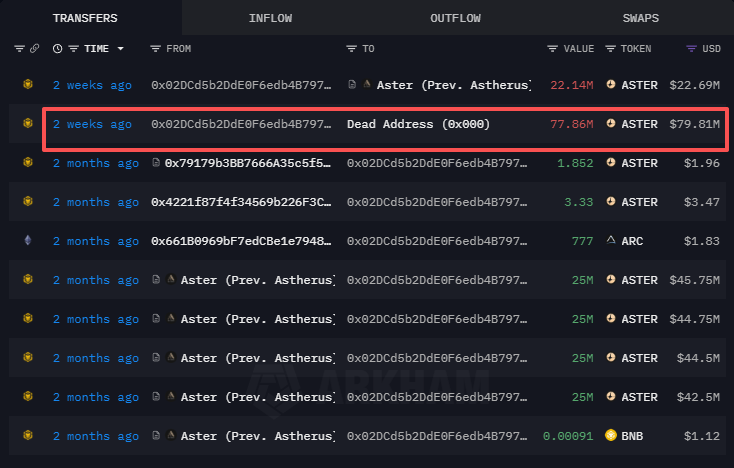
Aster Buyback Address

Launches Human vs. AI Trading Duel

On December 9, Aster announced on platform X that the Human vs. AI trading duel is live. 70 funded human traders are competing against 30 AI agents run by @nofA_ai (initial capital $10,000 each). The trading duel runs from December 9 to December 23.

As of now, only 29 out of the 100 traders (human and AI) are profitable. Among them, only 9 have profits exceeding $5,000—8 are human traders, and 1 is AI. The top performer is human trader Tippy, with profits as high as $47,000, far ahead.
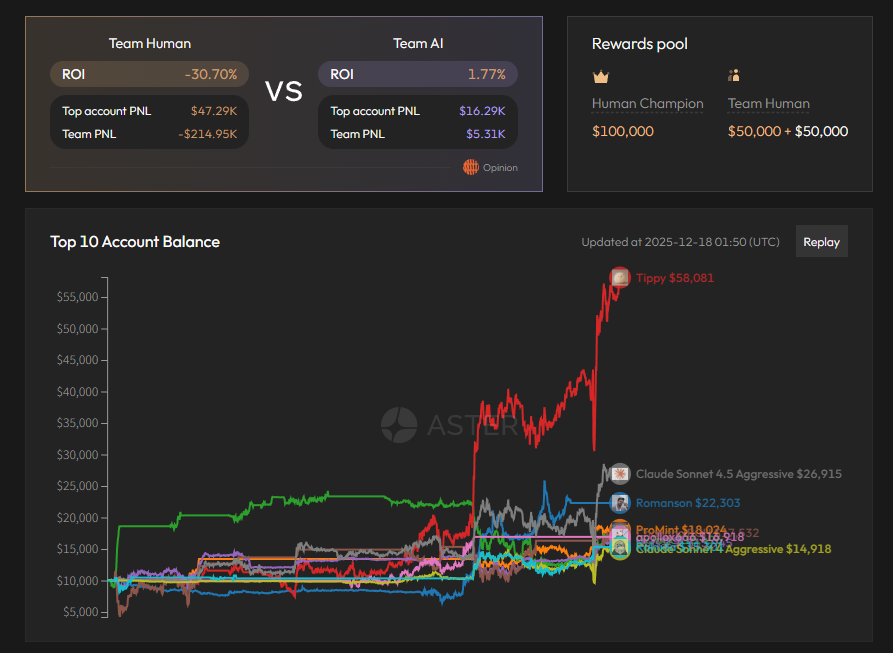
Human vs. AI Trading Profit Chart

Lighter: To List on Coinbase, but TGE Might Be Delayed

Since Lighter announced the completion of a $68 million funding round on November 11, valuing the company at $1.5 billion post-funding, its daily trading volume has consistently remained at the forefront of Perp DEXs, often ranking first. Regarding Q2 points, the official distribution is scheduled for every Friday. Market makers are allocated 50,000 points weekly (only advanced accounts are eligible to earn points through market making). Regular trading users are allocated 200,000 points weekly. Factors influencing points include: trading volume, open interest, account equity, leverage, profit/loss amount, and trading categories, but the specific weights have not been disclosed, making it a "blind box."

On December 13, Coinbase Markets announced on platform X that Lighter had been added to its listing roadmap, leading community members to believe Lighter's TGE is imminent.
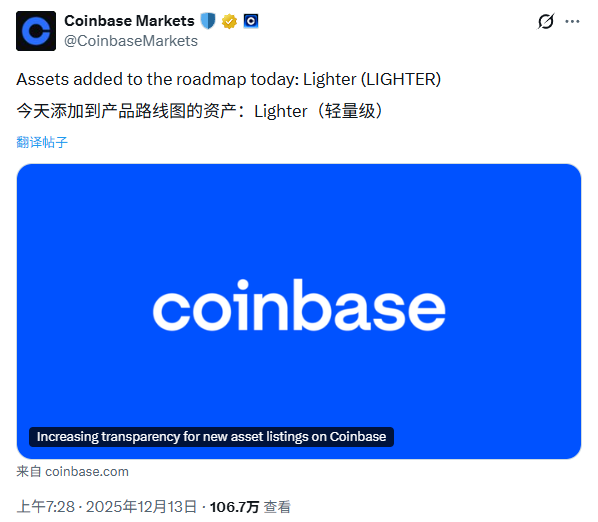
Coinbase Adds Lighter to Listing Roadmap

However, based on feedback from participants in Lighter's Japanese AMA, the TGE might be delayed to between December 24 and January 1 next year. Influenced by this news, the probability of "No" in the Polymarket event "Will Lighter airdrop tokens this year?" increased from just 8% on December 16 to 33%.
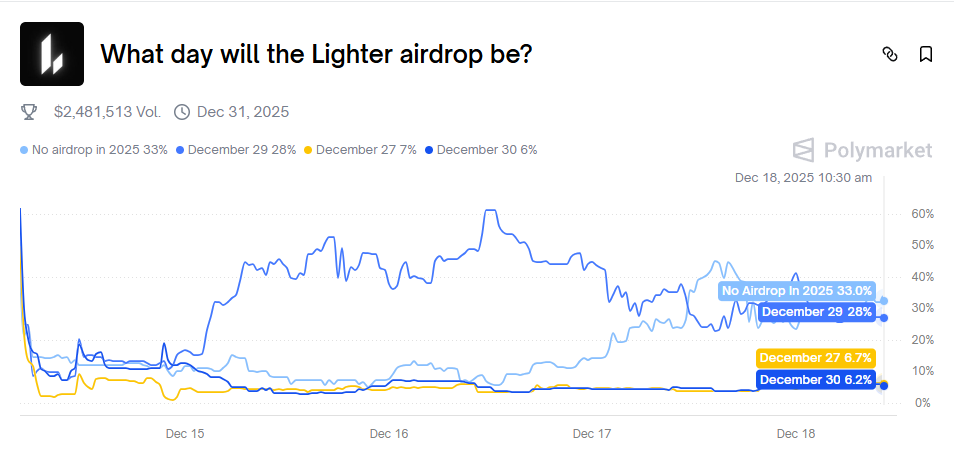
Polymarket Event: "Will Lighter Airdrop Tokens This Year?"

Furthermore, in a recent podcast interview on The Chopping Block, Lighter founder and CEO Vladimir Novakovski, when asked about the token, stated: "From an expectation management perspective, this is a marathon, not a sprint. The team and early community don't really anticipate a 'day one moonshot.' A more realistic expectation is starting from a relatively healthy position, with the overall trend gradually improving as we continue building the product. Our goal is clearly not to maximize value on day one, but to have it in a healthy state in the current market environment, and then iterate from there. We've seen too many tokens pump hard on day one and then trend downwards."

Related Content

2025 Airdrop Farming Survival Rules: Past Gold Rushes, Now Relying on These Two Trump Cards

Criptos en tendencia

Preguntas relacionadas

QWhat are the main ways to earn points on StandX and which method is recommended for new users?

AThe main ways to earn points on StandX are: 1) Depositing DUSD to get tDUSD (1.2x points), 2) Providing liquidity (LP), 3) SWAP trading on specified pairs, 4) Inviting friends for a 5% bonus, and 5) Trading on the mainnet. The method recommended for new users or those who don't want to trade is depositing stablecoins to 'farm' points with minimal risk.

QWhat is the current status of Aster's token airdrop and what are the key details of its upcoming Phase 5?

AAster's Phase 4 airdrop (Aster Harvest) is currently ongoing until December 22, 2025, distributing 1.5% of the total ASTER supply. Phase 5 (Aster Crystal) will begin on December 22, 2025, and last for 6 weeks until February 1, 2026. It will distribute 1.2% of the total supply (approx. 96 million ASTER), with half (0.6%) claimable immediately and the other half (0.6%) subject to a 3-month lockup.

QHow has Aster modified its token buyback mechanism in Stage 4 and what was the recent major burn event?

AAster has accelerated its Stage 4 buyback, increasing the daily buyback volume from approximately $3 million to about $4 million starting December 8th. This is executed transparently on-chain. Additionally, Aster recently burned 77.86 million ASTER tokens from the S3 season回购, valued at nearly $80 million.

QWhat was the outcome of the 'Human vs. AI Trading Duel' event hosted on Aster, and who was the top performer?

AIn the Human vs. AI Trading Duel on Aster, 70 human traders competed against 30 AI agents. As of the report, only 29 of the 100 participants were profitable. The top performer was a human trader named 'Tippy', who achieved a profit of $47,000. Only 9 traders had profits exceeding $5,000, 8 of whom were human and 1 was an AI.

QWhat is the current expectation for Lighter's TGE (Token Generation Event) according to community speculation, and what evidence suggests a potential delay?

ACommunity speculation, based on a Japanese AMA, suggests Lighter's TGE might be delayed to between December 24th and January 1st. This is further supported by the probability of 'No' on the Polymarket prediction market for 'Will Lighter airdrop its token this year?' rising from 8% to 33%.

Lecturas Relacionadas

The Biggest AI Black Hole: After Anthropic's Annual Revenue Hits $1 Trillion, Compute Power Prices Soar 10x

The article explores the potential for a dramatic surge in compute prices driven by the AI industry's explosive growth. It highlights a provocative prediction by tech podcaster Dwarkesh Patel: if AI labs like Anthropic continue their rapid revenue growth (projected to reach $1 trillion annually) while compute supply only expands at about 3x per year, the price of computing power could skyrocket by 10x or more. The core argument is a paradigm shift: GPUs are transitioning from mere hardware tools to carriers of "digital labor." If a single H100 GPU can host an AI agent capable of replacing a top-tier software engineer (with a Silicon Valley salary of $250k), its economic value should be recalibrated accordingly. Currently, the annual rental cost of an H100 is around $16k, creating a massive 15x valuation gap—a "labor arbitrage black hole." This imbalance stems from a critical mismatch: AI capabilities and commercial revenue are growing faster than the physical infrastructure (chips, data centers) can be built. With compute supply constrained by physical limits like chip manufacturing capacity, and demand soaring, prices are pressured upward. The piece further argues that expensive compute incentivizes using the most capable (and expensive) AI models, as cheaper, less efficient models waste more costly compute time—a phenomenon linked to the Alchian-Allen effect. Counterarguments are noted, suggesting AI's value may be capped in physical-world applications and that history often disproves predictions of resource scarcity. However, the response is that compute supply lacks the elasticity of traditional commodities. The conclusion is that before compute potentially becomes cheap and abundant, the industry may face an intense period of compute inflation and an arms race for this strategic resource.

marsbitHace 25 min(s)

The Biggest AI Black Hole: After Anthropic's Annual Revenue Hits $1 Trillion, Compute Power Prices Soar 10x

marsbitHace 25 min(s)

China's 'Bio DeepSeek' Emerges: 4 Oxford Prodigies Let AI Take Over Life Science

China's 'Biology DeepSeek' Emerges: Four Oxford Alumni Aim to Let AI Take Over Life Sciences Following DeepSeek-V4-Flash's global impact, a Chinese counterpart for life sciences has arrived. Jindu Bio, founded by four Oxford University alumni, has developed GeneLLM, a multi-omics large language model. Published in top journals *Nature Communications* and *Advanced Science*, GeneLLM is the first model pre-trained directly on raw omics data, aiming to understand the "language" and "system" of life. GeneLLM treats the four RNA bases (A, U, G, C) as fundamental tokens, learning from raw sequencing data without relying on pre-defined annotations. It uses a Transformer architecture to predict the next base, processing trillions of RNA reads. With versions ranging from 1.5 billion to 30 billion parameters, it achieves high accuracy in disease prediction with significantly lower-cost, shallow-depth sequencing, making precision medicine more accessible. Beyond the model, Jindu Bio is building BioFord Harness, an infrastructure to connect AI with physical labs. This system translates scientific intent into executable commands for various lab equipment, manages scheduling, and creates a data feedback loop. Its platform features five collaborative AI agents for literature review, experimental design, scientific reasoning, lab scheduling, and data analysis, drastically speeding up research cycles. Crucially, it turns all experimental data—including failures—into valuable learning material. The founding team combines expertise in bioengineering, AI, computational biology, and business. After initial challenges in securing funding, the company completed four financing rounds in 2023 following China's national push for "AI+" initiatives, supported by prominent investors like Sequoia Capital China and Gaotegaj Investment. In the broader AI for BioScience landscape, Jindu carves a unique niche. Unlike digital-only AI scientists or capital-intensive fully automated labs, it focuses on the "last mile" of infrastructure—orchestrating the entire research workflow by bridging AI models with existing laboratory hardware. Its long-term vision is to build an intelligent operating system for life sciences, defining a new, scalable paradigm for scientific discovery.

marsbitHace 25 min(s)

China's 'Bio DeepSeek' Emerges: 4 Oxford Prodigies Let AI Take Over Life Science

marsbitHace 25 min(s)

NVIDIA Has Moved the Mountain

**Title: NVIDIA Moves the Mountain** This article analyzes a dramatic two-day reversal in the AI and semiconductor stock markets, driven by a key announcement from NVIDIA. On Monday, August 3rd, Asian markets fell sharply, led by a crash in South Korean leveraged ETFs and panic selling in semiconductors. This spilled over to China's A-share market, where major indices dropped and semiconductor stocks like GigaDevice were hammered despite buyback announcements. The outlook for optical modules (a key AI infrastructure component) appeared bleak, weighed down by rumors of delays in CPO (Co-Packaged Optics) technology adoption. The turnaround came from the U.S. market later that same day. NVIDIA announced its Vera Rubin platform and, crucially, its senior VP declared that CPO technology had entered mass production and would be widely deployed in AI factories in the second half of the year. This directly countered the "CPO delay" narrative. Positive capex data from U.S. cloud giants added to the bullish sentiment. On Tuesday, August 4th, A-shares surged, particularly the ChiNext and STAR boards. The market saw heavy volume with over 2.2 trillion yuan in turnover. Optical module and CPO concept stocks skyrocketed, with leaders like Zhongji Innolight soaring over 13%. The rally was concentrated in growth sectors like tech and communications, while traditional "old economy" stocks like Kweichow Moutai declined. The article also notes other key developments: * A strong earnings report and raised guidance from WuXi AppTec sparked a rally in the CXO (pharma outsourcing) sector. * Mixed signals from the Middle East regarding the Strait of Hormuz. * New Chinese policies supporting the semiconductor industry and Hong Kong-China market cooperation. * Significant inflows into equity ETFs in July, suggesting institutional buying. The piece concludes by highlighting upcoming catalysts: AMD and SpaceX earnings, the potential reopening of the Strait of Hormuz, and NVIDIA's upcoming financial report later in August, which will be the next major test for the AI investment theme.

marsbitHace 31 min(s)

NVIDIA Has Moved the Mountain

marsbitHace 31 min(s)

Trading

Spot

Artículos destacados

Cómo comprar HOT

¡Bienvenido a HTX.com! Hemos hecho que comprar Holo (HOT) sea simple y conveniente. Sigue nuestra guía paso a paso para iniciar tu viaje de criptos.Paso 1: crea tu cuenta HTXUtiliza tu correo electrónico o número de teléfono para registrarte y obtener una cuenta gratuita en HTX. Experimenta un proceso de registro sin complicaciones y desbloquea todas las funciones.Obtener mi cuentaPaso 2: ve a Comprar cripto y elige tu método de pagoTarjeta de crédito/débito: usa tu Visa o Mastercard para comprar Holo (HOT) al instante.Saldo: utiliza fondos del saldo de tu cuenta HTX para tradear sin problemas.Terceros: hemos agregado métodos de pago populares como Google Pay y Apple Pay para mejorar la comodidad.P2P: tradear directamente con otros usuarios en HTX.Over-the-Counter (OTC): ofrecemos servicios personalizados y tipos de cambio competitivos para los traders.Paso 3: guarda tu Holo (HOT)Después de comprar tu Holo (HOT), guárdalo en tu cuenta HTX. Alternativamente, puedes enviarlo a otro lugar mediante transferencia blockchain o utilizarlo para tradear otras criptomonedas.Paso 4: tradear Holo (HOT)Tradear fácilmente con Holo (HOT) en HTX's mercado spot. Simplemente accede a tu cuenta, selecciona tu par de trading, ejecuta tus trades y monitorea en tiempo real. Ofrecemos una experiencia fácil de usar tanto para principiantes como para traders experimentados.

117 Vistas totalesPublicado en 2024.12.11Actualizado en 2026.06.02

Cómo comprar HOT

Qué es HOLO

Entendiendo HOLO: El Futuro de las Aplicaciones Descentralizadas Introducción a HOLO, $holo En el paisaje en rápida evolución de las criptomonedas y las tecnologías descentralizadas, HOLO, también conocido como Holo, ha emergido como un jugador notable. Este proyecto innovador facilita el desarrollo de aplicaciones descentralizadas (DApps) a través de su arquitectura subyacente conocida como Holochain. Con la visión de crear un puente entre el internet centralizado que conocemos hoy y el ecosistema descentralizado del futuro, HOLO tiene como objetivo hacer que las DApps sean accesibles para el usuario cotidiano sin los obstáculos de instalaciones complejas y habilidades técnicas. ¿Qué es HOLO, $holo? En su núcleo, HOLO es una plataforma distribuida diseñada para alojar DApps construidas sobre Holochain. A diferencia de las plataformas de blockchain tradicionales, Holochain adopta un enfoque único al permitir que cada aplicación funcione bajo su propio conjunto de reglas. El mandato de HOLO es conectar estas aplicaciones Holochain (hApps) con los usuarios a través de tecnologías web familiares. El objetivo principal de HOLO es democratizar el acceso y uso de las DApps al permitir que los usuarios accedan a estas aplicaciones directamente a través de navegadores web estándar. Esta accesibilidad es clave para reducir la fricción para los usuarios promedio de internet, permitiéndoles utilizar aplicaciones de próxima generación sin necesidad de navegar por las complejidades a menudo asociadas con las criptomonedas y el uso de DApps. Creador de HOLO, $holo HOLO surge de la visión de sus creadores, Arthur Brock y Eric Harris-Braun. Ambos son desarrolladores experimentados y codificadores de contratos, y comenzaron el proyecto en diciembre de 2016 como parte del Proyecto MetaCurrency. Esta iniciativa se centró inicialmente en desarrollar herramientas y tecnologías destinadas a fomentar una economía de igual a igual. Sus antecedentes en codificación y emprendimientos los posicionaron de manera única para abordar los desafíos del desarrollo y alojamiento de aplicaciones descentralizadas. Inversores de HOLO, $holo Si bien los detalles específicos sobre inversores individuales en HOLO no están fácilmente disponibles, es evidente que el proyecto ha recibido un respaldo y atención significativos de la comunidad de criptomonedas en general. Su enfoque innovador para alojar aplicaciones descentralizadas, junto con una comunidad de apoyo, ha alimentado el interés y la inversión en el proyecto. ¿Cómo funciona HOLO, $holo? HOLO opera creando un extenso ecosistema en el que los anfitriones contribuyen con almacenamiento y poder de procesamiento para las DApps basadas en Holochain. Al convertir sus dispositivos o incluso hardware dedicado como HoloPorts en nodos de alojamiento, los individuos pueden monetizar efectivamente los recursos no utilizados de sus computadoras. Los componentes funcionales clave de HOLO incluyen: Proveedor de Aplicaciones: Estas entidades compran créditos de alojamiento de HOLO, que se mantienen en una cuenta de reserva. Este mecanismo permite a los desarrolladores de DApp asegurar los recursos necesarios para ejecutar sus aplicaciones. Anfitrión: Individuos u organizaciones que eligen alojar DApps generan registros de servicio firmados a medida que responden a las solicitudes de los usuarios. Este proceso asegura que todas las interacciones en la red sean rastreadas y autenticadas. Prueba de Servicio: Un elemento crucial de la integridad operativa de HOLO, los anfitriones envían facturas a los proveedores de aplicaciones, que luego validan el servicio proporcionado. Tras la validación, los anfitriones reciben compensación en forma de créditos de alojamiento. HoloFuel: Sirviendo como el token nativo de la red Holo, HoloFuel está diseñado para microtransacciones. Este token facilita el extenso rendimiento de transacciones necesario para que la plataforma soporte miles de millones de transacciones simultáneas sin problemas. La sinergia combinada de estos componentes asegura un entorno de alojamiento robusto y descentralizado, impulsando la utilidad y el alcance de las aplicaciones Holochain. Cronología de HOLO, $holo El viaje de HOLO ha estado marcado por varios hitos desde su inicio: Diciembre de 2016: La creación de HOLO por Arthur Brock y Eric Harris-Braun como parte del Proyecto MetaCurrency. 2018: La emisión de un token ERC20, conocido como HoloToken (HOT), que sirvió como un “IOU” que es canjeable por HoloFuel al lanzamiento del proyecto. Desarrollo Continuo: Avances continuos, pruebas y optimización de la red Holo y HoloFuel, asegurando que el proyecto permanezca a la vanguardia de la tecnología de alojamiento de aplicaciones descentralizadas. Características Únicas de HOLO, $holo HOLO se destaca en el abarrotado campo de las criptomonedas y plataformas descentralizadas debido a sus características distintivas y el marco innovador en el que opera: Alojamiento de Igual a Igual: HOLO abre la puerta para que cualquiera se convierta en anfitrión de DApps simplemente utilizando sus computadoras. Esta democratización del alojamiento es similar a cómo plataformas como Airbnb interrumpieron la industria hotelera tradicional al empoderar a los individuos para participar en la economía. Marco Holochain: Central a las innovaciones de HOLO está el marco Holochain en sí. Posicionado como una tecnología de próxima generación, Holochain cuenta con escalabilidad sin igual, velocidades de transacción rápidas, eficiencia energética excepcional y rentabilidad en comparación con las tecnologías de blockchain convencionales. HoloFuel para Microtransacciones: HoloFuel está meticulosamente diseñado para acomodar microtransacciones, permitiendo que la red Holo gestione de manera eficiente miles de millones de transacciones simultáneamente. Esta capacidad es fundamental para la adopción generalizada, permitiendo a los desarrolladores crear aplicaciones que sean económicamente viables a gran escala. Conclusión HOLO representa un avance significativo en el panorama de las aplicaciones descentralizadas y la tecnología blockchain. Con su infraestructura robusta, enfoque amigable para el usuario y el innovador marco Holochain, HOLO está preparado para desempeñar un papel crucial en el futuro de la web. Si mejorará las experiencias cotidianas de internet o redefinirá cómo los desarrolladores y usuarios interactúan con las aplicaciones digitales sigue siendo una incógnita, pero su progreso hasta ahora vale la pena seguirlo a medida que el mundo continúa avanzando hacia una economía digital descentralizada. A medida que el proyecto evoluciona, sus desarrollos continuos y el compromiso de la comunidad serán componentes cruciales de su éxito, estableciendo potencialmente a HOLO como una plataforma principal para aplicaciones descentralizadas. Con el creciente interés en torno a las tecnologías descentralizadas, la importancia e impacto de proyectos como HOLO solo aumentarán en los años venideros.

126 Vistas totalesPublicado en 2024.12.26Actualizado en 2024.12.26

Qué es HOLO

Discusiones

Bienvenido a la comunidad de HTX. Aquí puedes mantenerte informado sobre los últimos desarrollos de la plataforma y acceder a análisis profesionales del mercado. A continuación se presentan las opiniones de los usuarios sobre el precio de HOT (HOT).

活动图片