Hoskinson Says Failed Wyoming Clinic Refocused Him On Cardano And Midnight

bitcoinistPublicado a 2026-05-28Actualizado a 2026-05-28

Resumen

Charles Hoskinson, founder of Cardano, announced the closure of a family-backed medical clinic in Gillette, Wyoming, citing unsustainable financial losses. The clinic, which served approximately 22,000 patients, was losing about $1.7 million per month due to structural issues in the U.S. healthcare system and insufficient local support. Hoskinson framed the shutdown as a strategic refocusing of his time and resources. He stated that his primary daily priorities are now driving adoption for Cardano's privacy-focused sidechain, Midnight, and returning Cardano to the top tier of cryptocurrencies. He emphasized that these are areas where he has direct expertise and agency, unlike the healthcare venture which he described as a costly diversion.

Charles Hoskinson said the closure of his family-backed Wyoming medical clinic has reinforced where his attention now belongs: Cardano, Midnight and the crypto ventures where he believes he has the most direct agency.

In a May 27 livestream, the Cardano founder gave an detailed account of why the Gillette, Wyoming clinic is being shut down, framing the decision as the result of structural losses, weak local support, difficult healthcare economics and a business model he said could not survive without subsidy or a private-equity-style operating approach.

Hoskinson said the project began in 2021 as a family effort involving his father and brother, both physicians, and was intended to build a “center of excellence” in an underserved rural market. The clinic eventually served about 22,000 patients, which he said amounted to roughly two-thirds of the town. But the economics moved in the wrong direction.

According to Hoskinson, the facility initially lost about $4 million per month before cost reductions brought losses down to roughly $1.7 million per month. He said even that reduced burn rate remained untenable, especially because reimbursements for primary care and mental health often failed to cover the clinic’s cost per appointment.

Related Reading: Hoskinson Reaffirms Cardano Focus After IO Treasury Proposals Pass

“The American health care system is broken,” Hoskinson said. “This was never a business. It was basically a charity.” He added that the clinic had become “an indispensable component of the public health of that county,” but said local and state stakeholders were unwilling to provide the kind of support needed to keep it operating.

Why This Matters For Cardano And Midnight

The most relevant part for crypto markets and Cardano observers came when Hoskinson connected the clinic’s failure to his own allocation of time. He said his strongest focus is no longer on running fee-for-service clinical operations, but on areas where he has expertise and influence.

“Every day I wake up, I say, ‘How do I get Midnight adopted? And how do I get Cardano back into the top 10, back into the top five?’” Hoskinson said. “These are the things that I’m primarily interested in. And these are the things that I have core expertise in and agency over changing.”

That line gives the livestream a different significance from a local business postmortem. Hoskinson has often operated across a wide portfolio of ventures, including blockchain, ranching, healthcare, regenerative medicine and policy interests. In this video, he described the clinic as a costly diversion that ultimately could not be reconciled with his main professional priorities.

He did not present the closure as a bankruptcy or liquidity problem. Hoskinson said he has “well more than enough money” to settle bills and close accounts, and that the facility will remain vacant for a time while conversations continue with other healthcare systems that may be able to use the building.

The explanation also included a broader critique of US healthcare incentives. Hoskinson argued that clinics in primary care are structurally disadvantaged by insurance reimbursements, Medicare and Medicaid rates, hospital billing advantages and a system that rewards procedures, cancer treatment and pharmaceuticals far more than routine care. He said the clinic faced a choice between dramatically increasing patient volume, relying more heavily on mid-level providers and reducing specialist capacity, or shutting down.

“We could have built it as a steel warehouse with crude fixtures. It would still lose money,” he said. “That’s just the reality of the matter. It had nothing to do with the capex. It had to do with the opex.”

For Cardano, the livestream is notable less for any specific roadmap update than for the signal it sends about Hoskinson’s bandwidth. He described Midnight adoption and Cardano’s return to the upper tier of crypto market rankings as daily priorities, while making clear that running a rural clinic is not a venture he expects to revisit soon.

At press time, ADA traded at $0.23.
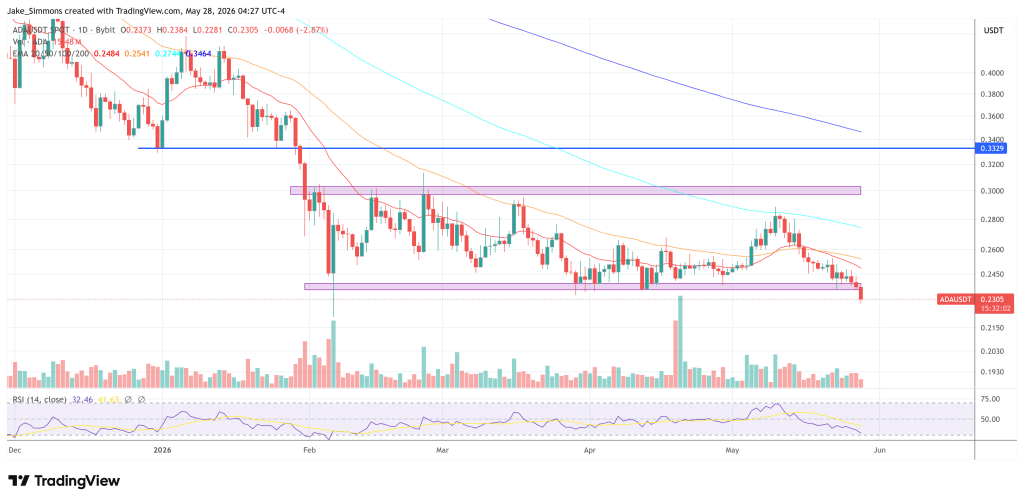
ADA drops below key support, 1-day chart | Source: ADAUSDT on TradingView.com

Criptos en tendencia

Preguntas relacionadas

QWhat is the primary reason Charles Hoskinson cited for closing the Wyoming medical clinic?

AHoskinson cited structural financial losses, weak local support, difficult healthcare economics, and an unsustainable business model that relied on subsidies or a private-equity-style approach.

QAccording to Hoskinson, what are his main daily professional priorities now?

AHis main daily priorities are focusing on getting Midnight adopted and getting Cardano back into the top 10, and ultimately the top 5, of the crypto market rankings.

QHow did Hoskinson characterize the clinic's role and its financial nature?

AHe characterized the clinic as an indispensable component of public health for the county, but stated it was never a true business and was essentially operating as a charity due to its financial losses.

QWhat broader issue in the US healthcare system did Hoskinson criticize in relation to the clinic's failure?

AHe criticized a system that structurally disadvantages primary care clinics through low insurance reimbursements, Medicare/Medicaid rates, and hospital billing advantages, while disproportionately rewarding procedures, cancer treatment, and pharmaceuticals over routine care.

QWhat does the clinic's closure signal for Hoskinson's involvement with Cardano?

AIt signals a refocusing of his time and bandwidth away from non-core ventures like healthcare and towards his crypto expertise, specifically on driving adoption for Midnight and improving Cardano's market position.

Lecturas Relacionadas

As Consensus Accelerates, What Are Young Investors Betting On?

Title: As Consensus Forms Faster, What Are Young Investors Betting On? In the rapid evolution of tech investment, a new generation of young investors is navigating a landscape where AI, robotics, commercial aerospace, and quantum computing are advancing simultaneously. Traditional investment logic based on financial models is giving way to a need for deep technical understanding and the ability to act before industry consensus forms. An analysis of trends from the "WAIC FUTURE TECH" list of young investment leaders reveals key shifts in focus. The first major trend is the movement of AI from the digital screen into the physical world. Investment is shifting from large language models and chatbots towards embodied AI, robotics, AI hardware, and edge computing. While demonstrations generate excitement, the real challenge lies in achieving scalable, reliable, and cost-effective delivery in complex real-world environments like factories and logistics. Success depends not just on algorithms but on the integration of sensors, actuators, and control systems. Second, the competitive focus for large models is moving beyond raw capability toward building an "intelligence flywheel." The goal is to create self-reinforcing systems where user interaction generates data, improving the model, which in turn enhances the user experience and attracts more engagement. Companies that successfully embed AI into workflows to create these closed-loop systems can build lasting value that isn't easily erased by the next model upgrade. Third, facing a potential bottleneck in high-quality human-generated data, investors are looking at new underlying technologies. Reinforcement learning and self-play, as demonstrated by AlphaGo Zero, offer paths for AI to generate its own experience. Scientific foundation models, which aim to build general AI capabilities for fields like life sciences and materials discovery, represent a non-consensus direction that could unlock new frontiers of knowledge and data. Finally, in deep-tech areas like quantum computing, commercial aerospace, and space-based infrastructure, patient capital is essential. These fields have long, uncertain development and validation cycles involving complex engineering, supply chains, and regulations. Investment here requires a long-term view, focusing on foundational team capabilities and the eventual emergence of market demand, even if commercial returns are distant. Collectively, these trends illustrate how young investors are adapting to a new era. They are learning to make earlier, technically-informed judgments, balance hype with real-world viability, and provide the patient capital needed to build the deep-tech foundations of the future.

marsbitHace 12 min(s)

As Consensus Accelerates, What Are Young Investors Betting On?

marsbitHace 12 min(s)

Can Japan Buy Growth with AI? Will the Bond Market Believe It?

Japan's cabinet has introduced the 2026 Basic Policy on Economic and Fiscal Management and Reform, shifting its primary fiscal target. The new framework moves away from the traditional annual primary balance goal and instead prioritizes a stable reduction of the debt-to-GDP ratio. This change is tied to a strategy of increased "responsible proactive fiscal" spending, aiming to boost long-term growth through investments in strategic sectors like AI, semiconductors, energy, and robotics. The government estimates total public and private investment in 62 key technologies could exceed 370 trillion yen by 2040. The market reaction has been mixed and cautious. While equity markets may respond to policy signals, bond markets are focused on fiscal credibility. Concerns center on whether the weakening of the clear primary balance anchor could lead to looser fiscal discipline. If investors doubt that these strategic investments will generate sufficient productivity gains, tax revenue, and nominal growth to outpace rising interest costs, they may demand higher yields on Japanese Government Bonds (JGBs). Recent volatility in the yen and JGB yields, with the 10-year yield briefly reaching 2.9%, reflects this skepticism. The success of this new framework hinges on two factors: whether Japan can achieve a nominal growth rate consistently higher than its long-term interest rates, and whether future budgets demonstrate disciplined control over bond issuance. The government's narrative is that strategic investment is essential to break Japan's cycle of low growth, aging, and labor shortages. However, the bond market will continuously assess the credibility of this plan, pricing the risk that it may represent fiscal expansion rather than a viable growth strategy.

marsbitHace 49 min(s)

Can Japan Buy Growth with AI? Will the Bond Market Believe It?

marsbitHace 49 min(s)

Misjudged A-Shares: Resilience, Expectations, and Confidence

China's A-share market recently faced selling pressure, especially in tech sectors, initially triggered by a global tech sell-off that began in South Korea. However, the article argues this is a case of "mistaken injury" and highlights the market's underlying resilience. This resilience stems from three main pillars: **1) Tech Sector Fundamentals:** Unlike Korea's market dominated by a few memory chip stocks, China's tech sector is diversified across computing, communications, electronics, and semiconductors, supported by dual narratives of global AI supply chains and domestic substitution. Core areas like optical modules and fiber optics continue to show strong earnings growth. **2) "National Team" Support:** State-backed institutions and large corporations have made significant market purchases and announced buybacks, providing liquidity and signaling confidence. This is seen as a stabilizing policy signal, often associated with market bottoms. **3) Broader Market Pillars:** Other major sectors are showing endogenous recovery momentum. Consumer stocks benefit from stabilizing CPI and signs of sector recovery (e.g., liquor price hikes). Cyclical sectors like aluminum have high earnings, potential price increases due to tight supply, and low valuations. The financial sector offers stable dividends and low valuations. The conclusion is that the sell-off was driven by external contagion, not a collapse in fundamentals. With strong policy support and recovering momentum across key sectors, the A-share market possesses the toughness to regain stability.

marsbitHace 1 hora(s)

Misjudged A-Shares: Resilience, Expectations, and Confidence

marsbitHace 1 hora(s)

Trading

Spot

Artículos destacados

Cómo comprar ADA

¡Bienvenido a HTX.com! Hemos hecho que comprar Cardano (ADA) sea simple y conveniente. Sigue nuestra guía paso a paso para iniciar tu viaje de criptos.Paso 1: crea tu cuenta HTXUtiliza tu correo electrónico o número de teléfono para registrarte y obtener una cuenta gratuita en HTX. Experimenta un proceso de registro sin complicaciones y desbloquea todas las funciones.Obtener mi cuentaPaso 2: ve a Comprar cripto y elige tu método de pagoTarjeta de crédito/débito: usa tu Visa o Mastercard para comprar Cardano (ADA) al instante.Saldo: utiliza fondos del saldo de tu cuenta HTX para tradear sin problemas.Terceros: hemos agregado métodos de pago populares como Google Pay y Apple Pay para mejorar la comodidad.P2P: tradear directamente con otros usuarios en HTX.Over-the-Counter (OTC): ofrecemos servicios personalizados y tipos de cambio competitivos para los traders.Paso 3: guarda tu Cardano (ADA)Después de comprar tu Cardano (ADA), guárdalo en tu cuenta HTX. Alternativamente, puedes enviarlo a otro lugar mediante transferencia blockchain o utilizarlo para tradear otras criptomonedas.Paso 4: tradear Cardano (ADA)Tradear fácilmente con Cardano (ADA) en HTX's mercado spot. Simplemente accede a tu cuenta, selecciona tu par de trading, ejecuta tus trades y monitorea en tiempo real. Ofrecemos una experiencia fácil de usar tanto para principiantes como para traders experimentados.

1.5k Vistas totalesPublicado en 2024.12.10Actualizado en 2026.06.02

Cómo comprar ADA

Discusiones

Bienvenido a la comunidad de HTX. Aquí puedes mantenerte informado sobre los últimos desarrollos de la plataforma y acceder a análisis profesionales del mercado. A continuación se presentan las opiniones de los usuarios sobre el precio de ADA (ADA).

活动图片













