Hoskinson Says Cardano Just Cleared A Major Binance Hurdle

bitcoinistPublicado a 2026-03-13Actualizado a 2026-03-13

Resumen

Charles Hoskinson, founder of Cardano, announced a major milestone for the ecosystem: the upcoming Binance spot listing of NIGHT, the native token of the privacy-focused sidechain Midnight. Hoskinson emphasized that this is the first Cardano-native asset to be listed on Binance, which he described as the world's largest altcoin exchange and the center of gravity for liquidity. He framed this development as a breakthrough that removes a significant structural barrier, opening the door for other Cardano assets to access top-tier global liquidity. Beyond market access, Hoskinson connected the listing to broader trends of chain abstraction and compliance, suggesting Midnight's technology could enable privacy-preserving tools essential for scaling tokenized real-world assets. He also presented this achievement as a direct rebuttal to critics who have questioned Cardano's ability to launch large-scale projects and remain relevant in the DeFi space.

Charles Hoskinson says the Cardano ecosystem has crossed a threshold it had struggled to reach for years: a Binance spot listing for a native asset. In a March 11 livestream, the Cardano founder described Binance’s announced support for Midnight’s token NIGHT as a milestone not just for that project, but for the broader effort to bring native assets into tier-one global liquidity.

NIGHT Gets Listed On Binance

Hoskinson framed the development around Midnight, the privacy-focused sidechain project tied to the Cardano ecosystem, whose token had already appeared on Binance Alpha. The bigger breakthrough, in his telling, is the move toward Binance spot. “Binance just tweeted today, Binance is excited to announce the Midnight Holder airdrop,” he said. “Plus, the token is going to be listed on Binance soon. So coming to Binance spot is NIGHT the first Cardano native asset to be listed on Binance. How about that?”

That distinction matters because Hoskinson cast Binance as the center of gravity for altcoin markets. He argued that getting a Cardano-native asset onto the exchange removes a structural barrier that had limited the ecosystem’s reach. “It’s a major milestone for the ecosystem. It’s opened the door for all other Cardano native assets,” he said. “This was a very high bar. It’s the largest market in the world... 80% of all altcoin trading is done here on Binance. It’s the market of markets, the granddaddy of them all.”

In Hoskinson’s telling, the significance goes beyond market access. He tied Midnight’s Binance arrival to a broader thesis around chain abstraction, account abstraction and compliance infrastructure, arguing that Midnight is meant to sit at the intersection of those trends as centralized and decentralized finance draw closer together.“

Traditional finance and DeFi are kind of coming together and Binance has always been on the forefront of that with BNB and what they’ve done with the Binance infrastructure,” he said. “When Midnight comes to this infrastructure and we can do things with this infrastructure, we can talk about reimagining the art of possible compliance and moving into the smart compliance world.”

He then pushed that argument further, saying privacy-preserving compliance tools could be essential if tokenized real-world assets are to scale. “That will open up $10 trillion of real world assets to enter the space above and beyond just making exchanges safer and more efficient,” Hoskinson said, pointing specifically to travel rule compliance and providing information “without revealing the underlying information.”

A rebuttal To Cardano Skeptics

The tone of the stream made clear that Hoskinson sees the Binance milestone as vindication after a long stretch of criticism around Cardano’s relevance in DeFi and its ability to launch large-scale products. He explicitly presented Midnight’s progress as a rebuttal to those narratives.

“There are some people who wrote off Cardano and they said, ‘Cardano can’t launch a billion-dollar project. Cardano can’t get tier one liquidity. Cardano’s days in the DeFi space are over. It’s not relevant anymore,’” he said. “And for us to be able to show them that they’re all wrong — you don’t get too many days like this.”

He compared the moment to earlier ecosystem inflection points, including Coinbase’s ADA listing in 2021 and the more recent arrival of USDCX, suggesting this latest move breaks another long-standing distribution bottleneck for Cardano-linked assets.

At press time, ADA traded at $0.2636.
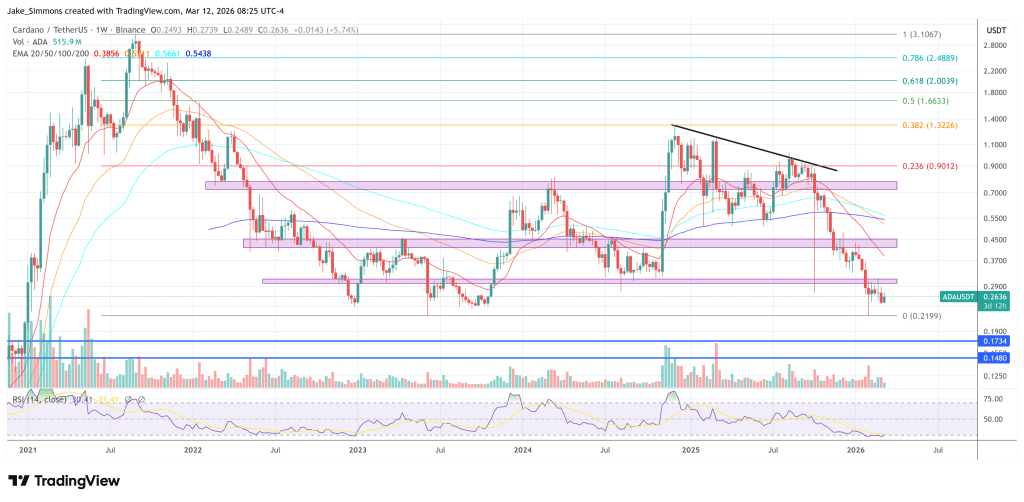
ADA hovers below key resistance, 1-week chart | Source: ADAUSDT on TradingView.com

Preguntas relacionadas

QWhat major milestone did Charles Hoskinson announce for the Cardano ecosystem regarding Binance?

ACharles Hoskinson announced that Midnight's token (NIGHT) will be listed on Binance spot, making it the first Cardano native asset to achieve a Binance spot listing.

QAccording to Hoskinson, why is Binance's role in altcoin trading significant for Cardano native assets?

AHoskinson stated that Binance is the largest market for altcoin trading, with 80% of all altcoin trading occurring there, making it a critical platform for liquidity and market access.

QHow does Hoskinson connect Midnight's Binance listing to broader trends in finance?

AHe links it to chain abstraction, account abstraction, and compliance infrastructure, suggesting Midnight sits at the intersection where traditional finance and DeFi are converging, enabling advanced privacy-preserving compliance tools.

QWhat does Hoskinson claim the Binance listing rebuts about Cardano?

AIt rebuts criticisms that Cardano cannot launch a billion-dollar project, secure tier-one liquidity, or remain relevant in the DeFi space, demonstrating the ecosystem's capability and growth.

QWhat potential does Hoskinson see for privacy-preserving compliance tools in tokenizing real-world assets?

AHe believes these tools could unlock $10 trillion in real-world assets by enabling compliance (like travel rule) without revealing underlying information, making exchanges safer and more efficient.

Lecturas Relacionadas

In-Depth Report on the On-Chain Lending Market: When Off-Chain Credit Meets On-Chain Liquidation

The on-chain lending market has evolved from a peripheral DeFi niche into core financial infrastructure. As of early 2026, total value locked (TVL) in on-chain lending protocols has reached $64.3 billion, accounting for 53.54% of total DeFi TVL, making it the largest and most mature vertical within decentralized finance. Aave dominates the sector with approximately $32.9 billion in TVL, commanding nearly half of the market—a leadership position that is unlikely to be challenged in the foreseeable future. However, the path of on-chain lending forward is not without risk. Liquidation cascades, credit defaults, and cross-chain vulnerabilities remain systemic threats hanging over the industry. At the same time, a deeper structural transformation is underway: on-chain lending is shifting from a “leverage tool for crypto-native users” to a “compliant gateway for institutional capital”. The scale of RWA (Real World Asset) lending has surpassed $18.5 billion, with U.S. Treasuries and government securities increasingly serving as core collateral. Institutional capital inflows are reshaping both the user base and risk appetite of the sector. This report systematically analyzes the evolution of on-chain lending definitions, competitive dynamics, core risks, and future trends, providing a comprehensive industry outlook for investors and trade practitioners. Key findings suggest that the “one dominant player with several strong challengers” structure will persist in the short term, while fixed-rate lending, compliant collateral, and institutional credit underwriting will define the next phase of competition. For investors focused on DeFi infrastructure, three key opportunity tracks stand out, namely, the Aave ecosystem (Morpho, Spark), RWA lending protocols (Ondo, Maple) and fixed-rate innovation (Notional, Pendle).

HTX LearnHace 37 min(s)

In-Depth Report on the On-Chain Lending Market: When Off-Chain Credit Meets On-Chain Liquidation

HTX LearnHace 37 min(s)

Fu Peng's First Public Speech in 2026: What Exactly Are Crypto Assets? Why Did I Join the Crypto Asset Industry?

Fu Peng, a renowned macroeconomist and now Chief Economist at New火 Group, delivered his first public speech of 2026 at the Hong Kong Web3 Festival. He explained his perspective on crypto assets and why he joined the industry, framing it within the context of macroeconomic trends and financial evolution. Fu emphasized that crypto assets are transitioning from an early, belief-driven phase to a mature, institutionally integrated asset class. He drew parallels to the 1970s-80s, when technological advances (like computing) revolutionized traditional finance, leading to the rise of FICC (Fixed Income, Currencies, and Commodities). Similarly, current advancements in AI, data, and blockchain are reshaping finance, with crypto assets becoming part of a new "FICC + C" (C for Crypto) framework. He noted that institutional capital, including traditional hedge funds, avoided early crypto due to its speculative nature but are now engaging as regulatory clarity emerges (e.g., stablecoin laws, CFTC classifying crypto as a commodity). Fu predicted that 2025-2026 marks a turning point where crypto becomes a standardized, financially viable asset for diversified portfolios, akin to commodities or derivatives in traditional finance. Fu defined Bitcoin not as "digital gold" in a simplistic sense but as a value-preserving, financially tradable asset. He highlighted that crypto's future lies in regulated, institutional adoption, moving away from retail-dominated trading. His entry into crypto signals this maturation, where traditional finance integrates crypto into mainstream asset management.

marsbitHace 1 hora(s)

Fu Peng's First Public Speech in 2026: What Exactly Are Crypto Assets? Why Did I Join the Crypto Asset Industry?

marsbitHace 1 hora(s)

Justin Sun Sues Trump Family: What $75 Million Bought Was Only a Blacklist

Justin Sun, founder of Tron, has filed a lawsuit in federal court against World Liberty Financial (WLF), alleging he was made the "primary target of a fraudulent scheme" after investing $75 million. Sun claims the investment secured him an advisor title and WLFI tokens, which were later frozen by WLF, causing "hundreds of millions in losses." The dispute began in late 2024 when Sun's investment helped revive WLF's struggling token sale, which ultimately raised $550 million. Shortly after, the SEC dropped its lawsuit against Sun following Donald Trump's inauguration. However, relations soured when Sun refused WLF's demands for additional funding. In August 2025, WLF added a "blacklist" function to its smart contract, allowing it to unilaterally freeze tokens. Sun's holdings, worth approximately $107 million, were frozen, and he was threatened with token destruction. The lawsuit highlights WLF's structure, which directs 75% of token sale profits to the Trump family, who had earned $1 billion by December 2025. WLF's CEO is Zach Witkoff, son of U.S. Middle East envoy Steve Witkoff. The project faces scrutiny for opaque operations, including a controversial loan arrangement on the Dolomite platform, co-founded by a WLF advisor. Despite Sun's history with the SEC, the case underscores centralization risks within DeFi, as WLF controls governance and holds powers to freeze assets arbitrarily. Sun's tokens remain frozen as legal proceedings begin.

marsbitHace 1 hora(s)

Justin Sun Sues Trump Family: What $75 Million Bought Was Only a Blacklist

marsbitHace 1 hora(s)

Trading

Spot
Futuros

Artículos destacados

Cómo comprar ADA

¡Bienvenido a HTX.com! Hemos hecho que comprar Cardano (ADA) sea simple y conveniente. Sigue nuestra guía paso a paso para iniciar tu viaje de criptos.Paso 1: crea tu cuenta HTXUtiliza tu correo electrónico o número de teléfono para registrarte y obtener una cuenta gratuita en HTX. Experimenta un proceso de registro sin complicaciones y desbloquea todas las funciones.Obtener mi cuentaPaso 2: ve a Comprar cripto y elige tu método de pagoTarjeta de crédito/débito: usa tu Visa o Mastercard para comprar Cardano (ADA) al instante.Saldo: utiliza fondos del saldo de tu cuenta HTX para tradear sin problemas.Terceros: hemos agregado métodos de pago populares como Google Pay y Apple Pay para mejorar la comodidad.P2P: tradear directamente con otros usuarios en HTX.Over-the-Counter (OTC): ofrecemos servicios personalizados y tipos de cambio competitivos para los traders.Paso 3: guarda tu Cardano (ADA)Después de comprar tu Cardano (ADA), guárdalo en tu cuenta HTX. Alternativamente, puedes enviarlo a otro lugar mediante transferencia blockchain o utilizarlo para tradear otras criptomonedas.Paso 4: tradear Cardano (ADA)Tradear fácilmente con Cardano (ADA) en HTX's mercado spot. Simplemente accede a tu cuenta, selecciona tu par de trading, ejecuta tus trades y monitorea en tiempo real. Ofrecemos una experiencia fácil de usar tanto para principiantes como para traders experimentados.

1.2k Vistas totalesPublicado en 2024.12.10Actualizado en 2025.03.21

Cómo comprar ADA

Discusiones

Bienvenido a la comunidad de HTX. Aquí puedes mantenerte informado sobre los últimos desarrollos de la plataforma y acceder a análisis profesionales del mercado. A continuación se presentan las opiniones de los usuarios sobre el precio de ADA (ADA).

活动图片