HongKongDoll Reveals Conditions of Opinion's $100 Million Valuation KOL Round; Hot Project Mired in 'Rug' Controversy

marsbitPublicado a 2026-03-04Actualizado a 2026-03-04

Resumen

The prediction market project Opinion (OPN), one of the most anticipated TGEs in early 2026, faced significant backlash from the community following its token distribution announcement. Despite strong backing from top VCs including YZi Labs (formerly Binance Labs), Hack VC, and Jump Crypto, and its position as a leading platform in the prediction market niche, the airdrop allocation disappointed many users. Although 23.5% of the total 1 billion OPN supply was designated for airdrops, only 3.5% was unlocked at TGE, with the remainder vested over 7 months. In contrast, insiders—including the team, advisors, and investors—collectively held over 54% of tokens. Many users reported losses, with some estimating that their airdropped tokens were worth far less than their initial investment. High-profile KOLs like HongKongDoll publicly shared their negative returns, further fueling community anger. Additional frustration arose from last-minute Sybil account purges and the perception that Binance received disproportionately favorable treatment, with its Launchpool allocation fully unlocked at TGE. While the project's fundamentals remain strong, the incident has severely damaged community trust, with many labeling the event a "rug" or "scam." Rebuilding user confidence is now Opinion's most pressing challenge.

If we were to vote for the most anticipated TGE in the crypto space in early 2026, the prediction market Opinion (OPN) would likely be a top contender.

This project has almost all the elements to become a market sensation: top-tier VC backing, a hot sector, strong ties to the Binance ecosystem, and the prediction market narrative, which has been one of the hottest trends in recent years, attracting immense attention even before its launch.

The funding lineup is nothing short of stellar. Opinion Labs has raised a total of $25 million across three rounds: an initial angel round in August 2024, a $5 million Seed round led by YZi Labs (formerly Binance Labs) in March 2025, and a $20 million Pre-Series A round in February this year, attracting top-tier institutions like Hack VC, Jump Crypto, and Primitive Ventures.

Hack VC is a well-known fund in the crypto space focused on AI and DeFi, having early investments in Anthropic; Jump Crypto is a key pillar of the Solana ecosystem with assets under management in the tens of billions. The simultaneous backing from these two institutions is itself a strong market signal. Meanwhile, YZi Labs (formerly Binance Labs) participated in both the angel and Seed rounds without missing a beat, directly paving the way for Opinion's listing within the Binance ecosystem.

The timing of the sector choice is impeccable. Continuous funding for Polymarket and Kalshi, partnerships with mainstream media, and soaring trading volumes have made prediction markets one of the hottest crypto narratives since 2025. Opinion, deeply entrenched in the BSC ecosystem, has long ranked among the top three prediction markets by TVL, emerging as an early leader in this wave.

The market's high expectations for prediction markets are also evident in the resource allocation. Binance set up a dedicated Launchpool for OPN, allocating 2% of the supply for BNB/USDC staking mining. Pre-market trading saw prices surge over 30%, hitting a high of $0.57. Binance's endorsement solidified OPN's market position even before its official launch.

With all these positive factors combined, Opinion was listed by many as a must-farm project for Season 1 airdrops, with numerous users investing real money in hopes of a substantial return from this highly anticipated project.

However, when the airdrop query page went live, community expectations turned to disappointment, which quickly escalated into anger.
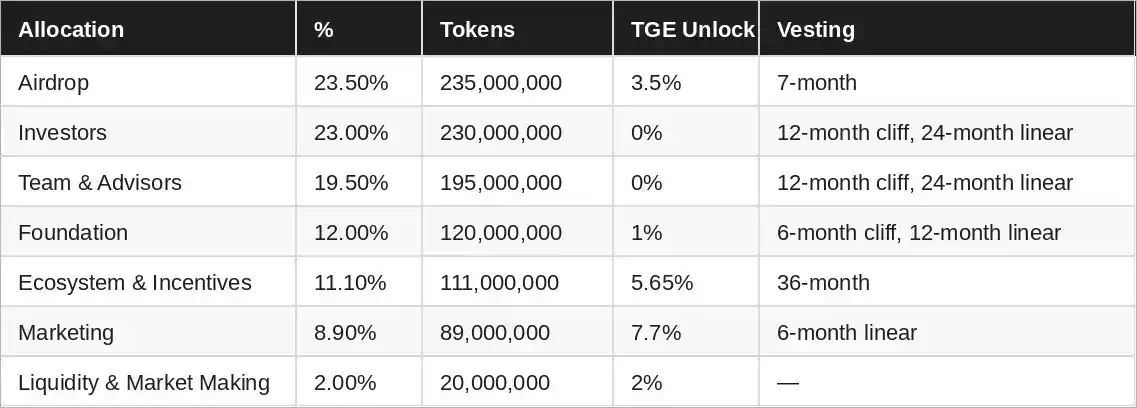
OPN has a total supply of 1 billion tokens. On the surface, the airdrop allocation of 23.5% (235 million tokens) doesn’t seem low. The problem, however, is that only 3.5% (35 million tokens) were unlocked on TGE day, with the remainder to be released over 7 months linearly. For the vast majority of farming users, the immediate rewards were far less than expected.

Meanwhile, another set of data pushed community sentiment over the edge: the team and advisors hold a combined 19.5%, investors hold 23%, and the foundation holds 12%—insiders collectively hold over 54% of the tokens, while all the hardworking community users only get 3.5% on TGE day.

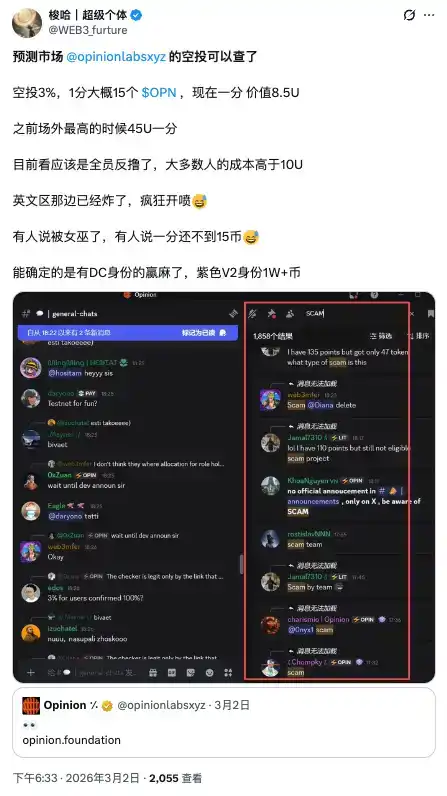
Actual user returns were dismal. Multiple participants publicly shared their scores and earnings. Influencer Suoha (@WEB3_furture) summarized: "Airdrop 3%, one point is about 15 OPN, now worth $8.5 per point. At its peak OTC, it was $45 per point. It looks like everyone got rugged; most people's costs were above $10 per point."
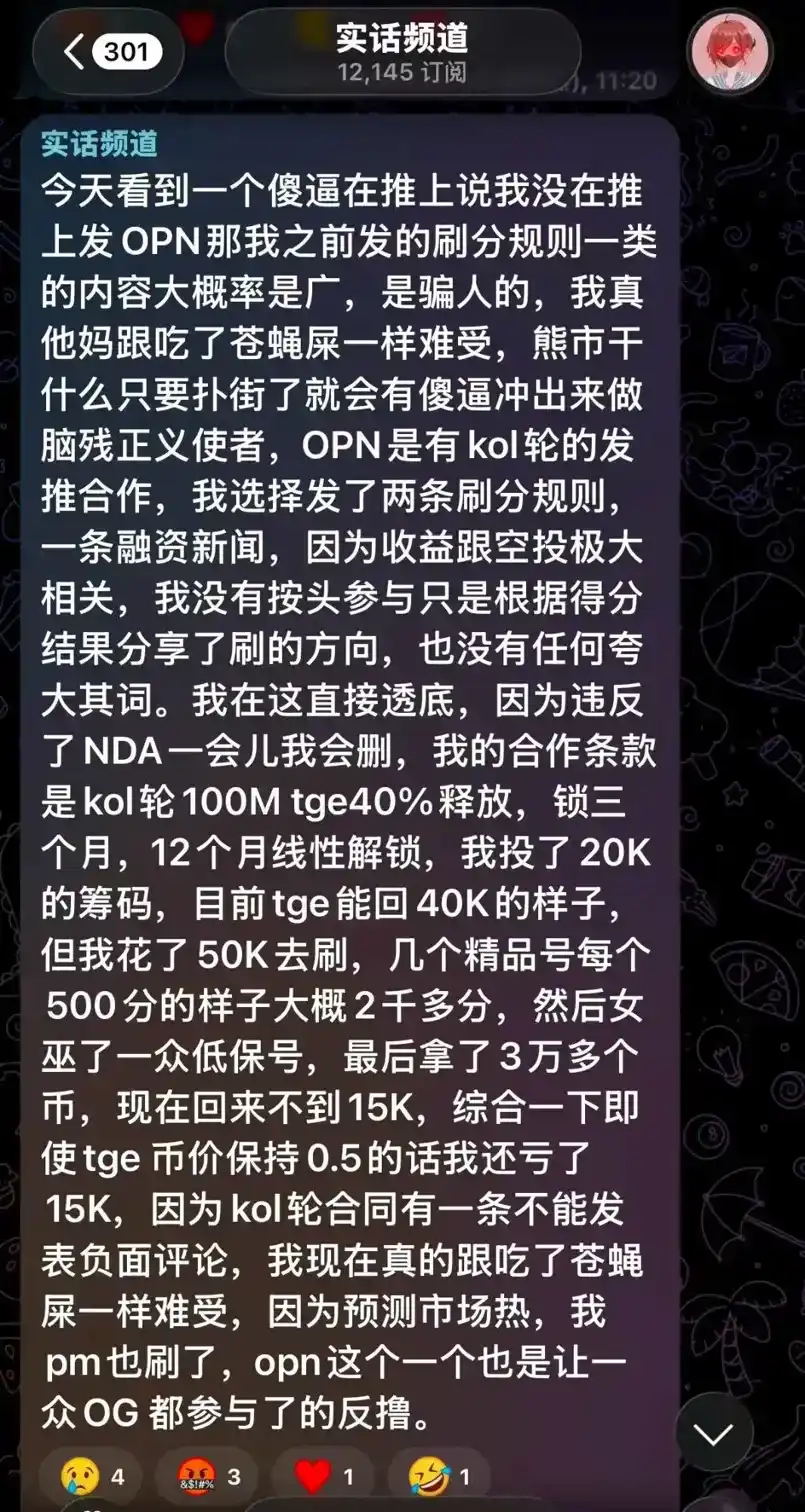
HongKongDoll, who has participated in many crypto projects, complained about her Telegram channel regarding her KOL round cooperation terms and farming data. Although the KOL round cooperation yielded definite returns, she invested $50,000 in farming. Each premium account had about 500 points, and she ultimately received just over 30,000 OPN. Calculated at the TGE price of $0.5, she recouped less than $15,000. Even including the unlocked returns from the investment, she overall lost $15,000. She bluntly stated: "I feel as disgusted as if I’d eaten fly droppings."
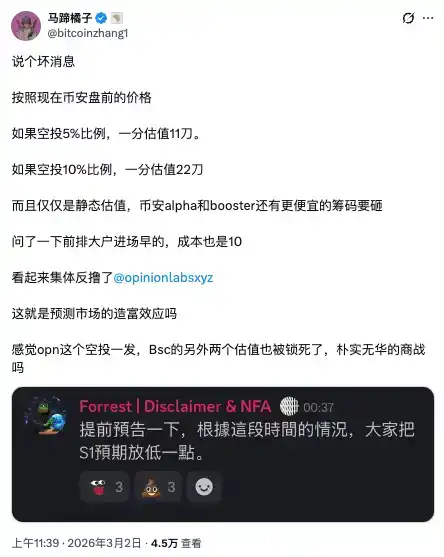
Another KOL, Mati Orange (@bitcoinzhang1), pointed out: "Based on Binance’s pre-listing price, if the airdrop ratio were 5%, one point would be valued at $11; if it were 10%, one point would be $22. And that’s just the static valuation; Binance alpha and booster have even cheaper筹码 to dump...... It seems like a collective rug."
Sybil attacks sparked a new wave of controversy. Beyond the allocation ratio itself, the project team’s large-scale crackdown on Sybil accounts and multi-account operations just before TGE led to many farming users having their points slashed or disqualified. While this move is justified in principle, the execution method and timing left the community feeling dissatisfied: during the farming period, the project team tacitly allowed or even encouraged high-frequency participation, only to start a concentrated crackdown on the eve of TGE. This was interpreted by many as a "use and discard" strategy, further deepening the impression of a "rug pull."

Binance’s allocation became a major point of criticism. Compared to the community’s mere 3.5% unlocked at TGE, the Binance Launchpool directly received 2% of the supply, with the marketing portion having a 7.7% TGE unlock ratio, and the liquidity portion being 100% unlocked. This contrast led many to conclude directly: "Opinion only airdropped 3% to users but gave a huge amount of筹码 to Binance." The community widely perceives this as a typical allocation method that "favors the exchange at the expense of the community."

On Discord and Twitter, discussions about Opinion were quickly filled with intense words like "scam" and "rug." The English-speaking community also erupted. KOLs publicly shared their loss statements, and negative sentiment continued to ferment.

It is worth noting that the project’s fundamentals are not fundamentally problematic—$25 million in funding, backing from Hack VC and Jump Crypto, and a leading position in the BSC prediction market are all objective advantages. However, even the strongest funding lineup can hardly弥补 the damage once community trust collapses.

When "welcoming data farming initially, then pulling the rug after launch" becomes the community consensus, the biggest challenge Opinion faces may no longer be market cap management, but how to rebuild basic trust with its users.

Preguntas relacionadas

QWhat is the total supply of Opinion (OPN) tokens and what percentage was allocated for the airdrop?

AThe total supply of Opinion (OPN) tokens is 1 billion. The airdrop allocation was 23.5% (235 million tokens).

QWhy did the community become angry about the OPN airdrop distribution?

AThe community was angry because only 3.5% (35 million tokens) of the total airdrop allocation was unlocked at TGE, with the rest vested over 7 months. This was a much lower immediate distribution than expected, especially compared to the 54% of tokens allocated to insiders (team, advisors, and investors) who received a larger share.

QWhich major venture capital firms invested in Opinion Labs?

AMajor venture capital firms that invested in Opinion Labs include YZi Labs (formerly Binance Labs), Hack VC, Jump Crypto, and Primitive Ventures.

QWhat was the financial outcome for the KOL HongKongDoll (玩偶姐姐) from her participation in the OPN airdrop?

AHongKongDoll invested $50,000 to farm points and received just over 30,000 OPN tokens. At the TGE price of $0.50 per token, her return was less than $15,000, resulting in an overall loss of approximately $15,000, even when including returns from her KOL partnership.

QWhat was a major point of controversy regarding Binance's role in the OPN token launch?

AA major controversy was the perceived unfair allocation favoring Binance. The Binance Launchpool received 2% of the total token supply, and the marketing allocation had a 7.7% TGE unlock, while the community airdrop only had a 3.5% unlock at TGE. This led to accusations that the project favored the exchange over its community users.

Lecturas Relacionadas

This Week's Key Events Preview | U.S. to Release April CPI Data; U.S. Senate Banking Committee to Review "Digital Asset Market Structure Act of 2025"

Weekly News Preview: Key events for May 12-16 include major economic and crypto industry developments. On Tuesday, May 12, the U.S. will release its April CPI data. Additionally, the gaming blockchain Ronin will begin a 10-hour migration to an Ethereum Layer 2, built on OP Stack with EigenDA for data availability. This aims to leverage Ethereum's security and settle RON's annual inflation below 1%. Base's first independent network upgrade, "Base Azul," is scheduled for mainnet activation on Wednesday, May 13, focusing on security, performance, and developer experience enhancements. Thursday, May 14, sees the U.S. Senate Banking Committee voting on the "Digital Asset Market Structure Act of 2025." In other news, Solana DeFi protocol Carrot will shut down, setting a final withdrawal deadline due to impacts from the Drift exploit. The Moscow Exchange will launch futures trading for Solana, Ripple, and Tron indices (RUB-settled) for qualified investors. Multiple service closures are scheduled for Friday, May 15. Dmail Network will begin winding down due to unsustainable infrastructure costs and failed commercialization. Users must export data before this date. Separately, the Cosmos-based lending blockchain UX Chain will fully shut down. Finally, on Saturday, May 16, gaming infrastructure provider Lattice will wind down operations, with its Redstone Layer 2 network ceasing. Users are urged to withdraw assets, especially from contracts like Uniswap pools, before the shutdown.

链捕手Hace 55 min(s)

This Week's Key Events Preview | U.S. to Release April CPI Data; U.S. Senate Banking Committee to Review "Digital Asset Market Structure Act of 2025"

链捕手Hace 55 min(s)

Morning Post | Trump Media Group Releases Q1 Financial Report; Top Three DeFi Applications Return Nearly $100 Million in Revenue to Token Holders in 30 Days; Michael Saylor Shares Bitcoin Tracker Info Again

**Title: Daily Briefing | Trump Media Group Releases Q1 Report; Top 3 DeFi Apps Return Nearly $100M to Token Holders; Michael Saylor Signals Potential Bitcoin Buy** **Summary:** Key developments in the past 24 hours include: * **Economic Outlook:** Goldman Sachs has pushed back its forecast for the next two Federal Reserve interest rate cuts to December 2026 and March 2027, citing persistent inflationary pressures from energy costs. This delayed timeline is expected to tighten liquidity flow into risk assets, including cryptocurrencies. * **DeFi & Revenue:** Data from DefiLlama shows that three leading DeFi applications—Hyperliquid, Pump.fun, and EdgeX—collectively distributed $96.3 million in revenue to their token holders over the last 30 days. This trend highlights a shift in the crypto community's focus towards real protocol earnings and sustainable economic models. * **Corporate Bitcoin Moves:** Michael Saylor, founder of MicroStrategy (note: referred to as 'Strategy' in the text, likely a typographical error), has signaled potential upcoming Bitcoin purchases by posting a "Bitcoin Tracker" update, following a pattern that typically precedes the company's official disclosure of new acquisitions. * **Market Integrity:** Prediction market platform Polymarket announced updates to address platform issues, including identifying and banning clusters of accounts involved in "ghost-fill" activities and implementing measures to prevent bulk account creation. * **Regulation:** The Bank of England Governor warned that stablecoin regulation could lead to tensions between US and international regulators. In South Korea, the National Tax Service has launched a pilot program to entrust seized virtual assets to private custody firms for management. * **Meme Token Trends:** GMGN data lists the top trending meme tokens on Ethereum (e.g., HEX, SHIB), Solana (e.g., FWOG, TROLL), and Base (e.g., SKITTEN, PEPE) over the past day. **Financial Note:** Trump Media & Technology Group reported a Q1 loss of approximately $4 billion, primarily attributed to unrealized losses on its Bitcoin and other digital asset holdings.

链捕手Hace 1 hora(s)

Morning Post | Trump Media Group Releases Q1 Financial Report; Top Three DeFi Applications Return Nearly $100 Million in Revenue to Token Holders in 30 Days; Michael Saylor Shares Bitcoin Tracker Info Again

链捕手Hace 1 hora(s)

Telegram Takes Direct Control of TON, Social Traffic Rewrites the Public Chain Narrative

Telegram founder Pavel Durov announced that Telegram will replace the TON Foundation as the core driver and largest validator of The Open Network (TON). Key initiatives include a sixfold reduction in transaction fees, performance upgrades, and improved developer tools within the next few weeks. This marks a strategic shift from Telegram merely providing user access to deeply integrating TON into its platform's core infrastructure. The goal is to transform Telegram's massive social traffic into sustainable on-chain activity. While viral mini-apps like Notcoin have demonstrated Telegram's ability to drive user adoption, TON aims to support frequent, low-value transactions inherent to social platforms—such as tipping, in-app payments, and game rewards. Ultra-low fees and sub-second finality (0.6 seconds) are crucial to making blockchain interactions seamless and nearly invisible within the Telegram user experience. However, Telegram's increased central role raises questions about network decentralization. Durov argues that Telegram's participation will attract more large validators, thereby enhancing decentralization. TON also offers high annual staking rewards (18.8%), aiming to retain capital within its ecosystem. The fundamental challenge for TON is no longer leveraging Telegram's user base, but becoming an indispensable, seamless infrastructure layer for Telegram's everyday applications—moving from an adjacent chain to an embedded utility.

marsbitHace 1 hora(s)

Telegram Takes Direct Control of TON, Social Traffic Rewrites the Public Chain Narrative

marsbitHace 1 hora(s)

Trading

Spot
Futuros
活动图片