High-Frequency Trading, $100K Annual Income: The Most 'Boring' Profit Myth on Polymarket

marsbitPublicado a 2026-02-11Actualizado a 2026-02-11

Resumen

A user known as planktonXD (0x4ffe49ba2a4cae123536a8af4fda48faeb609f71) has generated over $106,000 in profit on Polymarket within a year by executing more than 61,000 predictions—averaging around 170 trades per day. This high-frequency, automated strategy focuses on exploiting small, certain opportunities rather than betting on high-risk, high-reward outcomes. The approach is characterized by market-making and micro-arbitrage: placing orders on both sides of the order book to capture spreads or profiting from mispriced options in low-liquidity markets. The largest single win was only $2,527, illustrating a disciplined, risk-managed method that avoids large drawdowns. The bot operates across diverse categories—sports, weather, crypto prices, politics—constantly scanning for pricing inefficiencies. Notable examples include buying heavily undervalued options in niche markets, such as esports matches or extreme crypto price movements, where probability is mispriced due to emotional trading or thin order books. For instance, a $16 bet on SOL falling to $130 (priced at 0.7¢, implying <1% chance) returned $1,574 during a volatile period. Key takeaways: The strategy highlights the power of compounding small gains, the necessity of automation and API tools, and the superiority of high-probability opportunities over high-risk bets. In prediction markets, the most advanced approach isn’t forecasting—it’s managing probability and liquidity.

Original Author: Ma He, Foresight News

Another miracle has emerged on Polymarket.

Through extensive monitoring and frenzied betting, an address has netted $100,000 in just one year by compounding small profits.

The address we are reviewing, planktonXD (0x4ffe49ba2a4cae123536a8af4fda48faeb609f71), is an extremely typical high-frequency quantitative trader. From February 2025 to the present, in just one year, it has generated a net profit of $106,000 through over 61,000 predictions.
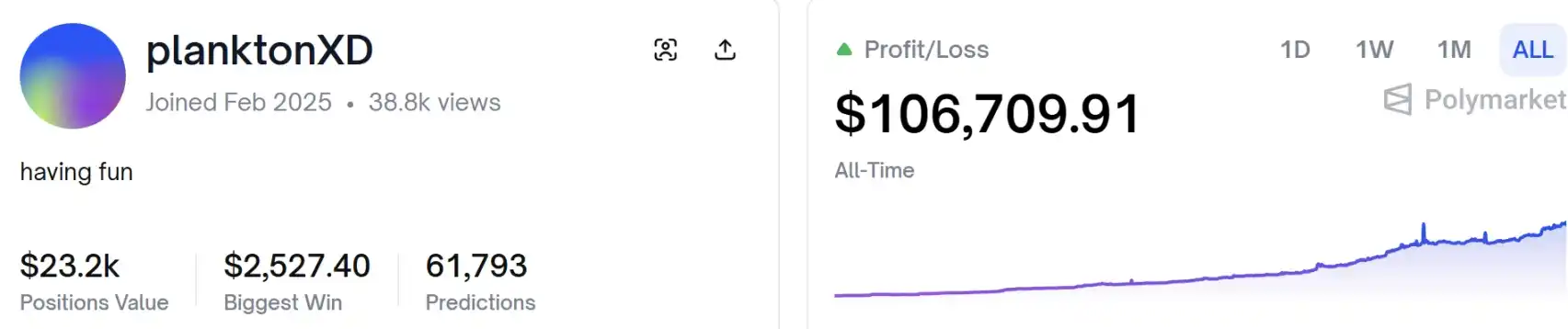
In prediction markets, most people are gambling on "black swans" or chasing big news, but planktonXD takes a completely different path: extreme certainty and terrifying execution frequency.

Looking at planktonXD's historical trading data, the most astonishing aspect is its 61,000 predictions. From February 2025 to February 2026, it averages about 170 transactions per day.

This frequency far exceeds the limits of manual human operation, confirming that this player uses an automated trading script (Bot). It is not "predicting" outcomes but "harvesting" price differences.

A very interesting phenomenon is that planktonXD's "Biggest Win" is only $2,527.4. Compared to its total profit of $100,000, this single largest gain appears very "small" (only about 2% of the total profit).

Some retail players always hope to make a big score, betting all their chips on a confident judgment.

Winning is good, of course, but losing makes it hard to get back to the table.

Even if every ALL-IN could win, just one loss would mean a big defeat.

Reviewing its trading history, it never goes all-in on a single extreme event, nor does it bet on high odds. Its profit curve shows a perfect 45-degree smooth rise with almost no significant drawdowns. This indicates it employs a market-making strategy: placing orders on both sides of the order book to earn the bid-ask spread, or performing micro-arbitrage using price fluctuations between different markets.
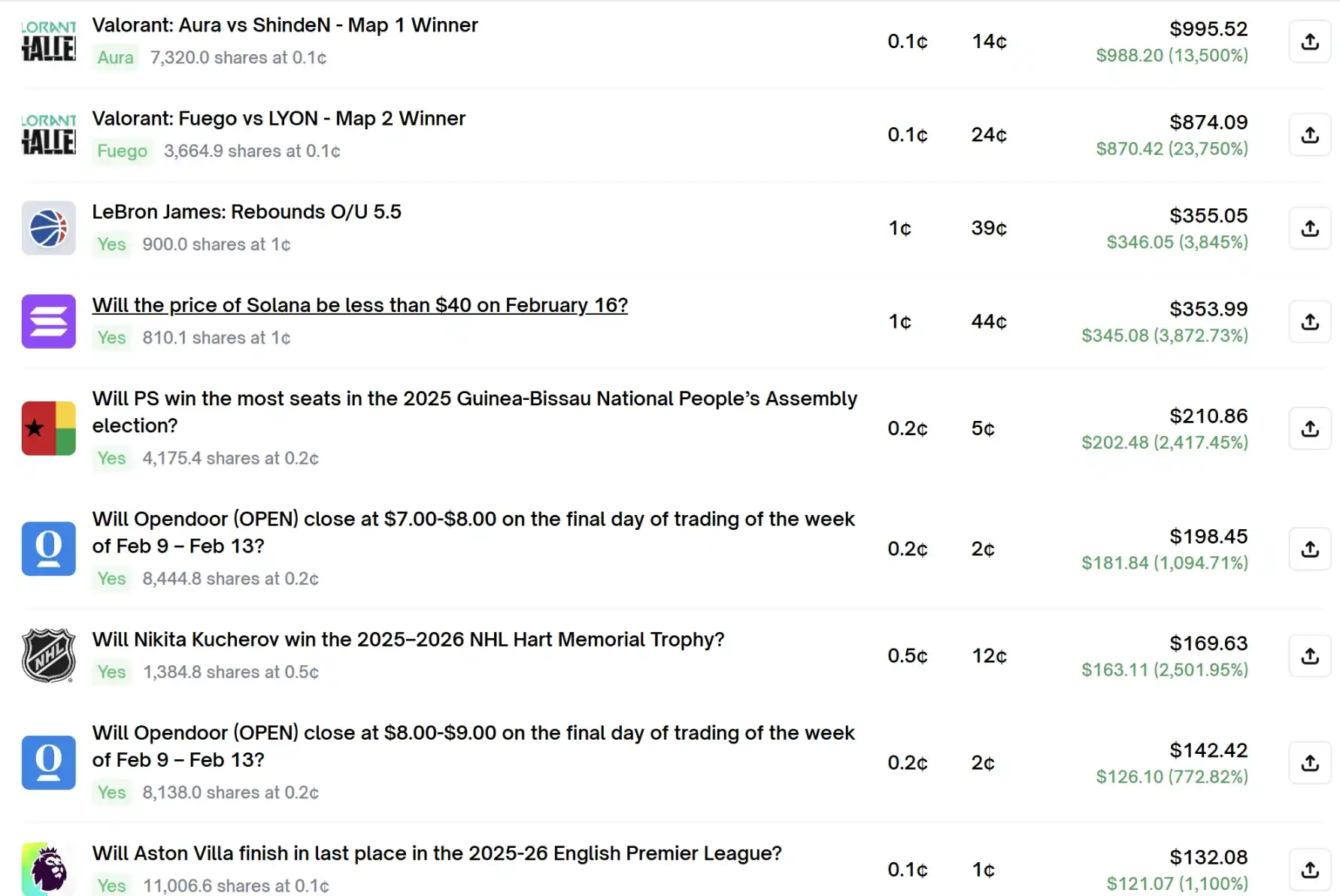
It does not always hold positions long-term (Buy and Hold) but frequently enters and exits the market. This "light position, fast turnover" approach greatly reduces single-point risk. Even if an unexpected event occurs in a prediction market (like a sudden election result change), its impact on the total capital pool is minimal.

This quantitative robot does not specialize in trading vertical sectors like weather but places bets across multiple sectors: sports, weather, coin prices, politics, etc. It monitors thousands of prediction markets on the platform 24/7, looking for moments of pricing inefficiency.

VALORANT Challengers is a classic实战 case study for this trader.

You can think of it as the "minor league" or "regional league" of the esports circle. Fuego and LYON are professional teams in the Latin American region. Because such matches have a small audience and extremely high information asymmetry, they become a "套利天堂" (arbitrage paradise) for quantitative robots.

It bought 3,664.9 shares of Fuego winning at a unit price of $0.001, and this trade ultimately yielded a return of $874.09, with a staggering return rate of 23,750%!

This is a typical "small position, big odds" play. In long-tail markets with extremely poor liquidity or where the public is extremely bearish on a certain option (like the round results of esports matches), it uses a Bot to monitor options that are mispriced to near "zero." It doesn't need to predict who will win; it only needs to know that Fuego's probability of winning is definitely not 0.1%. This is essentially harvesting the market's "extreme sentiment" and "lack of liquidity."

When it comes to sentiment, coin prices embody it most vividly.
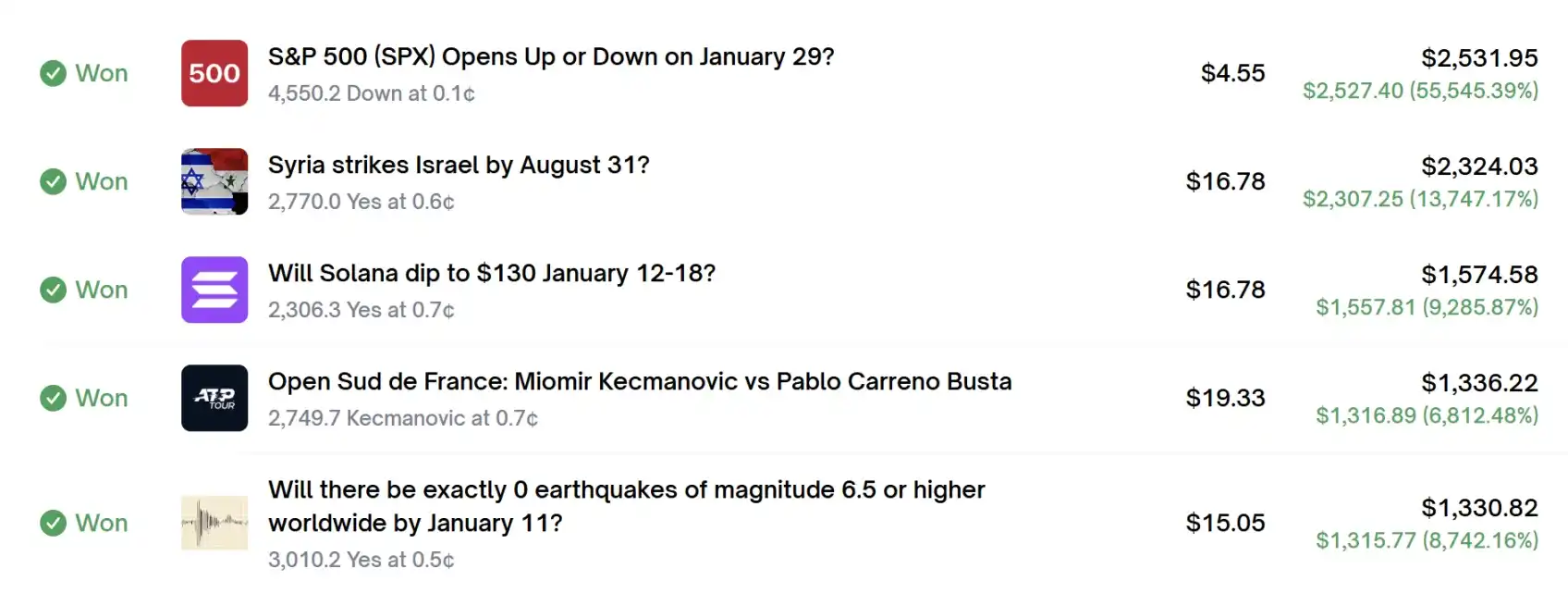
Will the SOL price drop to $130 between January 12-18?

It invested about $16 at $0.007 (the market believed the probability of success was less than 1%) and ultimately took away $1,574, with an amazing return rate of 9,285%.

Why did this "almost impossible" prediction allow it to make big money at that time?

During periods of剧烈波动 (sharp volatility) in the cryptocurrency market, mainstream predictions tend to be bullish or sideways. planktonXD would捕捉 (capture) those "extremely bearish" options priced at $0.001 - $0.01 around the clock. These options are like worthless paper to ordinary people, but they are extremely cheap insurance to quant traders. As long as the market experiences a deep wick or sudden bad news, these "worthless papers" can instantly surge thousands of times. Additionally, in specific price ranges (e.g., SOL < $40), because the current price is far from the predicted price, the order book is often very thin. planktonXD uses automated scripts to place orders in these "no-man's land," eating up the cheap shares抛出的 (thrown out) due to panic or misoperation, essentially acting as a probability搬运工 (mover).

planktonXD's SOL strategy shows that on Polymarket, buying the "impossible" does not mean it believes it will happen, but because the "probability of it happening" is underestimated by the market. It uses a few dollars to buy out the market's one-in-ten-thousand possibility of panic. This is a typical "antifragile" trade.

planktonXD's success offers three core启示 (insights) for ordinary retail users:

The power of compound interest should not be underestimated. Earning 0.5% daily through high-frequency trading yields much more stable returns after a year than betting on a 10x coin. Technology is the killer skill. In the Crypto era, quantitative tools and API capabilities are standard for top players. Finally, certainty is greater than odds. In prediction markets,寻找 (finding) those small profit opportunities with extremely high probability (e.g., 90%+ certainty) is easier to survive than gambling on 50/50 major events.

After all, the highest level of play in prediction markets is not predicting the future, but managing probability and liquidity.


Preguntas relacionadas

QWhat is the key strategy used by the address planktonXD to earn over $100,000 on Polymarket in a year?

AThe key strategy is high-frequency automated trading (using a bot) that focuses on small, certain profits through market making and micro-arbitrage, rather than betting on high-risk, high-reward events. It executed over 61,000 predictions in a year, averaging about 170 trades per day.

QHow does planktonXD achieve such a smooth profit curve with minimal drawdowns?

AIt achieves this by using a market maker strategy: placing orders on both sides of the order book to capture the bid-ask spread, and engaging in micro-arbitrage across different markets. This 'light position, fast turnover' approach minimizes single-point risk and avoids large bets on volatile outcomes.

QWhat type of markets does planktonXD typically target for its trades?

AIt targets multiple sectors including sports, weather, cryptocurrency prices, and politics. It monitors thousands of prediction markets 24/7 to identify mispriced opportunities, especially in illiquid or emotionally driven markets where extreme mispricing occurs.

QCan you give an example of a high-return trade made by planktonXD and explain why it was successful?

AOne example is buying 3,664.9 shares of Fuego winning a VALORANT Challengers match at 0.1¢ each, which resulted in an 874.09 USD profit with a 23,750% return. The success came from exploiting extreme mispricing in a low-liquidity, information-asymmetric market where the probability of Fuego winning was significantly higher than the market price reflected.

QWhat are the three key lessons for retail traders from planktonXD's success on Polymarket?

A1. The power of compounding: small daily gains through high-frequency trading can yield more stable returns than betting on high-risk events. 2. Technology is essential: automated tools and API capabilities are crucial for top performers. 3. Certainty over odds: seeking high-probability, small-profit opportunities is more sustainable than gambling on 50/50 outcomes.

Lecturas Relacionadas

From South Korea to the United States: Blue-Collar Jobs Are Becoming Increasingly Popular, Thanks to AI

AI is reshaping the labor market's value proposition. The traditional four-year college degree is losing its appeal as a guaranteed career path, while skilled blue-collar trades like electricians, welders, and plumbers are experiencing historic demand and wage premiums. This shift is driven by dual pressures: AI's displacement of certain white-collar roles and a booming need for physical infrastructure and data center construction. Data confirms the trend. In the U.S., vocational school revenue surged, and a significant portion of recent layoffs are AI-related. Surveys show a majority of Gen Z adults plan to pursue blue-collar work, citing better job security against AI automation. Vocational education interest has exploded recently. Experts cite a psychological shift as younger generations seek tangible, AI-resistant careers and avoid high student debt. In many cases, salaries for skilled trades now match or exceed those requiring a bachelor's degree. In South Korea, semiconductor vocational high schools boast near-total employment, with graduates securing high-paying roles at companies like Samsung. The shortage is structural, exacerbated by a retiring baby boomer workforce and massive infrastructure projects. Companies like JPMorgan Chase, Meta, and Lowe's are investing heavily in training programs. However, overcoming historical stigma and a "perception gap" around trade careers remains a key challenge to closing the talent gap.

marsbitHace 1 hora(s)

From South Korea to the United States: Blue-Collar Jobs Are Becoming Increasingly Popular, Thanks to AI

marsbitHace 1 hora(s)

Qualcomm: AI Hype Subsides, When Will Smartphones Emerge from the Gloom?

Qualcomm reported its Q3 FY2026 results (ending June 2026), with revenue of $9.95B, down 4% YoY but above expectations. Gross margin declined to 53.1%, pressured by rising costs across manufacturing and memory. Key business segments showed mixed performance: Handset revenue fell 19.6% YoY to $5.09B, dragged by an 11% decline in non-Apple Android shipments and weaker high-end mix. Conversely, Automotive revenue surged 61% to $1.59B, and IoT grew 9% to $1.83B. Core operating profit dropped 41% YoY due to margin compression and higher expenses. Management's Q4 FY2026 guidance projects revenue of $9.7B-$10.5B, in line with consensus, but Non-GAAP EPS guidance of $2.05-$2.25 fell short of expectations. Amidst persistent weakness in its core handset market, Qualcomm is pursuing growth in AI, focusing on Edge AI (smartphones, PCs, automotive) and Data Center AI. Its data center strategy includes four pillars: AI accelerators (e.g., AI200), commercial CPUs (Dragonfly C1000), custom silicon, and connectivity solutions. While these initiatives initially boosted its stock, concerns over AI capital expenditure sustainability have since erased those gains. The company targets $5B in data center revenue for FY2027 and $15B for FY2029. The report concludes that with the traditional handset business still under pressure, the data center opportunity is currently viewed as a longer-term option, and a more conservative valuation based on core operations may be warranted until AI contributions materialize.

marsbitHace 1 hora(s)

Qualcomm: AI Hype Subsides, When Will Smartphones Emerge from the Gloom?

marsbitHace 1 hora(s)

From TPU to Self-Evolving Agents: How Jeff Dean Predicts the Next Step in AI

At the 2026 YC Startup School, Jeff Dean outlined his vision for AI's next phase, shifting focus from simply scaling models to building intelligent, autonomous systems. He believes AI's progress is no longer just about creating smarter models, but about integrating them into systems capable of long-term, iterative work, automated experimentation, and continuous learning. This evolution moves the competition from "who has the bigger model" to "who can best organize intelligence." Dean suggests AI capabilities are now comparable to a junior engineer, enabling the automation of complex workflows. However, the true challenge and opportunity lie in managing these AI "workers" at scale. He emphasizes the importance of **context engineering**—structuring tools, memory, and feedback loops—over raw model power. For startups, this means building deep expertise in niche domains where general models currently fail (near 0-1% success rates), leveraging proprietary data, specialized tools, and domain-specific evaluators. A recurring theme is re-examining fundamental constraints. Dean's past work, like moving Google's search index to memory or creating the TPU, stemmed from questioning outdated assumptions about hardware and cost. He sees similar inflection points today, particularly in **specialized inference hardware** to drastically reduce latency and energy consumption for real-time Agent operation. Notably, he points out that in modern AI systems, the dominant cost is often not computation but **data movement**. Reliable, long-running Agents require robust system design, borrowing concepts from distributed computing like checkpointing, state management, and parallel exploration to handle failures and maintain progress over days or weeks. As AI automates execution, the scarcest human skills will shift to **defining clear specifications**, **judging what problems are worth solving** (taste), and designing effective feedback loops. Ultimately, Dean's framework prioritizes understanding the problem deeply, identifying the true bottlenecks, and systematically building closed-loop systems where AI can not only perform tasks but also improve AI itself.

marsbitHace 1 hora(s)

From TPU to Self-Evolving Agents: How Jeff Dean Predicts the Next Step in AI

marsbitHace 1 hora(s)

Trading

Spot
活动图片




