Hidden Ads No More: Under X's New Disclosure Rules, KOLs' Easy Money Model Faces Account Suspension Risks

比推Publicado a 2026-02-24Actualizado a 2026-02-24

Resumen

X, formerly known as Twitter, is set to enforce stricter advertising disclosure rules, as announced by product lead Nikita Bier. The new policy will require users to clearly label paid promotions with tags like #ad or #sponsored. This follows a public intervention by Bier, who warned an influential account promoting Kalshi without proper disclosure of its financial ties. The article highlights several high-engagement “stealth ads”—posts disguised as organic content that are actually paid promotions—from accounts like @jota_snchez and @FluentInFinance, which garnered millions of views without disclosure. These posts often promoted prediction markets like Polymarket and Kalshi by leveraging FOMO and misleading narratives. The new rules aim to increase transparency, impacting Web3 projects and influencers who rely on undisclosed soft promotions for user acquisition. KOLs may face higher risks, including post removal and account suspension, while projects could see rising marketing costs. Alternatively, advertisers may shift budgets to X’s official promoted post system, potentially increasing the platform’s ad revenue. The move is expected to reduce deceptive marketing practices and improve user awareness in the long term.

Author: Sanqing, Foresight News

Original Title: X's New Advertising Disclosure Rules to Launch, Potentially Ending the Crypto KOLs' 'Easy Money' Model


On February 21, X platform product lead Nikita Bier (@nikitabier) publicly intervened in a post suspected of undisclosed paid promotion, directly requesting the original poster to add a disclosure statement or face account suspension. User @infodexx posted a list of the "Most Valuable Startups of 2025," with prediction market Kalshi ranking second with a $11 billion valuation, accompanied by Kalshi's green brand image and founder's photo.

The post garnered over 420,000 views, nearly 2000 likes, and hundreds of reposts. While it appeared to be an objective ranking, it was flagged in the reader community notes as "this is a paid post." Furthermore, @infodexx's bio explicitly states "@Kalshi partner," yet the original post lacked any clear disclosure labels like #ad or #sponsored.
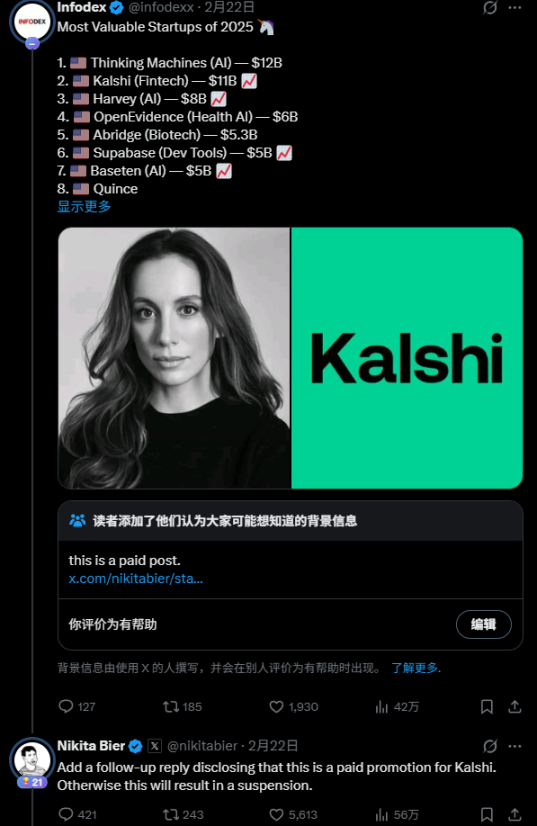
Nikita Bier replied to the post on the same day: "Please add a follow-up reply disclosing this is a paid promotion for Kalshi. Otherwise, this will result in account suspension." Later, when user @AlexFinn complained about the X platform being flooded with undisclosed ads (especially posts related to prediction markets and AI), Nikita Bier further stated: "We are launching a disclosure feature for this type of issue next week."
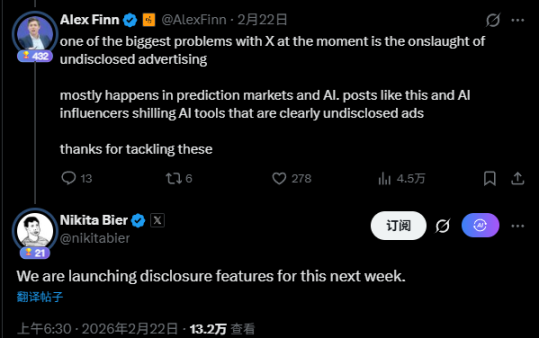
High-Viewership Hidden Ads Will Be Brought into the Light

Below are several examples of high-viewership "hidden ads" selected by the author. These tweets appear to be natural shares but are suspected promotions lacking any disclosure labels. They attract high views, lure degens to follow the trend, yet evade responsibility.

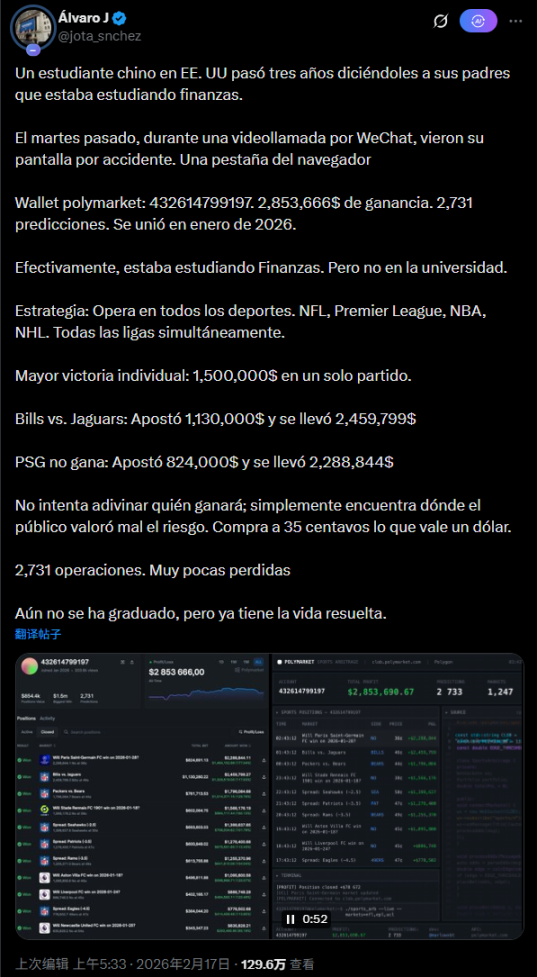
A Spanish-language account @jota_snchez shared a story about a "Chinese student making a fortune on Polymarket," with over 1.29 million views, 7313 likes, and 312 reposts. The content detailed strategies with images and videos, seeming like an inspirational post but actually softly promoting Polymarket's money-making potential. No #ad label, yet indirectly hyping the platform—a classic disguise of experience sharing.
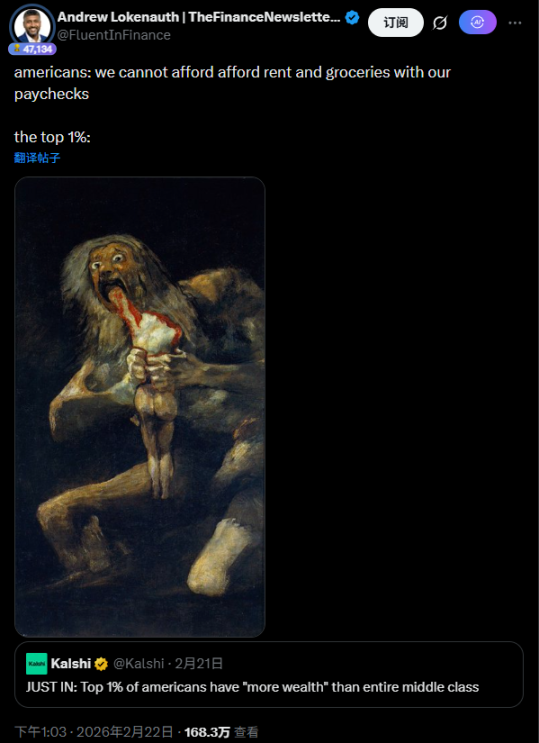
User @FluentInFinance quoted a Kalshi tweet, complaining "US 1% wealthier than middle class," with 1.68 million views, 150k+ likes, and 20k+ reposts. Superficially social commentary, it actually quoted Kalshi's "JUST IN" news, guiding users to bet on related events on the platform. Not labeled #sponsored, yet amplified exposure through high engagement. This is where Web3 degens often get tricked.
@Shelpid_WI3M "exposed" a 5-minute setup framework for Polymarket Clawdbot, with 940k views, 2940 likes, 6091 bookmarks. Detailed steps + link, seeming like a "free share" but actually promoting a copytrade tool, indirectly pulling new users to Polymarket. No disclosure of any partnership—this type of "developer perspective" hidden ad is the most deceptive for technical degens.
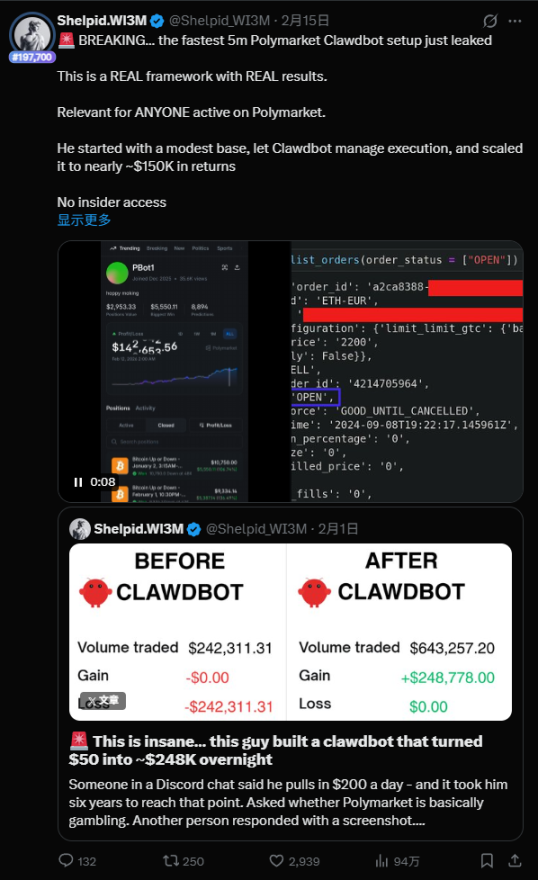
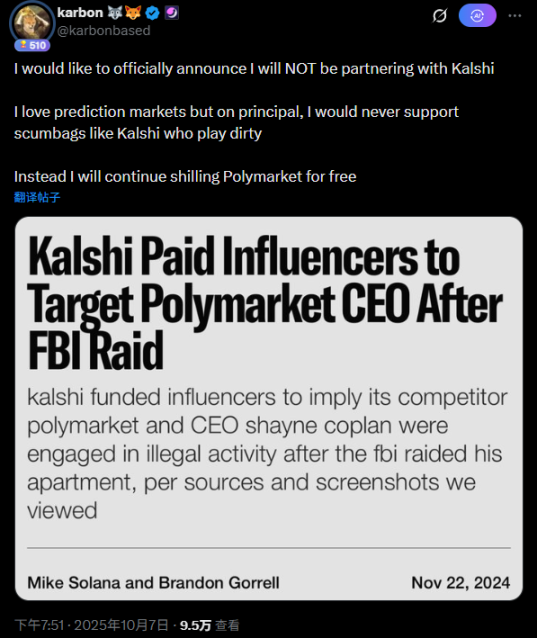
@karbonbased publicly "refused Kalshi collaboration but continues to shill Polymarket for free," with 95k views, 764 likes. Superficially a "principled" refusal, it actually promotes Polymarket indirectly. The word "free" is most suspicious—what's truly free in Web3? No #ad, yet using moral high ground to induce followers.
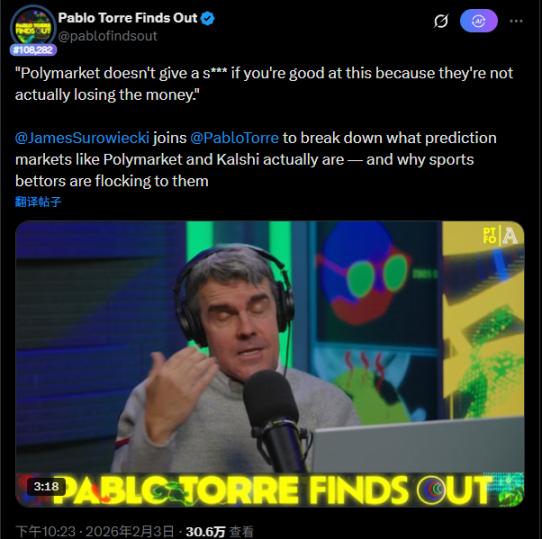
@pablofindsout uploaded a video discussing the nature of Polymarket and Kalshi, with 300k views, 1657 likes. Citing expert opinions, seemingly neutral but actually amplifying platform exposure—an unlabeled sponsored隐形广告片 (stealth ad video).
These examples show that high viewership does not equal sincerity. They rely on FOMO for viral spread but avoid disclosure, costing wallets dearly. After the new rules, similar tweets will be restricted.

Impact of X's New Rules on Web3 Marketing

For Web3 project teams, this means a significant increase in marketing costs. Many prediction market projects (like Polymarket and Kalshi) rely on KOLs' soft ads to drive user FOMO entry at low cost.

Now, the new rules require any content involving payment, gifts, affiliate links, or material incentives to be prominently labeled with "#ad," "sponsored," or "paid partnership," etc. Otherwise, the tweet will be directly removed, and the account faces suspension or even permanent ban.

In the short term, growth for these platforms will slow down. KOLs will hesitate to share freely, collaboration thresholds will be raised, and budgets will be forced towards more expensive channels.

For KOLs, the most direct impact is the end of the "low-effort easy money" model. In the past, many projects heavily relied on KOLs' "soft ad" strategy: disguising promotions as neutral experience sharing, data-driven complaints, or viral memes to create FOMO and drive user participation at low cost.

Now, forced explicit disclosure means KOLs can no longer hide commercial relationships and dare not casually "share naturally." Once detected by AI or reported, the risk of tweet deletion and account suspension is extremely high.

This will also raise the collaboration threshold between projects and KOLs. As risks increase, KOLs' rates may rise. But in the long run, this is positive for the Web3 ecosystem. Increased transparency will restore user trust in promoted content, reducing rug pulls and short-term speculation.

A common alternative is shifting to X's official Promoted Post system: these ads automatically carry "Promoted" or "Ads" labels, handled uniformly by the platform for disclosure, avoiding manual labeling risks. However, this also means project teams pay directly to X, concentrating more ad revenue into the platform's hands rather than dispersing it to KOLs.

X's move also likely aims to enhance its own advertising monetization capability. By enforcing explicit disclosure and promoting official ad tools, the platform can attract more budgets into its own system, capturing the share of "hidden ads" that originally flowed to KOLs, further strengthening its position as an ad revenue source, especially in competitive fields like prediction markets and AI content.


Twitter:https://twitter.com/BitpushNewsCN

Bitpush TG Discussion Group:https://t.me/BitPushCommunity

Bitpush TG Subscription: https://t.me/bitpush

Original article link:https://www.bitpush.news/articles/7614106

Preguntas relacionadas

QWhat new policy is X platform introducing regarding paid promotions?

AX platform is introducing a new policy that requires any content involving paid promotions, giveaways, affiliate links, or material incentives to be clearly labeled with disclosures such as '#ad', 'sponsored', or 'paid partnership'. Failure to comply will result in post removal and potential account suspension or permanent ban.

QWho is Nikita Bier and what action did he take on February 21st?

ANikita Bier is the Product Lead at X platform. On February 21st, he publicly intervened on a post by user @infodexx that was suspected of being an undisclosed paid promotion. He instructed the user to add a disclosure statement or face account suspension.

QWhat are some examples of high-engagement 'stealth ads' mentioned in the article?

AExamples include a Spanish account @jota_snchez sharing a story about a Chinese student making money on Polymarket (1.29M views), @FluentInFinance criticizing wealth inequality while referencing Kalshi (1.68M views), and @Shelpid_WI3M sharing a 'setup framework' for a Polymarket tool (940k views). All lacked proper disclosure tags.

QHow will the new disclosure rules impact Web3 projects and KOLs according to the article?

AFor Web3 projects, marketing costs will rise as they can no longer rely on low-cost, undisclosed KOL soft promotions. For KOLs, their 'easy money' model of sharing undisclosed ads will end, forcing them to properly label content. This raises the cooperation threshold and may increase KOL pricing due to higher risks.

QWhat is a potential alternative for advertisers under the new rules, and what is X platform's possible motive?

AA common alternative is to use X's official Promoted Post system, which automatically labels ads as 'Promoted' or 'Ads'. The article suggests X's motive may be to increase its own advertising revenue by redirecting budgets from KOL 'stealth ads' to its official ad platform, especially in competitive areas like prediction markets and AI content.

Lecturas Relacionadas

In Conversation with Ray Dalio: We Are Currently in an AI Bubble, with 1% of My Portfolio in Bitcoin

Ray Dalio, founder of Bridgewater Associates, warns in an interview that the current AI boom shows classic bubble characteristics, which could lead to significant economic downturns as seen in past cycles like 1929 or 2000. He explains that speculative enthusiasm, fueled by debt and overvaluation, often precedes a crash when rising rates or taxation force asset sales, causing widespread losses and recession. Dalio also outlines his "Big Cycle" theory, describing an approximate 80-year pattern where widening wealth gaps, massive government deficits, and shifting geopolitical power (like China's rise) create internal conflict and global instability. He emphasizes that we are in a late-cycle, transitional phase where traditional powers like the US and UK face decline. For personal wealth protection, Dalio advises diversification beyond cash into assets like stocks, bonds, real estate, and particularly gold, which he prefers over Bitcoin. While he holds about 1% of his portfolio in Bitcoin as a non-printable hard asset, he views gold as more secure from technological or governmental threats. Regarding AI's impact, Dalio believes it will disproportionately benefit capital owners, worsening inequality by replacing both physical and cognitive labor. He suggests that human intuition and emotional intelligence, combined with AI, will be key for future workers. On taxation, Dalio argues that wealth taxes are impractical and risk triggering asset sell-offs, reducing productive investment. He points to the UK as a cautionary example of debt, low productivity, and political strife. Geopolitically, Dalio foresees a more regionalized world, with the US showing weakness in prolonged conflicts like with Iran, akin to past imperial declines. The ideal outcome, he suggests, is coexisting powerful blocs (e.g., Americas, China-Asia Pacific) without major war.

marsbitHace 33 min(s)

In Conversation with Ray Dalio: We Are Currently in an AI Bubble, with 1% of My Portfolio in Bitcoin

marsbitHace 33 min(s)

Daily 7.2 Trillion KRW: Foreign Capital's Record Net Buying on Friday! Wall Street Says Headwinds for Korean Stock Fund Flows Have Subsided

South Korean stock market sees a dramatic shift in fund flows. On July 31, foreign investors made a record net purchase of approximately KRW 7.2 trillion in KOSPI stocks, marking a fundamental reversal from the persistent large-scale net outflows seen in previous months. This contributed to a significant narrowing of foreign net selling in July to KRW 9.8 trillion, down sharply from KRW 48.4 trillion in June and KRW 44.5 trillion in May. Simultaneously, domestic institutional pressure eased. South Korean pension funds and asset managers turned to a net buying position in July, purchasing KRW 1.0 trillion worth of KOSPI shares, contrasting with net sales in May and June. Market volatility is expected to be dampened by new financial regulations. Effective July 31, the Financial Services Commission tightened access for retail investors to single-stock leveraged ETFs by raising the minimum cash deposit requirement. Trading volumes for these products subsequently dropped to about 50% of their monthly average. Citigroup Research maintains its year-end KOSPI target of 10,000 points. The firm cites several supportive factors: the substantial easing of headwinds from capital outflows, a robust fundamental outlook for the semiconductor sector, historically low market valuations, strong economic fundamentals, and the potential for policy support from financial authorities if needed.

marsbitHace 33 min(s)

Daily 7.2 Trillion KRW: Foreign Capital's Record Net Buying on Friday! Wall Street Says Headwinds for Korean Stock Fund Flows Have Subsided

marsbitHace 33 min(s)

Thanks to Dice Rolls, Bitcoin Keys Are Stored Offline, But Not Everyone Will Do It

The article discusses using dice rolls to generate secure Bitcoin wallet seeds, providing entropy independent of potentially flawed hardware random number generators. It explains that each fair dice roll offers about 2.585 bits of entropy, with around 50 rolls needed for a standard 12-word seed phrase and 99+ recommended for higher security. This method gained attention after a vulnerability was revealed in some Coldcard hardware wallets, where a faulty firmware RNG (dating back to 2021) compromised generated keys. The analysis notes that while a dice-generated main seed was safe from this specific flaw, other Coldcard functions (like creating paper wallets, backup keys, or passwords) could still be vulnerable if they used the defective RNG. The piece argues that while dice-based entropy is technically robust, the manual process is error-prone, tedious, and unrealistic for most new users, who might make mistakes in recording or inputting rolls. It concludes that while manual entropy generation should remain an option for advanced users, the long-term goal is to develop reliable, user-friendly hardware and software that securely generates randomness without requiring specialized knowledge. Coldcard users are advised to check their firmware version and replace any secondary secrets (like paper wallet keys) created with vulnerable devices, while also considering multi-signature setups with devices from different manufacturers for added security.

cryptonews.ruHace 5 hora(s)

Thanks to Dice Rolls, Bitcoin Keys Are Stored Offline, But Not Everyone Will Do It

cryptonews.ruHace 5 hora(s)

Trading

Spot
活动图片





