Helium jumps 20%, but is this a real trend shift for HNT?

ambcryptoPublicado a 2026-02-16Actualizado a 2026-02-16

Resumen

Helium (HNT) surged over 20% to $1.36, rebounding sharply from a long-term descending regression channel low near $0.75. The price now tests the upper boundary of this channel around $1.50, a level where previous rallies have stalled. While technical indicators like MACD show strengthening bullish momentum and spot trading volume has expanded, underlying sell pressure remains. The 90-day Spot Taker CVD still reflects persistent selling dominance, creating a divergence with the rising price. Open Interest increased 22.83%, indicating new positions are being opened. The rally faces key resistance between $1.40–$1.80. A sustained break above could signal a trend reversal, but rejection at this level would reinforce the ongoing downtrend. The token is at a critical structural decision point.

Helium [HNT] has surged over 20% to $1.36, rebounding sharply from regression channel lows near $0.75 as buyers return aggressively.

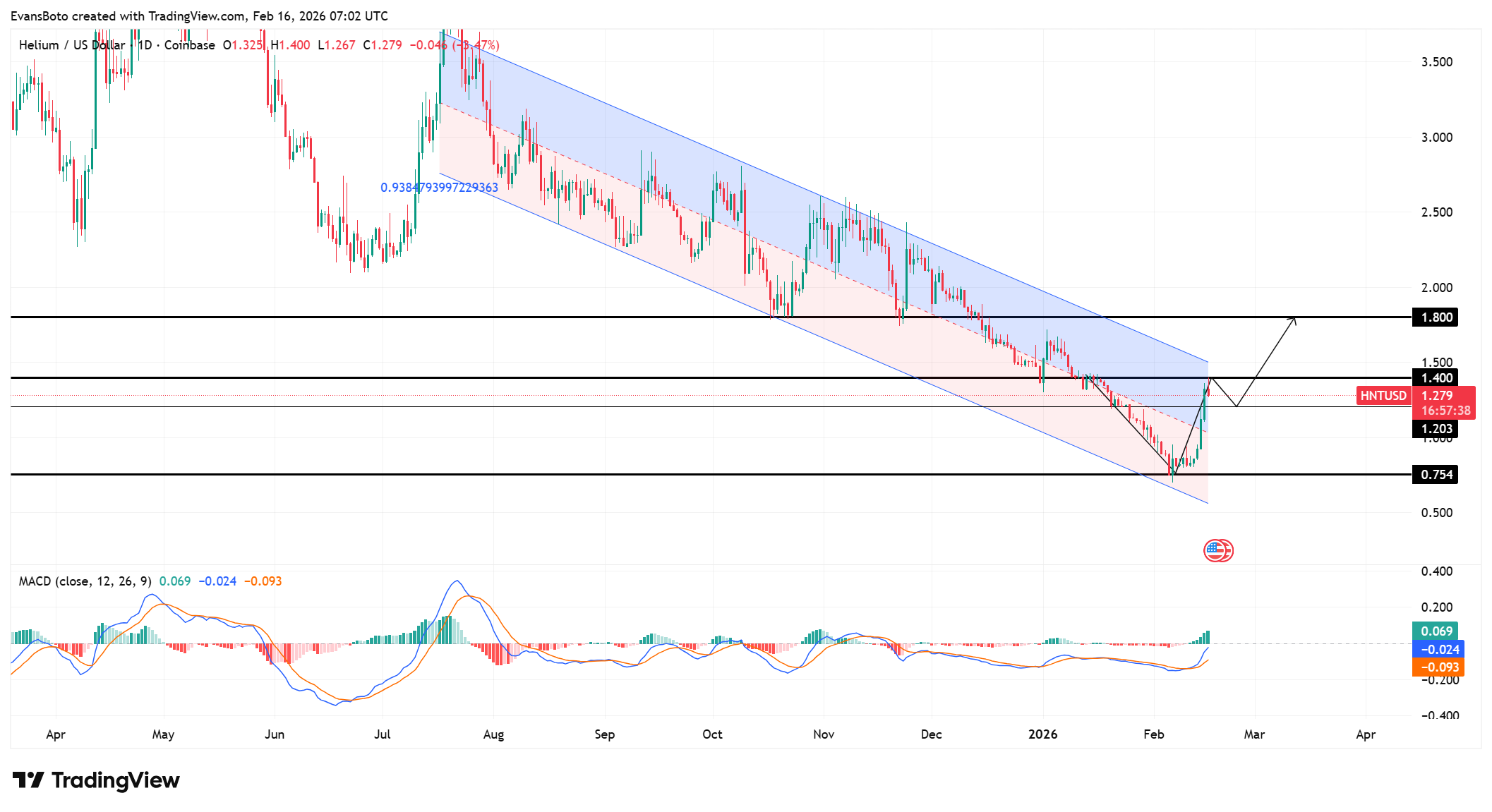
Price now trades around $1.27 after reaching $1.40 intraday, marking its strongest upward reaction in months.

This rebound emerged precisely from the lower boundary of a descending regression trend channel that has guided the broader decline since mid-2025.

However, HNT now approaches the channel’s upper boundary, where previous rallies stalled.

At the same time, structural sell pressure still lingers beneath the surface, creating tension between price recovery and underlying flow.

Helium tests upper regression channel

HNT has reclaimed the $1.20 level and pushed into the $1.40 supply zone, marking a decisive short-term shift in structure.

Price now sits near the upper boundary of a descending regression trend channel that has guided the broader decline for months.

This boundary aligns closely with the $1.50 region, while stronger horizontal resistance rests at $1.80. Therefore, price faces layered overhead pressure at a technically sensitive zone.

A sustained hold above $1.40 could open room toward $1.80. However, rejection near the channel ceiling would reinforce the prevailing downtrend.

At the same time, MACD prints 0.069, with the signal line at -0.024 and the histogram turning positive. Green bars are now expanding after prolonged compression, showing strengthening bullish energy.

However, the indicator still hovers near neutral territory. Buyers must maintain follow-through to validate this breakout attempt.
Sell pressure lingers beneath the rally

Despite the sharp rebound from $0.75, the 90-day Spot Taker CVD still reflects taker sell dominance.

This reading shows aggressive market sells continue to outweigh buys on a cumulative basis. This creates a divergence between rising price and persistent sell-side flow.

In other words, price climbs even while broader spot aggression favors sellers. Such divergence can weaken rallies if demand fails to absorb supply fully.

However, rapid technical rebounds sometimes unfold under similar conditions when short-term buyers overwhelm liquidity temporarily.

If spot buyers increase conviction, the CVD trend could stabilize and gradually shift. Until that shift appears clearly, the rally remains technically impressive yet structurally fragile.

Open Interest expansion reflects new positions

Open Interest has increased 22.83% to $4.40 million during this surge. That expansion signals traders are opening fresh positions rather than merely closing shorts.

If short covering drove this rally alone, Open Interest would likely decline. Instead, derivatives traders now position aggressively around current levels.

Rising Open Interest alongside advancing price can support continuation if buyers maintain control.

However, leverage also increases downside risk near resistance zones. Should price reject near $1.50 or $1.80, liquidation pressure could amplify volatility quickly.

Therefore, positioning has become sensitive to price behavior at the regression channel ceiling, where leverage could either fuel extension or accelerate reversal.

Rising participation, confirmed

The Spot Volume Bubble Map now shows heating clusters, reflecting expanding spot participation.

Larger bubbles correspond with heightened trading activity during this rebound phase. Increased engagement supports the move from $0.75 toward the $1.40 region.

Rising participation often strengthens breakout attempts because it reflects genuine liquidity rotation.

However, continuation requires sustained activity above reclaimed resistance. If volume contracts sharply near the $1.50 boundary, buying enthusiasm could fade rapidly.

On the other hand, persistent bubble expansion beyond the regression ceiling would validate structural repair more convincingly.

Therefore, liquidity flow now plays a decisive role in determining whether Helium builds on this surge or stalls beneath overhead supply.

Relief bounce or structural shift?

Helium has delivered a powerful rebound from channel lows and now challenges the upper boundary of its regression trend structure.

Technical indicators show rebuilding strength, and participation has expanded. However, structural sell pressure and overhead resistance still dominate the broader picture.

If price sustains strength above $1.40 and pushes toward $1.80 with expanding participation, recovery could gain traction.

Yet rejection at the channel ceiling would reaffirm the prevailing downtrend. Helium now stands at a clear structural decision point.


Final Summary

  • Helium rebounded over 20% from $0.75 channel lows to test the $1.40–$1.50 resistance zone, signaling a strong short-term structural recovery.
  • However, persistent sell-side flow, rising Open Interest, and overhead channel resistance suggest the rally remains fragile.


Preguntas relacionadas

QWhat was the percentage surge in Helium (HNT) and what price level did it rebound from?

AHelium (HNT) surged over 20%, rebounding sharply from regression channel lows near $0.75.

QWhat key technical indicator is showing strengthening bullish energy, and what is its current value?

AThe MACD indicator is showing strengthening bullish energy. It currently prints a value of 0.069, with the signal line at -0.024 and the histogram turning positive with expanding green bars.

QDespite the price increase, what does the 90-day Spot Taker CVD reading indicate about market activity?

AThe 90-day Spot Taker CVD reading indicates that aggressive market sells continue to outweigh buys on a cumulative basis, reflecting persistent taker sell dominance beneath the surface.

QHow did Open Interest change during the price surge, and what does this signal about trader behavior?

AOpen Interest increased by 22.83% to $4.40 million. This expansion signals that traders are opening fresh new positions rather than merely closing out short positions.

QWhat are the two critical price levels that will determine if this is a relief bounce or a structural shift for HNT?

AThe two critical levels are $1.40 and $1.80. A sustained hold above $1.40 could open room toward $1.80, validating a recovery. However, rejection at the channel ceiling near $1.50 would reaffirm the prevailing downtrend.

Lecturas Relacionadas

The Verdict in Choi Tae-won's Divorce Case: Revealing the Inheritance Undercurrent Behind SK Hynix's Trillion-Won Empire

SK Group Chairman Chey Tae-won's high-profile divorce case, involving a record 1.38 trillion won settlement, has drawn attention to the succession plans for Korea's second-largest conglomerate, especially its crown jewel, SK hynix. Unlike traditional chaebol scripts centered on the eldest son, Chey's three children from his marriage to former President Roh Tae-woo's daughter, Roh Soh-yeong, are carving distinct, non-traditional paths. Eldest daughter Chey Yun-jung (b. 1989) is seen as the most evident successor. With a scientific and consulting background, she holds executive roles at SK bioscience and SK Inc.'s growth support department, focusing on future strategy and biopharma. Her marriage is to an AI infrastructure entrepreneur, not a traditional business alliance. Second daughter Chey Min-jung (b. 1991) took a unique route, voluntarily serving as a South Korean naval officer, including an anti-piracy deployment. She later worked on policy and strategy for SK hynix in Washington D.C. before co-founding an AI-driven healthcare startup. She married a former U.S. Marine Corps officer, connecting her to U.S. defense and policy circles—networks crucial for a global semiconductor giant. The only son, Chey In-geun (b. 1995), who studied physics like his father, worked briefly at SK E&S before joining McKinsey. Despite fitting the traditional "heir" profile as the eldest son, he remains silent and holds no public position or shares in SK, suggesting the old succession playbook is obsolete. As SK hynix's valuation soars, becoming a geopolitical asset in the AI era, the heirs' legitimacy is no longer automatic. They must prove themselves in fields like AI biotech, global policy, and strategic consulting. Their marriages also reflect new elite networks in tech and defense, not old political alliances. Their inheritance is the complex challenge of navigating a globalized, tech-driven world, not just a corporate throne.

marsbitHace 4 hora(s)

The Verdict in Choi Tae-won's Divorce Case: Revealing the Inheritance Undercurrent Behind SK Hynix's Trillion-Won Empire

marsbitHace 4 hora(s)

From OpenSea to OpenRouter: Is Alex Atallah Repeating His 'Exit at the Peak' Playbook?

From OpenSea to OpenRouter: Is Alex Atallah Repeating His "Exit at the Peak" Playbook? According to the Wall Street Journal, payments giant Stripe is in talks to acquire the AI model aggregation platform OpenRouter in a potential deal valuing the company near $100 billion. This would mark founder Alex Atallah's second creation of a company reaching a $100 billion valuation, following his co-founding of NFT marketplace OpenSea. OpenRouter, founded just over three years ago, has grown rapidly by acting as a unified gateway for developers to access over 400 AI models. It currently has about 10 million users and processes over 200 trillion tokens monthly. While the platform's annualized revenue is around $50 million, its valuation has skyrocketed from $1.3 billion in March 2026. The potential acquisition by Stripe, a company OpenRouter's founder once likened it to, represents a major expansion into AI infrastructure for the payments leader. This move echoes Atallah's previous timing with OpenSea, where he departed before the NFT market's significant downturn. For OpenRouter, selling now may be strategic. Despite its scale, its business model—charging a 5-5.5% fee on AI inference calls—faces pressure from competition, open-source models, and potential price wars among model providers, limiting its profitability narrative for an IPO. A key asset for potential acquirers like Stripe is OpenRouter's vast repository of real-world AI usage data, which offers unique insights into model performance and developer preferences that are difficult to replicate. Whether this potential deal signifies a new valuation benchmark for AI infrastructure or another market peak signal remains to be seen.

链捕手Hace 5 hora(s)

From OpenSea to OpenRouter: Is Alex Atallah Repeating His 'Exit at the Peak' Playbook?

链捕手Hace 5 hora(s)

Trading

Spot
活动图片




