Hash Global: After BTC, Who Will Take the Baton for the Next Bull Market?

marsbitPublicado a 2026-08-28Actualizado a 2026-08-28

Resumen

"Hash Global: After Bitcoin, Who Will Take the Baton in the Next Bull Run?" The market, following a period of consolidation, has re-entered a bull trend, initiated by Bitcoin's surge past key resistance levels. However, this cycle may differ from the last. While BTC remains a crucial entry point, the primary growth narrative is shifting from traditional capital flowing into crypto (TradFi → Crypto) to traditional assets migrating on-chain (TradFi → Onchain). This "Everything-on-chain" trend, fueled by evolving regulatory frameworks like Regulation Crypto, signifies a potential explosion in high-quality tokenized real-world assets (RWA) like stocks and bonds. The critical question becomes: which infrastructure will host this influx? The answer likely lies not in new entrants, but in mature, concentrated ecosystems with proven networks. Ethereum (ETH) offers **deterministic value** as the most established decentralized finance (DeFi) infrastructure, poised to capture the largest share of new demand. Binance Coin (BNB) represents **growth elasticity**, building a comprehensive financial network that connects users, assets, and liquidity, evidenced by its rapid RWA expansion. Robinhood mirrors this trend from the TradFi side, bridging traditional finance to the blockchain. In summary, while BTC opens the door, the next bull market's major beneficiaries could be the foundational platforms—like ETH and BNB—that enable and profit from the mass migration of real-world assets onto...

In the article published on August 13th, we concluded:

The market consolidation is nearing its end, and a reversal only needs a reason to rise.

A week later, that reason arrived.

The U.S. Treasury announced a bond buyback plan. BTC subsequently surged, quickly breaking through the short-term holder cost line and the 200-day moving average, and once challenged $80,000. The entire market rose sharply in sync, with technical indicators re-establishing a "bull market trend."

The market began discussing it – the bull market is back.

Following the script of the last cycle, the plot ahead seems predictable: institutional funds continue to increase holdings, ETFs see sustained net inflows, BTC leads the rally first, and then capital gradually spreads to ETH and other assets.

But we believe, this time might be different.

Just as the rally began, the market has already shown some signals diverging from the last cycle.

While BTC rebounded sharply, ETH, which was persistently bearish last cycle, actually led the gains significantly, with the ETH/BTC exchange rate rising over 10% in a single day; assets like BNB and HYPE also performed brilliantly, posting gains of approximately 20% and 42% respectively.

This differs markedly from the previous cycle's pattern where BTC stood alone.

This time, BTC will still rise, but it might not be the biggest winner of this bull market.

Because the industry's growth logic is shifting:

The last bull market was about capital entering Crypto; the next bull market might be about assets entering Crypto.

I. The last was "Capital On-chain," this round might be "Assets On-chain"

Over the past few years, the most significant change in Crypto has been the entry of traditional capital into this market.

BTC ETFs, corporate treasuries like DAT, institutional allocations... these essentially address one problem: how to get traditional capital into Crypto.

But now, another trend is unfolding.

Stablecoins, credit assets, bonds, funds, stocks... more and more traditional financial assets are being tokenized.

And recently, a concentrated release of policy signals has further fueled this trend.

The SEC's proposed Regulation Crypto establishes a clearer compliant path for token issuance and financing. As regulatory uncertainty diminishes, more capital can enter, driving project and asset creation, and further unlocking growth space on the Crypto supply side.

This has also been a key catalyst for the recent market surge.

However, a point the market easily overlooks is that Regulation Crypto is not an isolated system but should be understood within the context of "Project Crypto" promoted by SEC Chairman Paul Atkins.

Regulation Crypto primarily addresses asset issuance and financing under the Project Crypto framework; simultaneously, Project Crypto is advancing the rule-making for key on-chain market segments like trading, custody, and settlement, aiming to establish a regulatory framework better suited to the on-chain financial system, laying the institutional groundwork for the migration of traditional capital and assets on-chain.

On another front, the CLARITY Act progressing in Congress complements the digital asset classification, regulatory boundaries, and market structure from a higher level, building a clearer legal foundation for the long-term operation of on-chain markets.

Both lines are advancing simultaneously, gradually forming a genuine institutional foundation supporting on-chain capital market operations.

"Everything On-chain" is also moving from imagination to reality.

It used to be: TradFi capital → Crypto

Now it is: TradFi assets → On-chain

The two trends hold entirely different implications for the market.

If it's only capital entering Crypto, BTC is the most direct beneficiary.

But if it's a massive influx of assets into Crypto, then the real beneficiaries will become the financial infrastructure: issuance, trading, settlement, custody, lending.

This is also our core judgment for the next cycle.

II. After the Explosion in Asset Supply, Who Will Bear These Assets?

This moment is like that moment in the past.

A bull market driven by asset supply is not new to Crypto; the 2017 ICO wave was the most classic example.

What truly changed the market then was the explosion in on-chain asset supply.

Ethereum significantly lowered the barrier to on-chain asset issuance. A large number of new projects and tokens emerged, attracting users and capital to continuously enter, driving the rapid expansion of the entire Crypto market.

As the infrastructure carrying all of this at the time, ETH also became one of the most outstanding performing assets, rising 27 times, significantly outperforming BTC's 13 times during the same period.
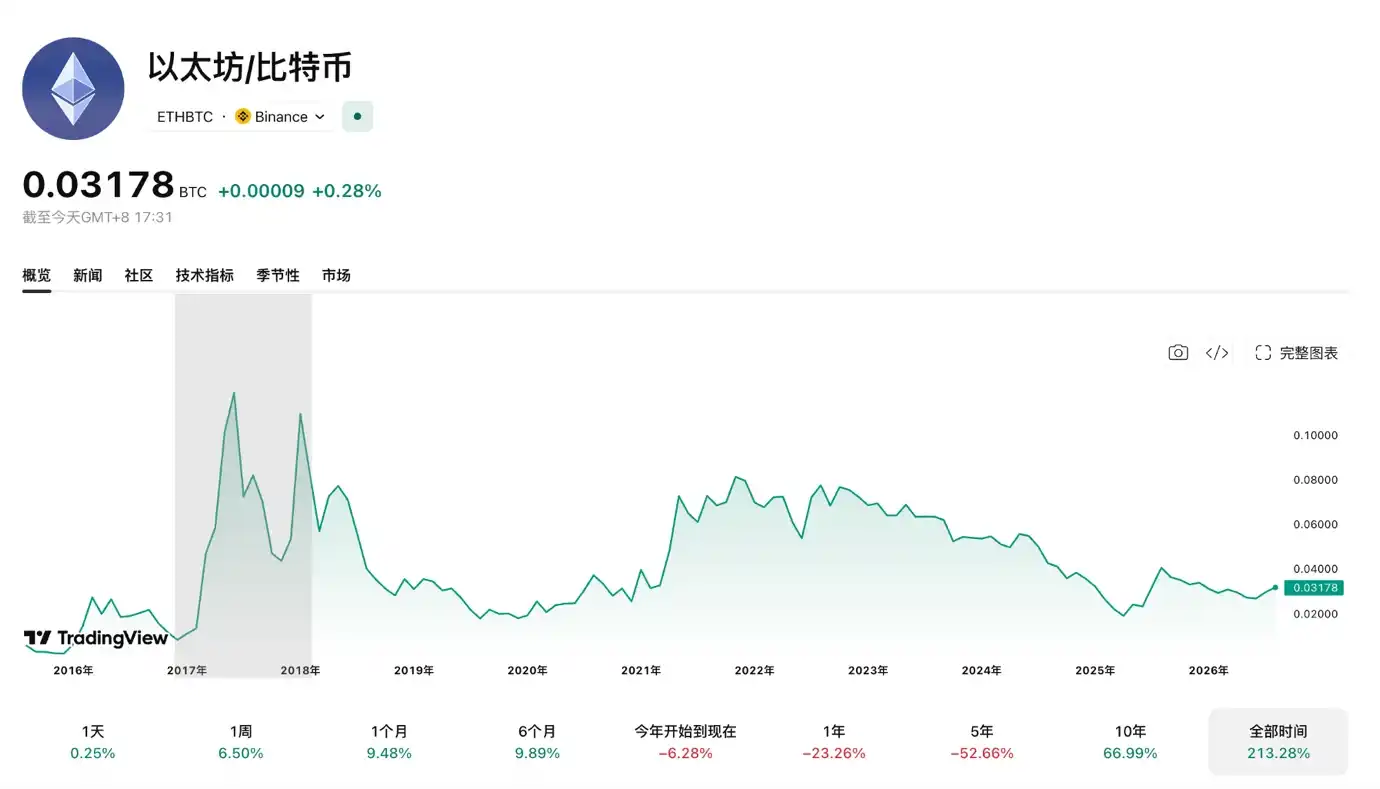
Comparison of ETH and BTC gains during the 2017 ICO cycle

Today, similar growth is re-emerging, but Everything-on-chain represents an upgrade of the ICO logic:

The asset scale is larger, asset quality is higher, and the institutional foundation is more mature.

This time, what's moving on-chain are no longer ICO projects of varying quality, but stocks, funds, and bonds backed by real value and demand.

Thus, the question becomes:

If trillions of dollars in assets truly come on-chain in the future, who will bear them?

This might be the most noteworthy structural opportunity in the next Crypto bull market.

Meanwhile, the industry consolidation in Crypto over the past few years has also made this competition quite different from the ICO era.

Early, fragmented infrastructure is gradually consolidating. A large number of public chains, protocols, and projects have exited the market, leaving behind only a few top ecosystems that have already established user bases, liquidity, and network effects.

So, a very interesting phenomenon might occur this time:

Assets are increasing, but infrastructure is becoming more concentrated.

Once demand picks up, the new flow might not be evenly distributed but is more likely to directly flow to the top-tier, battle-tested infrastructure.

III. So, Why Are We Bullish on ETH and BNB?

ETH — Certainty

ETH remains the most mature decentralized financial infrastructure currently.

Our bullish view on ETH has only one core logic:

If asset supply starts to explode, the most mature on-chain financial infrastructure will naturally capture the largest incremental demand.

Ethereum hosts over 50% of global tokenized RWAs and also covers nearly half of the global stablecoin supply; its DeFi TVL exceeds $40 billion, accounting for about 44% of the entire market, eight times larger than the second-tier public chains.

More importantly, the most mature DeFi protocols like Uniswap, Aave, Lido, and Sky are also highly concentrated in the Ethereum ecosystem, meaning Ethereum still possesses the most extensive liquidity and ecosystem moat.

So, what's truly worth betting on with ETH is not a new narrative, but: a decade-old infrastructure about to welcome a new demand cycle.

BNB — Growth Upside

If ETH represents certainty, then BNB represents growth upside.

Compared to competing in the public chain race, the BNB ecosystem has taken another path – building the most complete financial network.

If traditional financial assets truly start migrating on-chain en masse in the future, the competition focus won't just be "whose chain is better," but more importantly, who can truly connect assets, users, trading, and liquidity.

Gathering users and liquidity via a leading exchange, hosting DeFi infrastructure via a high-performance public chain, and connecting top-tier institutions through branding and ecosystem resources. Over the past two years, BNB has become one of the fastest-growing ecosystems for RWAs. Its RWA asset scale grew from about $3.6 million in early 2025 to over $5.8 billion today, becoming the largest RWA ecosystem outside of Ethereum; the number of RWA holders exceeds 1.15 million, ranking first among all ecosystems.

This year, this Web3 financial network has further extended into TradFi, with related businesses growing rapidly and ranking among the industry's top.

And these positive changes have yet to be priced in by the market.

ETH is the certainty of on-chain financial infrastructure.

BNB is the growth upside of an on-chain financial super network.

One is ETH, long suppressed last cycle but with its core status unchanged; the other is BNB, with fundamentals continuously improving yet not fully priced in.

We believe in the new cycle, both these types of value will return to the spotlight.
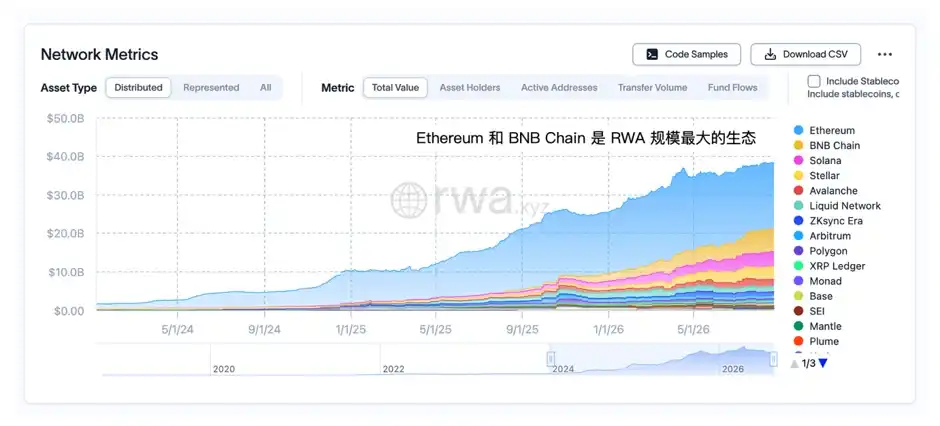
BNB Ecosystem RWA Growth Trend

IV. Robinhood is the Mirror Image of BNB in the Traditional Financial World

If "Everything On-chain" still sounds somewhat distant, look at Robinhood.

Robinhood is the most direct expression of Everything-on-chain in the traditional financial world.

It started as an internet brokerage.

Then it ventured into Crypto, explored Tokenized Stocks, and further built its own on-chain infrastructure.

What it's doing essentially is moving traditional financial assets step-by-step onto the chain.

Robinhood moves from TradFi towards on-chain; BNB moves from Crypto, extending into TradFi.

They seem to come from two entirely different worlds, but they are betting on the same underlying trend:

Traditional finance and on-chain finance will eventually converge.

This is why we are not only bullish on ETH and BNB but also very optimistic about Robinhood's explosive growth potential in this cycle.

V. BTC Opens the Door, Infrastructure Will Be the Destination

In this cycle, BTC will still be the most important core asset in Crypto and the most direct entry point for institutions into Crypto.

But if what truly happens in the new cycle is:

More and more assets moving on-chain.

Then the market's value capture method will change.

More assets mean more transactions, greater liquidity needs, and consequently, greater demand for financial infrastructure.

And after the full consolidation of the last cycle, market share across various businesses has also tended to concentrate.

Therefore, this round, we are more focused on:

ETH – Certainty

BNB – Upside

Robinhood – Representative of traditional finance moving on-chain

Our core judgment is also very clear:

In the last round, BTC brought Crypto into traditional finance.

In the next round, we look forward to traditional finance bringing the entire world of assets into Crypto.

BTC is still important.

But in the next round, infrastructure might be the protagonist.

Criptos en tendencia

Preguntas relacionadas

QAccording to the article, what is the core difference between the previous bull market and the potential next one?

AThe core difference is that the previous bull market was about 'money moving on-chain,' where traditional capital entered Crypto. The next bull market could be about 'assets moving on-chain,' where traditional financial assets like stocks, bonds, and funds are tokenized and moved onto blockchain networks.

QWhich assets or projects does the article specifically identify as primary beneficiaries of the 'assets on-chain' trend?

AThe article identifies ETH, BNB, and Robinhood as primary beneficiaries. ETH represents the most mature decentralized financial infrastructure, BNB represents an elastic financial super network, and Robinhood represents the trend of traditional financial assets moving on-chain.

QWhat are the two main regulatory developments mentioned in the article that support the trend of assets moving on-chain?

AThe two main regulatory developments are Regulation Crypto, which establishes a clearer compliance path for token issuance and financing, and the CLARITY Act, which aims to provide a clearer legal foundation for digital asset classification, regulatory boundaries, and market structure.

QWhy does the article compare the potential 'everything-on-chain' trend to the 2017 ICO boom?

AThe article compares it to the 2017 ICO boom because both represent periods of explosive growth in on-chain asset supply. However, the 'everything-on-chain' trend is seen as an upgrade: it involves larger-scale, higher-quality assets with a more mature regulatory foundation, moving beyond speculative projects to real-world assets like stocks and bonds.

QWhat are the key characteristics that make ETH and BNB attractive investments in the context of the article's thesis?

AETH is attractive for its *determinism*: it is the most mature and widely adopted on-chain financial infrastructure, positioned to capture the largest share of new demand. BNB is attractive for its *growth elasticity*: it is building a complete financial network that integrates exchange, public chain, and institutional connections, showing rapid growth in areas like RWA, and this positive change is seen as not yet fully priced in by the market.

Lecturas Relacionadas

When 34% of ETH is Staked: In the Era of Native Compounding, How Should You Choose Staking?

As Ethereum staking reaches a record 34.7% of the total supply, it is evolving from a niche technical activity into a standardized asset management practice. This article analyzes four primary staking methods for ETH holders, highlighting their core trade-offs between control, convenience, and risk. The foundational method is solo staking, which requires 32 ETH and running one's own validator node. It offers full control and native rewards but demands significant technical expertise and constant maintenance. Non-custodial native staking, like services offered by imToken, provides a middle ground. Users control their withdrawal keys and assets while outsourcing node operation to professional providers. This maintains self-custody but transfers operational risk. For users without 32 ETH or those prioritizing liquidity, liquid staking protocols like Lido are key. Users deposit ETH to receive a liquid staking token (e.g., stETH), enabling continued participation in DeFi. This introduces additional smart contract and protocol risks but solves liquidity constraints. Exchange-based staking offers the lowest barrier to entry, handling all technical complexities and custody. However, it requires full trust in the platform's management of assets, node operations, and reward distribution. The choice depends on individual priorities: control (solo staking), balanced custody (non-custodial native), liquidity (liquid staking), or simplicity (exchange). With developments like Pectra enabling native compounding and traditional finance integrating staking into ETFs, the ecosystem is maturing. The key takeaway is that the decision should weigh factors like control, liquidity, and third-party risk, not just the Annual Percentage Rate (APR). The true cost of staking encompasses what rights and risks are delegated alongside the potential reward.

marsbitHace 15 min(s)

When 34% of ETH is Staked: In the Era of Native Compounding, How Should You Choose Staking?

marsbitHace 15 min(s)

EASY Residency Season 4 Roster Announced: These 9 Projects Already Have Onboarding Angles

EASY Residency Season 4 Announces 24 Selected Projects, Highlighting 9 with Early User Interaction Opportunities On August 25th, YZi Labs revealed the 24 early-stage companies selected for the fourth season of its EASY Residency flagship incubation program, with each project receiving $500,000 in funding. The selection reflects a focus on more programmable, localized, and compliant solutions in global payments, on-chain markets, and "agentic finance." Among the 24, nine projects currently offer clear avenues for early user participation. Here is a summary: * **Neutral Trade:** An on-chain quantitative strategy marketplace. Users can participate in its "Autopilot Deposit" campaign for 2x NT Points. * **Primus:** A cryptography infrastructure for institutional on-chain finance. It is currently running a "Warm Up" creator campaign on Kaito.ai with an $8,000 prize pool. * **Roostoo:** An AI trading agent training and screening platform. Users can join the early waitlist via its website. * **SmartX:** A terminal for on-chain transactions. Its new website is live, with the application launching next month (currently invite-only). * **Alloco:** An on-chain ETF issuance platform. Its core products are upcoming; users can join its Telegram channel for early access announcements. * **XHunt:** An influence data platform for creators and projects. A Chrome extension is available for use, but no points system is active yet. * **Nara:** A PayFi digital dollar protocol for stablecoin payments. The platform is live (TVL ~$10M), but users should await its PayFi product launch or potential points campaigns in September. * **ElfomoFi:** An on-chain market-making protocol for EVM. Users can deposit into curated vaults, though no points system is yet implemented. * **Liquorice:** A liquidity protocol for professional market makers. The app allows deposits, but also lacks a live points system. The report positions these interaction opportunities as potential avenues for users to engage with the projects early, possibly ahead of future token distributions.

Odaily星球日报Hace 1 hora(s)

EASY Residency Season 4 Roster Announced: These 9 Projects Already Have Onboarding Angles

Odaily星球日报Hace 1 hora(s)

Spending Without Selling: Galaxy Turns BTC, ETH, SOL Into Personal Lines of Credit

On August 25th, Galaxy Digital launched a Crypto Portfolio Line of Credit on its GalaxyOne retail platform. Users can borrow USD or USDC at a fixed 8.99% APR using a mix of BTC, ETH, and SOL (including staked SOL) as collateral. The initial loan-to-value ratio is 50%, and the service is currently available in 40 U.S. states. Galaxy emphasizes that client collateral will not be rehypothecated, and staked SOL will continue to earn rewards. This product targets high-net-worth individuals, family offices, and founders who hold significant crypto assets but seek liquidity without triggering capital gains taxes by selling. Key features include combined collateral across multiple assets, acceptance of staked SOL, and flexible fund usage for expenses, investments, or trading within GalaxyOne. The launch occurs amidst a contracting crypto-backed lending market, which declined to $56.16 billion in Q2 2026. Galaxy's entry, led by BlockFi's former founder Zac Prince, positions itself with a safety-first promise of no rehypothecation, directly addressing failures seen in 2022. However, risks remain for borrowers, including potential margin calls if collateral values drop significantly and the ongoing cost of the 8.99% interest rate. The product is most advantageous during bullish markets where asset appreciation outweighs interest costs, functioning best as a short-term liquidity tool rather than a long-term leverage strategy.

marsbitHace 1 hora(s)

Spending Without Selling: Galaxy Turns BTC, ETH, SOL Into Personal Lines of Credit

marsbitHace 1 hora(s)

Trading

Spot

Artículos destacados

Qué es BITCOIN

Entendiendo HarryPotterObamaSonic10Inu (ERC-20) y Su Posición en el Espacio Cripto En los últimos años, el mercado de criptomonedas ha sido testigo de un aumento en la popularidad de las monedas meme, capturando el interés no solo de los comerciantes, sino también de aquellos que buscan compromiso comunitario y valor de entretenimiento. Entre estos tokens únicos se encuentra HarryPotterObamaSonic10Inu (ERC-20), un proyecto intrigante que mezcla referencias culturales en el tejido de las criptomonedas. Este artículo profundiza en los aspectos clave de HarryPotterObamaSonic10Inu, explorando sus mecanismos, ethos impulsado por la comunidad y su relación con el paisaje cripto más amplio. ¿Qué es HarryPotterObamaSonic10Inu (ERC-20)? Como su nombre sugiere, HarryPotterObamaSonic10Inu es una moneda meme construida sobre la blockchain de Ethereum, clasificada bajo el estándar ERC-20. A diferencia de las criptomonedas tradicionales que pueden enfatizar la utilidad práctica o el potencial de inversión, este token prospera en el valor de entretenimiento y la fuerza de su comunidad. El proyecto tiene como objetivo fomentar un entorno donde los usuarios comprometidos puedan reunirse, compartir ideas y participar en actividades inspiradas por diversos fenómenos culturales. Una característica notable de HarryPotterObamaSonic10Inu es su cero impuestos en las transacciones. Este atractivo elemento tiene como objetivo incentivar el comercio y la participación comunitaria, sin cargos adicionales que puedan disuadir a los comerciantes de pequeña escala. El suministro total de la moneda está establecido en mil millones de tokens, una cifra que marca su intención de mantener una circulación sustancial dentro de la comunidad. Creador de HarryPotterObamaSonic10Inu (ERC-20) Los orígenes de HarryPotterObamaSonic10Inu están algo envueltos en misterio; los detalles sobre el creador siguen siendo desconocidos. El desarrollo de este token carece de un equipo identificable o de un plan explícito, lo cual no es inusual dentro del sector de monedas meme. En cambio, el proyecto ha surgido de manera orgánica, con su progreso muy dependiente del entusiasmo y la participación de su comunidad. Inversores de HarryPotterObamaSonic10Inu (ERC-20) En cuanto a inversiones externas y respaldo, HarryPotterObamaSonic10Inu también sigue siendo ambiguo. El token no lista ninguna fundación de inversión conocida o apoyo organizacional significativo. En cambio, la savia del proyecto es su comunidad de base, que informa su crecimiento y sostenibilidad a través de la acción colectiva y el compromiso en el espacio cripto. ¿Cómo Funciona HarryPotterObamaSonic10Inu (ERC-20)? Como una moneda meme, HarryPotterObamaSonic10Inu opera principalmente fuera de los marcos tradicionales que a menudo rigen el valor de los activos. Hay varios aspectos distintivos que definen cómo funciona el proyecto: Transacciones Sin Impuestos: Sin tarifas impositivas en las transacciones, los usuarios pueden comprar y vender el token libremente sin preocuparse por costos ocultos. Compromiso Comunitario: El proyecto prospera en la interacción comunitaria, aprovechando plataformas de redes sociales para crear entusiasmo y facilitar la participación. Las discusiones, el intercambio de contenido y el compromiso son elementos cruciales que ayudan a expandir su alcance y fomentar la lealtad entre los seguidores. Sin Utilidad Práctica: Cabe señalar que HarryPotterObamaSonic10Inu no ofrece utilidad concreta dentro del ecosistema financiero. Más bien, se clasifica como un token principalmente para actividades de entretenimiento y comunitarias. Referencia Cultural: El token incorpora astutamente elementos de la cultura popular para atraer interés, conectando con entusiastas de los memes y seguidores de las criptomonedas por igual. HarryPotterObamaSonic10Inu ejemplifica cómo las monedas meme operan de manera diferente a los proyectos de criptomonedas más tradicionales, ingresando al mercado como construcciones sociales innovadoras en lugar de activos utilitarios. Cronología de HarryPotterObamaSonic10Inu (ERC-20) La historia de HarryPotterObamaSonic10Inu está marcada por varios hitos notables: Creación: El token surgió de un meme viral, capturando la imaginación de muchos entusiastas de las criptomonedas. Las fechas específicas de creación no están disponibles, subrayando su ascenso orgánico. Listado en Exchanges: HarryPotterObamaSonic10Inu ha llegado a varios exchanges, permitiendo un acceso y comercio más fácil por parte de la comunidad. Iniciativas de Compromiso Comunitario: Actividades continuas destinadas a mejorar la interacción comunitaria, incluyendo concursos, campañas en redes sociales y generación de contenido por parte de fanáticos y defensores. Planes de Expansión Futuros: La hoja de ruta del proyecto incluye el lanzamiento de una colección de NFT, mercancía y un sitio de comercio electrónico relacionado con sus temas culturales, involucrando aún más a la comunidad e intentando añadir más dimensiones a su ecosistema. Puntos Clave Sobre HarryPotterObamaSonic10Inu (ERC-20) Naturaleza Impulsada por la Comunidad: El proyecto prioriza la participación colectiva y la creatividad, asegurando que la involucración de los usuarios esté a la vanguardia de su desarrollo. Clasificación como Moneda Meme: Representa la epítome de las criptomonedas basadas en el entretenimiento, diferenciándose de los vehículos de inversión tradicionales. Sin Afiliación Directa con Bitcoin: A pesar de la similitud en el nombre del ticker, HarryPotterObamaSonic10Inu es distinto y no tiene relación con Bitcoin u otras criptomonedas establecidas. Enfoque en la Colaboración: HarryPotterObamaSonic10Inu está diseñado para crear un espacio para la colaboración y el intercambio de historias entre sus poseedores, proporcionando una vía para la creatividad y el vínculo comunitario. Perspectivas Futuras: La ambición de expandirse más allá de su premisa inicial hacia NFTs y mercancías describe un camino para que el proyecto potencialmente ingrese a avenidas más tradicionales dentro de la cultura digital. A medida que las monedas meme continúan capturando la imaginación de la comunidad de criptomonedas, HarryPotterObamaSonic10Inu (ERC-20) se destaca debido a sus lazos culturales y su enfoque centrado en la comunidad. Si bien puede no encajar en el molde típico de un token impulsado por la utilidad, su esencia radica en la alegría y la camaradería fomentadas entre sus seguidores, destacando la naturaleza en evolución de las criptomonedas en una era cada vez más digital. A medida que el proyecto continúa desarrollándose, será importante observar cómo las dinámicas comunitarias influyen en su trayectoria en el cambiante paisaje de la tecnología blockchain.

3.1k Vistas totalesPublicado en 2024.04.01Actualizado en 2024.12.03

Qué es BITCOIN

Cómo comprar BTC

¡Bienvenido a HTX.com! Hemos hecho que comprar Bitcoin (BTC) sea simple y conveniente. Sigue nuestra guía paso a paso para iniciar tu viaje de criptos.Paso 1: crea tu cuenta HTXUtiliza tu correo electrónico o número de teléfono para registrarte y obtener una cuenta gratuita en HTX. Experimenta un proceso de registro sin complicaciones y desbloquea todas las funciones.Obtener mi cuentaPaso 2: ve a Comprar cripto y elige tu método de pagoTarjeta de crédito/débito: usa tu Visa o Mastercard para comprar Bitcoin (BTC) al instante.Saldo: utiliza fondos del saldo de tu cuenta HTX para tradear sin problemas.Terceros: hemos agregado métodos de pago populares como Google Pay y Apple Pay para mejorar la comodidad.P2P: tradear directamente con otros usuarios en HTX.Over-the-Counter (OTC): ofrecemos servicios personalizados y tipos de cambio competitivos para los traders.Paso 3: guarda tu Bitcoin (BTC)Después de comprar tu Bitcoin (BTC), guárdalo en tu cuenta HTX. Alternativamente, puedes enviarlo a otro lugar mediante transferencia blockchain o utilizarlo para tradear otras criptomonedas.Paso 4: tradear Bitcoin (BTC)Tradear fácilmente con Bitcoin (BTC) en HTX's mercado spot. Simplemente accede a tu cuenta, selecciona tu par de trading, ejecuta tus trades y monitorea en tiempo real. Ofrecemos una experiencia fácil de usar tanto para principiantes como para traders experimentados.

6.3k Vistas totalesPublicado en 2024.12.12Actualizado en 2026.06.02

Cómo comprar BTC

Qué es $BITCOIN

ORO DIGITAL ($BITCOIN): Un Análisis Integral Introducción al ORO DIGITAL ($BITCOIN) ORO DIGITAL ($BITCOIN) es un proyecto basado en blockchain que opera en la red Solana, cuyo objetivo es combinar las características de los metales preciosos tradicionales con la innovación de las tecnologías descentralizadas. Aunque comparte un nombre con Bitcoin, a menudo referido como “oro digital” debido a su percepción como un refugio de valor, ORO DIGITAL es un token separado diseñado para crear un ecosistema único dentro del paisaje Web3. Su meta es posicionarse como un activo digital alternativo viable, aunque los detalles sobre sus aplicaciones y funcionalidades aún están en desarrollo. ¿Qué es ORO DIGITAL ($BITCOIN)? ORO DIGITAL ($BITCOIN) es un token de criptomoneda diseñado explícitamente para su uso en la blockchain de Solana. A diferencia de Bitcoin, que proporciona un papel de almacenamiento de valor ampliamente reconocido, este token parece centrarse en aplicaciones y características más amplias. Aspectos notables incluyen: Infraestructura Blockchain: El token está construido sobre la blockchain de Solana, conocida por su capacidad para manejar transacciones de alta velocidad y bajo costo. Dinámicas de Suministro: ORO DIGITAL tiene un suministro máximo limitado a 100 cuatrillones de tokens (100P $BITCOIN), aunque los detalles sobre su suministro circulante no se han divulgado actualmente. Utilidad: Si bien las funcionalidades precisas no están delineadas explícitamente, hay indicios de que el token podría ser utilizado para diversas aplicaciones, potencialmente involucrando aplicaciones descentralizadas (dApps) o estrategias de tokenización de activos. ¿Quién es el Creador de ORO DIGITAL ($BITCOIN)? En la actualidad, la identidad de los creadores y el equipo de desarrollo detrás de ORO DIGITAL ($BITCOIN) sigue siendo desconocida. Esta situación es típica entre muchos proyectos innovadores dentro del espacio blockchain, particularmente aquellos alineados con las finanzas descentralizadas y fenómenos de monedas meme. Si bien tal anonimato puede fomentar una cultura impulsada por la comunidad, intensifica las preocupaciones sobre la gobernanza y la responsabilidad. ¿Quiénes son los Inversores de ORO DIGITAL ($BITCOIN)? La información disponible indica que ORO DIGITAL ($BITCOIN) no tiene patrocinadores institucionales conocidos ni inversiones destacadas de capital de riesgo. El proyecto parece operar en un modelo de peer-to-peer centrado en el apoyo y la adopción de la comunidad en lugar de rutas de financiamiento tradicionales. Su actividad y liquidez se sitúan principalmente en intercambios descentralizados (DEX), como PumpSwap, en lugar de plataformas de trading centralizadas establecidas, lo que resalta aún más su enfoque de base. Cómo Funciona ORO DIGITAL ($BITCOIN) Los mecanismos operativos de ORO DIGITAL ($BITCOIN) pueden elaborarse en función de su diseño blockchain y atributos de red: Mecanismo de Consenso: Al aprovechar el único proof-of-history (PoH) de Solana combinado con un modelo de proof-of-stake (PoS), el proyecto asegura una validación de transacciones eficiente que contribuye al alto rendimiento de la red. Tokenómica: Si bien los mecanismos deflacionarios específicos no se han detallado extensamente, el vasto suministro máximo de tokens implica que podría atender microtransacciones o casos de uso nicho que aún están por definirse. Interoperabilidad: Existe el potencial de integración con el ecosistema más amplio de Solana, incluyendo varias plataformas de finanzas descentralizadas (DeFi). Sin embargo, los detalles sobre integraciones específicas permanecen no especificados. Cronología de Eventos Clave Aquí hay una cronología que destaca hitos significativos relacionados con ORO DIGITAL ($BITCOIN): 2023: El despliegue inicial del token ocurre en la blockchain de Solana, marcado por su dirección de contrato. 2024: ORO DIGITAL gana visibilidad al estar disponible para trading en intercambios descentralizados como PumpSwap, permitiendo a los usuarios comerciar contra SOL. 2025: El proyecto presencia actividad de trading esporádica y potencial interés en compromisos liderados por la comunidad, aunque no se han documentado asociaciones notables o avances técnicos hasta el momento. Análisis Crítico Fortalezas Escalabilidad: La infraestructura subyacente de Solana soporta altos volúmenes de transacciones, lo que podría mejorar la utilidad de $BITCOIN en varios escenarios de transacción. Accesibilidad: El potencial bajo precio de trading por token podría atraer a inversores minoristas, facilitando una participación más amplia debido a oportunidades de propiedad fraccionada. Riesgos Falta de Transparencia: La ausencia de patrocinadores, desarrolladores o un proceso de auditoría conocidos públicamente puede generar escepticismo sobre la sostenibilidad y confiabilidad del proyecto. Volatilidad del Mercado: La actividad de trading depende en gran medida del comportamiento especulativo, lo que puede resultar en una volatilidad de precios significativa y en incertidumbre para los inversores. Conclusión ORO DIGITAL ($BITCOIN) surge como un proyecto intrigante pero ambiguo dentro del ecosistema de Solana en rápida evolución. Si bien intenta aprovechar la narrativa del “oro digital”, su alejamiento del papel establecido de Bitcoin como refugio de valor subraya la necesidad de una diferenciación más clara de su utilidad y estructura de gobernanza previstas. La aceptación y adopción futura dependerán probablemente de abordar la actual opacidad y de definir sus estrategias operativas y económicas de manera más explícita. Nota: Este informe abarca información sintetizada disponible hasta octubre de 2023, y pueden haber ocurrido desarrollos más allá del período de investigación.

654 Vistas totalesPublicado en 2025.05.13Actualizado en 2025.05.13

Qué es $BITCOIN

Discusiones

Bienvenido a la comunidad de HTX. Aquí puedes mantenerte informado sobre los últimos desarrollos de la plataforma y acceder a análisis profesionales del mercado. A continuación se presentan las opiniones de los usuarios sobre el precio de BTC (BTC).

活动图片