Has the Supercycle Really Arrived? Fidelity's View on the 2026 Crypto Market

比推Publicado a 2026-01-06Actualizado a 2026-01-06

Resumen

Fidelity's 2026 crypto market outlook explores the possibility of a sustained "super cycle" driven by growing institutional and governmental adoption. Key trends include more nations, like the U.S. and Kyrgyzstan, officially adding cryptocurrencies to their strategic reserves, and corporations increasingly holding digital assets on their balance sheets. While historical four-year cycles suggest potential near-term volatility, some analysts argue that new demand could dampen extreme downturns. Fidelity’s Chris Kuiper notes that short-term investors should remain cautious, but long-term holders may still find value, especially if Bitcoin continues to serve as a non-inflationary store of value. The market's structure is shifting toward mainstream acceptance, though cyclical patterns may persist.

Author: Fidelity Investments

Compiled by: Nicky, Foresight News

Original Title: Fidelity's 2026 Crypto Market Outlook: We May Be Entering a Supercycle, the Bull Market Will Last for Years


TL;DR:

Investors looking to enter the market with the expectation of short-term gains should perhaps be cautious. However, those planning to hold for the long term may not have missed the opportunity yet. This year, more governments and corporations worldwide have incorporated digital assets into their balance sheets. Due to this new demand, some investors believe the traditional four-year cycle of cryptocurrency may have come to an end.

In March, President Trump signed an executive order to establish a strategic Bitcoin reserve for the U.S. government. The order formally designates all Bitcoin currently held by the government, along with several other cryptocurrencies, as reserve assets.

While the full impact of this executive order remains to be seen, 2025 made one thing clear: cryptocurrency is gaining mainstream acceptance. It is no longer viewed merely as a volatile form of gambling conducted by "degens" (an abbreviation for "degenerate," a term cryptocurrency traders use to describe themselves due to the market's wild nature and the mindset required to survive in it), but is now recognized by the U.S. government as a store of value.

What does this mean for the cryptocurrency market as we step into 2026? Does the significant price correction we are currently witnessing mean the bull market is over? Is it too late to invest in cryptocurrency now? Here are several key trends to watch.

Will More Countries Adopt Crypto Reserves?

Many countries around the world currently hold some amount of cryptocurrency, but few have formally established crypto reserves—meaning they designate their cryptocurrency holdings as financial assets serving a strategic national interest.

This began to change in 2025 (the most notable example being President Trump's executive order in March) and is likely to continue advancing in 2026.

For example, in September, Kyrgyzstan passed a bill to establish its own cryptocurrency reserve. Elsewhere, more countries are beginning to explore this possibility. Brazil's Congress recently advanced a bill that would allow up to 5% of the country's international reserves to be held in Bitcoin (though it remains to be seen whether this bill will become law).

"Fidelity Digital Assets believes that more countries may purchase Bitcoin in the future, driven by game theory," said Chris Kuiper, Vice President of Research at Fidelity Digital Assets. "If more countries include Bitcoin as part of their foreign exchange reserves, other nations may feel competitive pressure, increasing the likelihood they will do the same."

What does this mean for prices? "From a simple supply and demand economics perspective, any additional demand for Bitcoin could push prices higher," Kuiper said. "Of course, the key lies in how large the incremental demand is and whether other investors are selling or holding."

Will Corporations Continue to Buy Cryptocurrency?

Governments are not the only potential source of new demand in 2026. Corporations are likely to participate increasingly—some of which began incorporating Bitcoin and other cryptocurrencies into their balance sheets in 2025. To date, the most watched example is software and analytics company Strategy (formerly MicroStrategy, stock ticker MSTR), which has been steadily buying Bitcoin since 2020. However, this year more companies adopted this practice, turning it into a trend. As of November, well over 100 publicly traded companies (including domestic and international firms) hold cryptocurrency. About 50 of these companies currently hold over 1 million Bitcoins.

"There is clearly an arbitrage opportunity where some companies can leverage their market position or financing channels to raise funds for purchasing Bitcoin," Kuiper said. "Part of this stems from investment mandates, as well as geographical and regulatory issues. For example, investors who cannot buy Bitcoin directly might choose to gain exposure through these companies or the securities they issue."

On the surface, corporate purchases of cryptocurrency increase market demand, which helps drive up asset prices. But investors should also be aware of the risks. "If these companies choose or are forced to sell some of their digital assets—for instance, during a bear market—this could certainly create downward pressure on the price of the Bitcoin or other digital assets they hold," Kuiper noted.
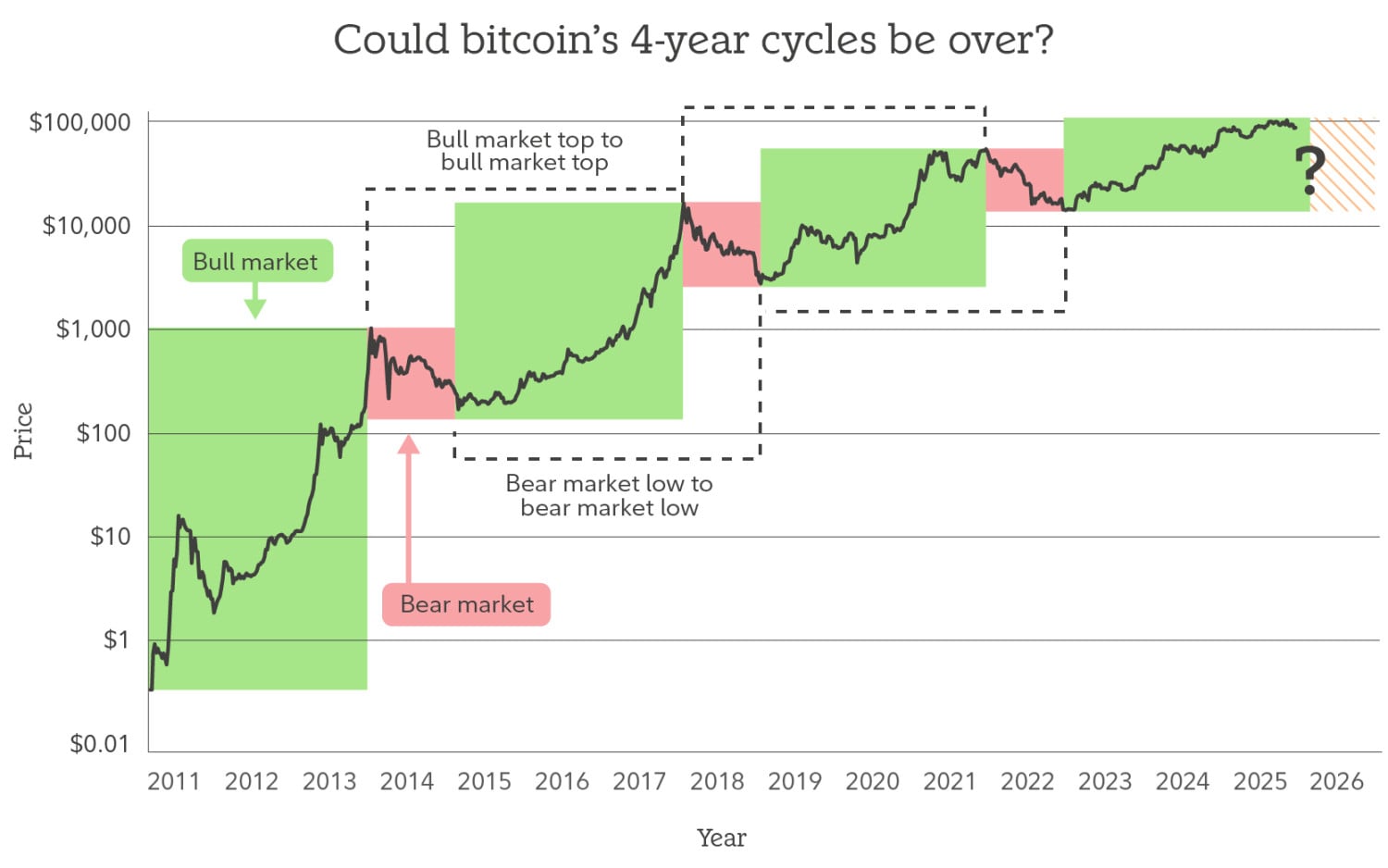
Source: Fidelity Investments. Past performance is not a reliable indicator of future results.

Will the Four-Year Cycle End?

Compared to traditional investments like stocks and bonds, Bitcoin's history is relatively short, but its price has roughly followed a four-year cycle (from bull market peak to peak, or from bear market bottom to bottom). It reached bull market peaks in November 2013, December 2017, and November 2021, and formed bear market bottoms in January 2015, December 2018, and November 2022. These cycles were accompanied by significant price volatility: the first cycle fell from $1,150 to $152, the second from $19,800 to $3,200, and the third from $69,000 to $15,500.

Bitcoin's movements often lead the entire cryptocurrency market to follow—in many cases, with even more剧烈 volatility.

Currently, we are at roughly the four-year mark of the current cycle, as the last bull market peaked in November 2021. And over the past month, cryptocurrency prices have continued to fall. So, has this bull market already peaked?

If the four-year cycle repeats, we might be at or near the end of Bitcoin's current bull run. However, some cryptocurrency investors believe this historical trend is about to end, and the current price pullback is merely a temporary retreat before the market resumes its upward trend.

What does this mean specifically? Some investors believe that while price pullbacks will still occur, the volatility of any declines will be far less than in the past, and the magnitude may be so small that it doesn't feel like a full bear market. Others think we may be entering a supercycle where the bull market lasts for years. For reference, the supercycle in commodities in the 2000s lasted nearly a decade.

Kuiper does not believe these cycles will disappear entirely, as the fear and greed that drive them haven't magically vanished. But he points out that if the four-year cycle were to repeat, we should have already hit the cycle's all-time high and entered a full bear market. Although the correction since November has been quite severe so far, he says we might not know for sure until 2026 whether a true four-year cycle has formed. The current price drop could be the start of a new bear market, or it could just be a correction within a bull market that will see new all-time highs again in the future—as we've already seen several times in this cycle.

Whether these predictions will come true remains to be seen, and we might not know until mid-2026.

Is It Too Late to Buy Bitcoin Now?

Despite the many uncertainties still present in the cryptocurrency market, one thing has become clearer: the crypto market is entering a new paradigm. "We are seeing a fundamental shift in the structure and categories of investors, and I believe this will continue into 2026," Kuiper said. "Traditional fund managers and investors have started buying Bitcoin and other digital assets, but in terms of the amount of capital they could bring into this space, I think we've only scratched the surface."

In light of this, investors who haven't yet entered the market might ask: Is it still a good time to buy Bitcoin now?

For Kuiper, it depends on your investment horizon. If you are looking to realize gains in the short or medium term (four to five years or less), you might be late, especially if this cycle ultimately follows historical patterns.

"However, from a very long-term perspective, I personally believe that if you view Bitcoin as a store of value, you are never fundamentally 'too late'," Kuiper said. "As long as its hard supply cap remains unchanged, I believe every purchase of Bitcoin is an act of putting your labor or savings into something that will not be devalued by government monetary policy inflation."


Twitter:https://twitter.com/BitpushNewsCN

Bitpush TG Discussion Group:https://t.me/BitPushCommunity

Bitpush TG Subscription: https://t.me/bitpush

Original link:https://www.bitpush.news/articles/7600402

Preguntas relacionadas

QAccording to Fidelity's 2026 crypto market outlook, what is the potential impact of more countries adopting cryptocurrency reserves?

AFidelity believes that if more countries adopt Bitcoin as part of their foreign exchange reserves, it could create competitive pressure for others to follow, potentially increasing demand and driving up prices due to simple supply and demand economics.

QWhat does Fidelity suggest about the traditional four-year cycle of Bitcoin and the possibility of a 'super cycle'?

AFidelity's Chris Kuiper notes that while the four-year cycle might not disappear entirely due to persistent fear and greed, some investors believe we might be entering a 'super cycle' where the bull market lasts for years, with less severe pullbacks than in the past.

QHow does Fidelity view the current trend of corporations adding cryptocurrencies to their balance sheets?

AFidelity sees corporations increasingly adding crypto to their balance sheets, which adds to market demand and could push prices higher. However, they caution that forced sales during bear markets could create downward pressure on prices.

QWhat is Fidelity's perspective on whether it's too late to invest in Bitcoin in 2026?

AFidelity states that for short-term gains, investors might be late if the cycle follows historical patterns. But for long-term holders viewing Bitcoin as a store of value, it's never fundamentally 'too late' due to its hard supply cap protecting against inflationary monetary policies.

QWhat key shift in investor structure does Fidelity identify for the crypto market in 2026?

AFidelity highlights a fundamental shift in investor structure, with traditional fund managers and investors beginning to buy Bitcoin and digital assets, suggesting that only the surface has been scratched in terms of the capital they could bring into the space.

Lecturas Relacionadas

If the AI Bubble Is Already Bursting, Who Will Truly Survive?

If the AI Bubble is Bursting, Who Will Remain? The debate over an AI bubble is intensifying, with figures like Ray Dalio warning of high levels and Jensen Huang seeing immense, early-stage opportunity. Both views hold truth: a speculative bubble in capital markets likely exists, mirroring the dot-com era, but the underlying technological shift is real and transformative. History shows that while bubbles burst—wiping out overvalued companies and speculative capital—they often leave behind critical physical and digital infrastructure. The dot-com bust, for instance, eliminated many firms but left the global fiber optic networks and data centers that enabled the rise of Amazon, Netflix, and cloud computing. Today's massive AI infrastructure investments (projected at trillions by 2030) in data centers, power, cooling, and GPUs may follow a similar path, creating the foundation for future applications. A key divergence from past bubbles is the "Jevons Paradox" effect in AI. As the cost of AI inference has plummeted by over 99.7% since 2023, enterprise spending on AI has skyrocketed. Cheap "tokens" have unlocked vast, previously uneconomical use cases, moving AI from simple chatbots into core business workflows—code generation, legal document review, scientific simulation, and financial analysis. The market is now in a phase of self-correction, weeding out superficial "API-wrapper" startups, but this cleansing process strengthens the ecosystem. The long-term trajectory is clear. The value is gradually shifting from capital expenditure (CapEx) on hardware to operational expenditure (OpEx) on transformative applications. As AI becomes a utility, the winners will be firms that deeply integrate it to solve vertical industry problems in law, healthcare, finance, and manufacturing. The泡沫 will recede, but the foundational shift towards an AI-powered era across all sectors is irreversible. The underlying productive force of AI contains no bubble.

marsbitHace 24 min(s)

If the AI Bubble Is Already Bursting, Who Will Truly Survive?

marsbitHace 24 min(s)

If the AI Bubble Is Already Bursting, Who Will Truly Remain?

**Summary: If the AI Bubble is Bursting, What Will Remain?** The debate around an AI bubble is intensifying, with figures like Ray Dalio warning of high valuations while Jensen Huang sees immense opportunity. This echoes the dot-com bubble, which saw massive wealth destruction but ultimately left behind critical infrastructure like undersea cables and broadband, enabling future giants like Amazon and Netflix. Similarly, today's AI boom involves trillions invested in data centers, power, cooling, and GPUs, while application-layer revenue remains comparatively modest. This investment-disparity signals a bubble. However, the core technological progress is real and accelerating. AI inference costs have plummeted by over 99.7% since 2023, making intelligence increasingly cheap and accessible. This cost collapse is unlocking vast new demand. Instead of reducing spending, enterprises are tripling their AI cloud expenditure. Cheap "tokens" enable AI to move beyond simple chatbots into complex workflows—automating code writing, legal document review, financial analysis, and scientific research. This follows "Jevons's paradox": improved efficiency leads to greater total consumption. The market is now undergoing a necessary purification, weeding out "API-wrapper" startups with no real moat. The deeper evolution involves a shift from capital expenditure (CapEx) on infrastructure to operational expenditure (OpEx) on value-creation in applications. While hardware vendors currently profit most, long-term value will migrate to AI-native firms solving vertical industry problems. Ultimately, a market correction will cleanse speculative excess but will not reverse the AI+ trend. The massive physical and algorithmic infrastructure being built will endure, becoming a cheap, utility-like foundation. Just as the internet became indispensable to all industries post-2000, AI is poised to empower and redefine every sector, moving society irreversibly toward an intelligence-augmented era. The bubble may burst, but the underlying productive momentum is solid.

链捕手Hace 31 min(s)

If the AI Bubble Is Already Bursting, Who Will Truly Remain?

链捕手Hace 31 min(s)

Microsoft CEO: In the AI Era, How Do You Define a Company's Moat?

Microsoft CEO Satya Nadella argues that in the AI era, a company's true competitive edge, or "moat," is not determined by choosing the single most powerful model, but by its ability to build a continuous "learning loop." This system integrates and evolves by connecting human workflows, domain expertise, organizational judgment, and employee experience. He posits that future companies will accumulate two types of capital: Human Capital (employee knowledge, judgment, creativity) and "Token Capital" (a firm's own built and owned AI capabilities). Importantly, AI amplifies rather than devalues human capital. Human direction is essential to guide progress, as computational power alone is aimless. The core opportunity lies in creating a closed-loop system where human and token capital reinforce each other in a compound, self-improving cycle. A company must be able to preserve its unique institutional knowledge—its "company veteran" expertise—even if it switches underlying general-purpose AI models. This requires private evaluation benchmarks, reinforcement learning environments based on internal data, and queryable knowledge bases. Nadella warns against a future where economic value is concentrated by a few dominant models that commoditize entire industries' knowledge. Instead, the priority should be building a broad "frontier ecosystem" where every company, industry, and nation can own its learning loop. This allows organizations to retain control of their intellectual property, amplify employee capabilities, and ensure the economic value created by AI is captured within their own businesses and communities. True corporate sovereignty in the AI age comes from turning organizational knowledge into a compounding system that creates enduring, defensible value.

marsbitHace 1 hora(s)

Microsoft CEO: In the AI Era, How Do You Define a Company's Moat?

marsbitHace 1 hora(s)

ETFs Are Just the Ticket: The True Institutionalization of Bitcoin Is Happening Where You Can't See It

Beyond the Bitcoin ETF spotlight, a deeper institutionalization is underway, leveraging Bitcoin as a foundational financial primitive. Institutions are using Bitcoin for purposes long reserved for assets like U.S. Treasuries and gold: as collateral for loans, insurance reserves, and the backbone of rated bonds. Examples include a Barbados-based insurer capitalizing with $40M in Bitcoin reserves and Ledn's $188M securitization of Bitcoin-backed loans, which received the first-ever investment-grade rating (BBB-) from S&P for a digital asset-backed security. This structure was stress-tested during a 27% price drop in early 2026, triggering automatic liquidations that functioned as designed but revealed the systemic risk of synchronized selling across leveraged positions. Infrastructure is evolving to support this, with platforms like Anchorage Digital's Atlas network enabling secure, institutional-grade settlement and collateral management. Strategies like basis trades and corporate treasuries (exemplified by companies like MicroStrategy issuing billions in equity and debt to fund Bitcoin acquisitions) further integrate Bitcoin into financial mechanics. While ETFs solved "how to own" Bitcoin, these developments answer "what to do with it," embedding the asset into the working machinery of finance—as collateral upon which loans, derivatives, and structured products are built. The real, enduring institutional shift is happening in these largely invisible plumbing and financing systems.

marsbitHace 1 hora(s)

ETFs Are Just the Ticket: The True Institutionalization of Bitcoin Is Happening Where You Can't See It

marsbitHace 1 hora(s)

ZEC Co-Founder Responds to Orchard Vulnerability: No Signs of Theft, Orchard Pool to Be Sealed

ZEC Co-Founder Addresses Orchard Vulnerability: No Signs of Theft, Plans to Sunset Orchard Pool A security vulnerability was recently discovered in Zcash's Orchard shielded pool, raising key concerns. The primary questions are whether the flaw was exploited, if user funds are safe, whether users can verify the total ZEC supply, and if other similar vulnerabilities exist. Analysis suggests the vulnerability was likely not exploited prior to its discovery. It was found proactively by a researcher using specialized tools, not due to an active breach. The development team and mining pools acted quickly to contain the issue. Typical financially-motivated attacks would likely have left visible on-chain evidence, which has not been observed. User funds in Orchard are considered safe and should be recoverable, assuming no prior exploitation. If the flaw was never used, all legitimate funds can be withdrawn. The article outlines risks associated with moving funds to transparent addresses or other pools, but concludes that leaving assets in place is a reasonable option. Currently, users cannot independently verify that the total ZEC supply hasn't been inflated due to this bug. However, the planned Ironwood network upgrade is designed to resolve this. It will permanently close the Orchard pool to new deposits and internal transfers, allowing only withdrawals. This mechanism will cap total withdrawals at the amount of legitimately deposited funds, enabling anyone to cryptographically verify the supply post-upgrade. Multiple teams, including Shielded Labs, have conducted extensive audits focused on counterfeiting vulnerabilities, assisted by advanced AI tools. No additional flaws of this type have been found so far, increasing confidence that no other similar undisclosed vulnerabilities exist. In summary, evidence indicates the Orchard bug was probably not used, user funds are secure, and no other counterfeiting flaws are currently known. The upcoming Ironwood upgrade will restore users' ability to independently verify the total ZEC supply, closing this chapter.

Foresight NewsHace 1 hora(s)

ZEC Co-Founder Responds to Orchard Vulnerability: No Signs of Theft, Orchard Pool to Be Sealed

Foresight NewsHace 1 hora(s)

Trading

Spot
Futuros
活动图片





