Has the Era of Global Central Banks 'Hoarding Gold' Come to an End?

marsbitPublicado a 2026-04-03Actualizado a 2026-04-03

Resumen

The article questions whether the global central bank gold-buying spree, ongoing for 15 years, is ending. Citing a UBS report, it concludes that a structural shift to large-scale selling is highly unlikely. While the pace of purchases may slow to 800-850 tons in 2026 from 860 tons in 2025, central banks are expected to remain net buyers. The report challenges the narrative that recent sales, like Turkey's alleged sale of 50 tons, signal a trend. It argues Turkey's data is distorted by commercial bank positions and swaps, and its central bank uses gold for domestic liquidity management, not necessarily market speculation. Short-term price volatility is attributed to dollar strength and real interest rates, not central bank selling. The underlying logic for holding gold remains strong: over 60% of central banks follow a buy-and-hold strategy, with diversification being the primary motive. While short-term noise and price consolidation are expected, the medium-term outlook is bullish, with UBS forecasting an average 2026 price of $5000/oz and a year-end target of $5600/oz.

Original Author: Zhao Ying

Original Source: Wall Street News

The hottest question in the market recently is: Are global central banks selling gold? Has this 15-year-long official "gold hoarding wave" come to an end?

According to Wind Trading Desk, UBS strategist Joni Teves gave a clear judgment in the latest precious metals research report released on April 2: The possibility of a structural shift and large-scale selling by central banks is extremely low. Official institutions will maintain a net buying stance, but the pace of purchases will slow moderately—it is estimated that gold purchases in 2026 will be about 800 to 850 tons, slightly lower than the approximately 860 tons in 2025.

The report targeted the most glaring recent example—the news that Turkey "sold about 50 tons of gold in a few weeks." Teves believes: Turkey's official gold data includes commercial bank positions, swaps, and other operations. Relying solely on headlines to infer that "central banks are starting to sell" is highly risky, and it is better to wait for more detailed breakdown data before making a judgment.

In terms of price, UBS defines the short term as "full of noise": news cycles about geopolitical situations will keep gold prices fluctuating and consolidating; but the medium-term logic still points to new highs. The bank lowered its 2026 average gold price forecast to $5,000 (previously $5,200, mainly an adjustment for the first quarter) and maintained its year-end target price of $5,600 (set at the end of January).

Evidence That "Central Bank Gold Selling" Is the Main Cause of This Pullback Is Not Solid; 800-850 Tons Is More Like "Slowing Down"

The market's concern is specific: If the Middle East conflict prolongs, oil prices push up inflation, growth weakens, and local currencies depreciate, some central banks may be forced to sell gold to cope with the pressure. The report does not deny that "individual central banks may sell," but it emphasizes that this does not equate to a trend reversal in the official sector.

A key reminder from the report is: During the past 15 years of continuous gold accumulation by the official sector, "selling" in a single month is not uncommon. The reasons can be practical—central banks that bought cheaply earlier may take some profit tactically outside their core positions; sharp gold price increases trigger rebalancing; "natural inflows" from gold-producing countries turn into external shipments at certain points. In other words, selling can be an action, not necessarily a stance.

The baseline judgment is that net buying continues, but at a slower pace. The detail here lies in the trading habits of the official sector: They are more like "physical buyers," often providing support during pullbacks, helping the market stabilize more quickly at higher levels; conversely, the official sector typically does not chase rallies, preferring to intervene when prices are more suitable and volatility is lower.

This also explains why, when volatility increases, the market suddenly feels that "central banks have disappeared." The observation mentioned in the research is: Recently, the official sector and other long-term holders have tended to wait and see rather than immediately replenish positions in every decline.

The Narrative of Turkey Selling "50 Tons" Is Overstated; Short-Term Gold Prices Are More Influenced by the Dollar and Real Interest Rates

The case of Turkey is sensitive because it seems to fit the narrative of "central banks starting to sell gold." But Turkey has certain particularities: Some changes may be due to swaps rather than direct selling; more importantly, the Turkish Central Bank has long used gold as a policy tool to support liquidity management in the domestic banking system.

Part of the total gold disclosed by the Turkish Central Bank corresponds to commercial bank positions. Combined with policies since 2017 that allow banks and other entities to use gold within the financial system, "changes in total data" do not equal "central bank selling in the market." The report's advice is clear: Wait for more detailed data that can break down the口径 before discussing trends.

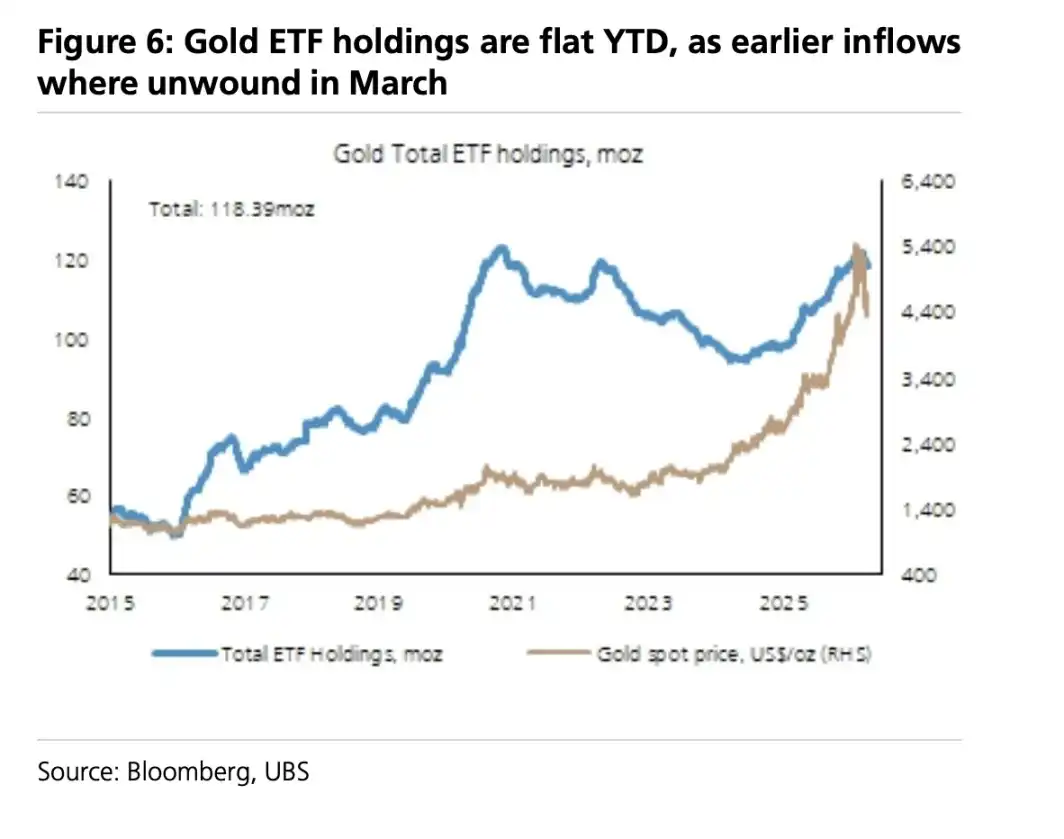
The trading environment in March had "dual uncertainty": On one hand, gold prices were seeking a new stable range after sharp rises and falls in January-February when Iran-related news fermented; on the other hand, the impact of the Middle East conflict on macro and asset pricing is nonlinear, and long-term funds are reluctant to bet easily.

When strategic funds that "buy on dips" are absent, gold prices in the short term are more likely to return to the traditional framework: A stronger U.S. dollar and rising U.S. real interest rates suppress gold prices; long positions are further squeezed out, and even some short-selling forces emerge. In addition, Chinese demand supported the decline during this phase, with gold prices stabilizing near $4,500 before fluctuating around the $4,700 level.
The Underlying Logic of Central Bank Gold Holdings: Buy and Hold

The World Bank's "Fifth Biennial Reserve Management Survey Report (2025)" explains a more fundamental question: How do central banks really think about gold? The survey covers holdings as of December 2024, with 136 institutions participating—the highest ever—and for the first time includes a separate chapter on gold.

Several numbers can clarify the behavioral boundaries of central banks: About 47% of central banks determine gold holdings based on "historical legacy," about 26% based on qualitative judgment; only about a quarter incorporate gold into a formal strategic asset allocation framework.

More critically, only about 4.5% make short-term tactical adjustments to gold reserves, while the investment style for gold is mainly buy-and-hold (about 62%). This profile means: Even if the buying pace slows, the official sector is not like a group of traders driven by news to frequently trade positions.

In terms of reasons for increasing holdings, more than half cited "diversification" as the primary reason; local gold purchase plans accounted for about 35%, geopolitical risks about 32%; only about 6% cited "liquidity needs" as a reason. The official sector's rationale for gold has not been invalidated by recent volatility.

Short-Term Volatility Is Inevitable, but "New Highs Not Finished" Remains the Main Theme

Returning to the trading level, gold's rise is not a straight line: It may continue to consolidate and experience bumpy movements in the coming weeks as the market repeatedly reassesses geopolitical risks. But it believes that the two long-term drivers pushing funds to allocate to gold—the combination of growth and inflation risks, and the persistence of geopolitical tensions—are making "diversification into gold" a more common portfolio action.

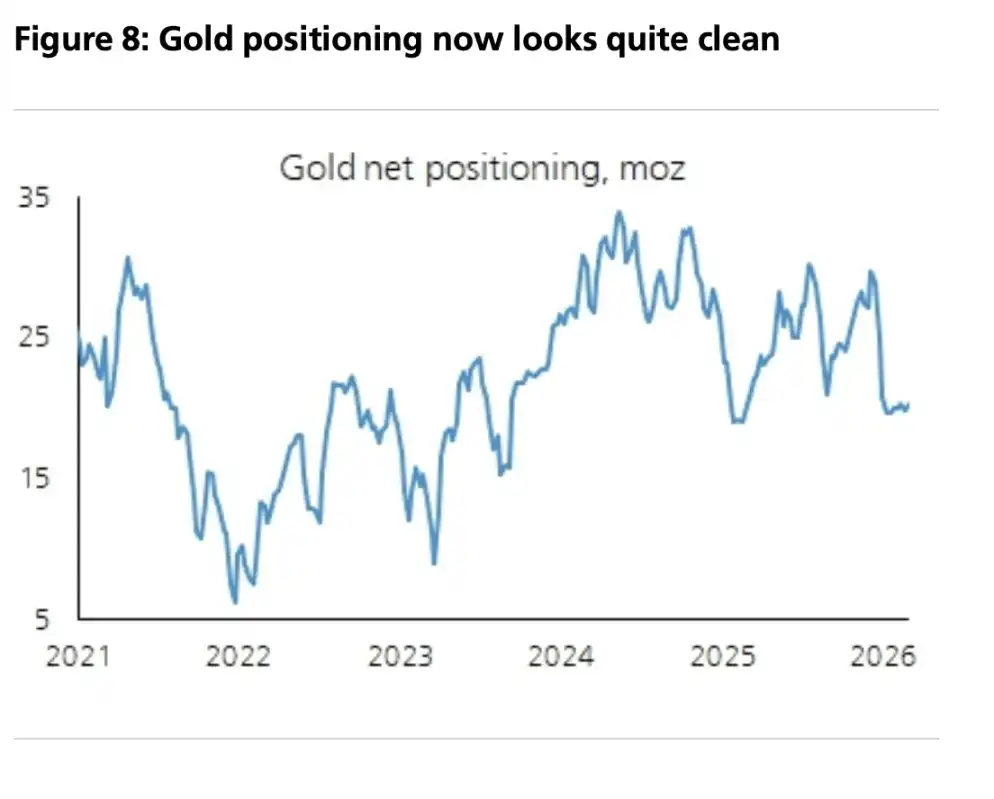
Under this framework, the report's pricing anchor is: An average gold price of $5,000 in 2026, with a year-end target of $5,600. It also mentions that speculative positions are already "cleaner," and long-term participants are still underweight; if another pullback occurs, it is closer to a "strategic window for building positions" rather than a signal of the end of the trend.
Preguntas relacionadas

QIs the UBS report suggesting that global central banks are structurally shifting away from gold and starting large-scale selling?

ANo, the UBS report states that the possibility of a structural shift and large-scale selling by central banks is extremely low. They are expected to maintain a net buying stance, albeit at a slightly slower pace.

QWhat is the specific reason cited in the report for the recent news about Turkey selling gold, and why should it be interpreted cautiously?

AThe report cautions that Turkey's official gold data includes commercial bank positions and swap operations. It suggests waiting for more detailed, disaggregated data before concluding that the central bank is selling, as the headline figure does not equate to direct central bank market selling.

QAccording to the World Bank's survey, what is the primary investment style and main reason central banks hold gold?

AThe primary investment style for central banks is 'buy and hold' (approximately 62%). The main reason for increasing gold holdings is 'diversification', cited by over half of the central banks surveyed.

QWhat is UBS's medium-term price target for gold by the end of 2026, and what is their revised average price forecast for the year?

AUBS maintains a year-end 2026 price target of $5600 per ounce. They have revised their average annual price forecast for 2026 down to $5000 from a previous $5200, mainly as an adjustment for Q1 performance.

QWhat two long-term factors does the report identify as driving continued gold allocation, despite short-term noise and volatility?

AThe two long-term factors driving gold allocation are the combination of growth and inflation risks, and the persistence of geopolitical tensions, which are making diversification into gold a more common portfolio action.

Lecturas Relacionadas

From a $300 Million Valuation to a 'Fire Sale' at Tens of Millions: What Happened to Messari?

On June 12, leading crypto data and capital markets platform Blockworks announced its acquisition of competitor Messari for over $10 million. This price represents a significant discount from Messari's 2022 valuation peak of approximately $300 million, highlighting the survival pressures faced by high-valuation startups during the bear market and a consolidation wave in data infrastructure. Blockworks, founded in 2018, began as a media and events company but has pivoted to focus on institutional-grade data, investor relations, and compliance tools. Its recent Series A extension round, valuing the company at $192 million, aimed to fund this shift and strategic acquisitions like this one. Messari, also founded in 2018, grew as a go-to platform for professional crypto research and data, raising a $35 million Series B at its $300 million valuation in late 2022. However, the prolonged bear market and subsequent internal changes, including founder Ryan Selkis's departure in 2024, increased operational pressures. The acquisition integrates Messari's extensive data platform and API capabilities with Blockworks's strengths in issuer-side disclosure, investor relations, and compliance workflows. The combined entity aims to build a unified "system of record" for the on-chain market. This reflects a broader industry trend where high-quality, structured data is becoming critical for institutional adoption, AI agents, and creating data moats akin to traditional financial platforms like Bloomberg. The deal exemplifies how market consolidation is reshaping the fragmented crypto data landscape.

marsbitHace 3 min(s)

From a $300 Million Valuation to a 'Fire Sale' at Tens of Millions: What Happened to Messari?

marsbitHace 3 min(s)

If the AI Bubble Is Already Bursting, Who Will Truly Survive?

If the AI Bubble is Bursting, Who Will Remain? The debate over an AI bubble is intensifying, with figures like Ray Dalio warning of high levels and Jensen Huang seeing immense, early-stage opportunity. Both views hold truth: a speculative bubble in capital markets likely exists, mirroring the dot-com era, but the underlying technological shift is real and transformative. History shows that while bubbles burst—wiping out overvalued companies and speculative capital—they often leave behind critical physical and digital infrastructure. The dot-com bust, for instance, eliminated many firms but left the global fiber optic networks and data centers that enabled the rise of Amazon, Netflix, and cloud computing. Today's massive AI infrastructure investments (projected at trillions by 2030) in data centers, power, cooling, and GPUs may follow a similar path, creating the foundation for future applications. A key divergence from past bubbles is the "Jevons Paradox" effect in AI. As the cost of AI inference has plummeted by over 99.7% since 2023, enterprise spending on AI has skyrocketed. Cheap "tokens" have unlocked vast, previously uneconomical use cases, moving AI from simple chatbots into core business workflows—code generation, legal document review, scientific simulation, and financial analysis. The market is now in a phase of self-correction, weeding out superficial "API-wrapper" startups, but this cleansing process strengthens the ecosystem. The long-term trajectory is clear. The value is gradually shifting from capital expenditure (CapEx) on hardware to operational expenditure (OpEx) on transformative applications. As AI becomes a utility, the winners will be firms that deeply integrate it to solve vertical industry problems in law, healthcare, finance, and manufacturing. The泡沫 will recede, but the foundational shift towards an AI-powered era across all sectors is irreversible. The underlying productive force of AI contains no bubble.

marsbitHace 35 min(s)

If the AI Bubble Is Already Bursting, Who Will Truly Survive?

marsbitHace 35 min(s)

If the AI Bubble Is Already Bursting, Who Will Truly Remain?

**Summary: If the AI Bubble is Bursting, What Will Remain?** The debate around an AI bubble is intensifying, with figures like Ray Dalio warning of high valuations while Jensen Huang sees immense opportunity. This echoes the dot-com bubble, which saw massive wealth destruction but ultimately left behind critical infrastructure like undersea cables and broadband, enabling future giants like Amazon and Netflix. Similarly, today's AI boom involves trillions invested in data centers, power, cooling, and GPUs, while application-layer revenue remains comparatively modest. This investment-disparity signals a bubble. However, the core technological progress is real and accelerating. AI inference costs have plummeted by over 99.7% since 2023, making intelligence increasingly cheap and accessible. This cost collapse is unlocking vast new demand. Instead of reducing spending, enterprises are tripling their AI cloud expenditure. Cheap "tokens" enable AI to move beyond simple chatbots into complex workflows—automating code writing, legal document review, financial analysis, and scientific research. This follows "Jevons's paradox": improved efficiency leads to greater total consumption. The market is now undergoing a necessary purification, weeding out "API-wrapper" startups with no real moat. The deeper evolution involves a shift from capital expenditure (CapEx) on infrastructure to operational expenditure (OpEx) on value-creation in applications. While hardware vendors currently profit most, long-term value will migrate to AI-native firms solving vertical industry problems. Ultimately, a market correction will cleanse speculative excess but will not reverse the AI+ trend. The massive physical and algorithmic infrastructure being built will endure, becoming a cheap, utility-like foundation. Just as the internet became indispensable to all industries post-2000, AI is poised to empower and redefine every sector, moving society irreversibly toward an intelligence-augmented era. The bubble may burst, but the underlying productive momentum is solid.

链捕手Hace 42 min(s)

If the AI Bubble Is Already Bursting, Who Will Truly Remain?

链捕手Hace 42 min(s)

Microsoft CEO: In the AI Era, How Do You Define a Company's Moat?

Microsoft CEO Satya Nadella argues that in the AI era, a company's true competitive edge, or "moat," is not determined by choosing the single most powerful model, but by its ability to build a continuous "learning loop." This system integrates and evolves by connecting human workflows, domain expertise, organizational judgment, and employee experience. He posits that future companies will accumulate two types of capital: Human Capital (employee knowledge, judgment, creativity) and "Token Capital" (a firm's own built and owned AI capabilities). Importantly, AI amplifies rather than devalues human capital. Human direction is essential to guide progress, as computational power alone is aimless. The core opportunity lies in creating a closed-loop system where human and token capital reinforce each other in a compound, self-improving cycle. A company must be able to preserve its unique institutional knowledge—its "company veteran" expertise—even if it switches underlying general-purpose AI models. This requires private evaluation benchmarks, reinforcement learning environments based on internal data, and queryable knowledge bases. Nadella warns against a future where economic value is concentrated by a few dominant models that commoditize entire industries' knowledge. Instead, the priority should be building a broad "frontier ecosystem" where every company, industry, and nation can own its learning loop. This allows organizations to retain control of their intellectual property, amplify employee capabilities, and ensure the economic value created by AI is captured within their own businesses and communities. True corporate sovereignty in the AI age comes from turning organizational knowledge into a compounding system that creates enduring, defensible value.

marsbitHace 1 hora(s)

Microsoft CEO: In the AI Era, How Do You Define a Company's Moat?

marsbitHace 1 hora(s)

Trading

Spot
Futuros

Artículos destacados

Cómo comprar ERA

¡Bienvenido a HTX.com! Hemos hecho que comprar Caldera (ERA) sea simple y conveniente. Sigue nuestra guía paso a paso para iniciar tu viaje de criptos.Paso 1: crea tu cuenta HTXUtiliza tu correo electrónico o número de teléfono para registrarte y obtener una cuenta gratuita en HTX. Experimenta un proceso de registro sin complicaciones y desbloquea todas las funciones.Obtener mi cuentaPaso 2: ve a Comprar cripto y elige tu método de pagoTarjeta de crédito/débito: usa tu Visa o Mastercard para comprar Caldera (ERA) al instante.Saldo: utiliza fondos del saldo de tu cuenta HTX para tradear sin problemas.Terceros: hemos agregado métodos de pago populares como Google Pay y Apple Pay para mejorar la comodidad.P2P: tradear directamente con otros usuarios en HTX.Over-the-Counter (OTC): ofrecemos servicios personalizados y tipos de cambio competitivos para los traders.Paso 3: guarda tu Caldera (ERA)Después de comprar tu Caldera (ERA), guárdalo en tu cuenta HTX. Alternativamente, puedes enviarlo a otro lugar mediante transferencia blockchain o utilizarlo para tradear otras criptomonedas.Paso 4: tradear Caldera (ERA)Tradear fácilmente con Caldera (ERA) en HTX's mercado spot. Simplemente accede a tu cuenta, selecciona tu par de trading, ejecuta tus trades y monitorea en tiempo real. Ofrecemos una experiencia fácil de usar tanto para principiantes como para traders experimentados.

385 Vistas totalesPublicado en 2025.07.17Actualizado en 2026.06.02

Cómo comprar ERA

Discusiones

Bienvenido a la comunidad de HTX. Aquí puedes mantenerte informado sobre los últimos desarrollos de la plataforma y acceder a análisis profesionales del mercado. A continuación se presentan las opiniones de los usuarios sobre el precio de ERA (ERA).

活动图片













