Google Engineer Arrested For Using Company’s Own Search Data To Win $1.2 Million On Polymarket

bitcoinistPublicado a 2026-05-28Actualizado a 2026-05-28

Resumen

A Google information security engineer, Michele Spagnuolo, has been arrested and charged with commodities fraud, wire fraud, and money laundering. Prosecutors allege he used confidential internal Google search data to place bets on the crypto-based prediction market Polymarket, winning approximately $1.2 million by knowing outcomes before the public. Using an internal tool showing real-time search trends, he reportedly placed successful wagers on contracts tied to Google's "Year in Search" rankings for 2025. This is the second federal criminal case involving Polymarket insider trading in just over a month, following an April arrest of a U.S. Army sergeant accused of using classified military information. The cases highlight increasing legal scrutiny of prediction markets, with blockchain transparency aiding prosecutors. Google placed Spagnuolo on leave and is cooperating with authorities.

A Google information security engineer has been arrested and charged with commodities fraud, wire fraud, and money laundering after allegedly using confidential internal company data to place a series of bets on Polymarket — the crypto-based prediction market platform — winning approximately $1.2 million by knowing the outcomes of his wagers before the trading public did.

The US Attorney’s Office for the Southern District of New York unsealed the complaint against Michele Spagnuolo, 36 — also known by his Polymarket account alias “AlphaRaccoon” — on May 27, 2026. Spagnuolo, an Italian citizen residing in Switzerland, was arrested in New York and appeared before US Magistrate Judge Sarah Netburn, where he was released on a $2.25 million bond secured by $1 million in cash, per the DOJ’s official statement. He did not enter a plea.
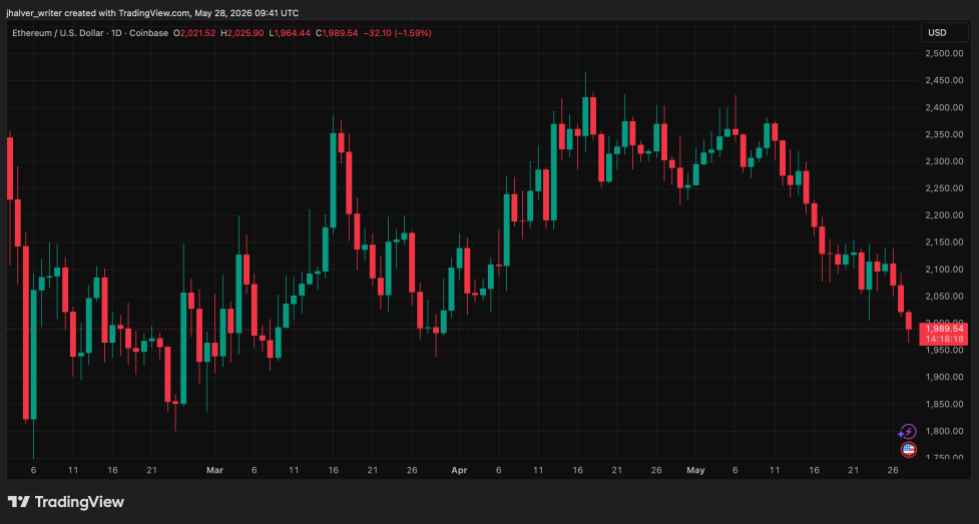
ETH's price trends to the downside on the daily chart. Source: ETHUSD on Tradingview

How The Scheme Worked

According to the unsealed complaint, Spagnuolo had access to an internal Google software tool — bearing a banner marked “Google Confidential” in red text — that provided real-time visibility into what users were searching across Google’s platform, including data that fed directly into Google’s annual “Year in Search” rankings, per the DOJ filing.

Beginning in May 2024, Spagnuolo created a Polymarket account and began placing bets on contracts tied to which individuals would rank on Google’s most-searched list for 2025 — markets Polymarket launched last fall, per the complaint.

Prosecutors allege Spagnuolo transferred approximately $3.8 million in USDC to his Polymarket address and placed bets including a $381.12 “yes” wager that the artist d4vd would rank in Google’s most-searched list and correctly predicted contracts such as “Will Zohran Mamdani rank in the Top 5 most searched” and “Will Squid Game be the number one searched TV show,” per CNBC’s reporting of the complaint. His success rate across these markets was, according to the complaint, no accident. He knew the answers before the markets settled.

The CFTC filed a simultaneous civil case against Spagnuolo seeking monetary disgorgement, restitution, and additional penalties, per the complaint. Google confirmed it had placed Spagnuolo on leave and was cooperating with law enforcement — noting that the tool he used was technically available to all employees, but that using confidential information to place bets represented a serious breach of company policy, per a statement reported by ABC News.

The Second Case In Thirty Days

The Spagnuolo arrest is the second federal criminal case tied to Polymarket insider trading in just over a month. In April 2026, US Army Special Forces Master Sergeant Gannon Ken Van Dyke was arrested for allegedly using classified military knowledge of the planned capture of Venezuelan President Nicolás Maduro to place bets on Polymarket, reportedly netting more than $400,000. Van Dyke has pleaded not guilty, per CNN’s reporting.

Polymarket’s chief legal officer Olivia Chalos said in a statement that the company worked closely with the US Attorney’s Office and the CFTC on the Spagnuolo case — noting that Polymarket is the only prediction platform to date whose cooperation has led to insider trading charges in the United States, and that the blockchain-based nature of the platform means bad actors leave footprints.

This development marks a critical and accelerating moment for the nascent prediction market sector. Two federal insider trading arrests in thirty days — one involving military classified information, the other corporate search data — arriving simultaneously with an active congressional investigation into Polymarket and Kalshi, confirms that the legal perimeter around prediction markets is closing fast. The transparency of blockchain trading, once seen primarily as a feature for users, is now functioning as a forensic trail for federal prosecutors.

Cover image from Grok, ETHUSD chart from Tradingview

Preguntas relacionadas

QWhat was the Google engineer accused of doing, and how much did he allegedly win?

AThe Google engineer, Michele Spagnuolo, was accused of using confidential internal search data to place bets on Polymarket's prediction markets, specifically those tied to Google's 'Year in Search' rankings. He allegedly won approximately $1.2 million by knowing the outcomes before the trading public.

QWhat specific internal tool did the Google engineer allegedly misuse, and what kind of data did it provide?

AHe allegedly misused an internal Google software tool that displayed a 'Google Confidential' banner. This tool provided real-time visibility into what users were searching across Google's platform, including data that fed directly into Google's annual 'Year in Search' rankings.

QWhat were the federal criminal charges brought against Michele Spagnuolo?

AMichele Spagnuolo was charged with commodities fraud, wire fraud, and money laundering.

QAccording to the article, what was the other recent insider trading case involving Polymarket?

AIn April 2026, US Army Special Forces Master Sergeant Gannon Ken Van Dyke was arrested. He was accused of using classified military knowledge about the planned capture of Venezuelan President Nicolás Maduro to place bets on Polymarket, allegedly netting more than $400,000.

QHow did Polymarket's chief legal officer characterize the platform's role in the Spagnuolo case?

APolymarket's chief legal officer, Olivia Chalos, stated that the company worked closely with authorities, that Polymarket is the only prediction platform whose cooperation has led to U.S. insider trading charges, and that the blockchain-based nature of the platform means bad actors leave forensic footprints.

Lecturas Relacionadas

Fei-Fei Li's Team Clarifies the Concept of 'World Models', Sora Merely a Renderer

"World Models" has become a widely used yet confusing term in AI. To address this, a team led by Fei-Fei Li and World Labs proposed a functional taxonomy based on the Partially Observable Markov Decision Process framework. This taxonomy categorizes systems called "world models" into three distinct projections: Renderers, Simulators, and Planners. Renderers, like OpenAI's Sora and other video generation models, focus on producing photorealistic visual outputs for human perception. They prioritize visual fidelity over physical accuracy. Simulators, such as NVIDIA Omniverse, aim to compute precise future environmental states for computational tasks like engineering analysis or digital twins. Planners, like Vision-Language-Action models, take in observations and goals to output executable actions for robots or agents. The article clarifies that most current "world models," including Sora, are primarily Renderers. They generate convincing visuals but lack the core ability to simulate state transitions based on actions, a key requirement for a true world model in classic reinforcement learning definitions. This conceptual confusion has practical implications, leading to potential misalignment in technology selection, investment, and public understanding of AI capabilities. Clear categorization is crucial. It helps enterprises avoid costly mistakes (e.g., using a renderer for robot training), allows investors to accurately assess markets, and enables researchers to build comparable benchmarks. While future systems may integrate these functions, recognizing current boundaries is essential for honest assessment and progress.

marsbitHace 1 hora(s)

Fei-Fei Li's Team Clarifies the Concept of 'World Models', Sora Merely a Renderer

marsbitHace 1 hora(s)

Bloomberg Uncovered: How Do China's Wealthy Circumvent the Annual $50,000 Limit to Transfer Assets?

**Summary: How Wealthy Chinese Circumvent $50,000 Annual Foreign Exchange Limits** Despite China's strict capital controls, including an annual $50,000 per person foreign exchange quota, an estimated $150 billion in funds still leaves the country annually via various gray and underground channels. This report outlines the evolution of China's "capital wall" and the methods used to bypass it. **The Evolving Capital Controls:** * **Foundation (1994):** The system of "current account convertibility with strict capital account controls" was established. * **Quota Set (2007):** The $50,000 individual annual forex purchase limit was formalized. * **Crackdown Begins (2015-2017):** Following market volatility, enforcement tightened. Banks were required to scrutinize transactions, and channels like using UnionPay cards for Hong Kong insurance premiums or buying overseas property were blocked. * **Digital & Legal Upgrades (2024-2026):** Enhanced algorithms now flag suspicious patterns (e.g., "smurfing"). The Common Reporting Standard (CRS) provides Chinese tax authorities with data on citizens' offshore accounts. Unlicensed cross-border brokers have been targeted. **Five Primary Methods for Moving Capital:** 1. **Underground Banking / "Hawala" (Duiqiao):** The largest-scale method. No money crosses borders. Clients pay RMB to a domestic account; an overseas associate deposits equivalent foreign currency into the client's offshore account. Risks include high fees, account freezes, and legal penalties. 2. **"Smurfing" or "Ant Moving":** Using multiple individuals' $50,000 quotas to pool funds for one offshore recipient. Increasingly detected by anti-money laundering algorithms. 3. **Trade Invoice Manipulation:** Businesses over-invoice imports or under-invoice exports via offshore shell companies, creating a pretext to transfer excess funds abroad under the guise of trade. 4. **Channel Migration:** After a crackdown on internet brokers, funds flow toward more compliant but costly channels like major banks' cross-border wealth management services or Qualified Domestic Institutional Investor (QDII) quotas. 5. **Structural Arrangements:** High-net-worth individuals use complex, high-cost legal structures involving offshore trusts, insurance, and investment migration programs to transfer asset ownership. **Regulatory Response: Focusing on People, Not Just Money** The current strategy extends oversight from enterprises to **individual residents**. Tools like CRS allow retroactive visibility into offshore assets. Cryptocurrencies, once seen as a potential loophole, are now actively monitored and prosecuted as an illegal channel. The underlying driver remains: with significant wealth concentrated among millions of affluent households seeking diversification amid domestic economic shifts, the incentive to move assets offshore persists despite regulatory barriers.

marsbitHace 1 hora(s)

Bloomberg Uncovered: How Do China's Wealthy Circumvent the Annual $50,000 Limit to Transfer Assets?

marsbitHace 1 hora(s)

Trading

Spot
Futuros
活动图片





