Gold Returns to $4800, Where Is This Year's Peak?

Odaily星球日报Publicado a 2026-04-09Actualizado a 2026-04-09

Resumen

Gold has rebounded above $4,800 per ounce amid easing U.S.-Iran tensions after six weeks of conflict. This article explores gold's potential peak in 2026, citing predictions from platforms like Polymarket, where some traders bet on prices exceeding $6,000 by year-end. Key drivers include sustained central bank purchases (notably China’s 17-month buying streak), institutional demand from entities like Tether (now a top-30 global gold holder), and retail investment, particularly in Asia. While short-term volatility persists, analysts from UBS and Goldman Sachs project gold could reach $5,200-$5,400 by mid-year and $5,900-$6,300 longer-term, supported by geopolitical uncertainty, dollar weakening, and gold’s role as a hedge in a shifting global monetary system. The outlook remains bullish despite periodic corrections.

Original | Odaily Planet Daily (@OdailyChina)

Author | Wenser (@wenser 2010)
After enduring nearly six weeks of sudden shocks from the U.S.-Iran conflict, gold has returned above $4800 for the first time in nearly a month, following news related to a U.S.-Iran ceasefire agreement.

From the gold token XAUm mentioned as early as October 2024, to the accurate prediction of gold spot prices rising above $3900 when it was at $3500 in September last year, and later to the gold token XAUT mentioned when gold rose to around $4500 in January this year, I myself began a journey of fixed investment while following gold.

On the other hand, at the macro level, against the backdrop of intensifying geopolitical conflicts, central banks around the world continue to increase their gold holdings, with the Chinese central bank making large purchases for 17 consecutive months; major investment institutions and banks are also very confident about the gold price rally.

In view of this, this article from Odaily Planet Daily will explore a question from the perspectives of recent industry dynamics and changes in the political and economic situation: What is the upper limit for gold this year?
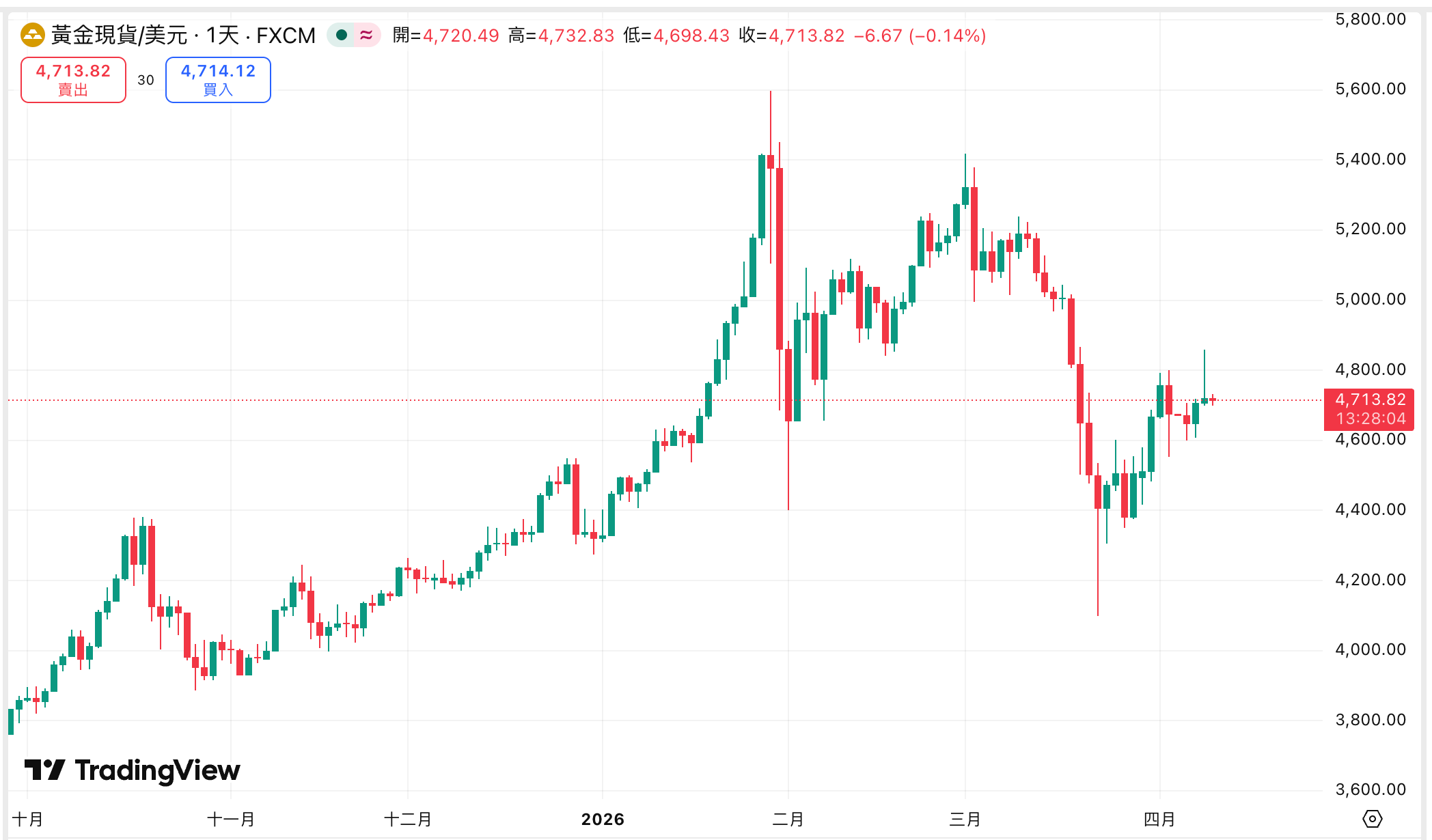
Gold price trend in the past six months

Views on gold price fluctuations in the prediction market: Price may be below $4200 before June, annual peak may exceed $6000

Since the emergence of prediction markets, thanks to factors such as real-money betting and "collective intelligence," they have become an important barometer for predicting asset prices. Currently, the annual price range for gold on Polymarket is around $3800-$6000.

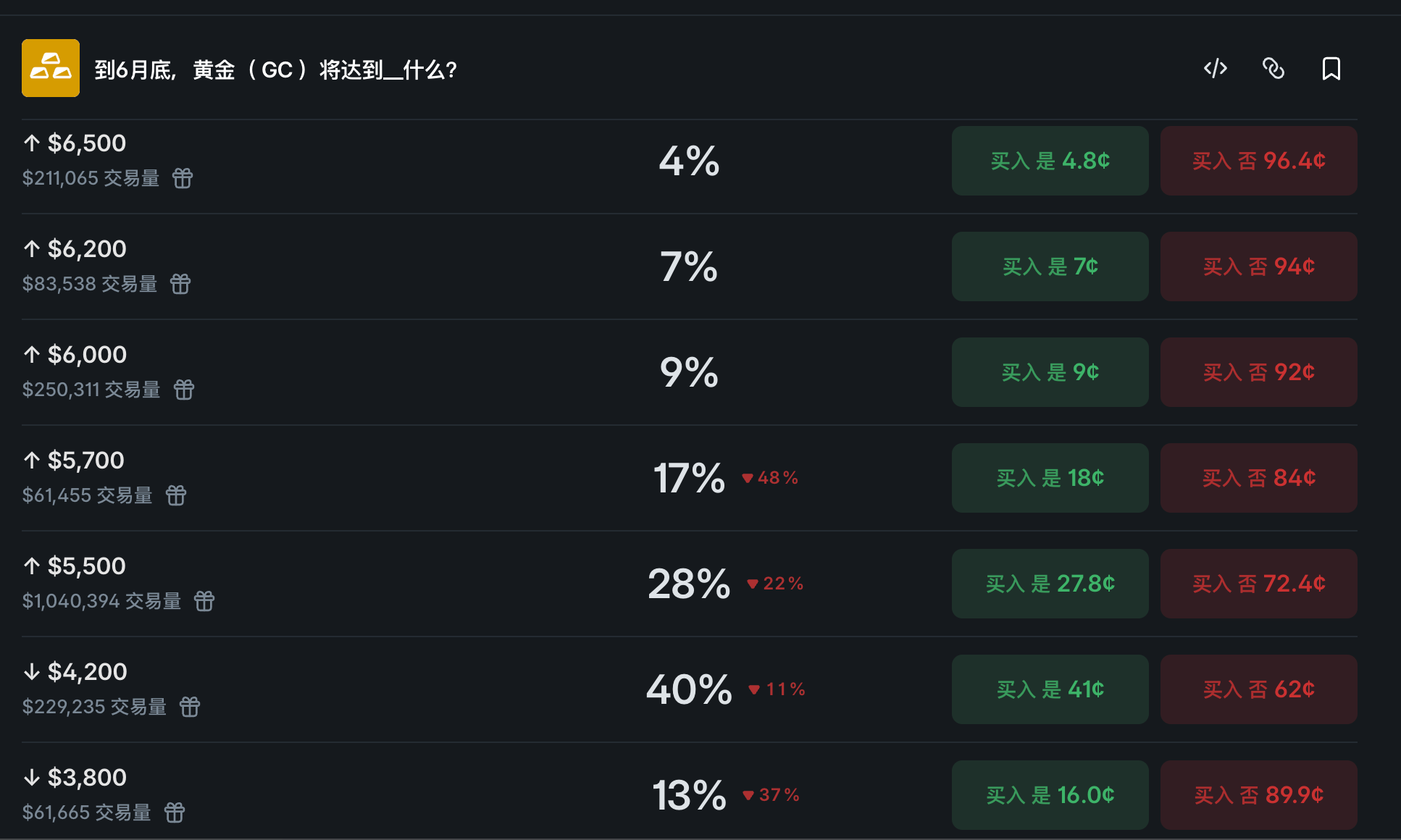
On Polymarket, the betting volume for the mid-year gold price prediction currently exceeds $3.5 million, of which:

The probability of being below $4200 is the highest, at 40%;

The probability of being above $5500 is next, at 28%;

Followed by above $5700 (probability temporarily reported at 17%) and below $3800 (probability temporarily reported at 13%).
The betting volume for the annual gold price prediction on Polymarket is currently only nearly $200,000, of which:

The probability of being above $6000 is the highest, at 46%;

The probability of being above $7000 is next, at 25%;

The probability of being above $8000 is next, at 16%.
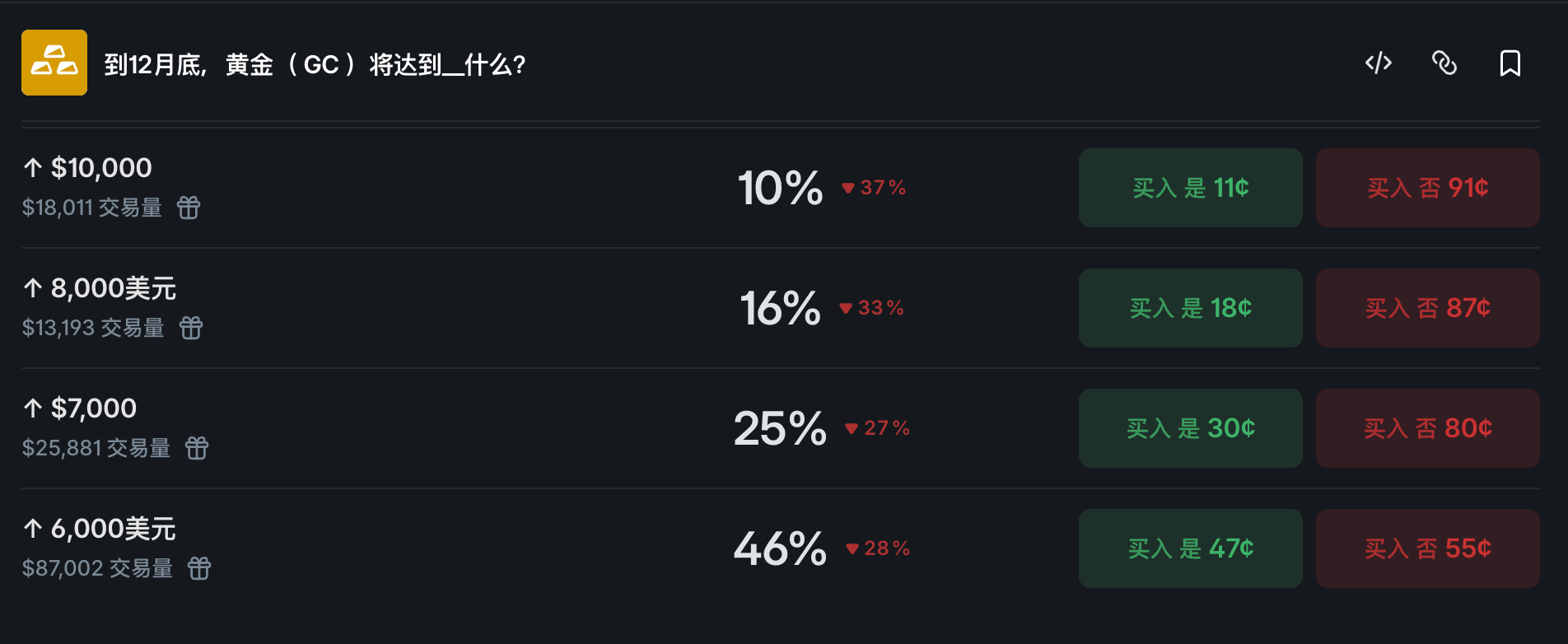
In other words, although the trading volume is relatively small, prediction market users still place the annual price above $6000, a difference of nearly 20%.

It is worth noting that the rules for gold price-related events on Polymarket use the official settlement price of the CME gold (GC) futures contract active month. Intraday trading, highest price, lowest price, bid, ask, or indicative prices are not counted.

Macro buying: Central banks continue to increase holdings, Turkish central bank exchanges gold for money

As the world's largest asset class by market value, the largest buyer of gold is naturally the central banks that control the fiat currency minting rights.

In early April, the World Gold Council released its February central bank gold buying monthly report. It pointed out that central banks net bought 19 tons of gold in February 2026, although still below the monthly average of 26 tons reported in 2025, it rebounded compared to the net purchase of 5 tons in January 2026. In addition, the report showed that some central banks maintained a continuous net buying record, with a cumulative gold purchase of 44 tons from November 2024 to February 2026, and the Czech Republic reported its 36th consecutive month of net buying. China increased its gold holdings for the 16th consecutive month (February data).

Goldman Sachs' research report at the end of March pointed out that supported by continued gold purchases by central banks and the expectation that the Federal Reserve will cut interest rates twice this year, the medium-term prospects for gold remain solid, and the gold price is expected to climb to $5400/ounce by the end of the year. UBS, at the end of March, expected the target price of gold to be $5900/ounce by early 2027.

On the 7th of this month, the Chinese central bank announced that China's gold reserves at the end of March were 74.38 million ounces (approximately 2313.48 tons), an increase of 160,000 ounces (approximately 4.98 tons) from the previous month. The figure at the end of February was 74.22 million ounces (approximately 2308.5 tons), marking the 17th consecutive month of increasing gold holdings.

On the other hand, traditional gold reserve powers have remained almost unchanged—such as the United States (approximately 8100 tons), Germany (approximately 3300 tons), Italy (approximately 2400 tons), and France (approximately 2400 tons).

As for the pressure on the fiat currency system in the Middle East due to the U.S.-Iran conflict, "the Turkish central bank sold over 120 tons of gold in the past 3 weeks, worth $20 billion." Many people only know one side of the story. In fact, most of this gold did not flow into the market but belonged to gold-currency swap futures. Simply put, the Turkish central bank only mortgaged its gold reserves to obtain U.S. dollar foreign exchange to stabilize the exchange rate of its domestic currency, the lira.

Structurally, the proportion of gold reserves to total reserves in emerging market central banks is still at a low level of just over 10%, and China is even in the single digits. This means that the room for central banks to increase holdings is far from saturated, and the strategic need for "de-dollarization" will provide rigid buying support for gold for many years to come.

Crypto buying: Stablecoin giant Tether's gold reserve scale ranks among the top 30 globally

In February, Wall Street investment bank Jefferies released a report stating that stablecoin issuer Tether continues to increase its gold holdings. As of January 31, its gold reserve scale has increased to about 148 tons, worth about $23 billion at current prices. Its holdings have exceeded those of many sovereign nations, ranking among the top 30 gold holders globally.

The report showed that Tether increased its gold holdings by about 26 tons in the fourth quarter of 2025 and continued to increase by about 6 tons in January this year. Its quarterly gold purchase scale was second only to a few central banks such as Poland and Brazil. Its current gold reserve scale has exceeded that of countries such as Australia, the UAE, Qatar, South Korea, and Greece.

The institution pointed out that the above gold is mainly used to support the dollar stablecoin USDT and the gold-pegged token XAUT (current FDV market value exceeds $3.3 billion). Since Tether is not a listed company, its disclosed data may only be the minimum level, and the actual gold holdings may be higher than the published value. Tether CEO Paolo Ardoino previously stated that the company plans to allocate about 10%–15% of its investment portfolio to physical gold.

Retail buying: High-level套牢 determines holding stability

In 2026, retail participation in gold investment has significantly increased, especially Asian funds becoming the new main force in the gold market.

In January, Asian gold ETFs saw a single-month inflow of up to $10 billion.

In addition, Chinese investors purchased 432 tons of gold bars and coins throughout 2025, a record high. The scene of queues at domestic gold stores to purchase accumulated gold, and the frequent sold-out status of accumulated gold on bank apps, reflect ordinary investors' strong recognition of gold's value preservation function.

However, the flip side of retail buying is the intensified two-way volatility of gold prices. In January, the news of Kevin Warsh being nominated as Fed chairman caused the gold price to plummet by more than 9% in a single day, the largest single-day drop in nearly 40 years; in March, the gold price once fell below $4200/ounce, and a large number of retail investors were套牢 at high levels. Combined with the action of the Chinese central bank buying heavily, it formed a sharp contrast of "retail panic selling, sovereign funds buying at lows."

As a result, a large amount of retail buying套牢 at high levels反而 means that the amount of gold sold within the year will not be too large.

Note: 套牢 (tào láo) is a Chinese term meaning to be trapped in a position (e.g., bought at a high price and now the price is lower, unable to sell without a loss). The translation uses "套牢" (tao lao) transliterated and explained as "trapped in a position" or simply "trapped" in context.

Institutional views: Gold will still hit new highs, price may be around $5200 by the end of June

At the institutional level, UBS, which has always paid much attention to the precious metals market, has frequently expressed views this year.

On January 21, UBS precious metals strategist Joni Teves said that diversification needs are the core driving force behind this round of gold price increases. Institutional investors, retail investors, and central banks are all increasing their gold holdings to cope with macro uncertainties. It is expected that the gold price will still have upward momentum in the first half of the year. If market concerns about the Fed's independence continue to heat up, the gold price is expected to hit the $5000/ounce mark in the first half of the year. Silver will benefit from the带动 of rising gold prices and its own narrowing supply-demand gap, and may challenge $100/ounce this year.

Subsequently, gold and silver both surged, with the former once rising to nearly $5600/ounce, and the latter once rising to $120/ounce.

On February 24, UBS Group said it expects the gold price to reach $6200 per ounce in the coming months because the key factors driving its strong rally over the past year remain.

Subsequently, on February 28, the U.S.-Iran conflict officially broke out, with Israel and the United States jointly attacking Iran, and regional hot war began.

On March 5, UBS Group analysts stated in a report that data since 1900 shows that for financial markets, economic risks have proven to be more significant than geopolitical risks. They said that in most cases, investors perform best if they can "see through" the noise of geopolitics.

At the end of March, UBS expected the target price of gold to be $5900/ounce by early 2027.

On April 2, UBS strategist Joni Teves预计, despite recent gold price fluctuations, the gold price will hit a new high this year, and views the recent回调 as a buying opportunity. UBS expects the average gold price in 2026 to be $5000 per ounce, and $4800 and $4250 in 2027 and 2028 respectively.

On April 7, UBS lowered its gold price expectation for the end of June to $5,200/ounce, due to cooling investor demand amid increased market volatility.

In addition, in early February, JPMorgan publicly firmly看好 gold, believing that the year-end target is up to $6300, with a remaining 34% increase.

Understanding the nature of gold: Safe-haven asset and core of the de-dollarized monetary system

Finally, let's briefly discuss the nature of gold investment.

In 1971, the United States亲手 dismantled the Bretton Woods system it had built. Subsequently, the gold price soared from $35/ounce to nearly $5000/ounce today, a cumulative increase of over 94 times in 55 years. Taking 4-5 years as an investment cycle, it has累计穿越 at least 10 bull and bear cycles.

After the outbreak of the Russia-Ukraine conflict in 2022, the economic process of "de-dollarization" suddenly accelerated, and global central banks thus started a new round of gold reserve competition, which step by step created the "super行情" of gold in the past 3 years.

Entering 2026, as the US Trump was挑拨 by Israel's Netanyahu to send troops to the Middle East (Odaily Planet Daily Note: It is rumored that Netanyahu personally lobbied before the US-Israel joint attack on Iran), although affected by AI, technology, local industrial回流 and other news and policies, the US political and economic situation will not collapse instantly, but the monetary credit system of the US dollar has already shown initial signs of decline.

In January this year,知名投行 Morgan Stanley said that the role of the US dollar in the global system is being continuously and gradually weakened, but since credible alternative currencies are still limited, in an increasingly multipolar world, gold has become the biggest challenger to the US dollar. According to Morgan Stanley's research, the international influence of the US dollar has declined on several indicators, including its share in central banks' foreign exchange reserves下滑, and its use in corporate and emerging market sovereign issuance减少. Nevertheless, the US dollar still accounts for the largest share of global reserves, indicating that there is currently no challenger of substantive significance. However, once gold is taken into account, the situation changes. The proportion of gold in central banks' held assets has risen from about 14% to 25%—28%, and this upward trend "shows no signs of slowing down." Risk premiums and hedging behavior will continue to put pressure on the US dollar while supporting gold demand.

Although in the chaos caused by the U.S.-Iran conflict in Dubai, gold's "safe-haven asset属性" was questioned due to its inconvenience to carry,但从 the current international situation, it is still the only hard currency recognized by the international community besides the US dollar.

As for Iran's guarding of the Strait of Hormuz and charging passage fees in RMB, BTC and other cryptocurrencies, it further exposed the reality of the declining credibility of the US dollar in the global economic system.

Therefore, although Bloomberg Intelligence senior market analyst Mike McGlone warned in his April metal market outlook report that gold and silver may have peaked, and the "once-in-a-generation" high may have passed. But given Trump's current首鼠两端、sometimes winning, sometimes winning political attitude, gold is still at a relative low for the year.

Based on the above multi-dimensional analysis, the trend of gold in 2026 can be summarized as a three-stage structure of "surging to the top in the first quarter, a shallow回调 in the second quarter, and bottoming out and rising in the third and fourth quarters". The core logic is still upward, but volatility will be significantly higher than in previous years.

At the current price level of $4800/ounce, gold may be in a修复性反弹 stage, and $4900 is the key resistance interval in the near term. The progress of the U.S.-Iran ceasefire talks, US CPI data, and Fed policy signals will be the most critical short-term price catalysts. If the ceasefire agreement continues and oil prices continue to fall, and rate cut expectations further heat up, the gold price is expected to challenge the $5200 mark by the end of the second quarter.

In the second half of the year, as US inflationary pressures ease with falling oil prices, the Fed's rate cut window reopens, and a weaker US dollar will provide more room for gold to rise. In addition, the unpredictable situation of the midterm elections will also provide certain political momentum for the rise of assets such as gold and BTC.

In terms of price上限, comprehensive institutional predictions and market trends, the reasonable upper limit prediction interval for the gold price in 2026 is $5400~$6000/ounce, and under optimistic conditions, it may rise to $6200-$6400/ounce.

In a nutshell, the United States is like the powerful but declining Qin Dynasty in the past, "When Qin loses its deer, all heroes chase it." At this time, among the大类 assets under heaven, if we talk about稳妥保障、保值增值, who else is there besides gold?

Recommended Reading

What's more worth paying attention to behind the gold回调: The loosening of the old system

Is Iran's talk of paying Strait passage fees with Bitcoin just hot air?

Preguntas relacionadas

QAccording to the article, what is the current price of gold and what key resistance level is it approaching in the near term?

AThe current price of gold is $4800 per ounce, and it is approaching a key near-term resistance level of $4900.

QWhat are the two main drivers for gold's medium-term prospects as mentioned by Goldman Sachs in their late-March research report?

AGoldman Sachs cited continued gold purchases by central banks and the expectation that the Federal Reserve will cut interest rates twice this year as the main drivers for gold's medium-term prospects.

QWhich stablecoin issuer has a significant gold reserve that ranks among the top 30 globally, and what is the estimated size of its holdings?

AThe stablecoin issuer is Tether, and its estimated gold reserve is about 148 tons, valued at approximately $23 billion, placing it among the top 30 global holders.

QWhat overall price structure does the article predict for gold in 2026, and what is the core logic behind this prediction?

AThe article predicts a three-phase structure for gold in 2026: a peak in Q1, a shallow correction in Q2, and a bottoming-out and recovery in Q3 and Q4. The core logic is that the overall trend is still upward, but volatility will be significantly higher than in previous years.

QWhat does the article identify as the 'only hard currency' recognized by the international community besides the US dollar?

AThe article identifies gold as the only hard currency recognized by the international community besides the US dollar.

Lecturas Relacionadas

Trading

Spot
Futuros

Artículos destacados

Qué es $S$

Entendiendo SPERO: Una Visión General Completa Introducción a SPERO A medida que el panorama de la innovación continúa evolucionando, la aparición de tecnologías web3 y proyectos de criptomonedas juega un papel fundamental en la configuración del futuro digital. Un proyecto que ha atraído la atención en este campo dinámico es SPERO, denotado como SPERO,$$s$. Este artículo tiene como objetivo reunir y presentar información detallada sobre SPERO, para ayudar a entusiastas e inversores a comprender sus fundamentos, objetivos e innovaciones dentro de los dominios web3 y cripto. ¿Qué es SPERO,$$s$? SPERO,$$s$ es un proyecto único dentro del espacio cripto que busca aprovechar los principios de descentralización y tecnología blockchain para crear un ecosistema que promueva la participación, la utilidad y la inclusión financiera. El proyecto está diseñado para facilitar interacciones de igual a igual de nuevas maneras, proporcionando a los usuarios soluciones y servicios financieros innovadores. En su esencia, SPERO,$$s$ tiene como objetivo empoderar a los individuos al proporcionar herramientas y plataformas que mejoren la experiencia del usuario en el espacio de las criptomonedas. Esto incluye habilitar métodos de transacción más flexibles, fomentar iniciativas impulsadas por la comunidad y crear caminos para oportunidades financieras a través de aplicaciones descentralizadas (dApps). La visión subyacente de SPERO,$$s$ gira en torno a la inclusividad, buscando cerrar brechas dentro de las finanzas tradicionales mientras aprovecha los beneficios de la tecnología blockchain. ¿Quién es el Creador de SPERO,$$s$? La identidad del creador de SPERO,$$s$ sigue siendo algo oscura, ya que hay recursos públicos limitados que proporcionan información de fondo detallada sobre su(s) fundador(es). Esta falta de transparencia puede derivarse del compromiso del proyecto con la descentralización, una ética que muchos proyectos web3 comparten, priorizando las contribuciones colectivas sobre el reconocimiento individual. Al centrar las discusiones en torno a la comunidad y sus objetivos colectivos, SPERO,$$s$ encarna la esencia del empoderamiento sin señalar a individuos específicos. Como tal, comprender la ética y la misión de SPERO sigue siendo más importante que identificar a un creador singular. ¿Quiénes son los Inversores de SPERO,$$s$? SPERO,$$s$ cuenta con el apoyo de una diversa gama de inversores que van desde capitalistas de riesgo hasta inversores ángeles dedicados a fomentar la innovación en el sector cripto. El enfoque de estos inversores generalmente se alinea con la misión de SPERO, priorizando proyectos que prometen avances tecnológicos sociales, inclusión financiera y gobernanza descentralizada. Estas fundaciones de inversores suelen estar interesadas en proyectos que no solo ofrecen productos innovadores, sino que también contribuyen positivamente a la comunidad blockchain y sus ecosistemas. El respaldo de estos inversores refuerza a SPERO,$$s$ como un contendiente notable en el dominio de proyectos cripto que evoluciona rápidamente. ¿Cómo Funciona SPERO,$$s$? SPERO,$$s$ emplea un marco multifacético que lo distingue de los proyectos de criptomonedas convencionales. Aquí hay algunas de las características clave que subrayan su singularidad e innovación: Gobernanza Descentralizada: SPERO,$$s$ integra modelos de gobernanza descentralizada, empoderando a los usuarios para participar activamente en los procesos de toma de decisiones sobre el futuro del proyecto. Este enfoque fomenta un sentido de propiedad y responsabilidad entre los miembros de la comunidad. Utilidad del Token: SPERO,$$s$ utiliza su propio token de criptomoneda, diseñado para servir diversas funciones dentro del ecosistema. Estos tokens permiten transacciones, recompensas y la facilitación de servicios ofrecidos en la plataforma, mejorando la participación y la utilidad general. Arquitectura en Capas: La arquitectura técnica de SPERO,$$s$ apoya la modularidad y escalabilidad, permitiendo la integración fluida de características y aplicaciones adicionales a medida que el proyecto evoluciona. Esta adaptabilidad es fundamental para mantener la relevancia en el cambiante paisaje cripto. Participación de la Comunidad: El proyecto enfatiza iniciativas impulsadas por la comunidad, empleando mecanismos que incentivan la colaboración y la retroalimentación. Al nutrir una comunidad sólida, SPERO,$$s$ puede abordar mejor las necesidades de los usuarios y adaptarse a las tendencias del mercado. Enfoque en la Inclusión: Al ofrecer tarifas de transacción bajas e interfaces amigables para el usuario, SPERO,$$s$ busca atraer a una base de usuarios diversa, incluyendo a individuos que anteriormente pueden no haber participado en el espacio cripto. Este compromiso con la inclusión se alinea con su misión general de empoderamiento a través de la accesibilidad. Cronología de SPERO,$$s$ Entender la historia de un proyecto proporciona información crucial sobre su trayectoria de desarrollo y hitos. A continuación se presenta una cronología sugerida que mapea eventos significativos en la evolución de SPERO,$$s$: Fase de Conceptualización e Ideación: Las ideas iniciales que forman la base de SPERO,$$s$ fueron concebidas, alineándose estrechamente con los principios de descentralización y enfoque comunitario dentro de la industria blockchain. Lanzamiento del Whitepaper del Proyecto: Tras la fase conceptual, se lanzó un whitepaper completo que detalla la visión, los objetivos y la infraestructura tecnológica de SPERO,$$s$ para generar interés y retroalimentación de la comunidad. Construcción de Comunidad y Primeras Interacciones: Se realizaron esfuerzos de divulgación activa para construir una comunidad de primeros adoptantes y posibles inversores, facilitando discusiones en torno a los objetivos del proyecto y obteniendo apoyo. Evento de Generación de Tokens: SPERO,$$s$ llevó a cabo un evento de generación de tokens (TGE) para distribuir sus tokens nativos a los primeros seguidores y establecer liquidez inicial dentro del ecosistema. Lanzamiento de la dApp Inicial: La primera aplicación descentralizada (dApp) asociada con SPERO,$$s$ se puso en marcha, permitiendo a los usuarios interactuar con las funcionalidades centrales de la plataforma. Desarrollo Continuo y Alianzas: Actualizaciones y mejoras continuas a las ofertas del proyecto, incluyendo alianzas estratégicas con otros actores en el espacio blockchain, han moldeado a SPERO,$$s$ en un jugador competitivo y en evolución en el mercado cripto. Conclusión SPERO,$$s$ se erige como un testimonio del potencial de web3 y las criptomonedas para revolucionar los sistemas financieros y empoderar a los individuos. Con un compromiso con la gobernanza descentralizada, la participación comunitaria y funcionalidades diseñadas de manera innovadora, allana el camino hacia un paisaje financiero más inclusivo. Como con cualquier inversión en el espacio cripto que evoluciona rápidamente, se anima a los posibles inversores y usuarios a investigar a fondo y participar de manera reflexiva con los desarrollos en curso dentro de SPERO,$$s$. El proyecto muestra el espíritu innovador de la industria cripto, invitando a una mayor exploración de sus innumerables posibilidades. Mientras el viaje de SPERO,$$s$ aún se desarrolla, sus principios fundamentales pueden, de hecho, influir en el futuro de cómo interactuamos con la tecnología, las finanzas y entre nosotros en ecosistemas digitales interconectados.

72 Vistas totalesPublicado en 2024.12.17Actualizado en 2024.12.17

Qué es $S$

Qué es AGENT S

Agent S: El Futuro de la Interacción Autónoma en Web3 Introducción En el paisaje en constante evolución de Web3 y las criptomonedas, las innovaciones están redefiniendo constantemente cómo los individuos interactúan con las plataformas digitales. Uno de estos proyectos pioneros, Agent S, promete revolucionar la interacción humano-computadora a través de su marco agente abierto. Al allanar el camino para interacciones autónomas, Agent S busca simplificar tareas complejas, ofreciendo aplicaciones transformadoras en inteligencia artificial (IA). Esta exploración detallada profundizará en las complejidades del proyecto, sus características únicas y las implicaciones para el dominio de las criptomonedas. ¿Qué es Agent S? Agent S se presenta como un marco agente abierto innovador, diseñado específicamente para abordar tres desafíos fundamentales en la automatización de tareas informáticas: Adquisición de Conocimiento Específico del Dominio: El marco aprende inteligentemente de diversas fuentes de conocimiento externas y experiencias internas. Este enfoque dual le permite construir un rico repositorio de conocimiento específico del dominio, mejorando su rendimiento en la ejecución de tareas. Planificación a Largo Plazo de Tareas: Agent S emplea planificación jerárquica aumentada por la experiencia, un enfoque estratégico que facilita la descomposición y ejecución eficiente de tareas complejas. Esta característica mejora significativamente su capacidad para gestionar múltiples subtareas de manera eficiente y efectiva. Manejo de Interfaces Dinámicas y No Uniformes: El proyecto introduce la Interfaz Agente-Computadora (ACI), una solución innovadora que mejora la interacción entre agentes y usuarios. Utilizando Modelos de Lenguaje Multimodal de Gran Escala (MLLMs), Agent S puede navegar y manipular diversas interfaces gráficas de usuario sin problemas. A través de estas características pioneras, Agent S proporciona un marco robusto que aborda las complejidades involucradas en la automatización de la interacción humana con las máquinas, preparando el terreno para una multitud de aplicaciones en IA y más allá. ¿Quién es el Creador de Agent S? Si bien el concepto de Agent S es fundamentalmente innovador, la información específica sobre su creador sigue siendo elusiva. El creador es actualmente desconocido, lo que resalta ya sea la etapa incipiente del proyecto o la elección estratégica de mantener a los miembros fundadores en el anonimato. Independientemente de la anonimidad, el enfoque sigue siendo en las capacidades y el potencial del marco. ¿Quiénes son los Inversores de Agent S? Dado que Agent S es relativamente nuevo en el ecosistema criptográfico, la información detallada sobre sus inversores y patrocinadores financieros no está documentada explícitamente. La falta de información disponible públicamente sobre las bases de inversión u organizaciones que apoyan el proyecto plantea preguntas sobre su estructura de financiamiento y hoja de ruta de desarrollo. Comprender el respaldo es crucial para evaluar la sostenibilidad del proyecto y su posible impacto en el mercado. ¿Cómo Funciona Agent S? En el núcleo de Agent S se encuentra una tecnología de vanguardia que le permite funcionar de manera efectiva en diversos entornos. Su modelo operativo se basa en varias características clave: Interacción Humano-Computadora Similar a la Humana: El marco ofrece planificación avanzada de IA, esforzándose por hacer que las interacciones con las computadoras sean más intuitivas. Al imitar el comportamiento humano en la ejecución de tareas, promete elevar las experiencias de los usuarios. Memoria Narrativa: Empleada para aprovechar experiencias de alto nivel, Agent S utiliza memoria narrativa para hacer un seguimiento de las historias de tareas, mejorando así sus procesos de toma de decisiones. Memoria Episódica: Esta característica proporciona a los usuarios una guía paso a paso, permitiendo que el marco ofrezca apoyo contextual a medida que se desarrollan las tareas. Soporte para OpenACI: Con la capacidad de ejecutarse localmente, Agent S permite a los usuarios mantener el control sobre sus interacciones y flujos de trabajo, alineándose con la ética descentralizada de Web3. Fácil Integración con APIs Externas: Su versatilidad y compatibilidad con varias plataformas de IA aseguran que Agent S pueda encajar sin problemas en ecosistemas tecnológicos existentes, convirtiéndolo en una opción atractiva para desarrolladores y organizaciones. Estas funcionalidades contribuyen colectivamente a la posición única de Agent S dentro del espacio cripto, ya que automatiza tareas complejas y de múltiples pasos con una intervención humana mínima. A medida que el proyecto evoluciona, sus posibles aplicaciones en Web3 podrían redefinir cómo se desarrollan las interacciones digitales. Cronología de Agent S El desarrollo y los hitos de Agent S pueden encapsularse en una cronología que resalta sus eventos significativos: 27 de septiembre de 2024: El concepto de Agent S fue lanzado en un documento de investigación integral titulado “Un Marco Agente Abierto que Usa Computadoras Como un Humano”, mostrando las bases del proyecto. 10 de octubre de 2024: El documento de investigación fue puesto a disposición del público en arXiv, ofreciendo una exploración profunda del marco y su evaluación de rendimiento basada en el benchmark OSWorld. 12 de octubre de 2024: Se lanzó una presentación en video, proporcionando una visión visual de las capacidades y características de Agent S, involucrando aún más a posibles usuarios e inversores. Estos marcadores en la cronología no solo ilustran el progreso de Agent S, sino que también indican su compromiso con la transparencia y la participación comunitaria. Puntos Clave Sobre Agent S A medida que el marco Agent S continúa evolucionando, varios atributos clave destacan, subrayando su naturaleza innovadora y potencial: Marco Innovador: Diseñado para proporcionar un uso intuitivo de las computadoras similar a la interacción humana, Agent S aporta un enfoque novedoso a la automatización de tareas. Interacción Autónoma: La capacidad de interactuar de manera autónoma con las computadoras a través de GUI significa un salto hacia soluciones informáticas más inteligentes y eficientes. Automatización de Tareas Complejas: Con su metodología robusta, puede automatizar tareas complejas y de múltiples pasos, haciendo que los procesos sean más rápidos y menos propensos a errores. Mejora Continua: Los mecanismos de aprendizaje permiten a Agent S mejorar a partir de experiencias pasadas, mejorando continuamente su rendimiento y eficacia. Versatilidad: Su adaptabilidad en diferentes entornos operativos como OSWorld y WindowsAgentArena asegura que pueda servir a una amplia gama de aplicaciones. A medida que Agent S se posiciona en el paisaje de Web3 y criptomonedas, su potencial para mejorar las capacidades de interacción y automatizar procesos significa un avance significativo en las tecnologías de IA. A través de su marco innovador, Agent S ejemplifica el futuro de las interacciones digitales, prometiendo una experiencia más fluida y eficiente para los usuarios en diversas industrias. Conclusión Agent S representa un audaz avance en la unión de la IA y Web3, con la capacidad de redefinir cómo interactuamos con la tecnología. Aunque aún se encuentra en sus primeras etapas, las posibilidades para su aplicación son vastas y atractivas. A través de su marco integral que aborda desafíos críticos, Agent S busca llevar las interacciones autónomas al primer plano de la experiencia digital. A medida que nos adentramos más en los reinos de las criptomonedas y la descentralización, proyectos como Agent S sin duda desempeñarán un papel crucial en la configuración del futuro de la tecnología y la colaboración humano-computadora.

330 Vistas totalesPublicado en 2025.01.14Actualizado en 2025.01.14

Qué es AGENT S

Cómo comprar S

¡Bienvenido a HTX.com! Hemos hecho que comprar Sonic (S) sea simple y conveniente. Sigue nuestra guía paso a paso para iniciar tu viaje de criptos.Paso 1: crea tu cuenta HTXUtiliza tu correo electrónico o número de teléfono para registrarte y obtener una cuenta gratuita en HTX. Experimenta un proceso de registro sin complicaciones y desbloquea todas las funciones.Obtener mi cuentaPaso 2: ve a Comprar cripto y elige tu método de pagoTarjeta de crédito/débito: usa tu Visa o Mastercard para comprar Sonic (S) al instante.Saldo: utiliza fondos del saldo de tu cuenta HTX para tradear sin problemas.Terceros: hemos agregado métodos de pago populares como Google Pay y Apple Pay para mejorar la comodidad.P2P: tradear directamente con otros usuarios en HTX.Over-the-Counter (OTC): ofrecemos servicios personalizados y tipos de cambio competitivos para los traders.Paso 3: guarda tu Sonic (S)Después de comprar tu Sonic (S), guárdalo en tu cuenta HTX. Alternativamente, puedes enviarlo a otro lugar mediante transferencia blockchain o utilizarlo para tradear otras criptomonedas.Paso 4: tradear Sonic (S)Tradear fácilmente con Sonic (S) en HTX's mercado spot. Simplemente accede a tu cuenta, selecciona tu par de trading, ejecuta tus trades y monitorea en tiempo real. Ofrecemos una experiencia fácil de usar tanto para principiantes como para traders experimentados.

677 Vistas totalesPublicado en 2025.01.15Actualizado en 2025.03.21

Cómo comprar S

Discusiones

Bienvenido a la comunidad de HTX. Aquí puedes mantenerte informado sobre los últimos desarrollos de la plataforma y acceder a análisis profesionales del mercado. A continuación se presentan las opiniones de los usuarios sobre el precio de S (S).

活动图片