Gold and Silver Have Gone Crazy: Is Bitcoin 'Lagging Behind' or Building Momentum During Christmas Week?

比推Publicado a 2025-12-23Actualizado a 2025-12-23

Resumen

During the Christmas week, global markets have seen a surge in safe-haven assets like gold and silver, which hit new all-time highs amid a weaker dollar and falling Treasury yields. In contrast, Bitcoin has remained stagnant, trading within a narrow range of $88,000–$89,000, failing to ride the macro tailwinds. The article questions whether Bitcoin is experiencing a "Santa Rally"—a seasonal uptrend often seen in traditional markets—or is instead consolidating for a potential move. Market analysts point to a cautious macro environment, with investors awaiting key U.S. economic data, including Q3 GDP and unemployment figures, to gauge the Federal Reserve’s policy direction. This uncertainty has led to risk-off sentiment, with capital flowing out of Bitcoin and Ethereum ETFs while seeing minor inflows into altcoins like XRP and Solana. Technically, Bitcoin is in a consolidation phase, with key resistance between $93,000–$95,000. A major $24 billion options expiration on Friday adds to near-term volatility, with bulls targeting $100,000 and bears defending $85,000. Analysts from CF Benchmarks and others describe the current behavior as digestion of prior gains rather than preparation for a new rally. Historical data shows mixed Christmas-week performance for Bitcoin, with an average gain of 7.9% since 2011. Overall, Bitcoin’s current stance reflects its perception as a risk asset amid broader market caution. The outcome depends less on seasonal trends and more on whether insti...

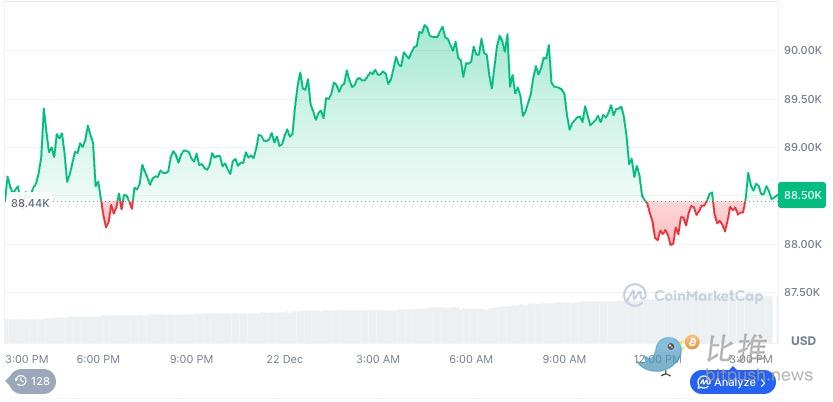
Entering Christmas week, the global market's initial answer did not belong to the crypto market. Against the backdrop of a weakening US dollar and falling US bond yields, risk-aversion sentiment quickly heated up. Gold and silver took the lead, with prices repeatedly刷新历史高位 (hitting new historical highs), becoming the most obvious destination for funds. In contrast, the crypto market appeared unusually quiet. Bitcoin did not take off with the macroeconomic tailwinds but remained stuck in the 88,000-89,000 fluctuation range, lacking the aggressive posture expected before the holiday.

It is precisely against this contrast that the question of "whether Bitcoin will usher in a Santa Rally" has once again become a topic of repeated discussion in the market. The so-called Santa Rally, originally a seasonal phenomenon in traditional financial markets, refers to a phased rise in risk assets around Christmas, driven by improved sentiment and changes in liquidity. But in the crypto market, this pattern has never been stable. Whether this year's Bitcoin is "lagging behind" amid rising risk-aversion sentiment or quietly building momentum within a high range still requires looking for answers in real price action and fund structures.
Fundamentals: Macro Environment Still in a "Wait-and-See" State, Funds Flowing Out of Risk Assets

Gabriel Selby, Research Head at CF Benchmarks, pointed out that before the Federal Reserve obtains data for several consecutive months that clearly points to sustained disinflation, market participants are unlikely to truly increase their配置 (allocation) to risk assets like Bitcoin. In his view, the current macro environment is still in a "waiting for verification" stage.

This cautious sentiment is closely related to investors' high attention to a series of upcoming US economic data. The Q3 GDP data will be released soon, with market expectations for an annualized growth rate of about 3.5%, slightly lower than Q2's 3.8%; meanwhile, indicators like the Consumer Confidence Index and weekly initial jobless claims will provide more clues about the labor market conditions. The outcomes of these data will directly affect the market's judgment on the Fed's policy path and further influence overall risk appetite.

From other macro conditions, a weakening US dollar and falling US bond yields do provide a theoretical tailwind for risk assets. But the actual choices of funds have given a completely different answer. Amid rising risk-aversion sentiment, funds clearly优先流向 (flowed preferentially to) traditional safe-haven assets like gold and silver.

Fund flow data further confirms this. According to statistics from SoSoValue, a clear divergence recently appeared at the ETF level: Bitcoin ETFs recorded a net outflow of approximately $158.3 million, and Ethereum ETFs saw an outflow of about $76 million; in contrast, XRP and Solana ETFs recorded small inflows of about $13 million and $4 million respectively, showing that funds are also undergoing structural adjustments within the crypto market, rather than a overall回流 (return flow).
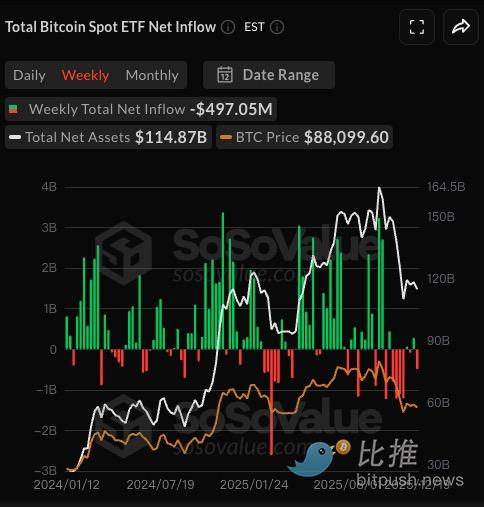
Looking at digital asset investment products more broadly, CoinShares pointed out in its latest weekly fund flow report that digital asset investment products collectively saw a net outflow of approximately $952 million last week, marking the first net redemption (outflow) after four consecutive weeks of inflows. CoinShares attributed this fund outflow partly to the regulatory uncertainty brought by the slowed progress of the US Clarity Act, causing institutional investors to倾向于 (tend towards) reducing risk exposure in the short term.

Technical Structure: More Like Digestion Than Launch

From a technical structure perspective, Bitcoin's current trend is not明显偏空 (obviously bearish), but it's also hard to call it strong. The 88,000 to 89,000 US dollar range has become the core fluctuation zone repeatedly tested in the short term, while the area above 93,000 to 95,000 US dollars constitutes a key resistance that the bulls must break through.

Several traders pointed out that if Bitcoin fails to effectively break through this resistance range during Christmas week, even if there is a short-term rebound, it is more likely to be seen as a technical repair rather than a trend reversal. Conversely, if the price continues to maintain a high横盘 (sideways movement), it means the market is waiting for new driving factors, rather than actively choosing a direction.

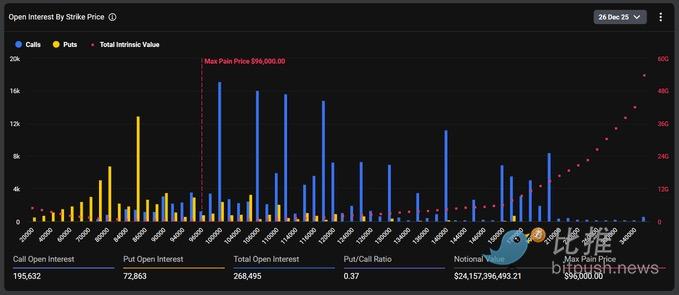
The structure of the derivatives market also partly explains why Bitcoin appears particularly restrained during Christmas week. This Friday, the Bitcoin market will witness the largest options expiration in history, with a total value of up to $24 billion. Currently, bulls and bears are engaged in fierce博弈 (game) around key price levels:

Bull camp: Betting that BTC will break through the 100,000 US dollar mark.

Bear camp: Defending the 85,000 US dollar关口 (level) with full force.

Key level: 96,000 US dollars is seen as the分水岭 (watershed) for this round's trend. Holding above here maintains the rebound momentum; otherwise, the market will continue to face pressure.
What Do Analysts Think?

Against the backdrop of Bitcoin's delayed breakout, analysts' judgments are generally cautious. Several market observers pointed out that this year's Christmas week is more like a "structure test" rather than a window for sentiment-driven one-sided行情 (market movement).

Gabriel Selby, Research Head at CF Benchmarks, stated bluntly in a recent interview that Bitcoin's current price action does not fit the characteristics of a typical Santa Rally. In his view, a real holiday rally is often accompanied by持续占优 (sustained dominance) of buying pressure and trend continuation, rather than反复拉锯 (repeated tug-of-war) within a high range. "What we are seeing now looks more like the market消化 (digesting) previous gains, rather than building momentum for the next rise." This judgment is also corroborated by the reality of持续偏低 (persistently low) trading volume.

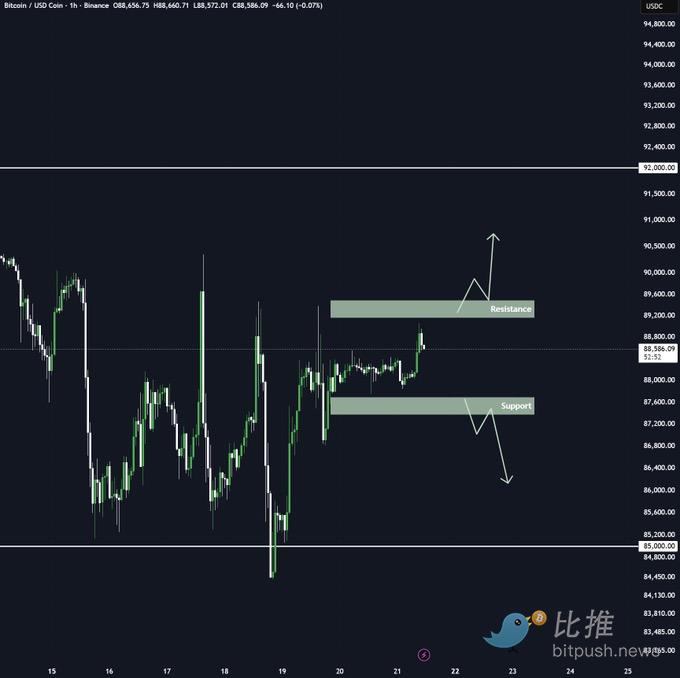
Crypto analyst DrBullZeus stated that BTC continues to fluctuate between the same support and resistance levels, with no clear breakout yet. Until a clear breakout occurs, the price will remain in a range-bound trend. Breaking above resistance would open the door to the 92,000 US dollar level, while breaking below support could lead to a price drop to the 85,000 US dollar region.
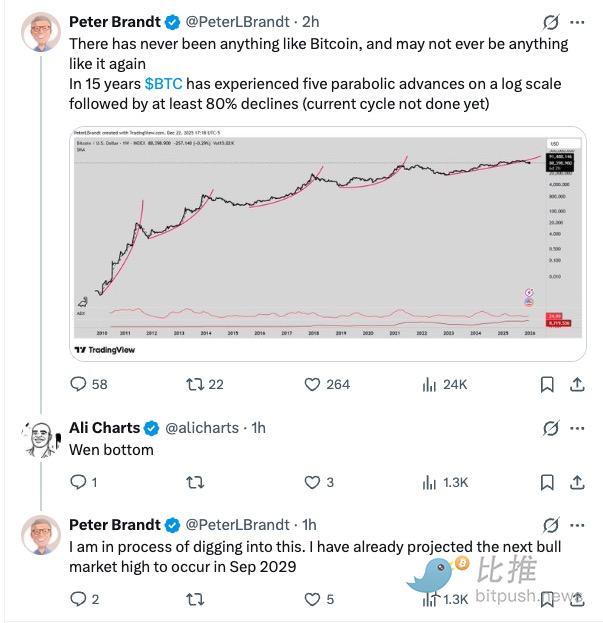
Legendary trader Peter Brandt最新复盘 (recently reviewed and pointed out) that Bitcoin has experienced 5 cycles of "parabolic growth followed by an 80% retracement" in 15 years, and the adjustment in this cycle has not yet bottomed out. Despite the冷酷 (harsh) short-term规律 (pattern), he predicted through cycle extrapolation that the next bull market peak will arrive in September 2029. Brandt emphasized that this asset's unprecedented attributes注定 (destine) it to move towards new highs through extreme洗盘 (shakeouts).
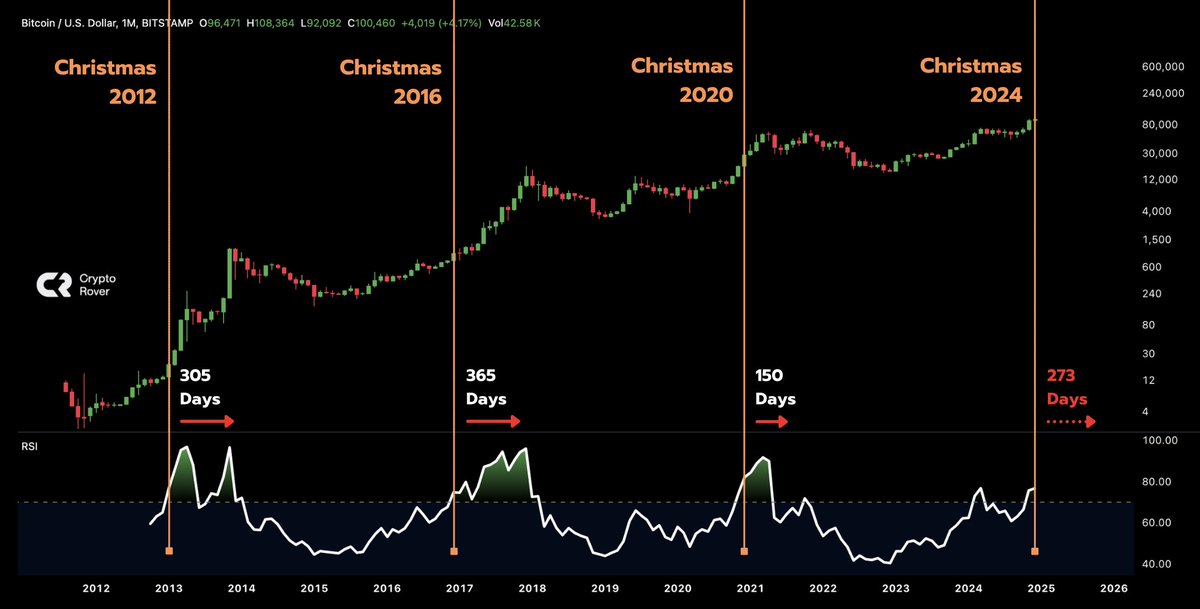
Bitcoin's "Santa Rally" has always been elusive. Looking back at history, there have been dazzling performances like surges of 33% and 46% during the holiday period in 2012 and 2016, but also平淡 (flat) or even declining years. Statistically, since 2011, Bitcoin's average gain during the Christmas period is about 7.9%.
However, judging from the current market structure, it seems difficult to reproduce a typical "Santa Claus rally" this year. The strength of gold and silver reflects more the集中释放 (concentrated release) of market risk-aversion sentiment; in contrast, Bitcoin's relative "calmness" once again highlights that it is still widely regarded as a risk asset in the current stage of global asset allocation.

Therefore, rather than simply attributing Bitcoin's current performance to "lagging behind," it is better to say that it is at a critical and微妙 (subtle) position: on the one hand, it lacks sufficient macroeconomic tailwinds to directly send it onto a new upward trajectory; on the other hand, there are no clear signals of a breakdown and weakness.

What truly determines whether Bitcoin can走出独立行情 (stage an independent rally) at the end of the year is not the "Christmas" time label, but whether market funds are willing to reinvest at the current high levels. Until this point is clearly confirmed,窄幅震荡 (narrow-range fluctuations) will likely remain the主旋律 (main theme) of this Christmas week.

Author: Bootly


Twitter:https://twitter.com/BitpushNewsCN

Bitpush TG Discussion Group:https://t.me/BitPushCommunity

Bitpush TG Subscription: https://t.me/bitpush

Original link:https://www.bitpush.news/articles/7597670

Preguntas relacionadas

QWhy did gold and silver prices hit record highs during the Christmas week, while Bitcoin remained stagnant?

AGold and silver surged due to rising safe-haven demand amid a weaker US dollar and falling Treasury yields, while Bitcoin, perceived as a risk asset, did not benefit from the same macro tailwinds and showed subdued price action.

QWhat is the 'Santa Rally' in the context of financial markets, and how has Bitcoin historically performed during this period?

AThe 'Santa Rally' refers to a seasonal phenomenon in traditional financial markets where risk assets often experience a rally around Christmas due to improved sentiment and liquidity changes. Historically, Bitcoin's performance during this period has been inconsistent, with an average gain of about 7.9% since 2011, including significant rallies in some years and flat or negative performance in others.

QWhat key economic data were market participants monitoring that influenced risk appetite and Bitcoin's price action?

AMarket participants were closely watching US economic data, including Q3 GDP (expected around 3.5% annualized growth), consumer confidence indices, and weekly initial jobless claims, as these indicators would affect expectations for Federal Reserve policy and overall risk sentiment.

QHow did ETF flows reflect the sentiment towards Bitcoin and other cryptocurrencies during this period?

AETF flows showed a divergence: Bitcoin ETFs saw a net outflow of approximately $158.3 million, and Ethereum ETFs had outflows of about $76 million, while XRP and Solana ETFs recorded small inflows, indicating structural adjustments within the crypto market rather than broad-based capital回流.

QWhat is the significance of the $96,000 level for Bitcoin's price trend according to derivatives market activity?

AThe $96,000 level is seen as a critical分水岭 (watershed) in the derivatives market. If Bitcoin can sustain above this level, it could maintain upward momentum; otherwise, the price may continue to face downward pressure, especially with a large options expiration influencing market dynamics.

Lecturas Relacionadas

AI "Transfer Station" Earning Millions Monthly? Five Questions Uncover the Truth of Token Arbitrage

The article "AI 'Transfer Station' Earns Millions Monthly? Five Questions Uncover the Truth of Token Arbitrage" explores the emerging business of API token transfer stations, which profit from global AI service price disparities and access barriers. These intermediaries purchase low-cost tokens from overseas AI providers (e.g., OpenAI, Claude) through grey-market methods—such as exploiting enterprise credits, bulk accounts, or subscription benefits—and resell them to Chinese users at a markup. Key drivers include the high cost of using top AI models (e.g., Claude Code costs ~$5 per million tokens), the performance gap between domestic and foreign models, and mismatches between subscription and API pricing. However, the practice carries significant risks: upstream token sources may be unstable or illegal; user data passing through intermediaries can be harvested or injected with hidden prompts; and models might be downgraded without disclosure. The market is evolving, with some operators now exporting cheaper Chinese models (e.g., Qwen3.5 at ~$0.11 per million tokens) to overseas users, leveraging price gaps. Yet, sustainability is low due to compliance crackdowns, instability, and reputational risks. Users are advised to employ detection methods (e.g., prompt adherence tests) and avoid sensitive data usage. The authors caution that while transfer stations offer short-term arbitrage, they lack long-term reliability and security compared to official APIs.

marsbitHace 28 min(s)

AI "Transfer Station" Earning Millions Monthly? Five Questions Uncover the Truth of Token Arbitrage

marsbitHace 28 min(s)

The Cost of an 11.5% Annualized Return: Will MicroStrategy's STRC Face a Moment of Reckoning?

This article analyzes the potential risks associated with MicroStrategy's (MSTR) use of structured financial products like STRC to leverage its BTC exposure. While these tools have enabled impressive returns (e.g., 11.5% annualized) and fueled significant capital inflows ($13.5B outstanding), they also create substantial annual dividend obligations (~$400M). The author argues that this structure, while effective in a bull market, could become a liability if BTC price stagnates or declines. The core risk is a potential negative feedback loop: the growing dividend burden from continued STRC issuance may eventually outweigh the benefits of increased BTC holdings. To meet these obligations, MicroStrategy might need to use new issuance proceeds for dividends instead of buying more BTC, which could disappoint equity investors. If the market capitalization (mNAV) falls below the value of its BTC holdings, the company could be forced to sell BTC instead of issuing new shares, potentially triggering a panic. The author estimates a potential inflection point in 6 months, where annual dividend costs reach $3-4B. At that stage, CEO Michael Saylor might face a difficult choice: sell BTC to meet obligations or sacrifice the credibility of the preferred shares by halting dividends. The article concludes that this financial engineering, while powerful, could ultimately "backfire" on MicroStrategy if market conditions turn.

marsbitHace 1 hora(s)

The Cost of an 11.5% Annualized Return: Will MicroStrategy's STRC Face a Moment of Reckoning?

marsbitHace 1 hora(s)

Trading

Spot
Futuros

Artículos destacados

Qué es BITCOIN

Entendiendo HarryPotterObamaSonic10Inu (ERC-20) y Su Posición en el Espacio Cripto En los últimos años, el mercado de criptomonedas ha sido testigo de un aumento en la popularidad de las monedas meme, capturando el interés no solo de los comerciantes, sino también de aquellos que buscan compromiso comunitario y valor de entretenimiento. Entre estos tokens únicos se encuentra HarryPotterObamaSonic10Inu (ERC-20), un proyecto intrigante que mezcla referencias culturales en el tejido de las criptomonedas. Este artículo profundiza en los aspectos clave de HarryPotterObamaSonic10Inu, explorando sus mecanismos, ethos impulsado por la comunidad y su relación con el paisaje cripto más amplio. ¿Qué es HarryPotterObamaSonic10Inu (ERC-20)? Como su nombre sugiere, HarryPotterObamaSonic10Inu es una moneda meme construida sobre la blockchain de Ethereum, clasificada bajo el estándar ERC-20. A diferencia de las criptomonedas tradicionales que pueden enfatizar la utilidad práctica o el potencial de inversión, este token prospera en el valor de entretenimiento y la fuerza de su comunidad. El proyecto tiene como objetivo fomentar un entorno donde los usuarios comprometidos puedan reunirse, compartir ideas y participar en actividades inspiradas por diversos fenómenos culturales. Una característica notable de HarryPotterObamaSonic10Inu es su cero impuestos en las transacciones. Este atractivo elemento tiene como objetivo incentivar el comercio y la participación comunitaria, sin cargos adicionales que puedan disuadir a los comerciantes de pequeña escala. El suministro total de la moneda está establecido en mil millones de tokens, una cifra que marca su intención de mantener una circulación sustancial dentro de la comunidad. Creador de HarryPotterObamaSonic10Inu (ERC-20) Los orígenes de HarryPotterObamaSonic10Inu están algo envueltos en misterio; los detalles sobre el creador siguen siendo desconocidos. El desarrollo de este token carece de un equipo identificable o de un plan explícito, lo cual no es inusual dentro del sector de monedas meme. En cambio, el proyecto ha surgido de manera orgánica, con su progreso muy dependiente del entusiasmo y la participación de su comunidad. Inversores de HarryPotterObamaSonic10Inu (ERC-20) En cuanto a inversiones externas y respaldo, HarryPotterObamaSonic10Inu también sigue siendo ambiguo. El token no lista ninguna fundación de inversión conocida o apoyo organizacional significativo. En cambio, la savia del proyecto es su comunidad de base, que informa su crecimiento y sostenibilidad a través de la acción colectiva y el compromiso en el espacio cripto. ¿Cómo Funciona HarryPotterObamaSonic10Inu (ERC-20)? Como una moneda meme, HarryPotterObamaSonic10Inu opera principalmente fuera de los marcos tradicionales que a menudo rigen el valor de los activos. Hay varios aspectos distintivos que definen cómo funciona el proyecto: Transacciones Sin Impuestos: Sin tarifas impositivas en las transacciones, los usuarios pueden comprar y vender el token libremente sin preocuparse por costos ocultos. Compromiso Comunitario: El proyecto prospera en la interacción comunitaria, aprovechando plataformas de redes sociales para crear entusiasmo y facilitar la participación. Las discusiones, el intercambio de contenido y el compromiso son elementos cruciales que ayudan a expandir su alcance y fomentar la lealtad entre los seguidores. Sin Utilidad Práctica: Cabe señalar que HarryPotterObamaSonic10Inu no ofrece utilidad concreta dentro del ecosistema financiero. Más bien, se clasifica como un token principalmente para actividades de entretenimiento y comunitarias. Referencia Cultural: El token incorpora astutamente elementos de la cultura popular para atraer interés, conectando con entusiastas de los memes y seguidores de las criptomonedas por igual. HarryPotterObamaSonic10Inu ejemplifica cómo las monedas meme operan de manera diferente a los proyectos de criptomonedas más tradicionales, ingresando al mercado como construcciones sociales innovadoras en lugar de activos utilitarios. Cronología de HarryPotterObamaSonic10Inu (ERC-20) La historia de HarryPotterObamaSonic10Inu está marcada por varios hitos notables: Creación: El token surgió de un meme viral, capturando la imaginación de muchos entusiastas de las criptomonedas. Las fechas específicas de creación no están disponibles, subrayando su ascenso orgánico. Listado en Exchanges: HarryPotterObamaSonic10Inu ha llegado a varios exchanges, permitiendo un acceso y comercio más fácil por parte de la comunidad. Iniciativas de Compromiso Comunitario: Actividades continuas destinadas a mejorar la interacción comunitaria, incluyendo concursos, campañas en redes sociales y generación de contenido por parte de fanáticos y defensores. Planes de Expansión Futuros: La hoja de ruta del proyecto incluye el lanzamiento de una colección de NFT, mercancía y un sitio de comercio electrónico relacionado con sus temas culturales, involucrando aún más a la comunidad e intentando añadir más dimensiones a su ecosistema. Puntos Clave Sobre HarryPotterObamaSonic10Inu (ERC-20) Naturaleza Impulsada por la Comunidad: El proyecto prioriza la participación colectiva y la creatividad, asegurando que la involucración de los usuarios esté a la vanguardia de su desarrollo. Clasificación como Moneda Meme: Representa la epítome de las criptomonedas basadas en el entretenimiento, diferenciándose de los vehículos de inversión tradicionales. Sin Afiliación Directa con Bitcoin: A pesar de la similitud en el nombre del ticker, HarryPotterObamaSonic10Inu es distinto y no tiene relación con Bitcoin u otras criptomonedas establecidas. Enfoque en la Colaboración: HarryPotterObamaSonic10Inu está diseñado para crear un espacio para la colaboración y el intercambio de historias entre sus poseedores, proporcionando una vía para la creatividad y el vínculo comunitario. Perspectivas Futuras: La ambición de expandirse más allá de su premisa inicial hacia NFTs y mercancías describe un camino para que el proyecto potencialmente ingrese a avenidas más tradicionales dentro de la cultura digital. A medida que las monedas meme continúan capturando la imaginación de la comunidad de criptomonedas, HarryPotterObamaSonic10Inu (ERC-20) se destaca debido a sus lazos culturales y su enfoque centrado en la comunidad. Si bien puede no encajar en el molde típico de un token impulsado por la utilidad, su esencia radica en la alegría y la camaradería fomentadas entre sus seguidores, destacando la naturaleza en evolución de las criptomonedas en una era cada vez más digital. A medida que el proyecto continúa desarrollándose, será importante observar cómo las dinámicas comunitarias influyen en su trayectoria en el cambiante paisaje de la tecnología blockchain.

1.3k Vistas totalesPublicado en 2024.04.01Actualizado en 2024.12.03

Qué es BITCOIN

Cómo comprar BTC

¡Bienvenido a HTX.com! Hemos hecho que comprar Bitcoin (BTC) sea simple y conveniente. Sigue nuestra guía paso a paso para iniciar tu viaje de criptos.Paso 1: crea tu cuenta HTXUtiliza tu correo electrónico o número de teléfono para registrarte y obtener una cuenta gratuita en HTX. Experimenta un proceso de registro sin complicaciones y desbloquea todas las funciones.Obtener mi cuentaPaso 2: ve a Comprar cripto y elige tu método de pagoTarjeta de crédito/débito: usa tu Visa o Mastercard para comprar Bitcoin (BTC) al instante.Saldo: utiliza fondos del saldo de tu cuenta HTX para tradear sin problemas.Terceros: hemos agregado métodos de pago populares como Google Pay y Apple Pay para mejorar la comodidad.P2P: tradear directamente con otros usuarios en HTX.Over-the-Counter (OTC): ofrecemos servicios personalizados y tipos de cambio competitivos para los traders.Paso 3: guarda tu Bitcoin (BTC)Después de comprar tu Bitcoin (BTC), guárdalo en tu cuenta HTX. Alternativamente, puedes enviarlo a otro lugar mediante transferencia blockchain o utilizarlo para tradear otras criptomonedas.Paso 4: tradear Bitcoin (BTC)Tradear fácilmente con Bitcoin (BTC) en HTX's mercado spot. Simplemente accede a tu cuenta, selecciona tu par de trading, ejecuta tus trades y monitorea en tiempo real. Ofrecemos una experiencia fácil de usar tanto para principiantes como para traders experimentados.

4.7k Vistas totalesPublicado en 2024.12.12Actualizado en 2025.03.21

Cómo comprar BTC

Qué es $BITCOIN

ORO DIGITAL ($BITCOIN): Un Análisis Integral Introducción al ORO DIGITAL ($BITCOIN) ORO DIGITAL ($BITCOIN) es un proyecto basado en blockchain que opera en la red Solana, cuyo objetivo es combinar las características de los metales preciosos tradicionales con la innovación de las tecnologías descentralizadas. Aunque comparte un nombre con Bitcoin, a menudo referido como “oro digital” debido a su percepción como un refugio de valor, ORO DIGITAL es un token separado diseñado para crear un ecosistema único dentro del paisaje Web3. Su meta es posicionarse como un activo digital alternativo viable, aunque los detalles sobre sus aplicaciones y funcionalidades aún están en desarrollo. ¿Qué es ORO DIGITAL ($BITCOIN)? ORO DIGITAL ($BITCOIN) es un token de criptomoneda diseñado explícitamente para su uso en la blockchain de Solana. A diferencia de Bitcoin, que proporciona un papel de almacenamiento de valor ampliamente reconocido, este token parece centrarse en aplicaciones y características más amplias. Aspectos notables incluyen: Infraestructura Blockchain: El token está construido sobre la blockchain de Solana, conocida por su capacidad para manejar transacciones de alta velocidad y bajo costo. Dinámicas de Suministro: ORO DIGITAL tiene un suministro máximo limitado a 100 cuatrillones de tokens (100P $BITCOIN), aunque los detalles sobre su suministro circulante no se han divulgado actualmente. Utilidad: Si bien las funcionalidades precisas no están delineadas explícitamente, hay indicios de que el token podría ser utilizado para diversas aplicaciones, potencialmente involucrando aplicaciones descentralizadas (dApps) o estrategias de tokenización de activos. ¿Quién es el Creador de ORO DIGITAL ($BITCOIN)? En la actualidad, la identidad de los creadores y el equipo de desarrollo detrás de ORO DIGITAL ($BITCOIN) sigue siendo desconocida. Esta situación es típica entre muchos proyectos innovadores dentro del espacio blockchain, particularmente aquellos alineados con las finanzas descentralizadas y fenómenos de monedas meme. Si bien tal anonimato puede fomentar una cultura impulsada por la comunidad, intensifica las preocupaciones sobre la gobernanza y la responsabilidad. ¿Quiénes son los Inversores de ORO DIGITAL ($BITCOIN)? La información disponible indica que ORO DIGITAL ($BITCOIN) no tiene patrocinadores institucionales conocidos ni inversiones destacadas de capital de riesgo. El proyecto parece operar en un modelo de peer-to-peer centrado en el apoyo y la adopción de la comunidad en lugar de rutas de financiamiento tradicionales. Su actividad y liquidez se sitúan principalmente en intercambios descentralizados (DEX), como PumpSwap, en lugar de plataformas de trading centralizadas establecidas, lo que resalta aún más su enfoque de base. Cómo Funciona ORO DIGITAL ($BITCOIN) Los mecanismos operativos de ORO DIGITAL ($BITCOIN) pueden elaborarse en función de su diseño blockchain y atributos de red: Mecanismo de Consenso: Al aprovechar el único proof-of-history (PoH) de Solana combinado con un modelo de proof-of-stake (PoS), el proyecto asegura una validación de transacciones eficiente que contribuye al alto rendimiento de la red. Tokenómica: Si bien los mecanismos deflacionarios específicos no se han detallado extensamente, el vasto suministro máximo de tokens implica que podría atender microtransacciones o casos de uso nicho que aún están por definirse. Interoperabilidad: Existe el potencial de integración con el ecosistema más amplio de Solana, incluyendo varias plataformas de finanzas descentralizadas (DeFi). Sin embargo, los detalles sobre integraciones específicas permanecen no especificados. Cronología de Eventos Clave Aquí hay una cronología que destaca hitos significativos relacionados con ORO DIGITAL ($BITCOIN): 2023: El despliegue inicial del token ocurre en la blockchain de Solana, marcado por su dirección de contrato. 2024: ORO DIGITAL gana visibilidad al estar disponible para trading en intercambios descentralizados como PumpSwap, permitiendo a los usuarios comerciar contra SOL. 2025: El proyecto presencia actividad de trading esporádica y potencial interés en compromisos liderados por la comunidad, aunque no se han documentado asociaciones notables o avances técnicos hasta el momento. Análisis Crítico Fortalezas Escalabilidad: La infraestructura subyacente de Solana soporta altos volúmenes de transacciones, lo que podría mejorar la utilidad de $BITCOIN en varios escenarios de transacción. Accesibilidad: El potencial bajo precio de trading por token podría atraer a inversores minoristas, facilitando una participación más amplia debido a oportunidades de propiedad fraccionada. Riesgos Falta de Transparencia: La ausencia de patrocinadores, desarrolladores o un proceso de auditoría conocidos públicamente puede generar escepticismo sobre la sostenibilidad y confiabilidad del proyecto. Volatilidad del Mercado: La actividad de trading depende en gran medida del comportamiento especulativo, lo que puede resultar en una volatilidad de precios significativa y en incertidumbre para los inversores. Conclusión ORO DIGITAL ($BITCOIN) surge como un proyecto intrigante pero ambiguo dentro del ecosistema de Solana en rápida evolución. Si bien intenta aprovechar la narrativa del “oro digital”, su alejamiento del papel establecido de Bitcoin como refugio de valor subraya la necesidad de una diferenciación más clara de su utilidad y estructura de gobernanza previstas. La aceptación y adopción futura dependerán probablemente de abordar la actual opacidad y de definir sus estrategias operativas y económicas de manera más explícita. Nota: Este informe abarca información sintetizada disponible hasta octubre de 2023, y pueden haber ocurrido desarrollos más allá del período de investigación.

83 Vistas totalesPublicado en 2025.05.13Actualizado en 2025.05.13

Qué es $BITCOIN

Discusiones

Bienvenido a la comunidad de HTX. Aquí puedes mantenerte informado sobre los últimos desarrollos de la plataforma y acceder a análisis profesionales del mercado. A continuación se presentan las opiniones de los usuarios sobre el precio de BTC (BTC).

活动图片














